VR GUN TRACKING GUIDE
VR Shooting Simulator: How Does Gun Tracking Work?
A tracked VR gun is located by timing, not by cameras: base stations sweep the room with infrared laser fans, photodiodes on the gun timestamp each sweep, and the software turns those timings into position and orientation about 60 times per second. This guide explains the mechanism, the aim-line problem behind it, the latency chain from sight to screen and the calibration routine that keeps a commercial booth accurate.
Laser Sweep Tracking Aim Line Accuracy Latency Chain Tracking Volume Calibration Routine Two-Gun Booths
60
Laser Sweeps per Second
~100 ms
Human Delay Threshold
5 x 5 m
Two-Station Volume
10 x 10 m
Four-Station Volume
1. The Short Answer: Two Tracking Layers and One Aim Line
A VR gun is tracked by the same timing-based system that tracks the headset. Base stations sweep the room with infrared laser fans, photodiodes on the gun time those sweeps, and the software triangulates the gun pose dozens of times per second. Nothing about the gun is seen by a camera: the position comes from when the sweeps arrive, not from an image.
What makes gun tracking harder than head tracking is not the sensor - it is the aim line. A headset sits rigidly on a head that the player rarely moves independently of it, while a gun is held in two hands, swings across the body, can be pointed away from every base station at once and has a muzzle that must line up with a rendered axis the player is looking down. The multiple players configuration guide covers how many guns one system can resolve at the same time; this article covers how each individual gun is located and what a venue has to do to keep that accuracy after installation day.
Optical Aim Coherence (OAC): the ongoing synchronisation between the direction the gun is physically aimed and the direction the game renders the muzzle. Tracking hardware produces it, and calibration plus occlusion control maintain it - which is why two venues running the same cabinet can feel completely different to aim.
2. How Base Station Tracking Actually Works
Inside a Lighthouse-class base station are two rotating drums that sweep a fan of infrared laser across the play area, plus an LED array that fires a synchronisation flash. Every tracked object carries photodiodes. When a diode is struck by a sweep, the object records that moment, and the delay between the synchronisation flash and the hit is proportional to the angle between the object and that station.
Two angles from two stations give a position, and repeating the measurement on every sweep gives orientation. The drum rotates at roughly 3,600 RPM, which works out to about 60 sweeps per second per axis, so the pose is refreshed many times inside the interval a person can perceive. That is the whole engineering trick: a fast, accurate timing loop rather than image processing.
- Sweep and sync - the flash sets a known start time, then each laser fan crosses the volume in a fixed sequence
- Photodiode hits - each diode returns a timestamp, so the more diodes face the stations, the more stable the computed pose
- Triangulation - two stations produce two angles, and their intersection is the gun position in space
- Orientation - the layout of the diodes on the gun turns a point into a full six-degree-of-freedom pose
This is worth knowing when you compare supplier claims. A quote that promises better accuracy through a higher-resolution camera is describing a different technology with a completely different set of failure modes - reflective floors, changing light and processing load instead of sweep timing. The compatible VR shooting game library guide explains which software runs on each class of machine; timing-based tracking is the hardware layer sitting underneath it.
3. Optical Aim Coherence: Why a Gun Is Harder Than a Headset
A tracked gun is a rigid body that the player keeps moving, so the system has to hold a stable reference between the tracker, the grip and the muzzle. Four things decide whether optical aim coherence holds through a session.
- Rigid mounting - the tracker must be fixed to the gun body so recoil, reloading and routine handling do not shift the reference frame
- Muzzle offset calibration - the game has to know where the muzzle sits relative to the tracker origin, and that offset is set at installation, not guessed by the player
- Occlusion from the player - a two-handed grip, a raised elbow or a second guest crossing the play area can blank one or more photodiodes and briefly degrade the pose
- Two-gun separation - in a double booth both guns are inside the same volume, so the session software has to keep two aim lines apart instead of blending them
OAC is therefore an operating metric rather than a datasheet number. A cabinet whose jitter is measured in fractions of a millimetre can still feel wrong if the muzzle offset drifts, if the stations were left pointing at a mirror, or if the second gun is permanently half-occluded by the frame of the booth. Guests never report those problems as tracking errors - they report that the game missed, and they blame the hardware.
4. The Four-Stage Latency Chain From Sight to Screen
Every tracked shot travels the same pipeline. Knowing where each stage sits tells you which supplier question to ask when a gun feels slow rather than inaccurate.
| Stage |
What happens |
Where it is normally lost |
| Input capture |
The trigger switch and the latest gun pose are read at the polling rate of the tracking layer |
Low polling shows up as a drifting crosshair rather than an obvious delay |
| Pose transmission |
The pose is passed from tracking to the host computer |
Wireless links and a congested venue network add jitter here |
| Simulation step |
The engine applies the shot and the aim line to the current frame |
Frame pacing and title optimisation set this cost |
| Render and display |
The frame is drawn and shown on the headset panel |
Panel, optics and refresh rate set the floor for this stage |
As published by HTC, the Vive measures roughly 22 ms of motion-to-photon latency on the headset and around 31 ms on the controller, which is the class of time budget a commercial booth is working inside. Haptic research puts the point where people begin to notice an action-feedback delay at around 100 ms, so the target for a shooting attraction is to stay far below that number: a guest notices a lagging aim line long before they notice a lagging menu. The recoil side of the same loop is measured differently and is covered in the recoil feedback guide.
Planning note: sweep rates, play volumes and accuracy figures in this article are published platform and independent-measurement references dated 2026. They describe a well set-up consumer-generation system, not a delivered warranty for a commercial gun module. Confirm the covered volume, tracked-object count and calibration routine with your supplier before you plan a floor.
5. How Much Volume Two Stations Cover
Station count and play volume are chosen together, because each station has to see the tracked object long enough to time a sweep. In the consumer ecosystem Valve publishes roughly 5 x 5 m for two stations on SteamVR 1.0 and around 10 x 10 m for four stations on 2.0; commercial cabinets and arenas adapt that geometry to the machine class and the room.
| Configuration |
Published volume |
Player positions it fits |
| Two base stations, 1.0 class |
Around 5 x 5 m |
One-player cabinet or a compact double booth |
| Four base stations, 2.0 class |
Up to around 10 x 10 m |
A double platform with free movement and two guns |
| Arena with multiple stations |
The room sets the volume |
Free-roam sessions with up to 8 players |
Published consumer measurements put jitter at under roughly 0.3 mm at close range, with RMS precision near 1.5 mm and accuracy around 1.9 mm. Treat those as the engineering ballpark of a correctly installed system rather than a warranty: mounting rigidity, room reflections and calibration quality move the real number in service, and a commercial gun module has to survive far more handling than a consumer controller.
Two practical rules come out of the geometry. Keep reflective surfaces - glass, mirrors, polished screens and shiny floor finishes - out of the tracking volume, because infrared reflections arrive late and distort the timing. And keep the player inside the marked play area, because a gun that walks two metres towards a station loses the third diode that was holding its orientation steady.
6. What Tracking Accuracy Means for a Commercial Venue
Tracking is the part of the setup that quietly degrades in service, so it belongs in the opening checklist rather than only in the purchase contract. Four routines keep optical aim coherence stable over months of paid sessions.
- Run a full calibration pass at installation and after every move, transport or station adjustment - a station knocked a few millimetres out of alignment is invisible until guests start missing.
- Record the calibration result and re-check it on a fixed schedule; drift is usually mechanical, showing up as a loose bracket or a shifted tripod rather than a software fault.
- Train staff on occlusion: mark the play boundary, keep spectators out of the line between the player and each station, and watch for guests who grip the gun body where the trackers are mounted.
- Check cover hygiene at the same time as calibration - a gun whose tracker window is smeared or scratched loses diode hits and drops pose stability without any error message.
Machine class follows from this. A single-player VR Terminator shooting simulator tracks one gun inside a compact cabinet, a two-player VR battle booth resolves two guns in the same volume, and the free-roaming VR arena 2.0 scales the same principle to a room that carries up to 8 players. If a quote claims a larger simultaneous player count, ask which station count and which software session cap support that number - the multiple players configuration guide walks through the calculation, the players per hour capacity model turns it into bookings per hour, and the complete equipment setup guide lists the tracking module alongside every other part of the delivery.
For a floor plan, compare the tracked configurations in the VR shooting simulator collection and use the free 3D layout service to check that each station has a clear line to the play area before the room is built. Guests describe a well-tracked booth as fair; they describe a badly tracked one as broken, and the difference is usually installation, not hardware.
7. Featured NextPlay Active Gaming Equipment
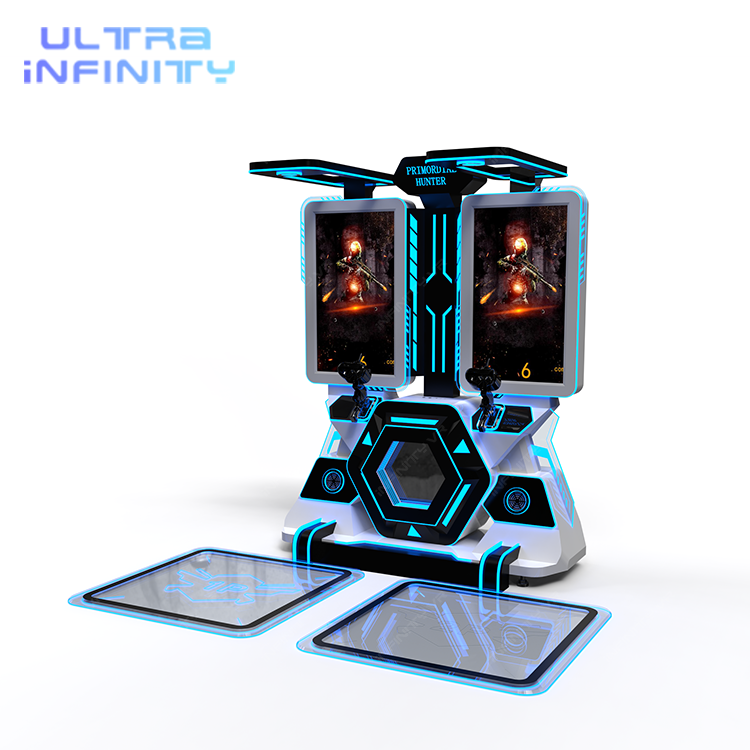
Two Tracked Guns
VR Battle Shooting Simulator
Complete double booth with two motion-capturing firearms, its own tracking set, a 40+ title library and online versus. The reference unit for two-gun aim coherence.
View Details ›
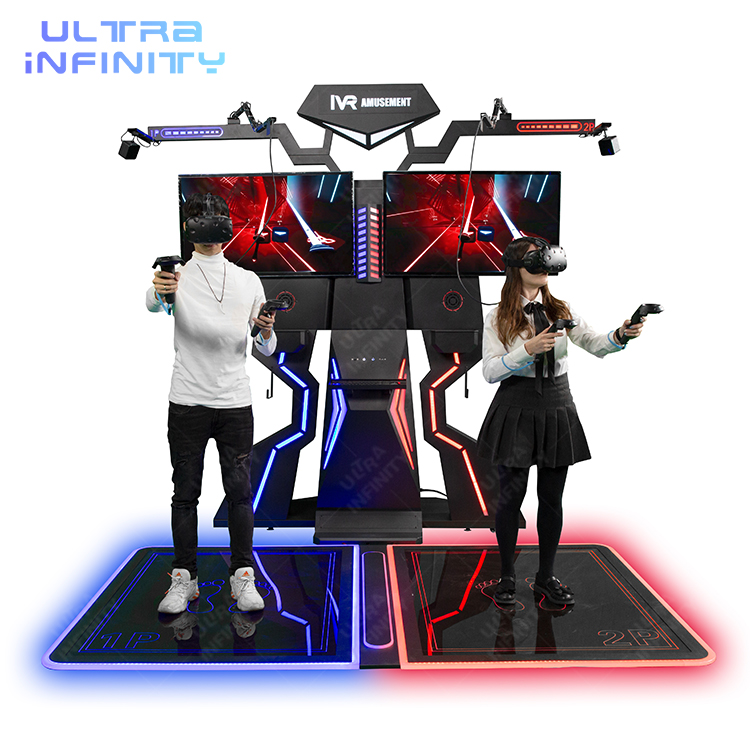
Lighthouse Tracking
HTC VIVE VR Standing Platform (Double)
Two-player HTC VIVE standing platform in a 2.67 x 2.10 x 2.70 m frame with a 100-title library, 2500W power draw and a spectator screen position.
View Details ›
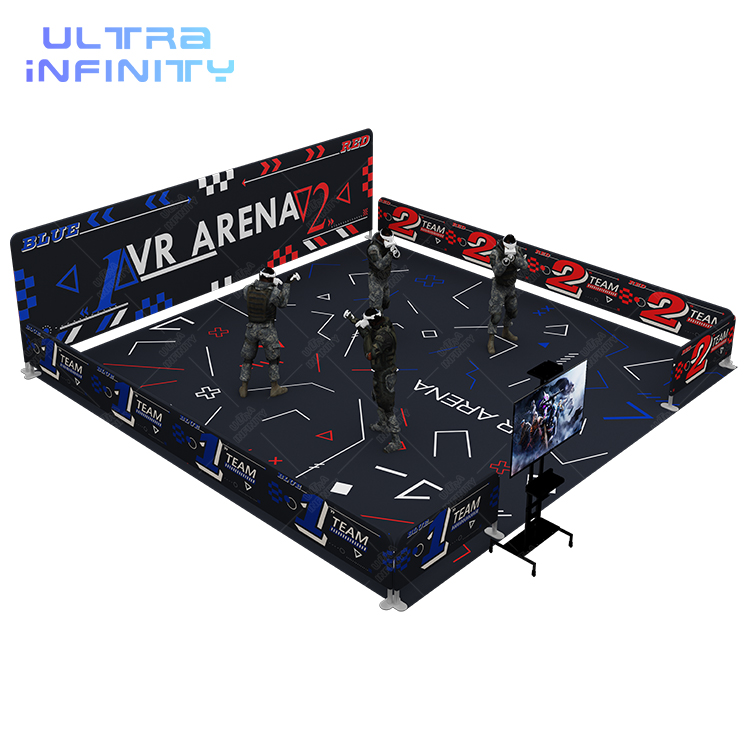
Tracking at Room Scale
Free Roaming VR Arena 2.0
Free-roam arena setup for up to 8 players with 24+ maps and one supervision point, where the tracking volume is the room rather than a cabinet.
View Details ›
8. VR Gun Tracking: FAQ
The gun tracking questions buyers and operators ask most often, answered directly.
How does VR gun tracking work?
Base stations sweep the play area with infrared laser fans and fire a synchronisation flash, photodiodes on the gun timestamp each sweep they receive, and the software converts those timings into angles and then into a full position and orientation for the gun - roughly 60 sweeps per second per axis.
Is VR gun tracking camera-based?
Not in Lighthouse-class systems. There is no image of the gun being processed; the pose comes from the timing of laser sweeps. Camera and inside-out systems exist and work differently, with their own lighting, reflection and processing trade-offs.
How accurate is VR gun tracking?
Published consumer measurements sit under roughly 0.3 mm of jitter at close range, with RMS precision near 1.5 mm and accuracy around 1.9 mm. Treat that as the engineering ballpark of a well-installed system rather than a delivered warranty for a commercial gun module.
How many guns can one tracking system handle?
It depends on three things: how many tracked guns the hardware supports, how much volume each station can see, and how many simultaneous shooters the session software admits. The multiple players configuration guide works through that ceiling configuration by configuration.
Why does the crosshair drift even when the gun feels fine?
A drifting aim line usually means the muzzle offset needs recalibrating, the gun tracker has shifted on its mount, or a station moved. Recalibrate first, then check the mount and the station alignment before assuming a software fault.
What causes tracking to lose the gun mid-session?
Occlusion is the main cause: the player grips the gun where the diodes are, raises an elbow across a station, or stands so that the gun body blocks its own tracker. Reflective floors, mirrors and glass also confuse sweep timing, and stepping outside the marked play area leaves fewer stations with a view of the gun.
Does a wireless gun track worse than a wired one?
The tracking itself is the same; the difference is pose transmission. A wireless link adds a jitter source that a wired connection does not, so on a busy venue network the wireless path has to be tested with the rest of the venue traffic running, not on an empty floor.
How often should a VR shooting booth be recalibrated?
Calibrate at installation and after any move or adjustment, then re-check on a fixed monthly routine. Most drift is mechanical - a loose bracket, a knocked tripod, a station nudged during cleaning - so the check is quick once it is scheduled.
What is optical aim coherence?
It is the ongoing synchronisation between the direction the gun is physically aimed and the direction the game renders the muzzle. Tracking hardware creates it, muzzle calibration establishes it, and occlusion control and scheduled calibration maintain it.
How do I check tracking quality before signing a quotation?
Ask for the covered play volume, the number of tracked objects the system resolves, the station count for the quoted player count and the calibration routine the supplier recommends. Then walk the play area at the edges and behind structures during a live demo, because that is where pose stability fails first.
Size the Tracking Volume for Your Own Room
The VR shooting simulator collection shows which tracking configuration ships with each cabinet, booth and arena, and the free 3D layout service maps each station against your floor plan - so the aim line your guests feel is planned before the room is built.

