VR RECOIL GUIDE
VR Shooting Simulator: How Does Recoil Improve the Shooting Experience?
Recoil is the moment the game tells the player hands that the shot actually left the gun. This guide explains what a kick adds to a paid session, how an actuated-mass mechanism differs from controller vibration, the four segments behind trigger-to-kick latency, and the duty-cycle and maintenance numbers to plan before you specify recoil hardware.
Trigger-to-Kick Latency Actuated Mass Force and Stroke Duty Cycle Vibration vs Recoil Session Scripting
<5 ms
Trigger-to-Kick (StrikerVR)
60 lbf
Peak Kick Force (StrikerVR)
~100 ms
Human Delay Threshold
1. The Short Answer: Recoil Is a Signal, Not a Special Effect
Recoil improves a VR shooting experience because it is the moment the game tells the player hands that the shot actually left the gun. Without it, a tracked pistol is a handle with a button: the target reacts on the screen, but the player muscles never do. Recoil closes the loop between aim, trigger and target, and it is usually the first thing guests mention when they say a commercial simulator feels real.
The measurable version of that signal is Trigger-to-Kick Latency: the time between the trigger switch being read and the recoil mechanism starting to move the gun. This article covers the feedback half of the experience - what the kick adds to a session, how the mechanism works and what the timing budget looks like. The aiming half is covered in the gun tracking guide, and the two together are what a guest experiences as a gun that shoots where it points and answers when they pull the trigger.
Trigger-to-Kick Latency: the delay from the trigger switch being read to the moment the recoil mechanism begins to move the gun. It is the recoil equivalent of motion-to-photon latency, and it decides whether the kick reads as the shot or as an echo of the shot.
2. What a Kick Actually Adds to a Session
Vibration confirms an event; recoil changes behaviour. That distinction is the whole reason commercial guns carry an actuated mechanism rather than a motor, and it shows up in five places during a paid session.
- Shot confirmation - the impulse tells the player the round left the barrel at the same moment the target reacts, so aim, trigger and result form one event instead of two
- Cadence and control - a kick pushes the muzzle off the target, so the player has to re-aim between shots; a rumble gives no reason to slow down and encourages spray and pray
- Aim discipline - scoring feels like a skill because the gun moves, and guests who feel the movement come back to improve a score instead of just watching a screen
- Physical engagement - the shoulders and arms are part of the game, which is what separates a shooting attraction from a seated arcade cabinet in the guest memory
- Spectator legibility - a queue watching the external screen sees a shooter whose body reacts to every shot, which is a better sales pitch than a still silhouette with a moving crosshair
None of those effects require a heavy mechanism. They require the kick to arrive early enough to be read as a consequence, and to be strong enough to disturb the aim line. Those are the two design numbers behind trigger-to-kick latency and peak force.
3. Inside the Mechanism: Actuated Mass, Not a Loudspeaker
Consumer VR controllers shake a small motor, which produces a soft buzz that the hand reads as texture rather than impact. A commercial recoil gun drives an actuated mass against the gun body or a striker plate, producing a short, directional impulse with a defined stroke - closer to a hammer than to a speaker.
- Actuated mass and stroke - a weighted slider is accelerated forward, strikes and returns, so force, stroke length and direction can all be tuned
- Force profile - a rifle impulse is not the same as a pistol muzzle flip; the direction and duration of the kick decide whether the gun reads as a rifle or as a pistol in the hand
- Trigger sensor - the switch and its scan rate are the first segment of the latency chain, and a slow or debounced switch erases the advantage of a fast mechanism
- Duty cycle and power - trigger life, heat and battery are the maintenance line items; one vendor publishes a rated 1,000,000+ trigger pulls and an 8-hour battery as reported by StrikerVR
Active recoil is not a gimmick invented for arcades. HapTech hardware is used in US military immersive training programmes, which is the useful part of the lineage: it tells you that a driven-mass recoil gun is an engineering product with a rated life and a power budget, not an accessory bolted to a handle. That is also why recoil hardware has its own maintenance schedule inside the equipment list described in the complete equipment setup guide.
4. The Trigger-to-Kick Chain, Segment by Segment
Recoil latency is not one number. It is four short segments added together, and knowing which segment a supplier measures tells you whether their figure is comparable to anyone else.
| Segment |
What it covers |
What to ask |
| Trigger read |
The switch scan interval and any debounce or filter applied before the shot is registered |
The polling rate of the trigger input, in milliseconds |
| Command to actuator |
The time from the fired signal to the actuator beginning its stroke |
The vendor figure, quoted as reported by that vendor |
| Mechanism rise time |
Time for the actuated mass to travel and deliver the impulse to the gun body |
Peak force in pounds and stroke length in millimetres |
| Motion to perception |
The human threshold where a delay between action and feedback becomes noticeable |
Whether the total stays well below roughly 100 ms |
One vendor publishes a trigger-to-kick figure of under 5 ms and a peak force of 60 lbf, quoted as reported by StrikerVR. For reference on the visual side of the same loop, HTC publishes roughly 22 ms of motion-to-photon latency on the Vive headset and around 31 ms on the controller, and haptic research puts the point where people notice an action-feedback delay at about 100 ms. The practical target is a kick that lands inside the same perceived moment as the muzzle flash: a gun that kicks several frames late reads as a follow-through from a shot that already finished, which is the same failure as badly synced film dialogue.
Planning note: latency, force and duty-cycle figures in this article are published platform and vendor figures dated 2026, quoted as reported by their sources. They are not a warranty for a specific gun module. Confirm rated force, trigger life, battery and warranty terms with your supplier before you specify recoil hardware or quote a replacement schedule.
5. Trigger-to-Kick Latency vs Vibration: Different Products
Vibration-only feedback
A small motor buzzes inside the grip. The player feels an event but the muzzle does not move, so nothing has to be corrected between shots. It is cheap, light and quiet - and it is the reason a toy-feeling gun is usually described as vibrating rather than kicking.
Directed recoil impulse
An actuated mass moves the gun along a defined axis. The aim line is disturbed, the player corrects, and the shot becomes a physical action rather than a confirmation. It costs force, stroke, power and maintenance - and it is what guests describe when they say the gun feels real.
One honest boundary matters here. Recoil in a commercial VR simulator is a game-feel feature; it is not a substitute for live-fire training. It teaches aim, cadence and trigger discipline inside the game, but it does not replicate a real firearm ballistics and no venue should advertise it as firearms training. The value for an entertainment operator is repeat play and the memory a guest carries to the ticket desk, not marksmanship certification - and stating that plainly is what keeps the claim defensible when a professional shooter tries the machine.
6. What Recoil Means for Your Venue
Recoil decisions show up in the operating budget rather than only on the specification sheet. Four items belong in the plan before the equipment is ordered.
- Duty cycle and spares - one vendor rates its mechanism at 1,000,000+ trigger pulls as reported by StrikerVR, and a busy booth can consume a large share of that; price at least one spare gun per row of cabinets.
- Batteries and charging rotation - a rated 8-hour battery only holds if the rotation is scheduled, so plan a charging station and a swap routine rather than a mid-session hunt for a cable.
- Noise and vibration on the shared frame - a double booth transmits kick through its structure, so check floor build-up and neighbouring units before you place a recoil booth against a shared wall.
- Session scripting - a kick slows a guest down, so a 60-second round feels different from the same round with vibration only; test the round length with the recoil enabled before you print the menu.
Machine class then follows the session format. A single-player VR Terminator cabinet carries one recoil gun for short target rounds and first-timers, a two-player VR battle booth puts two motion-capturing firearms into a duel format, and the free-roaming VR arena 2.0 spreads the same hardware across a room-sized session for up to 8 players. If the plan is to sell repeat rounds, pair the mechanism with a scoreboard so the shot that kicked has a number attached to it - the players per hour capacity model shows how round length and reset time turn into revenue per hour, and the multiple players configuration guide covers what changes when several guns fire in one session.
To compare hardware on the floor, work through the VR shooting simulator collection and use the free 3D layout service to place the booth where recoil noise and the spectator screen both work. Guests cannot describe a latency budget - they describe whether the gun answered the trigger, and that is decided by the mechanism, the timing and the maintenance routine behind it.
7. Featured NextPlay Active Gaming Equipment

Recoil First-Timer
VR Terminator Shooting Simulator
One-player VR shooting cabinet with a 10+ title library, Pico headset and six-camera tracking - the compact unit for target rounds where the kick is the first thing a guest notices.
View Details ›
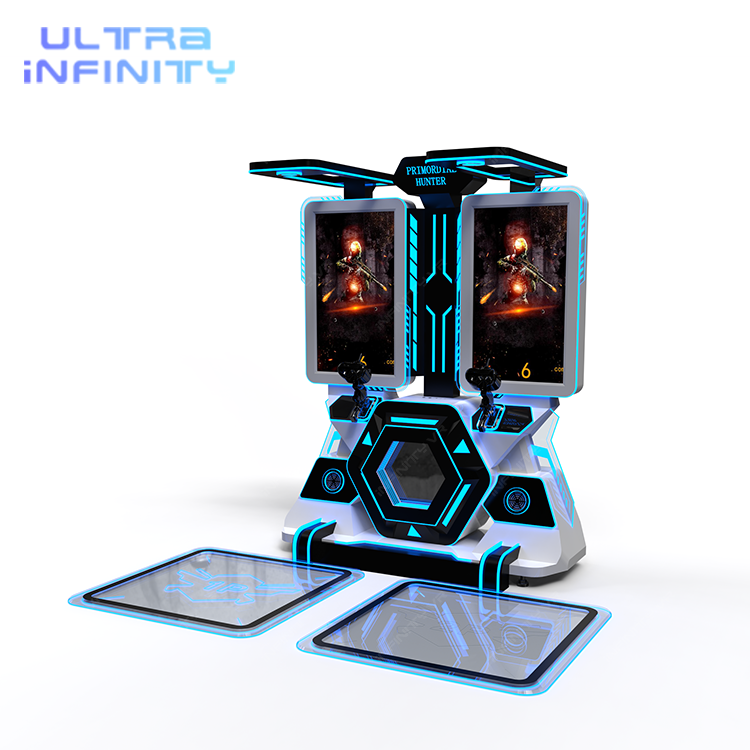
Two Firearms
VR Battle Shooting Simulator
Complete double booth with two motion-capturing firearms, its own tracking set, a 40+ title library and online versus. Built for duel formats and rematch pricing.
View Details ›
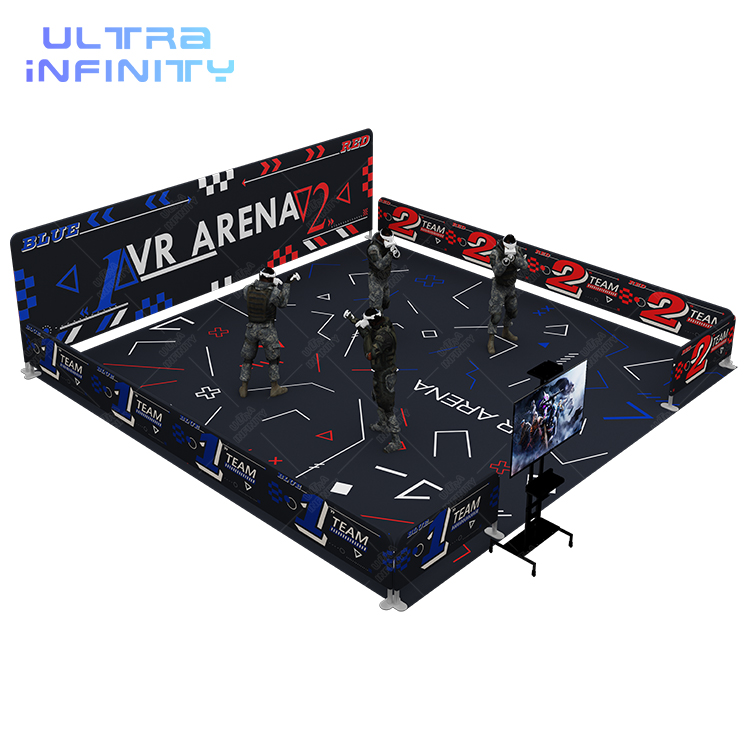
Tracks up to 8 Players
Free Roaming VR Arena 2.0
Free-roam arena setup for up to 8 players with 24+ maps and one supervision point - the group format where several guns fire in the same session.
View Details ›
8. VR Recoil: FAQ
The recoil questions buyers, operators and first-time guests ask most often, answered directly.
How does recoil improve the shooting experience?
It closes the loop between aim, trigger and target: the shot is confirmed by the gun moving rather than by the screen changing, the player has to re-aim between shots, and the round becomes a physical action instead of a button press.
What is trigger-to-kick latency?
The delay between the trigger switch being read and the recoil mechanism starting to move the gun. It is the recoil equivalent of motion-to-photon latency and the number that decides whether the kick reads as the shot or as an echo of it.
How fast should the kick arrive?
The total should stay far below the roughly 100 ms point where people begin to notice an action-feedback delay. One vendor publishes under 5 ms from command to recoil onset, quoted as reported by StrikerVR, which leaves the visible pipeline as the larger share of the budget.
Is recoil the same as controller vibration?
No. Vibration buzzes the grip without disturbing the muzzle, so nothing has to be corrected between shots. Recoil drives an actuated mass along a defined axis, which moves the aim line and turns the shot into an action the player has to control.
How much force should a commercial recoil gun produce?
There is no single correct number, because a rifle impulse and a pistol muzzle flip feel different in the hand. One published figure is 60 lbf of peak force, quoted as reported by StrikerVR; what matters is that the kick disturbs the aim line enough to be felt without pushing smaller guests off target.
How long do recoil guns last?
One vendor rates its mechanism at 1,000,000+ trigger pulls with an 8-hour battery, quoted as reported by StrikerVR. Treat that as the rated duty cycle and plan spares and a charging rotation instead of assuming a gun survives every session forever.
Is VR recoil realistic enough to train with?
No - and venues should say so plainly. Recoil in a simulator trains aim, cadence and trigger discipline inside the game; it does not replicate real ballistics and is not firearms training. That boundary is what keeps the marketing claim defensible.
Do I need recoil on every gun?
Recoil matters most on the gun a guest holds first, because that is where the impression is formed. On a multi-gun configuration the practical approach is to specify the mechanism across the player positions and keep the spare gun matched, so a session never switches feel mid-round.
Can recoil be turned off or reduced?
Most commercial mechanisms offer intensity settings, and lowering the force is the usual answer for younger guests or venues with neighbours above or below. Check that the setting is available to staff without a technician and that it persists between sessions.
What should I check in a recoil gun before purchase?
Ask for the rated trigger life, peak force, stroke direction, battery runtime, the trigger polling rate and the recommended spare-parts schedule. Then fire it in a live demo and judge the timing yourself: if the kick arrives after the muzzle flash, the mechanism is not the part that needs changing.
Specify Recoil Hardware With the Timing in Mind
The VR shooting simulator collection shows which cabinets, booths and arenas ship with tracked firearms, and the free 3D layout service places the booth where recoil noise and the spectator screen both work - so the kick your guests feel is designed in, not discovered on opening day.


