FLIGHT MOTION - CUE, WASH, RETURN
VR Flight Simulator: How Does Motion Simulate Takeoff and Flying?
How does a VR flight simulator simulate motion? VR flight simulator motion is cueing rather than travelling: a short acceleration jolt that matches the takeoff visual, a hidden return to centre, then a slow tilt that turns gravity into the sense of sustained flight. Here is each step, the hardware that delivers it, and the sync problem that decides whether guests enjoy it.
Cue Washout Tilt coordination 3DOF vs 360 Cue-to-frame sync Comfort
3 steps
Cue, Wash, Return
21-42 ms
Measured Latency
1. VR Flight Simulator: How Does Motion Simulate Takeoff and Flying? The Short Answer
VR flight simulator motion works by cueing, not by travelling. A flight motion platform cannot fly. It has a metre or two of travel, it never leaves the floor, and it can hold an acceleration for only a moment before it runs out of room. What it can do is give your body the three signals that make a brain accept that an aircraft is moving: a short, sharp acceleration cue when something changes, a quiet return to the centre position once you have registered it, and a slow tilt that substitutes gravity for the sustained acceleration it cannot produce.
That sequence is called motion cueing, and it is the reason a two-minute VR flight feels like a takeoff instead of a chair wobbling. This article walks the three steps in order - cue, wash, return - then maps them onto the hardware a venue actually buys, and onto the sync problem between the platform and the headset. The headset side of the loop is covered in our companion guide to how VR tracking works, while how virtual reality works covers the display chain that sits behind both.
Two clarifications up front, because they change what you should expect on the floor:
- The platform cues change, not travel. Your inner ear responds to acceleration, not to position. A simulator only has to produce the change; the sense of continuous flight is then carried by the visuals and by the tilt described below.
- The cue must land on the frame. Motion that arrives a few frames away from the matching picture is felt as a fault, so the platform and the headset are one system, not two machines in the same room.
Everything in this article applies to the paid case: a guest who has never flown a simulator, has two to five minutes, and will judge the machine entirely on whether the first thirty seconds felt like flying.
2. Why Sustained Acceleration Cannot Be Faked
Start with the physical constraint, because it explains every design compromise that follows. A real aircraft can accelerate for thirty seconds; a motion platform runs out of stroke in a fraction of that. If the machine simply kept translating, it would hit its end stop - and the end stop is not a soft failure: the guest feels a jolt that is nothing like flight, right at the moment the experience was supposed to be most convincing.
The second constraint is perceptual. The human motion system is far more sensitive to a change in acceleration than to a constant one. A steady acceleration that never varies fades out of perception within seconds - which is why a long, smooth, motionless translation is both physically impossible for the platform and psychologically unnecessary.
Put those two facts together and the whole field of motion cueing algorithms follows. As the peer-reviewed literature on the subject summarises it, filter-based washout remains the most widely used approach in flight simulation, and its logic is exactly the compromise above: give the high-frequency cue, hide the low-frequency truth.
Source basis: filter-based washout as the most widely used motion cueing approach is a peer-reviewed finding (Tong et al. 2023, Aerospace / MDPI), recorded in our verified-facts registry.
3. Step 1 - Cue: The Short, Sharp Jolt That Sells the Moment
The first thing the platform does is the thing guests remember: it moves quickly, in the direction of the acceleration the picture is showing, and then stops giving that cue. On takeoff, that is the push into the seat as the thrust comes up. On landing, it is the downward hit at touchdown. In a turn, it is the lateral kick as the aircraft rolls in.
The mechanism matters for comfort design. Peer-reviewed work on VR linear acceleration shows that a short pulse of angular acceleration is enough to produce a convincing sensation of being pushed forward - the platform does not need to reproduce real g; it needs to produce the cue that the brain reads as acceleration, at the moment the picture supports it.
- Why it is realistic. The guest gets a genuine vestibular signal, timed to a genuine visual change. That matching is the whole point; unmatched motion is what makes people feel unwell.
- Why it is short. Stroke is a budget. Spending it on a jolt that lasts a quarter of a second buys a much stronger impression than spending it on a slow move that the guest stops noticing halfway.
- What it means for content. Flight content that surprises - a burst of thrust, a buffet, a hard roll - reads as more dynamic than content that holds a steady heading, because each event buys its own cue.
Practical implication for a venue: if a machine feels dull, the fix is usually not a bigger platform but content with more change events per minute.
4. Step 2 - Wash: Returning to Centre Before You Notice
A cue spends travel. The platform is now somewhere other than where it started, and the next event needs that travel back. Washout is how it gets there without the guest noticing.
The filter works on the principle that the human motion system ignores slow, steady motion the way you stop feeling the speed of a train. So the platform begins easing back toward its neutral position at a rate below the threshold at which the guest would read it as a movement in the wrong direction. The literature describes the purpose plainly: the platform gives the acceleration cue first, then returns itself to the middle within the limits of human perception, freeing stroke for the next cue.
- It is tuned, not fixed. The rate has to be slow enough to stay under the perception threshold and fast enough to be ready for the next event. Different content and different guest populations push that trade-off in different directions.
- It is the reason long smooth flight works. A steady climb or cruise holds almost no motion cue, and the platform can sit quietly centred while the visuals carry the altitude change.
- It is invisible when it is right. Guests never describe washout. They describe its failures: a machine that drifts, or one that cannot keep up with the action.
The concept is old enough to have a documented history: NASA technical work from the mid-1970s already evaluated a linear washout system for flight simulation. What has changed since is the tuning and the compute, not the underlying idea.
Source basis: the function of washout (cue first, then return within human perception limits) is documented in peer-reviewed and vendor engineering literature; NASA published a linear washout evaluation in 1975 (institutional technical report). Both are recorded in our verified-facts registry.
5. Step 3 - Return: Tilt Coordination Carries the Illusion
Washout solves the short event. It does not solve the long one: a sustained turn or a long climb is a continuous acceleration, and no amount of washout will make a platform translate continuously without running out of stroke.
The answer is tilt coordination, and it exploits a genuine ambiguity in how the body reads acceleration. If a platform tilts slowly, the component of gravity along the guest body looks to the inner ear like an acceleration in the opposite direction. Tilt a seat backwards by a few degrees and hold it there, and the guest reads sustained forward acceleration; tilt it sideways and they read a sustained lateral push. Vendor engineering descriptions of cueing filters describe exactly this use of the gravity component for low-frequency sustained acceleration, commonly for sideslip and thrust.
- Rotate slowly, on purpose. The tilt has to be introduced below the threshold where the guest reads it as a rotation, or the illusion breaks and the machine feels like it is tipping.
- Hand over cleanly. The high-frequency cue comes from translation; the low-frequency part is carried by tilt. The handover between the two is the tuning problem, and it is why two machines with the same hardware can feel completely different.
- Respect the limit. Tilt coordination is an illusion of sustained acceleration, not sustained g. A guest does not experience the load of a real turn, and content that assumes real g transfer will always feel short of the original.
Read the three steps as one sentence: cue the change, wash out the cost, tilt for the part that lasts. Everything the platform does is one of those three.
6. What the Machine Actually Moves
Cue, wash and return describe the motion; the hardware decides which of them the machine can actually deliver. Three families cover what venues buy.
| Family |
Axes in practice |
What it cues well |
Where it is limited |
| 3DOF seated |
Pitch, roll and one translation axis (often a slide or heave movement). |
Takeoff, landing, speed changes along one direction, jump and dive formats. |
No yaw: the aircraft cannot roll into a sustained turn while the guest stays pointed at the screen. |
| 360 degree single seat |
Continuous yaw plus pitch, on a rotating platform. |
Roll into a turn, dogfight manoeuvring, roller-coaster style flight - the format where the aircraft itself spins. |
One guest per machine, so throughput is per-seat rather than per-group. |
| Multi-seat cinema or flight bay |
Shared pitch, roll and heave across two or more seats. |
Group rounds, helicopter and airliner formats where the whole cabin moves together. |
Less individual manoeuvring; the shared motion has to suit every seat. |
A concrete example from our own range, quoted as a product specification rather than a promise: the single-seat VR fighter jet machine measures about 2,660 x 1,460 x 2,330 mm, weighs roughly 380 kg, runs on AC 220 V at 2.5 kW, and ships with more than 40 titles. The two-seat 9D flight formats run on 110-240 V at roughly 2,000 W, with a maximum load of 300 kg, and sessions of two to five minutes. That is the size of machine - and of electrical service - you are planning around, and it should go into the floor plan before the marketing deck.
For comparison, and useful when you are deciding how many formats to buy: the single-seat 3DOF slide machine is a 1,200 x 1,200 x 800 mm unit at about 80 kg, roughly a sixth of the fighter footprint, while a five-seat 720 degree cinema occupies about 12 square metres and 950 kg. A zone built from one big centrepiece and several compact units usually beats a zone built from centrepieces alone, which is the same logic the wider station build uses in what a VR station is made of.
Source basis: dimensions, weight, electrical figures and title counts quoted here are our own product specifications, recorded as first-party data in the registry. Third-party cabinet power ranges are deliberately not quoted because the registered sources conflict.
7. Sync With the Headset: Why the Cue Must Land on the Frame
A motion platform and a headset are two devices trying to tell the same story, and the guest notices when they disagree. The measurement that describes the disagreement is motion-to-photon latency: the delay between something happening in the simulation and the guest seeing it.
Measured figures for real headsets sit in the range of roughly 21 to 42 ms, improving to about 2 to 13 ms for a well-learned task, with manufacturer numbers for one widely deployed commercial family around 22 ms for the headset and about 31 ms for a controller. Now add the platform: it has its own command delay, its own inertia, and its own settle time. The total is the window in which the motion and the picture must be made to agree.
- Synchronised motion helps. When motion and visuals agree, the vestibular and visual signals match, and the documented effect of synchronised rotational cues is a measurable reduction in reported motion sickness. When they disagree, the guest gets the opposite: conflicting signals, and the classic symptoms.
- Reprojection cannot help here. Warping a rendered frame fixes display latency inside the headset. It cannot retime a platform, and it cannot manufacture a cue that arrives late or never arrives.
- Choose content that suits the hardware timing. Sharp, well-separated events are far more forgiving than a continuous high-frequency shake the platform cannot follow.
This is also why motion machines and comfort questions are the same conversation: our guide on whether VR chairs reduce motion sickness works through the mechanism, and the short version is that matching what the guest sees with what the guest feels is the whole remedy.
8. What Guests Feel on Takeoff, Roll and Turbulence
Read the three steps as a guest would experience one flight, in order.
- Takeoff. The cue is the push: a short acceleration pulse timed to the thrust visual. The wash begins almost immediately, so the guest is off the end stop before the climb is even established. The tilt then holds the sustained sense of climbing while the visuals hand over to altitude and horizon movement.
- Roll into a turn. On a 360 degree machine the platform yaws and pitches with the turn, which is the strongest single impression a flight rig can produce, because rotation is the one motion the body reads unambiguously. On a 3DOF seat the same moment is carried mostly by visuals and a lateral kick, which is effective but different.
- Turbulence and buffet. This is high-frequency event territory, and it is where the cue-and-wash cycle does the most work, because each bump is a small, self-contained event. It is also the segment that separates a tuned machine from an untuned one: a platform that cannot wash out quickly enough turns a rough patch of air into a loose, wandering seat.
That structure is also why short sessions win. Two to five minutes is enough to deliver a takeoff, one or two manoeuvres and a landing. Each of them is a distinct cue with its own visual match, which is what a guest takes away - and it is long before the novelty of sitting on a moving platform wears off, or before cumulative discomfort has a chance to build. Our modelling of session-based throughput puts a single-seat flight rig at roughly 12 to 16 sessions per hour and a two-seat unit at 24 to 32, based on our planning model rather than as a guarantee.
The 2-to-5-minute rule is not a limitation to design around; it is the format. A guest needs one takeoff, one manoeuvre and one landing. Anything longer spends stroke and comfort without adding a memory.
9. Comfort Limits, and Why the Short Session Wins
Comfort on a flight rig comes from three things, and none of them is the headset brand.
- Motion that matches the picture. This is the root of the problem and the root of the cure. A rig in sync is comfortable; a rig out of sync is not, whatever the seat padding.
- Duration discipline. Ride-type sessions are commonly run at three to eight minutes, with the practical sweet spot for first-timers at the lower end. Guests who feel the first sign of discomfort can stop at any time in a properly run station, and staff should be watching for it rather than waiting to be told.
- Guest screening. Age guidance from headset makers puts VR outside the range of young children, and pregnancy, heart conditions, high blood pressure and a history of motion sickness all belong in the advisory and the waiver. Both the screening and the stop rule are operational, and both should be written before opening rather than improvised on a busy Saturday.
A note on the difference between a flight rig and a rotating chair: the roller-coaster format leans on one continuous rotation, and the flight format leans on discrete manoeuvres with washout between them. If you are choosing between the two families, our breakdown of how a VR roller coaster simulator works describes the rotational case, and the dogfight experience is covered separately in what a 360 degree VR dogfight feels like.
10. Choosing a Flight Motion Rig for Your Floor
Four questions decide which machine belongs on your floor: how much space you have, whether guests come in pairs, whether the appeal is flying or dogfighting, and how much electrical headroom the spot already has.
- A single centrepiece with manoeuvring. A one-player 360 flight shooter such as the VR Thunder Fighter F2 is the format for guests who want to roll and bank, and it is the machine that produces the strongest rotation cue.
- A group-friendly flight bay. The 9D flight game simulator carries the flight theme across a two-seat arrangement at a low power draw, which suits a family audience and a venue that sells rounds rather than single seats.
- A themed two-player format. The two-player helicopter flight simulator trades the fighter cockpit for a cabin, which reads as adventure rather than combat and pairs well with mixed-age traffic.
- A platform that doubles as a ride. The 360 degree flight and racing simulator shares its motion base with roller-coaster style content, so one machine covers two audiences.
Whichever you pick, ask for the motion profile as well as the machine size: which axes move, how much stroke each axis has, and how the cueing is tuned for the content library. A supplier who can talk about washout tuning has thought about how the machine feels after the first week; a supplier who only quotes the axis count has not. Looking for a flight rig for a specific floor? The models below are specified with their axes and their electrical requirements, and we will lay them out against your plan with a free 3D layout design.
11. Featured NextPlay Active Gaming Equipment
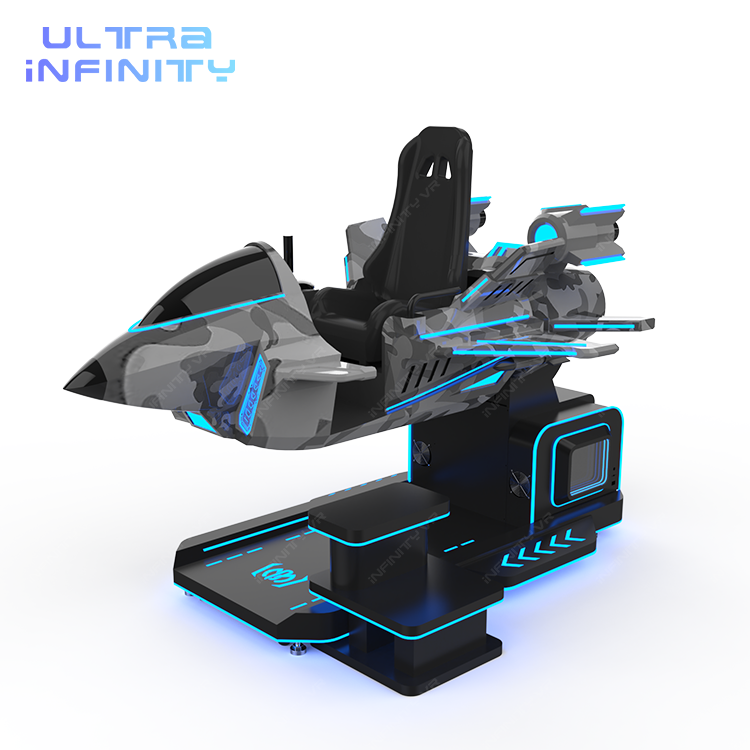
Single seat, 360
VR Thunder Fighter F2
A one-player 360 degree flight shooter: continuous yaw with pitch, built for rolling into turns and dogfight-style content, with a deep title library behind it.
View Details ›
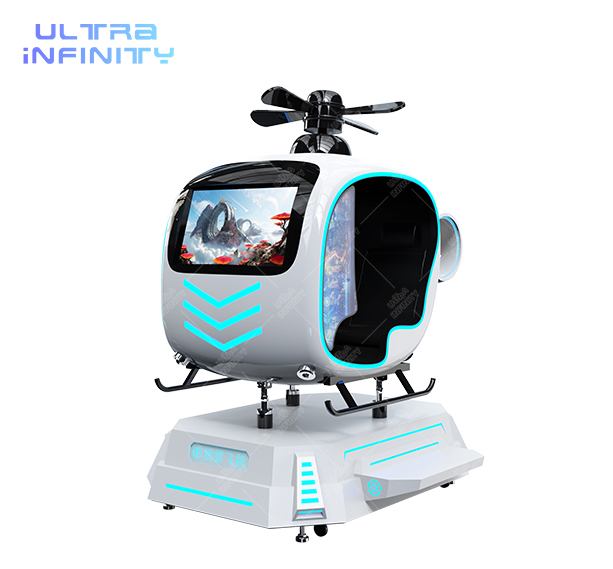
Two seats
9D VR Flight Game Simulator
A two-seat 9D flight machine at a low power draw, with a maximum load of 300 kg and sessions of two to five minutes - the flight format for pairs and family traffic.
View Details ›
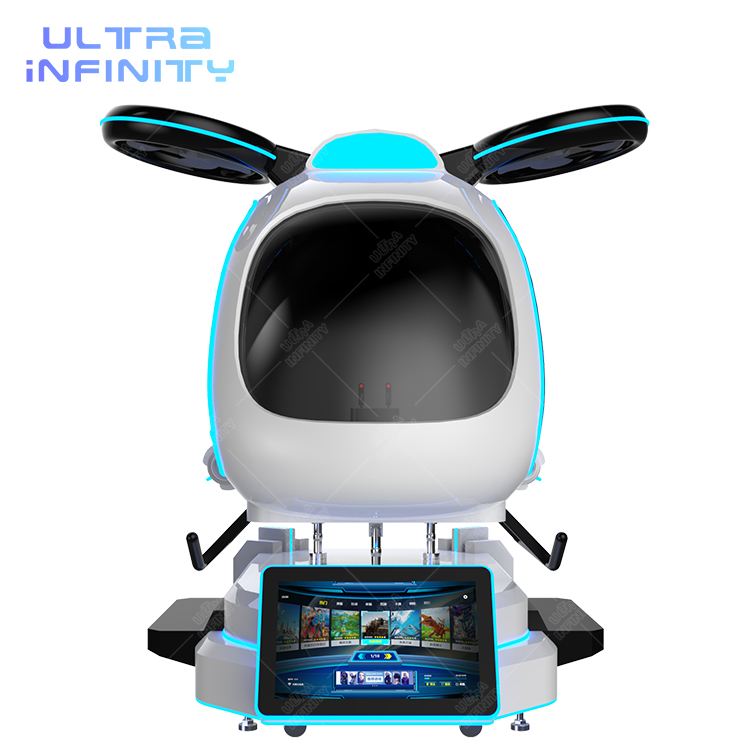
Two players
VR Helicopter Simulator
A two-player helicopter cabin format: the same motion family as a flight bay, themed for adventure rather than combat, which suits mixed-age groups.
View Details ›
12. Flight Motion FAQ
The questions buyers ask about flight motion, in the order they come up.
How does a VR flight simulator simulate takeoff and flying?
It cues rather than travels. The platform gives a short acceleration pulse that matches the takeoff visual, then washes that cue out by easing back to its centre position below the threshold of human perception, and finally holds a slow tilt so that the gravity component reads as sustained acceleration. Those three steps - cue, wash, return - are what a motion cueing algorithm manages.
What is washout in a motion simulator?
Washout is the return leg of every cue. Because a platform has limited stroke, it has to get back to its neutral position before the next event, and it does that slowly enough that the guest does not read the movement as the machine going the wrong way. Filter-based washout is described in the peer-reviewed literature as the most widely used motion cueing approach in flight simulation.
What is tilt coordination and why is it used?
Tilt coordination uses the gravity component to stand in for sustained acceleration. Instead of translating continuously - which no platform can do - the machine tilts slowly by a few degrees, and the guest inner ear reads that as a steady push. It is commonly used for sideslip and thrust, the low-frequency parts of a flight. It is an illusion of sustained acceleration, not real g load.
Do you need a 360 degree platform to fly in VR, or is 3DOF enough?
It depends on the format. A 3DOF seat with pitch, roll and one translation axis handles takeoff, landing and speed changes well, but it cannot yaw, so a sustained turn has to be carried mostly by the visuals. A 360 degree single-seat platform rotates the guest with the aircraft, which is the strongest cue a flight rig can give and the reason dogfight content is built for it.
Why do flight simulator sessions only last a few minutes?
Because the format is events, not endurance. Two to five minutes is enough for a takeoff, one or two manoeuvres and a landing, each with its own matched cue. Extending the session spends stroke and comfort without adding anything the guest remembers, and ride-type sessions are commonly kept within a three to eight minute range with first-timers at the shorter end.
What makes a VR flight simulator feel wrong?
Desynchronisation. If the motion arrives at a different time from the picture, or arrives in the wrong direction, the guest gets conflicting vestibular and visual signals, which is the mechanism behind motion sickness. Display-side fixes such as reprojection cannot retime a platform. Synchronised motion, on the other hand, is documented to reduce reported discomfort rather than cause it.
13. Key Takeaways: Cue, Wash, Return
Six lines for your next supplier conversation about flight motion.
- A motion platform cues change, it does not reproduce travel. Your inner ear reads acceleration, not position, so a short matched pulse beats a long slow move.
- Cue spends stroke, wash buys it back. The filter returns the platform to centre below the threshold of perception so the next event has room to move.
- Tilt coordination carries the sustained parts. A slow tilt turns the gravity component into the sense of steady acceleration that no platform can translate.
- Match the axes to the format: 3DOF for takeoff and landing, 360 degree yaw for rolling turns and dogfights, shared motion for group cabins.
- The cue must land on the frame. Measured headset latency runs around 21 to 42 ms, and the platform adds its own delay on top - synchronisation is a comfort feature, not a detail.
- Two to five minutes is the format, not the limitation. One takeoff, one manoeuvre, one landing, with throughput modelled at roughly 12 to 16 sessions per hour for a single seat.
The next step is floor planning rather than more reading: which axis set fits your ceiling, your electrical service and your guest mix. Send your plan for a free 3D layout design and we will mark out the flight rigs that fit it, or start from the VR park solution overview for the full zone picture.
Plan a Flight Motion Zone
Axes, power and floor space decide which rig fits. Review the VR park solution and send us your dimensions for a free 3D layout that shows the flight machines your building can carry.

