ROTATING CHAIR - YAW PLUS PITCH
360 VR Chair: How a Rotating Motion Chair Works, From Yaw to Cue
How does a 360 VR chair work? It turns the guest instead of the picture: full yaw for the sustained turn, up to 45 degrees of pitch for the drop, and a two-to-five minute cycle built around what the body can actually feel. Here is the mechanism, the ride cycle and the site limits that decide whether it fits.
360 + 45 rule Yaw and pitch Mechanism Ride cycle Site limits Comfort
1. 360 VR Chair: How a Rotating Motion Chair Works, From Yaw to Cue
A rotating VR chair does something much simpler than it looks. It does not fake a roller coaster with a screen; it turns the guest. Then it adds one pitch movement at the right moments, and the body does the rest of the work. Everything from the size of the machine to the number of sessions it can sell per hour follows from those two movements.
That is also why the format survives next to bigger simulators. A platform that translates needs stroke, a heavy frame and a lot of floor; a chair that rotates needs a bearing, a pivot and a safety envelope. The result is the smallest machine that still gives a guest a genuine vestibular signal - and a genuine vestibular signal is the difference between watching a coaster and riding one.
This article is about the mechanism: the two axes, what is inside the machine, how the ride cycle is built, what guests actually feel in each phase, and the site limits that surprise buyers on install day. The passenger-side view of the format is in our wider guide to VR chairs and immersion, and the content side of the roller-coaster experience is covered in how a VR roller coaster simulator works.
2. The Short Answer: It Turns the Body, Not the Picture
A seated VR guest is already getting a strong visual illusion - the headset can show any world from any angle. What it cannot do is move the part of the body that senses motion. The inner ear stays still, notes that the world is moving in a way the body is not, and the mismatch is what produces discomfort.
A rotating chair closes that gap in the cheapest possible way: it moves the guest. When the picture banks into a dive and the chair banks with it, the visual and vestibular signals agree. Peer-reviewed work on this mechanism identifies visual-vestibular mismatch as the primary cause of simulator sickness, and vendor and academic work on synchronised rotational cues reports measurable reductions in reported discomfort rather than increases.
- The rotation is the ride. Guests are not fooled by a moving screen; they are convinced by their own inner ear reporting a turn they can also see.
- One axis carries most of the sensation. Sustained yaw is what a coaster does best, and it is the movement the body reads most clearly.
- A second axis adds the drama. Pitch supplies the drop, the launch and the airborne float, which is why the format is not a turntable with a seat bolted to it.
The core idea in one line: a rotating chair does not simulate the ride - it moves the guest through the part of the ride the body can feel.
3. The Two Axes That Carry the Ride
Almost every rotating chair on a commercial floor moves in the same two ways, and understanding why they are the two is most of the engineering.
| Axis |
Movement |
What it delivers |
Why it is there |
| Yaw |
Continuous rotation about the vertical axis. |
The sustained turn: banking, spinning, sweeping through a corner. |
The one motion the inner ear reads without ambiguity, and the one a screen cannot fake at all. |
| Pitch |
Inclination forwards and backwards about the horizontal axis. |
The drop, the launch push, the float at the top of a hill. |
Supplies the acceleration change between the rotations, so the ride has rhythm rather than a constant spin. |
Our own rotating chair family is specified with 360 degrees of yaw and up to 45 degrees of pitch, which is a deliberate ceiling. The question every buyer asks is why not add more axes, and the answer is that the two that matter are the two the guest perceives as roller-coaster motion. Adding translation or extra rotation increases mass, cost, power and maintenance load while adding a sensation the content can already suggest visually.
The 45 degree limit is also a comfort decision rather than a mechanical shortfall. A pitch beyond that range starts to feel like a restraint problem rather than a ride, and the visual content that justifies it becomes increasingly hard to keep synchronised.
A useful way to think about the combination: yaw provides the journey, pitch provides the punctuation. Content that alternates between them - a climb, a bank, a drop, a recovery - reads as a coaster. Content that holds one axis on continuously reads as a spin, which is a different and more fatiguing experience.
4. Inside the Mechanism: What the Machine Is Made Of
Strip away the canopy and the LED lighting and a rotating chair is four subassemblies. Knowing them is what lets you ask sensible questions about a quote, and what tells you whether a service visit is a two-hour job or a two-day one.
- The rotation assembly. A geared drive on a vertical bearing carries the seat and the guest. This is the part that has to be rated for continuous service, because on a busy floor it is never truly at rest.
- The pitch pivot. A second powered axis sets the inclination, with the actuators and the geometry sized so the movement can stop at any point in the range rather than only at mechanical limits.
- The seat, restraint and frame. The chassis holds the guest, transmits the load into the floor, and takes the abuse of a full shift. Rated capacity matters here: our two-seat formats are specified for a maximum load of 300 kg.
- The safety envelope. Physical guards around the moving base, interlocks that stop rotation when the restraint is not closed, and an emergency stop within the operator reach. On our machines this is also where the moving envelope defines the clearance you must leave around the unit.
The electrical side is modest compared with a translating platform, and it is still a planning item. Based on our product specification, the single-seat rotating chair runs on 110-240 V at roughly 1.8 kW, and the two-seat V2 version at roughly 3.5 kW. Those are the numbers to give your electrician and your landlord, and they are the kind of figure that should appear on the quote rather than in an appendix.
Source basis: axis ranges, power figures, load ratings, clearance and headroom quoted in this article are our own product specifications, recorded as first-party data in the registry. Third-party cabinet power ranges are deliberately not quoted because the registered third-party sources conflict with each other.
5. Why Rotation Beats a Static Screen
The case for the mechanism is a comfort argument before it is a thrill argument, and it is worth being precise about it because it is the most common question a buyer asks.
- Mismatch is the problem. Simulator sickness is primarily a conflict between what the eyes report and what the vestibular system reports. A static chair plus a moving picture is exactly the configuration that creates the conflict.
- Matching is the remedy. When the chair turns with the picture, the two signals agree. Published work on synchronised rotational cues reports a reduction in reported discomfort of roughly a third, which is a meaningful operational difference: comfort converts directly into session completion.
- The limit is adaptation, not the machine. Sustained rotation produces its own effects as the inner ear adapts and then readjusts when it stops, which is why sessions are kept short and why the operator watches guests rather than leaving them to it.
This is the practical reason a chair is a good first motion machine for a venue: it removes the single biggest cause of bad reviews in VR attractions without adding a translation platform, and the resulting format is short, repeatable and easy to supervise. Our guide on whether VR chairs reduce motion sickness goes through the mechanism and the guest screening in more detail.
6. The Ride Cycle, in Seconds
A rotating chair earns money in cycles, and the cycle is short. Based on our product specification and our published cluster figures, the shape is:
| Phase |
Typical duration |
What is happening |
| Boarding and restraint |
30-60 s |
Seat, restraint check, headset fit and a one-line briefing. The operator is the only person who can fail this step. |
| Session content |
2-5 min |
The ride itself, from a library of 70+ titles on the rotating chair range - coasters, drops, racing and fantasy tracks. |
| Visible rotation |
15-20 s per passage |
The stretch of any single title where rotation is the dominant sensation, which is the part guests describe afterwards. |
| Reset and clean |
30-60 s |
Restraint release, headset wipe, exit and the next group in. This is the phase venues underestimate. |
Total resident time per turn is comfortably under seven minutes, and based on our planning model that puts a single-seat rotating chair at roughly 12 to 16 sessions per hour at peak, with a two-seat unit at 24 to 32. Treat those as a planning reference rather than a promise: the real figure depends on your footfall, your staffing and how honestly you measure the reset.
One operational note that falls out of the cycle: the reset phase is where throughput is won or lost. A chair whose restraint releases cleanly and whose headset has a spare cushion ready will beat an identical machine whose staff are improvising.
7. What Guests Actually Feel in Each Phase
The mechanism is only interesting if you can predict the guest reaction. Read a ride in the order the guest does.
- The climb. Pitch tips the seat back and holds, the visuals tilt the horizon, and the guest reads height. Comfort is high here because the movement is slow and matched, which makes it the right phase for a nervous first-timer to settle.
- The drop. Pitch releases forwards while yaw begins, and this is the moment the format exists for: a real vestibular event, timed to a visual one, sustained long enough to register but short enough to stay comfortable.
- The turn and recovery. Continuous yaw carries the banking section, which is where synchronised rotation does its comfort work. When the rotation stops, the inner ear readjusts for a moment, and a well-built cycle lets the guest settle before the next event or the exit.
That is also the honest answer to why a rotating chair feels better than a static headset to a first-time guest, and why the format works for a wide age range: the body is being moved with the story rather than argued with.
The guest-side test of a well-built cycle: they can name three moments afterwards - the climb, the drop, the turn. If they can only describe spinning, the content is holding one axis too long.
8. Site Limits Nobody Sees Until Install Day
Every rotating-chair install we have seen delayed was delayed by the building, not the machine. Five numbers are worth checking in the first week of planning.
- Clear headroom. Based on our product specification, the rotating chair range needs about 3.8 m of clear height. Mezzanine floors, low bulkheads and sprinkler runs are the usual culprits.
- Clearance around the unit. Roughly 3.5 m of surrounding clear space keeps the moving envelope away from guests, queue barriers and neighbouring machines.
- Floor loading. Plan for 350-500 kg per square metre. An upper-floor unit in a shopping centre may need a load check and, occasionally, a spreader plate.
- Electrical service. A 110-240 V circuit at roughly 1.8 kW for a single-seat chair, or about 3.5 kW for the two-seat V2. That may mean a dedicated circuit rather than a socket, and it is a landlord conversation.
- Access for delivery. A machine that fits the floor plan still has to come through a door, into a lift, and around a corner. Check that before you sign, not on delivery day.
None of that is exotic, but all of it is cheaper to discover on a drawing than on a Tuesday morning with the machine on the pavement.
9. How to Compare Two Rotating Chairs on Paper
Two quotes for a "360 VR chair" can describe machines that are not really comparable, because the category name hides the parts that decide the guest experience and the service cost. Nine lines are worth demanding in writing before you compare price. If a supplier will not answer one of them, that is the answer.
| What to demand in writing |
Why it matters |
How to check it |
| Axis range, in degrees |
Tells you whether the ride can pitch or only spin. A turntable with a seat is not the same product as a coaster-format chair. |
Ask for the pitch range next to the yaw. "360" describes only one axis. |
| Motion profile per title |
Sets the content library, the guest experience and how long a session can run before it fatigues. |
Ask which titles use pitch, and how much of the library is rotation-only. |
| Rated load |
Determines who can ride and whether two adult guests fit a two-seat unit. |
Our two-seat formats are specified for a maximum load of 300 kg; compare like with like. |
| Electrical draw |
Decides the circuit, the landlord conversation and whether the spot is viable at all. |
Based on our product specification: around 1.8 kW for a single seat, around 3.5 kW for the two-seat V2, at 110-240 V. |
| Clear height and clearance |
The two site limits that most often delay an install after the deposit is paid. |
Around 3.8 m of clear height and 3.5 m of surrounding clearance on our rotating range. |
| Restraint and interlock logic |
Separates a machine that stops when the bar is open from one that only warns. |
Ask what physically prevents rotation with an open restraint, not what the manual advises. |
| Session library size and update path |
A deep library is repeat custom; a fixed set of films is a single-visit ride. |
Ask how many titles ship, and how new content arrives on the same cabinet. |
| Spare parts and consumables |
Pads, cables and restraints wear first, and a missing spare is lost throughput. |
Ask for the recommended spares list and who stocks it locally. |
| Support access and lead time |
The difference between losing a session and losing a weekend. |
Ask who answers when the machine stops on a Saturday afternoon. |
None of those nine answers is complicated. The point is that they are the questions that decide whether the machine still feels like the demo unit after three months on a paid floor - which is a different question from how the rotation feels in the first thirty seconds.
A quick way to test a quote: ask for the pitch range, the rated load and the clear height in one message. A supplier who has those numbers ready has been through an install before.
10. Where a Rotating Chair Earns Its Keep
The chair is a compact, repeatable, easy-to-supervise machine, and it fits three different commercial jobs.
- Family zone anchor. A two-seat chair in a family entertainment centre gives parents a machine they can ride with a child, in a footprint that fits an existing corner. The two-seat format is specified for a maximum load of 300 kg.
- Mall atrium or entrance placement. Because the machine needs no base stations and modest power, a single-seat unit works as a first contact point where foot traffic is highest and dwell time is shortest.
- Arcade line-up building. Several units in a row create a visible queue and a visible rotation, which is the best advertisement a ride can have. Our breakdown of the egg chair format against 9D cinema options is useful here, because the choice between compact cabins is usually made on floor shape rather than on the ride itself.
If the business is group sessions rather than single turns, a rotating chair is the wrong centrepiece: put the roaming arena in the middle and use chairs to absorb the queue. The reverse layout - chairs centre stage, roaming tucked at the back - is one of the most common zone design mistakes we see in plans sent to us.
11. Choosing a Rotating Chair for Your Floor
Three questions decide the model: how many guests ride together, how much clear height you have, and whether the machine has to compete with a bigger centrepiece nearby.
- Two riders, one machine. The two-seat 360 rotating chair is the throughput answer - the same rotation and pitch cycle for two guests at once, on roughly 3.5 kW.
- One rider, smallest footprint. The single-seat 360 motion chair is the placement answer, at around 1.8 kW and a footprint that suits a corner, an atrium edge or an arcade line-up.
- Vertical thrill instead of rotation. The two-seat drop tower answers the same guest demand - the drop - with a different motion signature, and pairs well with a chair so the two do not read as the same ride. For the same cueing problem solved with a flight platform instead of a rotation, see how motion simulates takeoff and flying.
- Compact cabin formats. The VR egg chair sits between the two, trading the full rotation for an enclosed cabin that some family audiences prefer.
Ask for the axis range, the power draw, the clear height and the surrounding clearance in writing, and check them against the plan before the deposit. The machines below are specified with those figures, and we will lay them out on your floor plan with a free 3D layout design if you send us the drawing.
12. Featured NextPlay Active Gaming Equipment
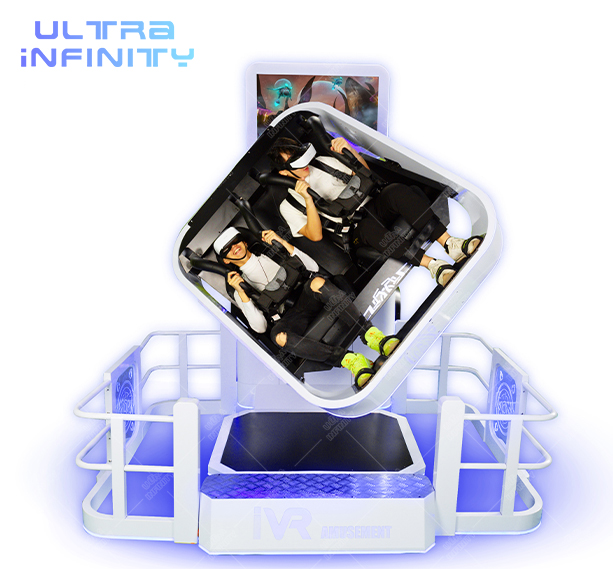
Two riders
360 Rotating VR Chair - 2 Seats
Two guests on one rotating base: 360 degrees of yaw with pitch, a maximum load of 300 kg and roughly 3.5 kW at 110-240 V - the throughput version of the format.
View Details ›
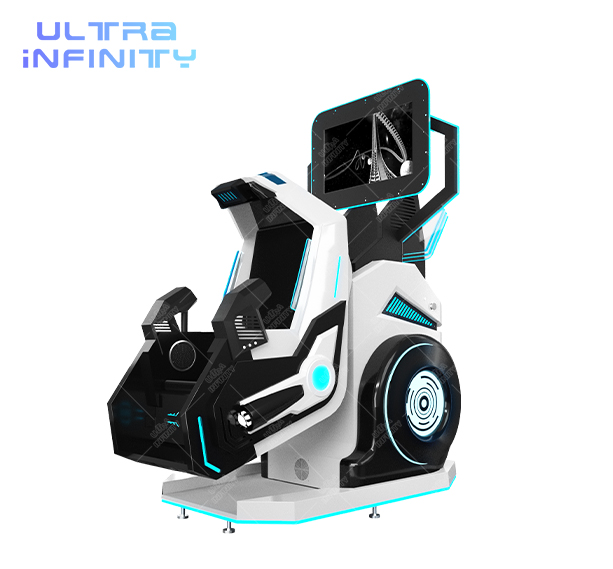
One rider
VR 360 Motion Chair - Single Seat
The compact version: full 360 degree rotation with pitch, around 1.8 kW, and a footprint that fits a corner, an atrium edge or an arcade line-up without a platform.
View Details ›
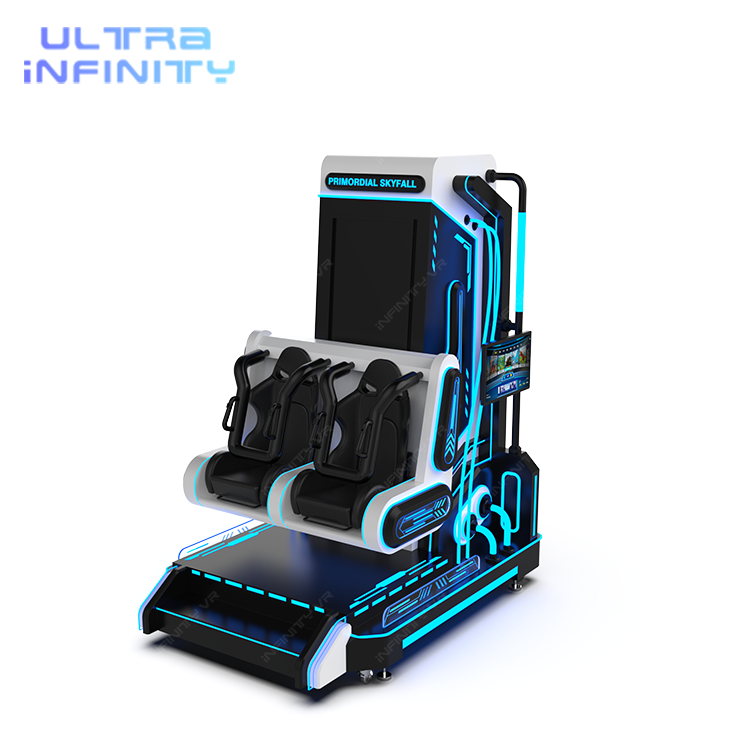
Vertical thrill
VR Drop Tower - 2 Seats
A two-seat vertical drop machine at 2.1 kW with 8+ titles - the same guest demand as a chair, delivered with a different motion signature so the two coexist on one floor.
View Details ›
13. Rotating VR Chair FAQ
What buyers ask about the mechanics of a 360 degree VR chair.
How does a 360 VR chair work?
It moves the guest instead of simulating the movement on screen. A powered bearing rotates the seat continuously about the vertical axis, and a second powered pivot inclines it forwards and backwards. The rotation supplies the sustained turn, the pitch supplies the drop and the launch, and because the guest body is actually moving, the vestibular system receives a signal that matches the visuals.
Why do rotating chairs only use two axes?
Because those are the two the guest reads as roller-coaster motion. Yaw gives the sustained turn that no screen can fake, and pitch gives the acceleration change that creates rhythm. Adding translation or further rotation increases mass, power, cost and maintenance while adding a sensation that content can already suggest visually. Our chairs are specified at 360 degrees of yaw and up to 45 degrees of pitch.
Do rotating chairs actually reduce motion sickness?
They address its main cause. Simulator sickness is primarily a mismatch between what the eyes report and what the vestibular system reports, and a chair that turns with the picture removes that mismatch instead of creating it. Published work on synchronised rotational cues reports a reduction in reported discomfort of roughly a third. Sustained rotation still has its own adaptation effects, which is why sessions are kept short.
What power and space does a rotating chair need?
Based on our product specification, the single-seat chair runs at roughly 1.8 kW and the two-seat V2 at roughly 3.5 kW, both at 110-240 V. The range needs about 3.8 m of clear headroom, around 3.5 m of surrounding clearance for the moving envelope, and a floor rated for 350-500 kg per square metre.
How long is a rotating chair session?
Sessions run two to five minutes from a library of more than 70 titles, with the visible rotation period typically 15 to 20 seconds inside a title. Including boarding, restraint check and reset, total resident time per turn stays under about seven minutes, which is what makes the format easy to schedule.
How many guests per hour can a rotating chair serve?
Based on our planning model, a single-seat chair is around 12 to 16 sessions per hour at peak and a two-seat unit around 24 to 32, counting briefing and reset honestly. Treat it as a planning reference and validate it with your own first month of operation, because footfall, staffing and group mix move the number.
14. Key Takeaways: The 360 + 45 Rule
Six lines to take into your next supplier conversation about rotating chairs.
- The chair moves the guest, not the picture. Rotation is the product, because rotation is the one motion an inner ear reads without ambiguity.
- Two axes carry the ride: 360 degrees of yaw for the journey, up to 45 degrees of pitch for the punctuation. More axes add cost and mass without adding a sensation guests can name.
- The mechanism is a geared rotation assembly, a powered pitch pivot, a rated seat and frame, and a safety envelope with interlocks - ask about all four on the quote.
- Comfort comes from matching, not from padding. Synchronised rotation addresses the mismatched-signal cause of simulator sickness, which is why the format suits first-timers.
- The cycle is short by design: 2-5 minute sessions, 15-20 second rotation passages, under seven minutes resident time, and throughput modelled at 12-16 sessions per hour for a single seat.
- Check the building first: 3.8 m headroom, 3.5 m clearance, 350-500 kg per square metre and a dedicated circuit decide whether the machine fits.
The next step is a height and power check on the spot you have in mind, plus a layout that shows the moving envelope and the queue. Send your floor plan for a free 3D layout design and we will mark out the chair placements that fit, or start from the VR park solution overview for the full zone picture.
Plan a Rotating Chair Zone
Headroom, clearance and power decide the placement. Review the VR park solution and send us your floor plan for a free 3D layout that shows where the chairs fit and what each option needs.

