LASER CS ARENA CAPACITY - PLAYERS PER SESSION, SESSIONS PER DAY
Laser CS Arena Capacity: How Many Players Per Hour & What a 16-Player System Really Earns
A capacity and throughput article for venue owners sizing a laser CS arena: the published revenue formula (Players x Price x Sessions x Operating Days x Utilization), the density band behind the player packs, the turnover mechanics that decide sessions per day, and the utilization tiers that swing a 16-player arena from about USD 22,000 to about USD 52,000 a month on the same hardware.
Revenue formula Density per player Session turnover Utilization tiers 16-player work through Sizing checklist
$31,680
16-Player Month at 50%, 22-Day Formula
$37,440
50% Utilization, 26-Day Default
$52,416
70% Utilization, 26-Day Month
~12
Sessions a Day, Official Model
1. The Capacity Question: Players per Session, Sessions per Day
You bought an 8-team system, and you are still running about 40 sessions a week while the same 16-player pack down the road runs closer to 80. Buyers usually blame the hardware. Operators who actually read the throughput believe the gap lives elsewhere: in how many players you seat per game, how many games you rotate per operating day, and the share of that potential you really sell. Those three numbers are the laser CS arena capacity question this article answers. The official Infinite Laser Tag solution page publishes the exact formula underneath them: revenue runs Players x Price x Sessions x Operating Days x Utilization, on a calculator default of 16 players at USD 15 per player, 12 sessions a day, over 22 to 26 operating days, at 50 percent utilization.
Run the model the way the page runs it and the scale appears. On the 22-day formula: 16 players x USD 15 x 12 sessions x 22 days x 50 percent equals about USD 31,680 a month. On the 26-day operating count that the calculator displays by default it is about USD 37,440 a month, which works out to roughly USD 1,440 a day and USD 158 of published revenue per square meter per month. The same formula on the 26-day base runs from about USD 22,464 a month at 30 percent utilization to about USD 52,416 at 70 percent. The four KPI cards repeat the headline numbers because they are the whole argument of this article in one screen: capacity is not the number of blasters you hang on the wall, it is the number of paid seats you can rotate through the arena in an operating day, and the formula the manufacturer publishes tells you exactly which lever moves which line.
This article deliberately sits between the four published laser CS articles instead of re-selling them. The full-venue ROI blueprint owns the payback picture end to end, the per-square-meter retrofit comparison owns the renovation decision, the game-mode and session tour owns what a session feels like, and the cost guide owns what the build costs. What is left open in the SERP is the operations math nobody has published as a method: the players-per-session and sessions-per-day structure, the density numbers behind the player packs, the turnover mechanics that control how many rounds an hour a floor really turns, and the utilization tiers that swing the monthly line from about USD 22,000 to about USD 52,000 on the same hardware.
Monthly revenue by utilization tier, 16-player system (26 operating days, official calculator)
Conservative, 30%
about USD 22,464/month
Expected, 50%
about USD 37,440/month
High performance, 70%
about USD 52,416/month
Same hardware, same ticket, same 12 sessions a day: only the share of seats actually served changes. Bars are normalized to the 100 percent value. Source: official Infinite Laser Tag revenue calculator tiers on its 26-day default base.
Capacity = players per session x sessions per day x operating days, and only the utilized share of that product becomes revenue. The published formula is Players x Price x Sessions x Operating Days x Utilization; at 50 percent it lands near USD 31,680 a month on the 22-day base or USD 37,440 on the 26-day default, and the 30 to 70 percent band on the 26-day base runs about USD 22,464 to USD 52,416.
Source basis: the revenue formula, the USD 15 ticket, the 12-session daily count, the 22/26 operating-day bases, the 50 percent default utilization and the USD 158 per square meter per month output follow the official Infinite Laser Tag solution page (infinite-laser-tag) and its revenue calculator, read live 2026-09-21. All multiplication shown is derived from the formula published on that page, not new statistics.
2. How Dense Can a Laser CS Arena Really Get?
Capacity starts with the floor, because the player pack sits inside a density budget. The density numbers used across the industry cluster in a band, and the band is the reference for sizing any arena. As of September 2026, according to the iCOMBAT field specification sheet, a traditional laser tag arena plans roughly 140 square feet per player and a tactical arena roughly 270 square feet per player, which is the gap between a simple open floor and an obstacle-heavy combat field. According to the wearecreativeworks arena planning paper, an all-in build lands between 125 and 150 square feet per player for the arena floor alone, and between 148 and 177 square feet per player once vesting, briefing and control space are included, for a planning average near 162.
The official product page turns the density band into a product decision. The Infinity Laser CS system is sold as synchronized player packs of 10, 12, 14, 16 (the page marks 16 as the Standard Recommended pack), 18 or 20 players, and every pack ships with its weapons, sensors, network and server so the arena is matched to a floor rather than assembled loose. The reason the pack exists as a packaged number is that density is what the arena can hold, not what the seller can dream: a 150 to 200 square meter arena zone inside a FEC floor supports the 10 to 16 player packs at the planning band, while a 400-plus square meter lease with double-height combat structure supports the 18 to 20 packs. The table below is the reference to bring to the floor plan, not a promise about any specific building.
| Reference |
Space per player (band) |
Venue scope |
Source basis (2026) |
| Traditional laser arena |
~140 sq ft per player |
Simple open combat floor |
iCOMBAT field spec |
| Tactical laser arena |
~270 sq ft per player |
Obstacle-heavy combat field |
iCOMBAT field spec |
| Arena floor only |
125-150 sq ft per player |
Real single-floor build |
wearecreativeworks paper |
| All-in, vesting/briefing/control |
148-177 sq ft per player |
Total footprint per player |
wearecreativeworks paper |
| Infinite Laser CS player pack |
10/12/14/16/18/20 per arena |
Packaged with weapons and server |
Official product page |
Read the rows as a sizing method, not as competing surveys. The traditional-to-tactical gap shows what the theme costs in floor: an obstacle-heavy combat field can need roughly twice the space per player of a bare open floor, so an operator who wants the dramatic multi-level look has to fund it in square meters before a single shooter is seated. The 125 to 177 band shows the real-world footprint of a working arena including the non-game rooms, which is the figure that belongs in the lease calculation. And the official pack ladder shows the supplying side: the arena is engineered to run as 10, 12, 14, 16, 18 or 20 players, so the floor decision and the pack decision are one decision. Cross-check the revenue side of the same floor in the laser CS arena versus arcade per-square-meter article, which compares what the same square meter earns under each retrofit option.
Source basis: the 140/270 square feet per player figures follow the iCOMBAT field specification sheet (vendor-reported, reconciliation through the NextPlay vendor registry). The 125-150 arena-only and 148-177 all-in figures with the 162 planning average follow the wearecreativeworks arena planning paper (2017). The 10/12/14/16/18/20 pack ladder and the Standard Recommended 16-player mark follow the official Infinite Laser Tag product page. Both vendor figures are named inline as attributed statements, not presented as independent measurements.
3. Turnover: the Mechanics That Decide How Many Rounds a Day You Run
A session-slot calendar only produces revenue if every slot turns. Turnover is the second lever in the capacity formula, and it is the one most influenced by the system itself, which is why the official page leads its selling points with fast game turnover. The headline mechanic is mid-session roster change: players can be added or removed while a game is live, and a round can start as soon as eight players are on the floor, without restarting the session for newcomers. For an operator this is the difference between selling an open slot to a late walk-in trio and watching the slot die empty because the lobby rule was "games start on the hour, no exceptions". The mid-game join rule is the single largest slot-salvage tool the hardware gives you, because late guests, split parties and birthday stragglers are exactly the bodies that normally kill a session boundary.
The supporting hardware is built around the same idea. The system runs on a Wi-Fi 7 mesh network, so guns, sensors and the leaderboard stay live across the whole arena without the split-second drops that stall a scoreboard mid-round. A single central server holds the session state, and the operator runs the whole floor from one screen control console: open the game, close it, adjust parameters, reset between groups, all without a technician standing by. The blasters carry an explosion-proof 12,000 mAh battery rated for a full day of sessions, which removes the overnight-charging queue that quietly eats the first session of every morning in battery-hungry venues. Each of these is a minute saved between groups, and minutes between groups are the turnover you sell, because the model counts sessions per day, not the sessions per hour a brochure wants you to believe.
The operator price-and-session anchors show what turnover is worth in practice. As of September 2026, according to Lost Worlds arena pricing in Los Angeles, sessions run in 30-minute slots with a registered capacity near 50 players, which is a long-rotation model on a big floor. According to Laserdome Plus pricing, a dome buyout covers up to 35 players and runs USD 750 on Sunday through Thursday and USD 900 on Friday through Sunday. What both anchors share is that the revenue is booked per slot, not per minute: the venue that turns 12 clean slots a day on a 16-player arena runs the official 22-day model to about USD 31,680 a month while the same arena turning eight slots runs closer to USD 21,120, before utilization is even applied. The counters and the mesh are not luxury options for a laser arena; they are the mechanical core of the sessions-per-day line.
The shared mistake
Treating the player pack as the capacity. A 16-player arena is not "we take 16 people"; it is 16 seats that have to rotate 12 times a day. If every slot is sold once, the model lands at the conservative tier, which is where most laser venues actually sit.
The turnover fix
Treat capacity as a rotation: seat 16, run 12 sessions, serve 22-26 days, sell 50-70 percent of the seats. Same hardware, same ticket, roughly double the monthly line, because the fix was never a bigger pack, it was more turns.
Source basis: mid-session add/remove, eight-player start, Wi-Fi 7 mesh, central server, single-screen console, explosion-proof 12,000 mAh battery and the Standard Recommended 16-player pack follow the official Infinite Laser Tag product page (infinite-laser-tag). Lost Worlds 30-minute slots and Laserdome buyout pricing follow operator pricing pages read 2026-09-21 and are attributed inline. The 8-slot versus 12-slot comparison (USD 21,120 versus USD 31,680 on the 22-day base) is derived from the official revenue formula, not a new statistic.
4. Utilization Is the Variable Everyone Underprices
The third lever in the formula is also the least mechanical and the most financial. Utilization is the share of the rotated seats you actually serve, and the official calculator makes the tiers dramatically visible: on its 26-day default base, at 30 percent utilization the 16-player model earns about USD 22,464 a month, at 50 percent about USD 37,440, and at 70 percent about USD 52,416. Note what does not change across those lines: the hardware, the ticket, the daily session count. The entire swing, a spread of about USD 30,000 a month, is produced by how much of the available rotation the marketing and events operation actually fills. That is why the capacity article keeps coming back to the same formula: utilization is the only lever that multiplies what the first two already built, and it is the one lever that costs no capex to move.
| Utilization tier |
22-day month |
26-day month (calculator default) |
Operating reading |
| 30% |
about USD 19,008 |
about USD 22,464 |
Typical small FEC, walk-in only |
| 50% |
about USD 31,680 |
about USD 37,440 |
Default calculator assumption, steady venue |
| 70% |
about USD 44,352 |
about USD 52,416 |
High-performance venue with events and league |
The 30 to 70 percent spread is where the sister article comes in. Raising utilization is mostly an operations and pricing problem, not an equipment problem: league nights, themed nights, party blocks and leaderboard-driven repeat visits are the published event kits that fill the weekday gaps. That is exactly the territory of the ROI blueprint on the payback side and the sister article on the fill side, and the practical weekly playbook belongs to the pricing article in this batch (laser tag pricing and party packages, off-peak fill), which builds the seven-day schedule that moves the 30 percent venue toward the 50 percent venue, and the 50 percent venue toward the 70 percent line. The two articles are the two halves of the same multiplication: this one sizes the boxes, that one fills them.
One caution belongs in the same section, because the model needs an honest off-switch. The calculator is a planning reference, not a guarantee: it multiplies baseline assumptions, and every line stands or falls on the actual ticket price, the actual session count, the operating days and the utilization a specific lease can honestly support. The cost guide (how much a laser CS arena costs) and the ROI blueprint (how profitable a laser tag arena is) exist precisely so a plan reads the utilization column against its real capex and its real week. When the two sides are read together, the 50 percent line stops being a slogan and becomes a budget number the operator either commits to or admits, which is the difference between planning a venue and writing a wish.
Utilization is the multiplier that costs nothing to buy. 30% to 70% on the same hardware moves the 26-day month from about USD 22,464 to about USD 52,416: about a USD 30,000 line swing produced by events, pricing and scheduling, not by new equipment.
Source basis: the 30/50/70 percent monthly values on the 26-day base are the official revenue calculator tiers (16 players x USD 15 x 12 sessions x 26 days x utilization); the 22-day column applies the same formula to the published 22-day example. The 50 percent default and the high-performance 70 percent tier follow the Infinite Laser Tag solution page. No new statistics.
5. A Worked Weekend: 16 Players on a 300 Square Meter Floor
Put the three levers on one floor to see the model hold together. Take a 300-square-meter FEC room in the US Midwest with a 16-player Laser CS arena plus a small party and lounge block. The arena runs 12 sessions a day on weekends and weekends are trivially fillable; the honest problem is the Monday-to-Thursday valley. At a 50 percent utilization across the week with 22 operating days, the published formula yields about USD 31,680 a month from the arena line alone, before food, drinks, party bookings, corporate nights and the leaderboard-driven repeat sessions that the paid programming feeds back. At the 26-day count the same floor shows about USD 37,440. The same room without a schedule between 5pm and 9pm on weekdays quietly lands nearer the 30 percent tier, about USD 22,464 on the 26-day base, roughly 40 percent below the 50 percent line on the identical hardware.
The party lane is where the density pays its rent. According to the wearecreativeworks birthday analysis, the average birthday party assembles about 12 people, which seats cleanly inside the 16-player pack with room for the party organizer and the stragglers, and birthday traffic is roughly half of the bookings at a typical laser venue, according to the LASERWAR operator database. The 16 pack is the Standard Recommended pack on the official page precisely because it seats the dominant walk-in unit, the birthday group, in one clean rotation. The session tour and game-mode guide covers what the birthday group actually plays; the capacity point here is that the pack size and the booking unit are the same number, which is why 16 as a default and the pack ladder around it is a floor decision, not a sales quote. The same booking unit converts to a second attraction when the moment is right: the Custom Interactive Sportainment line adds score-based stations across the same FEC floor, so the party group that already plays the arena can rotate into new scored games without leaving the building.
The full-business reading of the same weekend belongs to the ROI blueprint (how profitable is a laser tag arena), which wraps the capex, the operating cost and the payback around the arena line, with the per-square-meter lens as the second opinion on the same floor. This article stops where the money leaves the formula: seat 16, turn 12, serve 22 to 26 days, and price the utilization honestly against what the events calendar can actually fill. A venue that runs those four numbers on purpose is not hoping for capacity, it is operating it, and the same discipline transfers to a second arena later: the Free Roaming VR Arena 2.0 walking combat room runs the identical rotation arithmetic on a multiplayer floor, and the 60-square-meter VR arena day-rate case shows what that same formula earns, which is the natural second floor to add when the laser weekday is full.
Source basis: the USD 31,680/37,440/22,464 monthly figures are derived from the official revenue formula at the stated operating-day and utilization assumptions. The approximately 12-person average birthday party follows the wearecreativeworks birthday analysis (2017). The approximately 50 percent birthday share of laser bookings follows the LASERWAR operator database entry (vendor-reported, NextPlay vendor registry reconciliation). Both vendor statements are attributed inline as of September 2026. No new statistics.
6. Five Steps to Schedule Every Hour Full
- Size the floor first: apply the density band (125-150 sq ft per player arena-only, more for a tactical layout) to the actual square meters and confirm which player pack the room honestly holds, before any ticket is printed.
- Choose the pack from the official ladder: 10, 12, 14, 16 (Standard Recommended), 18 or 20. Match it to the dominant booking unit, the birthday group near 12, and to the FEC floor. Buy the weapon, sensor, network and server as the synchronized pack, not as loose hardware.
- Set the session rhythm: define the slot length and the turnaround gap, then publish the daily session count the floor actually turns, and use the mid-game join rule so late and split groups merge into the next session instead of killing the boundary.
- Pick an honest utilization target: start at 50 percent for the plan, model the 26-day operating count as the upside, and budget the 70 percent line as the events-achieved target, reading the cost guide and ROI blueprint against it.
- Schedule the fill, then the arena follows: league nights, themed nights and party blocks move the low-utilization days, exactly as the sister pricing article builds them; run the leaderboard and repeat-visit programming from the first month so the 50 percent number has a mechanism behind it.
The five steps are one loop, not a checklist. Step one fixes what the floor can hold, step two fixes what the pack seats, step three fixes how often the seats turn, step four fixes what the turn is worth in the plan, and step five fixes the utilization that multiplies everything. Walk the loop in that order and the capacity formula stops being the manufacturer page it came from and becomes the operating number of the specific building. The reference for the mechanical floor, the packs, the console and the batteries is the official Infinite Laser Tag solution page; the product that answers the whole envelope is the one in the cards below.
Capacity is a schedule, not a spec sheet. Floor density sizes the pack, the pack sets the slot, turnover sets the count, utilization sets the money, and scheduled events feed the utilization. None of the five steps requires a bigger machine to start.
Source basis: the step framework is synthesized from the official product page capabilities (pack ladder, mid-game join, console, network, event kits), the density band (iCOMBAT, wearecreativeworks) and the published cluster articles (cost, ROI). All named vendor figures remain inline attributed as of September 2026. No new statistics.
Key takeaways in four lines: (1) capacity is a rotation, not a headcount - 16 seats are revenue only if they turn 12 times a day over 22 to 26 days, on the official Players x Price x Sessions x Operating Days x Utilization formula; (2) density sets the pack - 125-150 sq ft per player seats the 10 to 20 packs, tactical layouts need more; (3) turnover is the mechanical lever - mid-game joins, Wi-Fi 7 mesh, one console and full-day batteries turn 8 into 12 sessions a day; (4) utilization is the money lever - 30 to 70 percent swings the 26-day month from about USD 22,464 to about USD 52,416, and the fill side of that swing is scheduled events and pricing.
7. Laser CS Arena Capacity FAQ
The capacity questions operators ask when they size the floor, answered with the same formula the body uses.
How many players can play laser CS at once?
The official Infinity Laser CS system runs up to 8 teams in the same session, and the arena is sold as synchronized player packs of 10, 12, 14, 16 (the Standard Recommended pack), 18 or 20 players, each pack shipped with its weapons, sensors, network and server. The team structure and the pack ladder together define the practical per-session count of a given arena.
How many square feet do I need per player?
The planning band is 125 to 150 square feet per player for the arena floor alone, 148 to 177 square feet per player once briefing and vesting are included, per the wearecreativeworks arena planning paper; a tactical obstacle-heavy layout needs more, around 270 square feet per player per the iCOMBAT field spec. Size the arena zone from that band, then pick the 10 to 20 player pack it holds.
How many sessions can an arena run per hour?
Sessions per hour depends on slot length and turnaround. Operator examples run 30-minute session slots (Lost Worlds), with the revenue counted per booked slot. The official calculator models the floor at 12 sessions per operating day, and mid-game player joins let a new group start once 8 players are on the floor instead of waiting for the next clean boundary.
Is the 16-player pack enough for a busy FEC?
The 16 pack is the Standard Recommended pack because it seats the dominant booking unit, the birthday group near 12 people, in one clean rotation. Venues that need more scale move to the 18 or 20 packs or add a second arena; the per-square-meter comparison article covers the add-a-route economics.
Do I need new equipment to raise throughput?
Raising throughput is mostly scheduling, not hardware. Within one arena, the sessions-per-day line rises with slower gaps, mid-game joins, and a filled weekday; utilization is the capex-free lever. New hardware raises the headline capacity (a larger pack or a second arena), but only after the existing floor is already turning cleanly.
8. Featured NextPlay Active Gaming Equipment

The 16-player system behind the model
Infinite Competition
The Infinity Laser CS arena package: 8-team multiplayer, 10/12/14/16/18/20 player packs, mid-game roster joins for fast turnover, Wi-Fi 7 mesh, a single-screen console, explosion-proof 12,000 mAh blasters, leaderboards and event kits, sized as a synchronized system for one floor.
View Details ›
The second floor for a full calendar
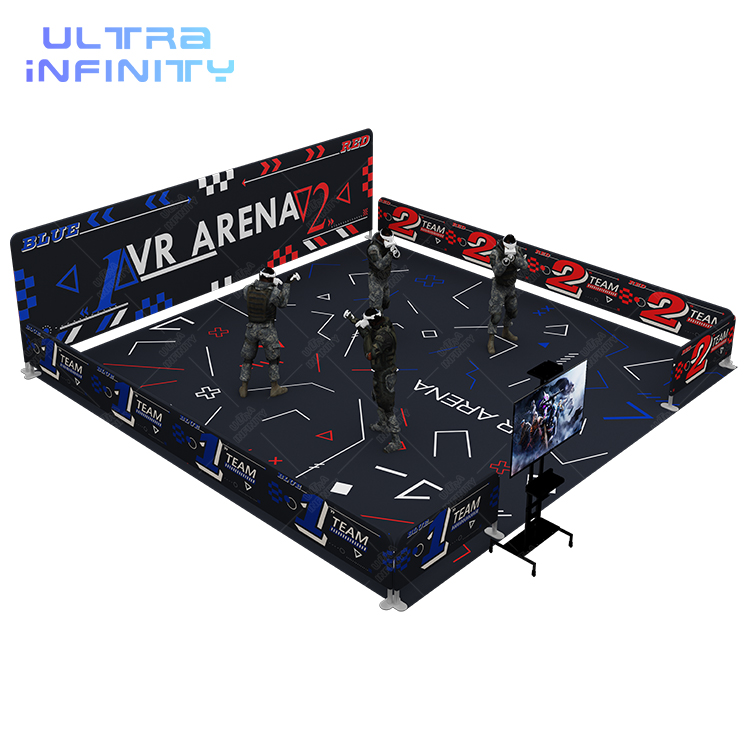
Free Roaming VR Arena 2.0
A multi-player free-roaming VR combat arena that seats another booking unit next to the laser floor: the add-a-room option that absorbs overflow after the laser weekday fills, running the same rotation arithmetic on a walking combat game.
View Details ›
The whole-floor multi-zone layout
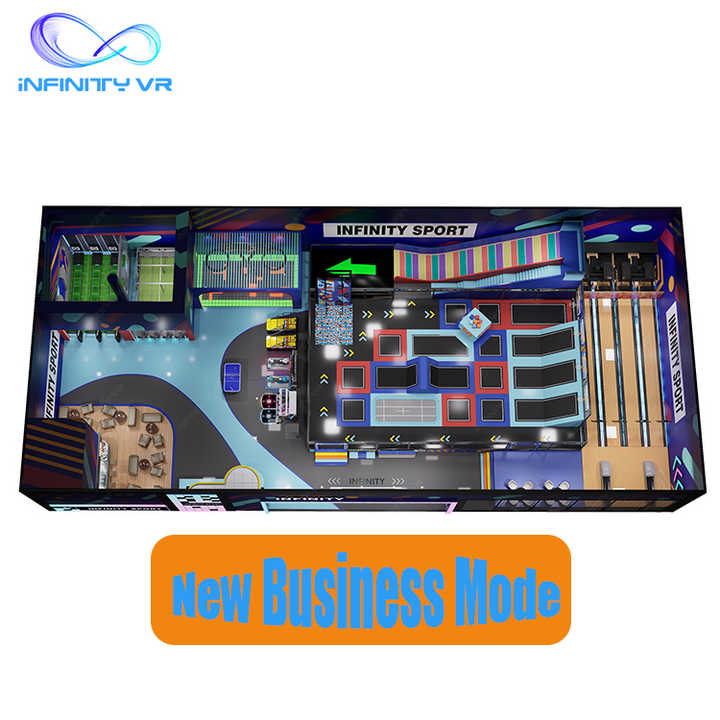
Custom Interactive Sportainment
A full-venue interactive equipment program that mixes the laser arena with complementary score-based stations across one FEC floor, giving the schedule more zones to rotate through on the same square meters and the same staff.
View Details ›
Size Your Laser CS Arena Floor
Send us the floor area, the ceiling layout and the intended player flow: we will return the player pack recommendation, the session rhythm, the installed cost model and the utilization target that matches your market, laid out with the Infinite Laser Tag layout planning - line up the Infinite Competition arena as the anchor, then read the cost guide to close the plan.

