Which Game Mix Profits Most in a 400m2 Party Room?
Which arcade party room game mix profits most in a 400 m2 room, answered with one division instead of a shopping list: the machines that finish a booked group inside the 60 minutes of play a two-hour block gives the floor. Built on published cycle times, throughputs, tickets and zone areas, checked against four external party price schedules.
Sep 21st,202617 Puntos de vista
PARTY ROOM GAME MIX - THE 60-MINUTE PLAY WINDOW TEST FOR A 400 M2 FLOOR
Which Game Mix Profits Most in a 400m2 Party Room?
The arcade party room game mix question answered with one division instead of a shopping list: which machines finish a single booked group inside the 60 minutes of play that a two-hour party block actually gives the floor. Built from our own published cycle times, throughputs, tickets and zone areas at 400 m2, cross-checked against four external price schedules that meter the room hour and the play hour separately, and closed with three configurations and the four places where the arithmetic breaks.
The 60-minute testPublished cycle timesVerdict tableThree mixes at 400 m2Where it breaks
60 min
Play Window Inside The Block
15
Children In The Tested Group
2 of 5
Machines That Clear It Solo
225 m2
Attraction Floor Across Its Five Zones
1. The Answer: Buy the Mix That Clears One Group Inside 60 Minutes
Ask six operators for the best arcade party room game mix and you get six shopping lists. This article answers a narrower question with one division: which machines finish a single booked group inside the minutes the booking actually gives them. In a 400 m2 party room the binding constraint is neither floor area nor hardware price. It is the 60 minutes of play inside a two-hour block, a split our own birthday package guide publishes as 10 minutes of arrival and wristbands, 60 minutes of play on the floor, 30 minutes of food and cake, and 20 minutes of open play before the farewell.
Hold each machine against that window using the cycle times, group sizes and hourly throughputs we have already published, and the shopping list re-sorts itself. Two of five group attractions clear a fifteen-child booking on their own. One clears it only in pairs. Two cannot clear it at any reasonable party size and belong in the walk-in area however well they earn per hour. That ordering, not revenue density, is what decides which game mix profits most in a room whose calendar is sold in rows.
Where the Two-Hour Party Block Actually Goes
Arrival and wristbands 10 min
Play time on the floor 60 min
Food and cake 30 min
Open play and farewell 20 min
Minutes exactly as published in our birthday party tier guide. The percent shares are those minutes divided by the 120-minute block: 8.33, 50, 25 and 16.67, rounded in opposite directions to whole numbers, so the four land on exactly 100 and no slice absorbs a remainder. Only the 50 percent wedge is play time, and only that wedge is a machine problem.
The three non-playing elements are not padding. Arrival and wristbands is where the headcount is reconciled against the booking, food and cake carries the party margin, and the farewell window is what protects the next booking start. Our published guide is explicit that the next party never waits for the last one to leave, which is why the block is described there as ninety minutes of activity plus a fixed cleanup buffer. Note that the same guide cuts the block two ways: its own minute table runs 10 plus 60 plus 30 plus 20 to the full 120, which counts arrival and the farewell window as activity, while the ninety-minute framing counts only play and food. We use the table, because the fit test needs to know where the play wedge sits inside the hold. That buffer rule is the reason this article exists: a machine that needs more than the play wedge does not merely run slowly, it pushes the next paying booking.
Clears it solo: the interactive LED floor and duckpin bowling on three lanes.
Clears it in pairs: the electronic dart cabinet, one unit short at party size.
Does not clear it: the shooting lane and the archery bay, both walk-in and corporate formats.
2. What a Party Booking Actually Buys: Two Clocks, Not One
Before any machine arithmetic, the pricing sheets themselves settle what is being sold. Every published party price we could read runs two separate clocks: a room hold and a play allocation, and the two are not the same length. The clearest example is not a competitor at all. A Canadian municipality, in an adopted 2026 user fee schedule, sells a childrens party as one hour of themed activities plus one hour in a party area, at CA$212 for ten children, CA$270 for fifteen and CA$329 for twenty, and rents the same multipurpose room separately at CA$57 an hour (the published schedule). That is a two-hour block with a 60-minute play window, priced by a public body with no interest in this argument.
Who sells the party
Published price
Play clock
Room clock
Municipal fee schedule, adopted 2026
CA$212 / 270 / 329 at 10 / 15 / 20 children
One hour of activities
One hour in a party area; hall alone CA$57 per hour
US trampoline operator, Los Angeles
USD 50 per jumper, 11-jumper minimum
60 minutes of jump
120 minutes of room hold
UK activity park, Watford
GBP 21.99 per person, 10-guest minimum
1 hour arena
30 minutes party room
NextPlay published party model
USD 15-17 / 19-22 / 25-28 per child, three tiers
60 minutes on the floor
120 minutes with food and farewell
US family chain, stated by its CEO
USD 99.99 for a party of six children, a little over 200 at about eight
inside the package
not separated in the quote
Read the last three columns together and two things follow. First, the play clock sits at about an hour wherever the product is honest about it, while the room clock sits at about two. Second, the upgrade at the top of every ladder buys play minutes, not room size: the trampoline operator sells more jump time, the UK park sells extra arena time, and the US chain sells a bigger play card to the birthday child rather than a bigger table. Association press frames the same ladder as a time problem rather than a space problem, stepping from a five to ten dollar walk-in play add-on to a twenty five dollar per head visit and a fifty dollar plus package built to hold a family on site for 45 minutes or more (the bundling guidance).
The group sizes the market books are also remarkably consistent, and they bracket the number this article tests. Six children in the entry tier quoted to the association interview, ten guests as the floor at two operators, eleven at the trampoline park, and ten, fifteen and twenty as the three separately priced headcounts on the municipal schedule, while in our own pricing model the range is ten to fifteen kids with the parent paying at the final count. We test fifteen because it is the middle rung of that municipal schedule and the top of our priced band at once, and a mix that only works at ten will be repriced by the first large booking.
Two of these external pages are operator price pages and are therefore described, not linked, in line with our own link policy. The three we do link are a municipal fee schedule and two association pages. The numbers behind our own tier model, the deposit rule and the host economics live in the birthday party tier guide and are not re-derived here; the party-slot price ladder across the week belongs to the party slot pricing ladder, and LED-floor party packaging to the LED dance floor birthday party guide. This article adds only the fit test.
3. The Test: Group Size Divided by Hourly Throughput
The arithmetic is one division, and it is the same division our own duckpin turnover guide publishes for a lane: 60 minutes divided by the game plus the transition gives the groups a lane serves per hour. Invert it and you get the party question, minutes needed equals group size divided by players per hour times 60. Where a machine prints an hourly throughput we use it directly. Where it prints a cycle and a simultaneous player count instead, we run the rounds and show the range, because a published number read across two different bases is not one number.
The shooting lane makes the shape of the problem visible, so it carries the first chart. Our sports simulator buying guide prints 12 to 18 players per hour for the Q4 lane; the line below plots the mid-point of that published band against group size.
Minutes to run one group through a single Q4 shooting lane
6 children 24 min8 children 32 min10 children 40 min12 children 48 min15 children 60 min18 children 72 min
Plotted at 15 players per hour, the mid-point of our published 12 to 18 band, so the result is a straight line by construction, not a fitted curve. The vertical axis is relative: the plotted span runs from 24 minutes to 72 minutes, which puts the 60-minute play window exactly at the fifteen-child point.
At twelve children the lane finishes with twelve minutes spare, enough for a final round and a photo. At fifteen it consumes the window to the minute, which means every minute of transition, every late arrival and every shy first shooter arrives on the next bookings clock. At eighteen it overflows by a fifth of an hour. Push the same group onto the low end of our own published band, twelve players per hour, and fifteen children need 75 minutes, a quarter more than the room was sold to give.
Throughput inputs: 12 to 18 players per hour, a 9 to 12 m2 lane and a 4 to 7 dollar ticket for the Q4, from the simulator and motion ride buying guide; the 7-minute round and the peak 5.5 rounds per hour come from the archery versus shooting revenue model; the 2 to 3 minute shooting segment with a group of 2 to 4 comes from the optical shooting guide. Note that 5.5 rounds per hour times 2 to 4 players per round gives 11 to 22 players per hour, which brackets the independently published 12 to 18. Two tables from two articles, on two different bases, agreeing. That agreement is why this lane is safe to plot.
The walk-in literature will not answer this for you, and it is worth saying why. Queue-management work on motion rides optimises the same division against an hour of walk-in arrivals, pre-boarding two machines to lift 40 rides an hour toward 80 (the throughput study). Per-lane duckpin turnover does the same against a Saturday of slots (the turnover guide). Both assume the customer leaves when their turn ends. A party does not: the group arrives together, must be on the floor inside the block, and must be off it before the cake. That is a hard ceiling, and it is the only reason a machine with good hourly numbers can be the wrong purchase for this room.
4. Machine by Machine Against a Fifteen-Child Group
Five group formats carry a party room in our published corpus: the interactive LED floor, duckpin bowling, the electronic dart cabinet, the shooting lane and the archery bay. Each has a printed cycle or throughput somewhere in our own articles. The table runs all five through the same division at the same group size, and reports the share of the 60-minute window each one takes.
Group machine
Published cycle basis
Published throughput
Minutes for 15 children
Share of the 60-minute window
Verdict
Interactive LED floor
4 to 8 players per round, 5 to 10 minute party round
not printed per hour; 24 to 96 derived from the two figures above
10 to 20 at eight per round, 20 to 40 at four
17 to 67 percent
Fits. Even the four-a-side end leaves at least a fifth of the window for food and farewell
Duckpin bowling
20 to 24 minute game, 5 to 6 players per lane
8 to 10 games per lane per hour on a 10 to 12 minute four-player round
20 to 24 on three lanes, 40 to 48 on two
33 to 80 percent
Fits at three lanes. Two lanes, the published boutique allocation, is a tight pass
Electronic dart cabinet X7
2 to 4 players per lane, 10 to 15 minute session
20 to 30 per hour as published; 16 to 20 on a full 15 minute lane
30 to 45 at the upper rate, 45 to 56 at the conservative rate
50 to 93 percent
Pairs only. One cabinet is within a whisker of eating the whole window
Shooting lane Q4
7 minute round, 5.5 rounds per hour at peak
12 to 18 per hour
50 to 75
83 to 125 percent
No. Cap the party at 8 to 12 or run two lanes
Archery bay A6
Six-arrow round of about six minutes, 7 rounds per hour sustained at peak, no operator at the bay
10 to 15 per hour
60 to 90
100 to 150 percent
No. Walk-in and corporate format, not a birthday block
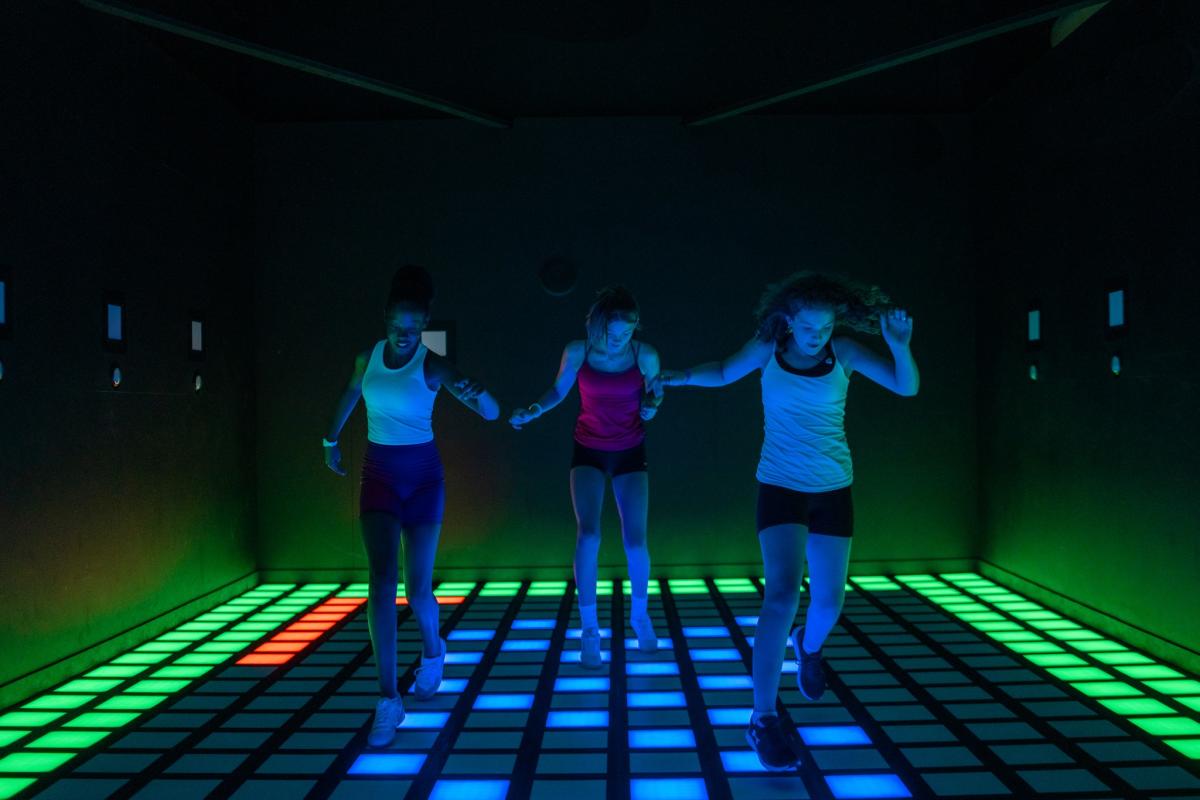
The LED floor is the only machine on the list that gets faster as it gets bigger, because its capacity is simultaneous rather than sequential. Our dead-corner guide publishes 4 to 8 players per round at 20 to 40 m2 of floor, and the round length is printed independently in three places: the impulse-ticket ranking states an LED round of 5 to 10 minutes with four to eight players outright, and the same 5 to 10 minute rhythm carries the challenge-room and party-rotation articles beside it. Eight children per leg clears fifteen in two legs, ten to twenty minutes. Four per leg takes four legs, twenty to forty minutes. Both land inside the window, and only the second is tight enough to need watching.
Duckpin is where our own published bases genuinely diverge, so the table shows both rather than averaging them. The 400 m2 boutique blueprint prints a 20 to 24 minute game with five to six players per lane; the four-lane turnover guide prints 10 to 12 minutes with a group of four and 8 to 10 games per lane per hour. Both are turnover statements, but they price different group sizes, and a party of fifteen resolves very differently on two lanes versus four. We use the slower published basis for the fit and flag the spread.
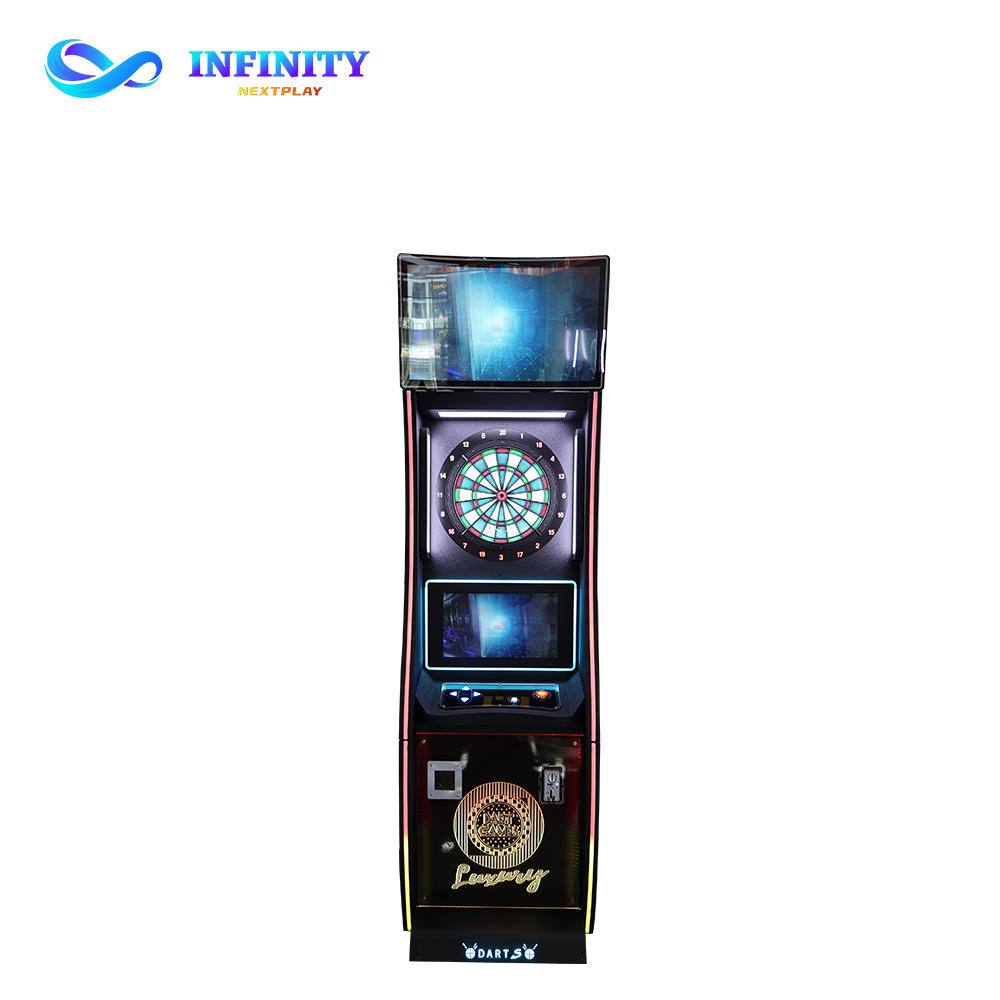
The dart row deserves the same care, because it is the row where a headline number misleads. The buying guide prints 20 to 30 players per hour for the X7 cabinet, which at fifteen children means 30 to 45 minutes and looks like a comfortable fit. Run the same cabinet off its own published session length instead and four players in fifteen minutes is sixteen per hour, so fifteen children take 56 minutes. We print 45 to 56. The difference is not pedantry: at the optimistic rate a single cabinet nearly fills the window, and at the conservative rate it overfills it, and either way the answer is two cabinets.
Our own scripts agree with the pairs conclusion. The corporate rotation guide runs an X3 dart competition as four teams across two cabinets in thirty minutes, and the LED and dart combination guide schedules the dart leg at 10 to 15 minutes inside a 90-minute loop pass, alongside LED sessions of 8 to 12 and VR rides of 6 to 9. That is the same 10 to 15 minute lane our conservative dart row already uses, so the loop guide confirms the slower basis from a different article: four players a round means four rounds for fifteen children, forty to sixty minutes at ten to fifteen minutes a round, which is where the 45 to 56 above lands. Read together, the published party and league material never puts fifteen children on one cabinet for one block. Note the base on that corporate figure, four teams and twenty-four players split across two cabinets, is a corporate booking, not a birthday.
The two that fail are the two a supplier will happily sell you first, because they print excellent per-head numbers. The archery bay earns the highest revenue per square metre and the highest margin in our published three-way comparison, and the shooting lane commands the higher ticket from a compact 9 to 12 m2 footprint. Neither statement is wrong. Both are silent about the one thing a party room prices, which is whether the whole group is done before the cake arrives. Archery clears the window only at twelve children and below, and shooting only at eight to twelve.
Archery is the one row whose two published bases need reconciling, so here is the reconciliation rather than a third figure. The revenue model prints a six-minute round at 7 rounds per hour sustained at peak; the buying guide prints 10 to 15 players per hour for the same bay. Divide the second by the first and the bay is carrying roughly one and a half to two archers a round on our arithmetic, which is a derived reading and is labelled as one: no page in our corpus prints an archery per-round player count we could have quoted. That is also why the fit column for archery runs off the published hourly band rather than off its round length, and why fifteen children is eight to ten rotations at that implied size, not the two rounds a four-a-side LED leg gives the same group.
5. From Verdict to Mix: What 400 Square Meters Can Hold
A 400 m2 shell is not 400 m2 of play. The published boutique blueprint for exactly this footprint allocates 120 m2 to a two-lane duckpin core with seating and shoe counter, 60 m2 to an arcade ring of four dart cabinets, 45 m2 to an archery and VR corner, 85 m2 to service, food and redemption, and 90 m2 to circulation and storage. Two hundred and twenty-five square metres is attraction floor; one hundred and seventy-five is the building around it. The density test on that 225 is separate and our own: the space-per-attraction guide sets a floor of two square metres per player in the active zones, so a fifteen-child wave is about thirty square metres of people standing on it, and the party core set out below takes 26 to 48 m2 of hardware out of the same pool, which leaves rather more than half of the 225 as circulation. That is the honest starting point for any mix question at this size, and it is also why this article prints no revenue per square metre figure at all.
The blueprint is a walk-in design: a dart ring sized for turnover, an anchor lane, no LED floor anywhere in it, and no dedicated party room. Apply the fit test and the same 400 m2 re-sorts into three configurations, each of which is a decision about what to take out.
Mix
What goes in
What it clears
Published price basis
Party core
One interactive LED floor at 20 to 40 m2, plus two dart cabinets at 3 to 4 m2 each
A 15-child group inside 60 minutes with a final round spare; the LED floor also carries a 4 to 8 player arrival wave without a queue
LED installation USD 22,000 to 30,000 including shipping, electrical and site prep; the X7 cabinet is published at USD 6,500 to 9,000 per unit including installation of that machine, so two cabinets land at USD 13,000 to 18,000 on our arithmetic
Paid add-on
One Q4 shooting lane at 9 to 12 m2, sold into the tier above the core
Groups of 8 to 12 inside the window, or a 15-child group split into two waves if the block is extended
Lane price USD 9,800 at a 4 to 7 dollar ticket, 62 percent margin in the published revenue model
Walk-in and corporate only
Archery A6 bay at 12 to 18 m2, kept off the party calendar
Nothing at party scale; 10 to 15 players per hour overflows any block you can sell
Bay price USD 9,200 at a 5 to 8 dollar ticket, 68 percent margin, the best per-head earner in the published comparison
Capex inputs are our own published planning figures: LED floor installation from the dead-corner activation blueprint, lane and bay prices and margins from the three-way simulator comparison, and the per-unit X7 cabinet and per-lane duckpin prices from the bowling and dart equipment price guide. For scale, the sports simulator buying guide prices a delivered and installed two-unit sports package at USD 28K, a five-unit package at USD 58K and a nine-unit package including one LED grid across 280 to 350 m2 at USD 105K. Zone areas come from the 400m2 boutique zone blueprint, which we cite for area and cycle only; its package economics are its own.
The fit test leaves three machines standing, and they are three we build: the interactive LED floor as the party core, the online electronic dart cabinet as the paired leg beside it, and the digital scoring shooting simulator as the sized add-on. Turning that mix into a floor plan for a specific shell is the step our layout service takes before anyone orders hardware.
What the party core does to the ticket is where the profit claim actually sits. Our published tier ladder prices Junior at 15 to 17 dollars per child, Champion at 19 to 22 and Legend at 25 to 28, and the difference between tiers is a room, a host and tournament games rather than more floor. Against that ladder the LED floor carries a 200 to 500 dollar party upsell as a published line, and the same floor in a private 30 to 36 tile configuration supports corporate team building at 40 to 60 dollars per person. The 520 m2 case study that put a tile floor at the centre of a group-booking programme moved repeat rate from 18 percent to 41 percent and group bookings from six to twenty-two a month, both figures from our own proposal modelled case rather than an audited venue, and labelled as such wherever they appear.
The room itself carries an opportunity cost the fit test prices implicitly. The municipal schedule rents the same hall it packages at CA$57 an hour, so a two-hour party holds roughly two hours of a rentable room. A mix that leaves twenty minutes of the play window unused has not saved time, it has left a priced asset idle inside a booking that was already sold; a mix that overruns the window has sold the same asset twice.
6. Where This Arithmetic Breaks
Four limits on the conclusion above, stated so nobody inherits them quietly.
Two of the five machines have no published hourly rate at all. The LED floor has a printed group size and round length but no players per hour anywhere in our corpus, so its 24 to 96 range is our arithmetic on the two published figures, not a published number. The dart cabinets 20 to 30 per hour is printed but only reachable at a shorter session than the same table prints.
The price cells above sit on three different scopes and do not add up to comparable budgets. The LED figure is an installed package that already carries shipping, electrical and site prep. The X7 cabinet at USD 6,500 to 9,000 and the duckpin lane at USD 6,500 to 8,000 are per unit and per lane prices covering installation of that machine alone, and the same guide quotes the building work around the lanes in a separate section. The lane and bay prices in the add-on rows are equipment lines from a revenue model that carries its own backstops, cabling and acoustic build-out at USD 26,000 to 30,000 on top of a two-bay, two-lane set. Read the three rows as three scopes, not one bill.
Fifteen children is the top of our priced band, not the whole market. The same party guide also describes two-hour rows of 15 to 25 kids. Above fifteen, no single-lane machine on this list clears the window, and the answer becomes either a longer block or a split group, not a faster machine.
Two of our own pages disagree in ways this article deliberately did not average. The party tier guide contradicts itself: one section says a venue can run three blocks on a Saturday, another says a Saturday that runs four two-hour parties out-earns any other use of that space, and this article quotes the three-block figure because the fit test needs a block count, not a maximum. And one figure in our own working notes for this article was wrong until we checked it: the mall anchor case averages 18 children per day through an afternoon club that gives each of them 20 minutes on the shooting simulator inside a three-hour program. We had read that as eighteen children through one lane in twenty minutes, which would be 54 players per hour against our published 12 to 18. It is not. It is a daily allocation across three hours and several attractions, and read correctly it is nowhere near 54 an hour: about six children an hour pass that station, which is below our published 12 to 18 rather than inside it, and no reading of the case contradicts the band. That is the trap in this whole genre of number: an allocation is not a throughput, and the fit test only accepts the second.
And one scope boundary, repeated because the title invites the wrong question. This article does not rank 400 m2 layouts by revenue per square metre. That formula, its denominator warnings and the conflicting published bands around it belong to the zoning and yield guide, and the specific 400 m2 duckpin anchor economics to the boutique blueprint. What is decided here is only which machines can serve a booked group inside its own block.
7. Party Room Game Mix FAQ
Which machine earns the most in a 400 m2 party room?
On hourly earnings our published tables rank the archery bay first, at 10 to 15 players per hour on a 5 to 8 dollar ticket and a 68 percent margin. On party earnings the ranking inverts, because the bay needs 60 to 90 minutes to clear fifteen children and the play window is 60. The machine that earns most in a booked room is the one that clears the booking: our fit test puts the interactive LED floor first at 10 to 40 minutes for the same group, then duckpin on three lanes.
How many dart cabinets does a party room need?
Two. One X7 cabinet publishes 20 to 30 players per hour, which looks sufficient for fifteen children at 30 to 45 minutes, but the same corpus publishes a 10 to 15 minute session for 2 to 4 players per lane, which puts a full fifteen-minute lane at 16 per hour and the same group at 45 to 56 minutes of a 60 minute window. Our own corporate script runs an X3 dart competition as four teams across two cabinets in thirty minutes, and that two-cabinet shape is what makes the format work at party size.
Can a shooting simulator be part of a birthday package?
As an add-on sized to the group, not as a core. The Q4 lane publishes 12 to 18 players per hour, so fifteen children take 50 to 75 minutes against a 60 minute play window. At eight to twelve children it fits with room to spare, and its 4 to 7 dollar ticket and 9 to 12 m2 footprint make it a strong tier upgrade. Above twelve, either split the group into waves or move the lane to the walk-in floor.
Why not fill the room with the highest throughput machines?
Because throughput is measured per hour and the party is measured per block. A cabinet that clears 30 players an hour and a cabinet that clears 16 both fail a fifteen-child booking that must finish in 60 minutes if the group cannot be split, and a mix of high hourly numbers and unsynchronised cycle lengths produces exactly the queue that delays the cake and pushes the next booking. The machines that profit most are the ones whose cycle divides evenly into the window.
What does the play window cost if a machine overruns it?
Two things at once. The block was sold with a fixed cleanup buffer precisely so the next party never waits for the last, so an overrun either compresses the farewell or moves the next start, and the room hold itself has a published price: the municipal schedule that packages one activity hour with one room hour rents the same hall alone at CA$57 an hour, which puts roughly two hours of rentable time behind every party row.
Does the 400 m2 figure change the machine verdict?
It changes the tolerance, not the verdict. The published 400 m2 blueprint allocates 120, 60 and 45 square metres to attractions and 85 and 90 to service and circulation, so add its own rows up and 225 m2 is attraction floor with 175 m2 of service, food and circulation behind it. That leaves room for a floor plus two cabinets plus one lane without crowding, and our own published density rule, a two square metre minimum per player in the active zones, prices a fifteen-child wave at about thirty square metres against 225 of attraction floor. What 400 m2 removes is the escape valve: there is no spare hall to absorb a group that overruns, so a machine that cannot clear the window has nowhere to go.
8. Featured NextPlay Active Gaming Equipment
The party core: clears 15 in 10 to 40 minutes
Immersive Interactive LED Floor Game
A scored LED tile floor for 4 to 8 players at a time on a 20 to 40 m2 footprint, with 5 to 10 minute party rounds and software mode swaps instead of hardware changes. The only machine in our published set that clears a fifteen-child booking inside the play window on its own, and the one that carries a 200 to 500 dollar party upsell as a published line.
View Details ›
The pairs format: two cabinets, one block
Online Electronic Dart Machine X7
A networked electronic dart cabinet for 2 to 4 players per lane in a 3 to 4 m2 footprint, with online scoring and global league play. Strong walk-in turnover, and at party scale it is a two-cabinet format: our published corporate script runs four teams across two cabinets in thirty minutes, which is the shape that fits a fifteen-child group inside the window.
View Details ›
The paid add-on, sized to 8 to 12 children
Digital Scoring Shooting Simulator Q4
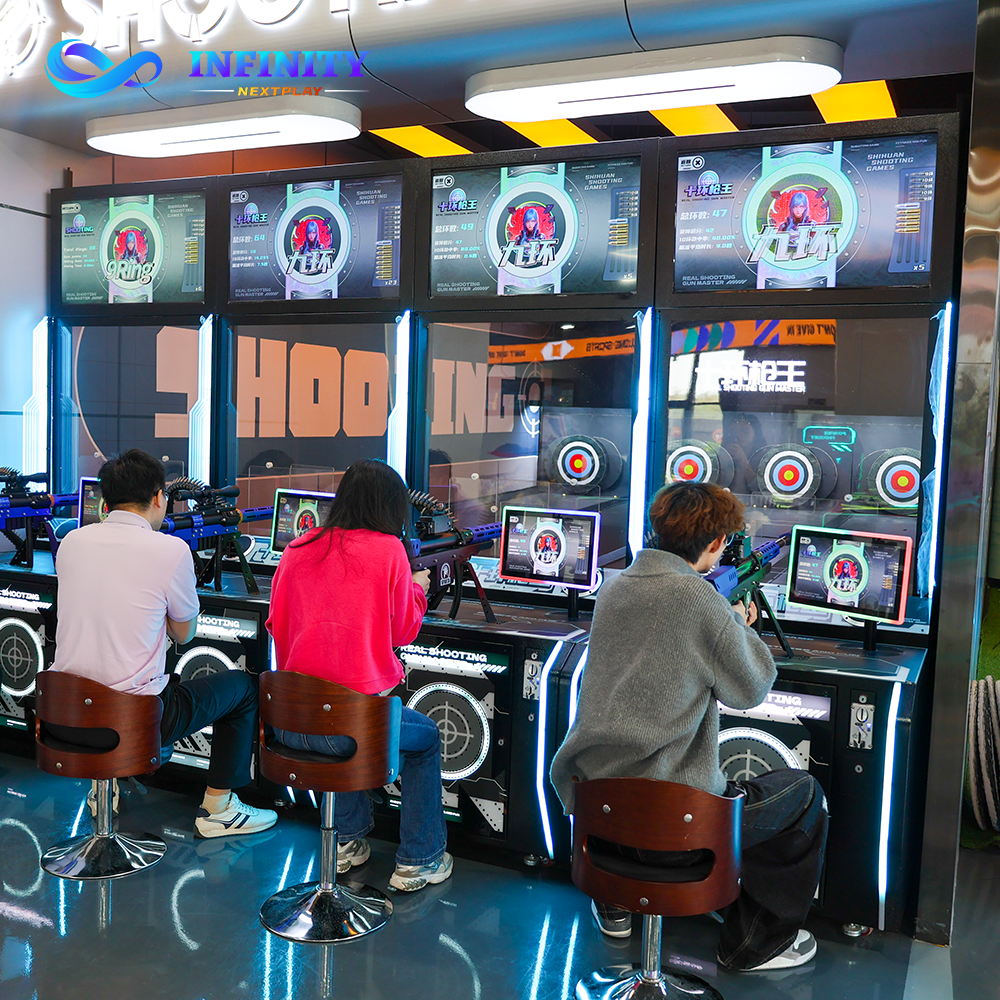
A digital scoring shooting lane with real-time leaderboard and reward rounds on a compact 9 to 12 m2 footprint, publishing 12 to 18 players per hour at a 4 to 7 dollar ticket and a 62 percent margin. It does not clear fifteen children inside a 60 minute play window, and it is the strongest tier upgrade in the room when the group is capped or split.
Send the block length you sell, the group size you book, and the floor plan. We will return the per-machine fit test against your own play window, the LED floor, dart and shooting configuration that clears it, and the installed cost model, laid out on your plan with the free 3D layout design - start from the active gaming solution page and read the birthday party tier guide and the LED floor activation blueprint while you decide.