Golf Simulator vs Mini Golf: Which Works Better in an Indoor Entertainment Venue?
A simulator bay is a supervised instrument sold by the hour; a mini golf course is a walk sold per head. Compare the same 84 square meters both ways, the published utilization curve, and four floor situations.
Sep 22nd,202657 Puntos de vista
GOLF SIMULATOR VS MINI GOLF - TWO SESSIONS, TWO METERS, TWO CALENDARS, ON ONE FLOOR
Golf Simulator vs Mini Golf: Which Works Better in an Indoor Entertainment Venue?
A bay is a supervised instrument sold by the hour. A course is a walk sold per head. Here is the same 84 square meters spent both ways, the utilization curve (published by a booking platform) that only one of them has, and the four floor situations that decide it.
Session firstSame 84 m2Hour vs headTwo calendarsFour situations
84 m2
Floor Our Simulator Sheet Specifies
6
Players Printed Per Bay
36%
Blended Annual Sim Utilization, Booking Data
12-48 m2
Our Published Per Hole Band
1. You Are Not Buying a Machine, You Are Buying a Session
Ask a simulator supplier and a mini golf builder the same question, what should I put in my venue, and you get two brochures. Each one is a competent argument for the thing they manufacture, and neither one starts where the decision actually starts, which is the shape of the visit that fills the space. A simulator bay and a putting course are not two versions of golf revenue. They are two different sessions, sold by two different meters, to two different people, on two different calendars, and one of them is a machine room while the other is a walk.
So this golf simulator vs mini golf comparison, written for the venue operator rather than the player, is built on that distinction, and it runs in this order: session shape first, then the physical footprint each one consumes, then the meter you bill against, then the demand calendar, the return visit, the staffing and the replacement clock. Where a number is ours it is marked as ours; where it belongs to a vendor or a booking platform it is named at the point of use; and where our own site already owns a figure, the money arithmetic for course cost, capacity per hour and revenue per square meter, this page links to that owner page instead of restating it. That is the whole method, and it is also the reason you should be suspicious of any comparison, including this one, that presents a single winner to an indoor entertainment venue.
One warning before the numbers. We found no study, in the sources opened for this article, that puts a simulator bay and a mini golf course in the same venue and measures them against each other. Every money figure in this article comes from a party that sells one of the two, from a platform that books one of the two, or from a trade site that sells listings to venues. That asymmetry is not a flaw in the research, it is the condition of the market, and it is why the last section of this page lists what the comparison genuinely cannot tell you.
The question worth asking - not which attraction earns more, but which session your floor is already failing to serve
The trap - comparing a per-hour bay price against a per-person round price as if the two units were the same thing
The honest output - a decision you can defend to a landlord, a partner or a bank, built on session, space, meter and calendar
2. What a Simulator Bay Is, on Our Own Published Sheet
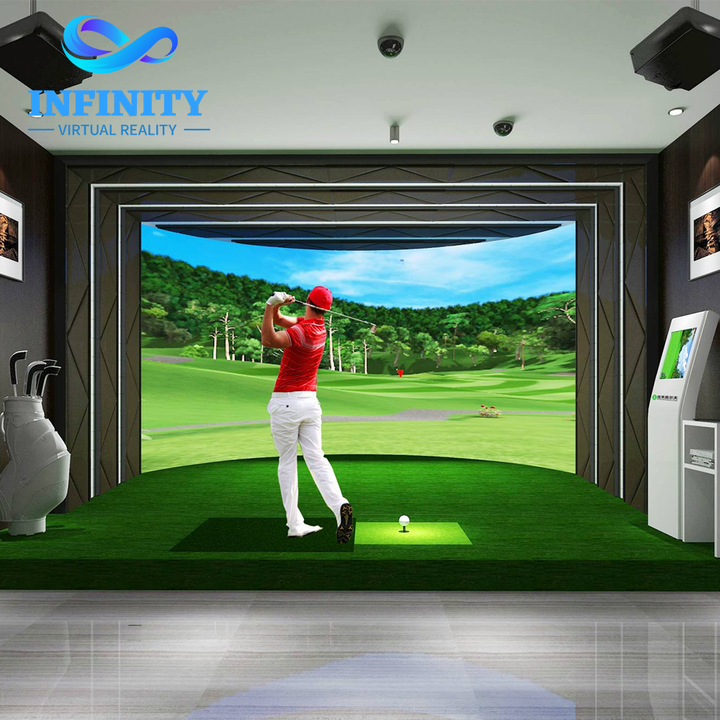
Start with the thing we sell, and start with what the sheet actually prints rather than the marketing copy around it. Our commercial AR golf simulator page lists a full set with an area size of 7 by 12 by 4 meters, six players, a 7 by 4 meter screen, one projector specified as Panasonic, one sensor spotlight, a four lens high speed camera detector at 4K in the spec table, an electronic control box, an action playback system, a computer server, a metal machine cabinet, eighty golf balls and one set of clubs. The same page also prints Product size: Welcome customized, which is the manufacturer way of saying the enclosure follows your room rather than the other way around.
Line on our simulator sheet
What it is published as
Why it matters to the decision
Area size 7 x 12 x 4 m
A footprint of 84 square meters with 4 m of height
Height is a hard constraint; a putting course has no ceiling requirement printed anywhere
Players 6
People per session on one bay
Six bodies, one instrument, one queue behind it
Screen 7 x 4 m, projector 1 pc
The visual surface and the lamp that feeds it
Both are bought as one time purchases, and the maintenance section covers what the published record numbers and what it leaves blank
Camera detector, sensor spotlight, control box, server
The measurement stack
This is the part that makes it a simulator rather than a screen in a room
80 golf balls, 1 set of clubs
The consumables shipped with the unit
A real ball, a real swing, and therefore a real struck-object risk profile
Product size: Welcome customized
Custom enclosure
The room is the specification, which is why bay counts get decided by the shell
Source basis: our own live product page, re-read 2026-09-21. The page prints no price, no power draw, no throughput figure and no session length. Anything not in the table above is not published by us, and we are not going to guess it here.
Read that sheet as a specification and it tells you three things a brochure will not. It is a bay, meaning the unit of sale is one instrument with one queue. It is height hungry, and 4 meters is well above the 3 meter general minimum that simulator and motion equipment install guides typically ask for. And it is a computer room wearing a golf outfit: camera, server, control box, projector, screen, each with its own failure mode and each of them upstream of the customer experience.
A bay is a machine with a queue attached. A hole is a piece of floor with a lane attached. Nearly every difference in this article follows from that one sentence.
3. What a Mini Golf Course Is, on Our Own Published Bands
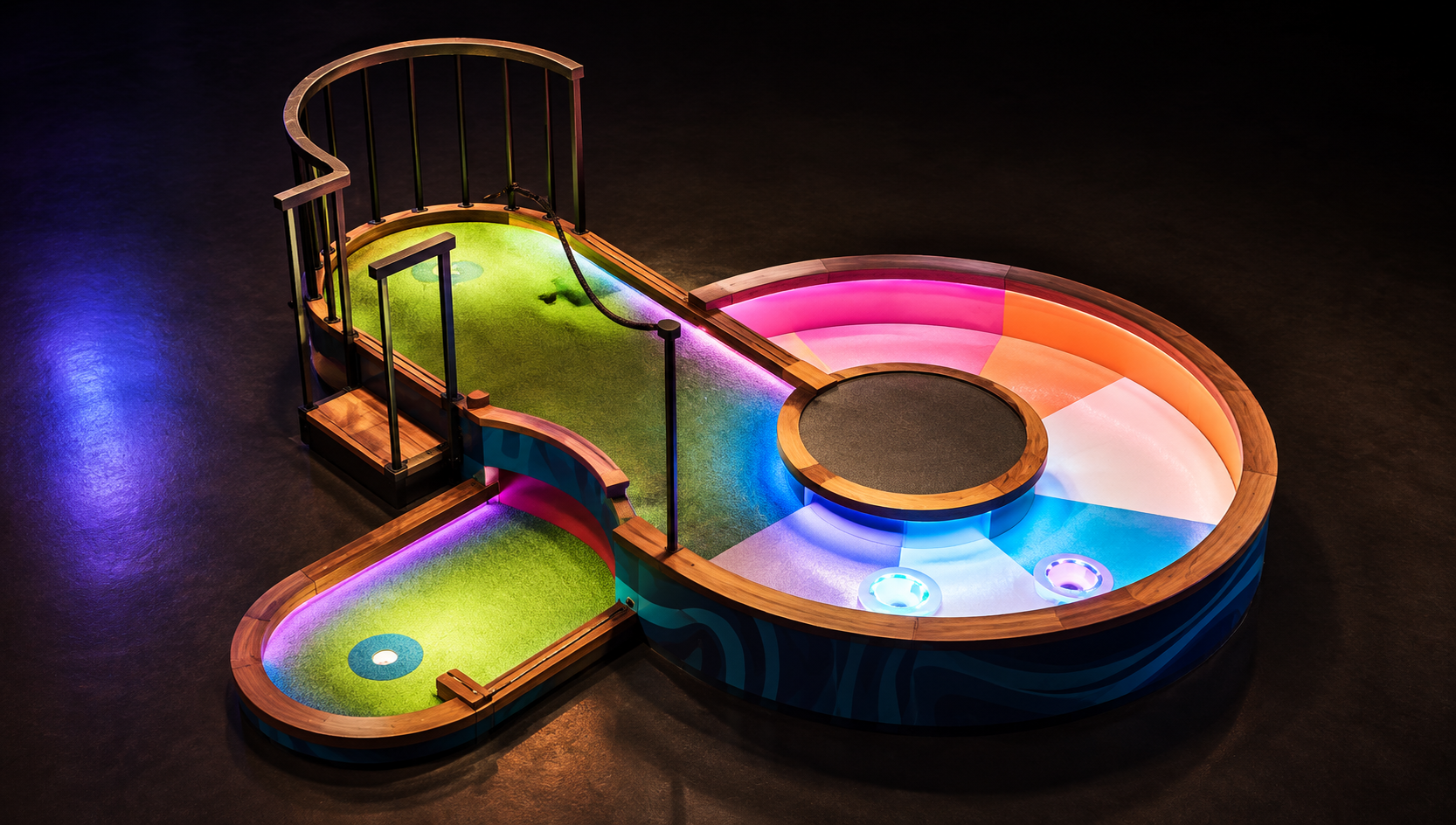
The course side is specced differently because it is bought differently. Our mini golf course solution material publishes a per hole footprint band of 12 to 48 square meters with a play time of three to five minutes per hole, and it splits that band by difficulty tier: beginner 12 to 25, intermediate 20 to 36, advanced 30 to 48 square meters per hole. That band is the factory footprint of the hole itself. The walking approach is extra: our own course cost page puts the working area per hole at roughly 1.5 to 2 times the footprint once the route around it is counted. Neither number is the dimensions of a machine.
The only two holes in our current commercial mini golf range that publish a hard equipment specification are the ones used in the table below, and their numbers are worth reading exactly. The Cyclone Spin Hole sheet gives 4.0 by 1.6 by 1.8 meters, 280 kg net, 100 W at 220 V 50 Hz, one to three people, twenty balls and one putter. The Gate Challenge Golf Hole sheet gives 2.4 by 4.5 by 1.0 meters, 260 kg net, 100 W, one to three people, the same accessories, and a 4.5 meter fairway. Both are furniture sized objects, and both print a player count of one to three rather than six.
Published figure
Simulator bay
Mini golf hole
Unit of sale
One bay, 84 m2 on our sheet
One hole, 12 to 48 m2 planning band
Head count printed
6 players
1 to 3 people on the two holes that publish a spec
Electrical line printed
Not published on our sheet
100 W at 220 V 50 Hz on two module sheets
Height line printed
4 m
No ceiling requirement published in any source we opened
Price printed on our page
None
None
Source basis: our own live product and solution pages, re-read 2026-09-21. Most holes in the range publish a difficulty rating and a description but no dimensions, and no page in the range publishes a price, so a per hole cost claim is always an assumption imported from a builder quote rather than a specification we hold.
The absence of a printed price on both sides is not an accident or a marketing gap, it is the real structure of the purchase. A bay and a course are both project quotes, and both scale with your shell, your ceiling, your circuits and your freight. The pages that own the money arithmetic for the course side are our indoor mini golf course cost breakdown and the cost, space and profit hub, and the simulator side is carried by what a golf simulator costs and the simulator space requirements page. What the course side actually has to buy, hole by hole, is on our commercial mini golf equipment list, which is a buy list rather than a price list. This article deliberately does not import their numbers, because a comparison that quietly borrows two models and subtracts them is the least useful document an operator can read.
4. The Same 84 Square Meters, Spent Two Ways
Now put them on one floor. Our simulator sheet specces 84 square meters for one bay. That same 84 square meters, spent on mini golf holes at the footprint bands we publish, buys somewhere between one and three quarters of an advanced tier hole at 48 square meters each, three holes at the 28 square meter intermediate midpoint, or seven beginner tier holes at 12 square meters each. Count the walking route on top, at the 1.5 to 2 times our cost page uses, and the same floor holds closer to one flagship hole, one to two intermediate holes or three to four compact holes. The honest version of that sentence is a range, not a number, and the range is the point: the course absorbs the floor as lanes while the bay refuses to absorb it at all, because a bay is one instrument that cannot be subdivided without buying another instrument.
What 84 square meters buys, computed by us from our own published bands
One advanced tier hole, at 48 m2 each
48 m2 of the 84
One intermediate tier hole, at the 28 m2 midpoint
28 m2 of the 84
One beginner tier hole, at 12 m2 each
12 m2 of the 84
One simulator bay, our own sheet
84 m2 of the 84
Our arithmetic on our own published per hole footprint band (12 to 48 m2 of factory footprint, on top of which our course cost page puts the working area at about 1.5 to 2 times the footprint once the walking route is added), and on the area size printed on our simulator sheet. It is a floor comparison only. It says nothing about how many people either configuration can serve per hour, which is a throughput question owned by our course capacity page, and it is not a revenue comparison, which belongs to revenue per square meter.
There is a second geometry difference that a square meter count hides completely. A bay is a box, and a box has to be a workable box: the enclosure, the swing arc, the ball flight to the screen, the seating behind the player. You cannot shrink a bay to fit a leftover corner, and you cannot lengthen it. A course is a route, and a route can be threaded, compressed, stacked across two levels or broken into nine holes in a corridor and eighteen in a loop. The consequence for a venue with awkward floor is that the course is the flexible object and the bay is the rigid one, which is exactly why our four bay 45 square meter layout formula exists as its own page.
The mirror consequence is equally real. Seven beginner tier holes in 84 square meters of footprint, which is the arithmetic before the route is drawn, is a tight route, and a tight route is where mini golf goes to die, because the walk between holes is not wasted space, it is the queue, the overtaking lane and the reason the group behind you does not walk into your putter. If the layout itself is wrong, adding holes makes it worse. Our how much space a course really needs page carries the venue size bands, the mini golf versus bowling comparison carries the per square meter argument against a different neighbour, the mini golf versus arcade page runs the same floor arithmetic against a bank of cabinets, and all three are better tools for that question than this section.
If your floor is a clean rectangle with 4 m of clear height, both products fit. If your floor is a basement with columns, a low ceiling or a mezzanine, only one of them is a route, and that fact decides the purchase before any number is discussed.
5. Two Meters, Two Prices, and Why They Are Not Comparable
Here is where most comparisons of these two products become nonsense. A simulator bay is billed by the hour against the instrument. A mini golf course is billed per person against a round, or in some markets per hole, and a technology layer on the holes moves the meter again, which is the subject of our interactive mini golf pillar. Those are different meters and they behave differently under the same crowd.
On the bay side there is one genuinely useful published dataset, and it comes from a booking platform rather than a hardware vendor. Tabski, reporting data from its own installed base in 2026, puts the median at about 55 US dollars per bay per hour across more than two hundred operating venues on its system, and reports a different number for the wider market: across 794 venues that publish their pricing the median printed rate is 40 dollars, with an interquartile range of 25 to 55 and a mean of 51. The same publisher puts urban markets at 55 to 70 and premium urban markets at 90 or more. That hourly figure is the one worth planning on. What this page deliberately does not carry is the annual revenue per bay number that booking platforms and simulator manufacturers both like to publish, because the two published datasets sit close together at the median and disagree completely about what is being counted: one is a franchise disclosure that does not say whether the figure is bay-time revenue or whole-store revenue divided by bays, and the other is derived from booked hours on a system whose venues skew larger and more urban.
What named venues publish is more useful than any average, and four of them bracket the platform median. Golfzon Social, whose own page says it runs two New York locations and one in Chicago, states the meter in as many words: it charges per hour per bay only, does not charge per person, and allows up to six people at the same bay. X-GOLF Glen Carbon, in Illinois, sells the same unit day parted, with a printed Saturday and holiday all day price of 60 dollars per sim. Albatross Golf, whose rates page covers its Hamilton and Ancaster rooms in Ontario, lists four hourly rate tiers across that span, from 40 to 65 dollars an hour on a Vision Plus bay up to 60 to 95 on its TwoVision NX VIP room. In Darlington, north east England, Virtual Fairways hires a bay at 13.50 pounds per half hour and adds 8 pounds for each additional guest up to six, which is the only one of these four that prices a head at all. Read as a set they straddle the platform median rather than confirm it, since the Illinois day part and the Ontario VIP room both print above 55 dollars while the Ontario standard bay starts below it at 40, and they show what a median cannot: the buyer is pricing the room and the instrument, because three of these four venues charge nothing extra for the players inside it and the fourth adds eight pounds a head.
The clock is published even where the revenue is not. Golfzon Social says in its own FAQ that for the average golfer a round of 18 takes 45 minutes to an hour on a bay. X-GOLF goes further and gives the throughput rule outright: each individual can finish 18 in about an hour, and each additional person in the group adds about an hour, which means a six player booking owns that instrument for close to six hours on the venue's own arithmetic. That is the real capacity of a bay. One party, one booking, dark to everyone else while they swing.
Meter
What the buyer pays for
Who publishes the rate
What it caps
Per bay hour, simulator
Exclusive use of one instrument
Tabski booking data, US median about 55 dollars
Revenue is capped by hours open times the published utilization assumptions, not by footfall
Both products can be packaged; only one of them can be bought out as a route
Say the arithmetic out loud and the asymmetry becomes obvious. A bay with a four hour booking at the median rate takes in on that multiplication something like 220 dollars from a single group, and if nobody books it, it takes in nothing, because the bay cannot be sold to a second party at the same hour. A course with a Saturday queue can be full of several hundred people and never issue a reservation, and it can also be completely empty on a Tuesday morning while charging the same ticket. One of these products is scarce and therefore priced like a room; the other is a flow and therefore priced like a ticket.
This section deliberately does not print a revenue per square meter figure for either product. That comparison has a page of its own on this site, and a second one against bowling, because the denominator is contested enough that it should not be re-derived inside a versus article.
6. Two Demand Calendars You Can Look Up
If you take one planning number from this article, take the seasonality, because it is the one both industries would rather you did not read. The Tabski booking platform dataset across more than two hundred venues reports a blended annual utilization of about 36 percent per simulator bay - a third party figure this page cites as published, not measured by us. The peak season figure needs reading carefully, because it is easy to print the wrong one: 41 percent is the median venue booked inside the November to April season, a percentile in a distribution whose 25th percentile venue sits at 20 percent and whose 90th sits at 72 percent, while the season as a whole runs at about 50 percent for that publisher. Summer runs about 23 percent between May and October, the best month is January at about 54 percent, the worst is September at about 21 percent, and the break even line the same source draws is a band rather than a point, 28 to 41 percent depending on your cost stack, with a hard floor at roughly 25 percent annual utilization in the same published dataset, below which it says a staffed four bay venue cannot cover its fixed costs.
Those numbers are startling for an indoor product. The bay does not care about weather; the golfer does. The demand for a simulator follows the outdoor season in reverse, and September is the worst month for a climate controlled room in a way that has nothing to do with your operations. Anything you plan on an annual average is going to be wrong in both directions, and a bay that clears 25 percent at break even will sit below that line for a real month of the year.
Simulator bay utilization across the calendar year, published booking platform dataset (Tabski, 2026, 200+ venues)
January (best month) 54%November to April season overall 50%Median venue inside peak season 41%Blended across the year 36%Break even floor, staffed four bay venue 25-41% bandMay to October summer average 23%September (worst month) 21%
Third party booking platform data, published by that platform, not measured by us; utilization means booked hours against available hours on a bay, plotted on the calendar as the series runs. Two of these points are a different object from the rest: January, September, the peak season and the summer average are time periods, while "median venue in peak season" is a venue ranked inside a period and "blended across the year" is the dataset average that publisher reports rather than a typical venue. Read the January-to-September drop as the operating reality of a single instrument venue. The break even point is the floor of a band, not the whole rule: the same source puts break even at 28 to 41 percent depending on cost structure.
The mini golf side does not have a published utilization dataset, and pretending otherwise would be the single biggest dishonesty available on this page. What it does have is a demand driver everyone can verify. The Bureau of Labor Statistics time use survey reports that 81 percent of employed people worked on an average weekday compared with 30 percent on an average weekend day. That is a measure of when Americans are at work, not a measure of who walks into your venue, and it is used here only for what it can carry: any attraction whose revenue depends on employed adults in daytime is structurally weekend weighted, and any attraction whose revenue depends on families and groups is weekend weighted for the same reason.
Calendar pressure
Simulator bay
Mini golf course
Best documented month
January, about 54 percent booked (platform data)
No published utilization figure in the sources opened for this article
Worst documented month
September, about 21 percent booked (platform data)
Unknown; our own capacity page models peak hours rather than months
Daypart
Evenings and weekends for employed adults; daytime is bookable by retirees, flex workers and off peak players
After school, weekend daytime, and the after six adult window if the holes carry a tech layer
Group size dependence
Weak, a bay serves a party of two and a party of six for the same hour price
Strong, a round is a group event and the walk is the product
What smooths it
Leagues, lessons, corporate bay time, resale of off peak hours
Theme rotation, leagues, party packages, tournament nights
A bay has a published utilization curve and it is steep. A course has no published curve in any source we opened, which is a finding rather than a gap in this article.
7. The Skill Wall, and What Actually Brings Each Customer Back
The two products sit on opposite sides of a skill question, and the sides matter more than the difficulty. A golf simulator is a training instrument pointed at a real sport. The player has a handicap, a swing they are trying to fix, and a number they watched get better. The return visit is intrinsic to the product, and the industry body tracking that market says the trade has grown on it: the National Golf Foundation counts at least 1,500 simulator businesses in the United States as of its November 2025 analysis, a total it reports as nearly tripled since 2022, in venues that average between three and four hitting bays, with more than three quarters of them offering a membership. A subscription is the clearest possible signal that the second visit is the business model. How quickly a bay pays for itself is a different claim, it is the one buyers most want, and it belongs to the owner pages rather than to an industry body summary: our guide to calculating your investment return, the payback timeline by hole count, and on the bay side whether an AR golf simulator is worth it in a 15 square meter bay.
Mini golf is the inverse: a near zero floor and a low ceiling. A six year old and a sixty year old can play the same hole at the same time and both can score, which is a commercial superpower and a retention problem in the same sentence. Nobody is practising to fix their putting arc for a holiday, so the return visit has to be manufactured by the venue. That is what the theme rotation calendar, the league night, the tournament bracket and the technology layer are for, and it is why our what indoor mini golf is page and the interactive hole pages spend so much time on the hole rather than the swing.
The simulator retention engine - measurable improvement, a licence to practise, lessons, and a social format where four players share one instrument and one screen
The mini golf retention engine - novelty, group occasion and programming, all of which are operator costs rather than machine features
The shared failure - a first visit that goes badly, because a bay that is calibrating or a hole that is out of play both convert a paying group into a complaint
There is a crossover worth naming before the decision table. The adult league argument for mini golf is really a scoring argument, and the scoring argument is a technology purchase, not a construction purchase. That is the retrofit versus modular versus cabinet question handled on the interactive mini golf pillar for hole level scoring, and if you are reading this article because you want adults on your floor after six in the evening, that is the page that will change your answer more than the last four sections did.
8. Staffing, Supervision and the Liability Shape of Each One
A bay with a live swing and a real ball is a supervised instrument. Somebody has to keep the room to a playing protocol, check the ball, watch the screen, and be able to stop the thing. A course, by contrast, is a walk. It is self policing in a way that a machine room never is, and the supervision it demands is crowd supervision rather than instrument supervision: the queue, the overtaking, the ball that went backwards, the child at the rail.
The asymmetry does not go the way people expect on maintenance labour, though. A bay fails as one object, and when it fails, the whole instrument is dark until the projector, the camera, the software or the screen is dealt with. What the trade site Screengolfers publishes on that line is a list rather than a number, and the site sells listings to venues: impact screens appear under upfront investments and simulator software updates and subscriptions appear under recurring costs, with no figures anywhere on it. The one document in this category that does price these parts is the room setup guide from Foresight Sports, which manufactures launch monitors and simulator packages, and it prices them as purchases rather than as cycles: enclosure and screen together at 3,000 to 10,000 dollars or more, software at 1,000 to 3,500 dollars, with a note on that software line that it is often included in packages and may carry ongoing subscription costs. So the recurring side is named by one source and numbered by neither. There is no subscription figure in either document, and no screen replacement interval on either line. Budget both as a question to your vendor, not as a line copied off this page. A course fails as many small objects, and a hole that is out of play removes 5 to 10 percent of a ten to eighteen hole route, and nearer a ninth of a nine hole compact build, while the rest of the floor keeps selling. Our weekly checklist for the course side lives on the hole maintenance page.
Operational load
Simulator bay
Mini golf course
Staff in the room
Instrument supervision, protocol, and a stop button
Crowd supervision, queue and route management
What breaks
One expensive object, entirely
Many cheap objects, partially
Published recurring lines
Enclosure plus screen and software both printed by one equipment maker as one time purchase bands; subscription named without a figure, and no screen interval in either document
No figure we could find in the sources opened for this article; our own checklist page carries the tasks, not a cost
Failure visible to the guest
Total and immediate
Gradual, and easy to disguise by rotating the route
Low for traditional holes, higher if scoring sensors are installed
The liability sentence is worth saying plainly rather than in a footnote. A bay puts a club and a ball at clubhead speed in an enclosed room with people standing behind the player. A putting hole puts a slow rolling ball and a putter in an open route. Both are safe when run properly and both generate the incident when run improperly, but they are not the same risk class, and your insurer will treat them as two different exposures. Getting that quote before you choose the product is not a formality.
9. Which One Fits: Four Venue Situations
Here is the decision reduced to four floors, each with the reason rather than the verdict. The audience each product serves is the real fork: the bay converts the skilled adult who books instrument time, the course converts the casual group that walks in and buys per head, and the two audiences overlap far less than their square meters suggest. None of these situations is a trick question, and in two of them the right answer is both.
Your situation
The product that fits
The reason, stated so you can argue with it
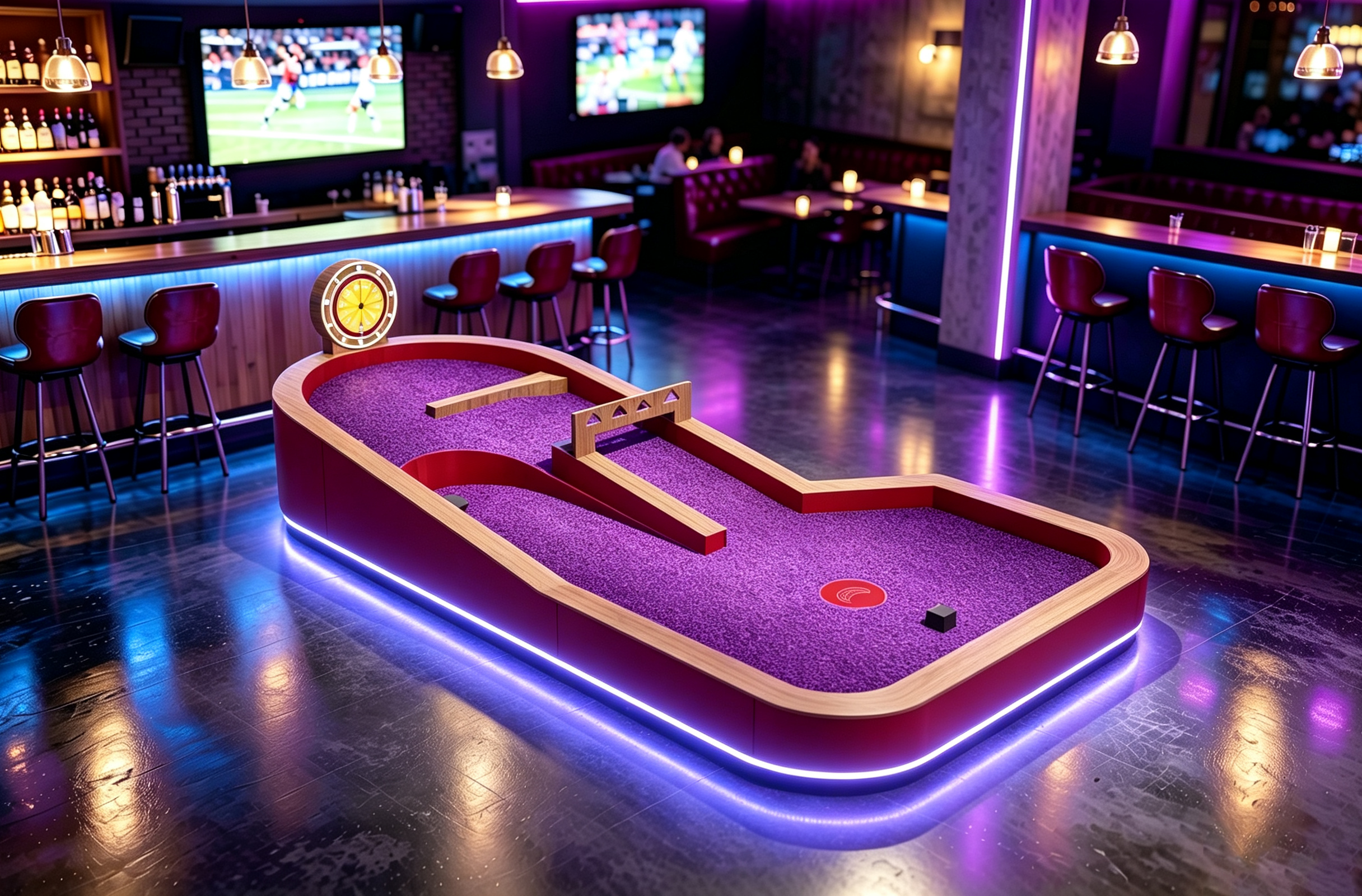
Bar, lounge or social club with 4 m of clear height and an adult evening trade
Bay, or two
You are selling scarce instrument time at an hourly rate to the customer who already has the skill, and the evening demand curve matches the published utilization peak
Family venue, mall anchor or hotel with a big irregular floor and daytime footfall
Course
The route can be threaded around columns and levels, the ticket is per head, and the group occasion is the product. The opposite reading is on our hotels and resorts revenue guide, which runs the bay case in a hospitality setting and headlines a per bay annual revenue figure this page refuses to carry
100 square meter or smaller floor, or a leftover corner
Neither, in general
A single bay eats the room at 84 square meters on our own sheet, and a course in that footprint is a corridor, so read the compact formats page and the arcade cabinet class before buying either
You already have one and the landlord wants the other half of the floor
The gap filler
A bay next to a course is a cross sell, not a competition, and the two sessions cover different dayparts of the same week
The third row deserves its one paragraph, because it is the row where operators get sold something that does not fit. Our simulator sheet is 84 square meters and cannot be shrunk without a custom enclosure conversation. A course squeezed below its own per hole band becomes a queue with a putting surface attached, and no technology layer fixes a route where two groups cannot pass. On a genuinely small floor the honest candidates are a single compact module, a cabinet class attraction, or a wall of darts, and our compact formats for bars and machine footprint pages carry that arithmetic.
One thing a versus page ought to own up to: the party writing it sells both products, so here is what we actually do when a floor like yours comes to us, stated exactly as our own service pages state it. Our free 3D layout design page says most customers receive the custom layout, floor plan and proposal within 48 hours of sending their venue details, and names four deliverables: a custom 3D venue layout, equipment planning, space optimization and business solution suggestions. That page also carries four self reported counters, 2,000+ venues delivered, 100+ countries served, 10+ years in the category and a CE certification line, and three named project cards, each with its own case study link: a 1,200 square meter family entertainment center in India scoped as zoning, equipment, installation and operations training, a 2,100 square meter regional trend park in Romania on 35 plus equipment lines, and an 800 square meter mall trend park in Australia on 20 lines. The India card is the one to read against this article, because it is a floor large enough to hold both products rather than a floor forced to choose. Our mini golf course solution page asks operators to send a venue size or a floor plan for a tailored layout. Those are vendor claims printed by the vendor, not audited outcomes, and neither page carries a price. What they do establish is the delivery shape of the decision this article is about: on a floor that can hold both, the layout question comes before the product question, and the honest deliverable is a drawing of your own room rather than a brochure of ours.
Buy the one whose session your floor is already failing to serve. If your evenings are full of adults who spend and linger, a bay converts them better. If your daytime is full of groups who wander, a course converts them better. Very few venues should be arguing about this, because most of them need both at different hours.
10. What This Comparison Cannot Tell You
The deliberate omissions, so nothing here is mistaken for a business case. No course cost, capacity per hour, revenue per square meter or payback figure from our own models appears in this article. Those numbers live on the pages that own them, linked above, each with its assumptions printed, and importing them into a versus page is how you get a comparison where the denominators quietly disagree. The only money figures printed here belong to third parties, and each is named where it is used: one booking platform that monetises bookings, three named venues that publish their own rate cards plus a fourth that publishes its metering rule and no rate, one trade site that sells listings to venues and names the recurring simulator costs without pricing them, and one equipment maker, Foresight Sports, whose install guide prices an enclosure and a software licence as purchases. The one line on this page built from those figures rather than printed by them is ours and is labelled as such where it appears: a four hour bay at that platform median comes to something like 220 dollars, which is a third party hourly rate multiplied by a booking length, not a revenue claim. None of the parties named above is us: NextPlay sells one of the two products and prints no money figure of its own on this page.
No simulator revenue figure in this article is our revenue figure. The bay rates and utilization percentages come from one booking platform reporting its own installed base, with the published pages of four named venues laid over it, and that platform prints two different medians for two different populations: about 55 dollars an hour across the venues running its system, and 40 dollars across the 794 venues whose published pricing it counted. Where our own sheet publishes nothing, this page says our sheet publishes nothing rather than filling the gap: no price, no power draw, no throughput and no session length appear on it, and the same is true of almost every hole page in our mini golf range.
Two areas sit outside this site entirely. What your insurer will actually charge for a swing bay in your jurisdiction is a quote, not an article, and the same goes for any permit path on occupancy and electrical work. And what the visit feels like from the guest side, which hole to design for which age and why a round reads as a good evening, is the consumer facing material on what indoor mini golf actually is. Take this page as the classification step, then let the owner pages do the arithmetic.
11. Golf Simulator vs Mini Golf FAQ
The questions that decide the purchase, answered with our own published sheets where we hold a number and named third parties where we do not.
What is the difference between a golf simulator and mini golf?
A simulator bay is one instrument that replays a real full swing against a measured ball flight into a screen, sold by the hour to a group of up to six on our own published sheet. Mini golf is a route of putting holes sold per person per round, where the swing is a putt and the walk between holes is part of the product. The bay is scarce, priced like a room, and supervised like a machine. The course is a flow, priced like a ticket, and supervised like a crowd.
How much floor does a golf simulator bay need?
On our published full set sheet, an area size of 7 by 12 by 4 meters, which is 84 square meters with four meters of height. Other pages on this site model smaller bays and a four bay formula, and the sheet itself says the enclosure is customizable, so treat the number as our specification rather than a category minimum. A mini golf hole in our published planning band carries a factory footprint of 12 to 48 square meters, and the walking route is counted on top of that at about 1.5 to 2 times the footprint. So the same 84 square meters holds somewhere between one flagship hole and three or four compact holes once people can actually walk between them, or up to seven on footprint alone if they cannot. Our page on how much space a golf simulator needs carries the room minimums, and the space a course really needs page carries the venue bands for the route.
Which earns more, a simulator bay or a mini golf course?
Neither can be answered honestly with a single number, because they are metered in different units, a bay by the hour and a course by the head, and the best published bay figures come from parties that sell or book bays. A booking platform with data across more than 200 venues reports a US median around 55 dollars per bay hour, and named venues publish 40 to 95 dollars an hour across four rate tiers at an Ontario venue, 60 per sim at an Illinois day part and 27 pounds an hour in Darlington, north east England. This page carries those hourly rates and not the annual revenue per bay claims that platforms and manufacturers publish, because the parties printing them do not define whether the figure is bay-time revenue or whole-store revenue divided by the bay count. Our own arithmetic sits on the pages that own it rather than in this comparison, on purpose: how to maximize revenue per square meter, what an indoor mini golf course costs, how to calculate your investment return and when a 300 square meter course pays back.
Does a golf simulator get used less in summer?
The platform data published by Tabski says yes, and this is the most useful single fact in the article. Blended annual utilization of about 36 percent, with the median venue booked about 41 percent of the time inside the November to April peak season, that season averaging about 50 percent across venues, and roughly 23 percent from May to October, with January at about 54 percent and September at about 21 percent, against a break even the same published source draws for a staffed four bay venue, a floor near 25 percent annual utilization that climbs with your cost structure. An indoor room does not cause this; the golfer causes it. We found no comparable published utilization dataset for mini golf in any source opened for this article, which reads as a gap in the category published record rather than a gap in this research.
Can a venue have both?
Yes, and it is the answer on most floors that reach the 300 to 500 square meter band our cost, space and profit tiers opens the small venue tier with, even though our course space page will take a compact nine hole course down to 150, because the two products peak at different hours and answer different customers. Below that band you are choosing between one bay and a corridor, not running both. The real conflict is ceiling height and enclosure space on one side against route continuity on the other, and the layout order matters: place the rigid object first, since a bay cannot be subdivided, and let the route thread around it.
Is mini golf only for families and a simulator only for golfers?
That is close enough to the truth to be the planning assumption, with one correction. The simulator trade is not a niche: the National Golf Foundation counts at least 1,500 US simulator businesses as of November 2025 and says that total nearly tripled since 2022, with more than three quarters of those venues selling memberships. The mini golf adult case is a scoring and programming case rather than a swing case, which is why leagues, tournament nights, corporate buyouts and the technology layer over the holes are the adult side of a course.
What maintenance am I agreeing to own?
A bay is one object with expensive components, and this is the line the published record leaves thinnest: the Screengolfers buildout list names impact screens as an upfront investment and simulator software updates and subscriptions as a recurring cost without printing an interval or a subscription price for either, and the only figures we could find in writing are the Foresight Sports install guide purchase bands, a premium enclosure with impact screen at 3,000 to 10,000 dollars and software at 1,000 to 3,500 dollars, neither of which is a replacement cycle or a subscription cost. That publisher sells the equipment it prices. A course is many small objects, where a single hole out of play removes a slice of capacity instead of darkening the whole attraction. Our own weekly hole checklist is published separately; our simulator sheet publishes no maintenance schedule at all, and that omission is stated rather than papered over.
12. Featured NextPlay Active Gaming Equipment
The rigid object: one bay, 84 square meters, six players, real swing data
Indoor AR Golf Simulator Full Set, Commercial Use
The sheet this comparison quotes: an area size of 7 by 12 by 4 meters, six players, a 7 by 4 meter screen, a Panasonic projector, a four lens high speed camera detector, sensor spotlight, control box, action playback system, computer server, metal cabinet, eighty balls and a club set, with the enclosure listed as customizable to your room. It is the honest version of the bay argument, and the honest limit of it: the page prints no price, no power draw, no session length and no throughput, so the bay count in your plan comes from your shell and your quote, not from a brochure.
View Details ›
The flexible object, specced: 4.0 x 1.6 m of floor, 100 W, one to three players
Cyclone Spin Hole, 360 Degree Loop Ramp Mini Golf
One of the only two holes in our commercial range that publishes a technical specification, and the numbers are the point: 4.0 by 1.6 by 1.8 meters, 280 kilograms net, 100 W at 220 V 50 Hz, one to three people, twenty balls and a putter, with the play described as a ball placement area, a 360 degree loop track and a central target zone. Set beside a simulator bay it shows what the flexible object actually is, a piece of equipment you can place, and one whose electrical line is printed rather than assumed.
View Details ›
The route object: a 4.5 meter fairway that fits where a bay cannot
Gate Challenge Golf Hole, Indoor Mini Golf Hole
The second hole in the range with a published spec sheet, at 2.4 by 4.5 by 1.0 meters, 260 kilograms net, 100 W, one to three people and a 4.5 meter fairway, shipped with twenty balls and a putter. Its value in this comparison is geometric rather than thematic, because a 2.4 meter wide object threads a corridor, turns a corner and sits beside a seating bank in a way that an 84 square meter bay with a four meter ceiling requirement never will. Note that the module prints a one to three player count, so the capacity arithmetic belongs on our course capacity page rather than in a product claim.