MINI GOLF DATE NIGHTS - THE WEEKDAY EVENING PLAYBOOK
How Do You Sell Mini Golf Date Nights? The Weekday Evening Playbook for Venues
Couples are the weekday-evening filler segment: the published rate card prices the evening tier at USD 8.00 for date-night demand, the bar analysis times a six-hole loop at 25 minutes with an 18 percent drink attach, and the alternating-shot pairs format turns one shared scorecard into the product.
Evening tier Pairs format Package design F&B attach Leaderboard keepsake Evening theming
USD 8.00
Published Evening Tier per Round
USD 45/hr
Compact Lane Rate
~25 min
Six-Hole Loop Time
1. How Do You Sell Mini Golf Date Nights? The Weekday Evening Playbook for Venues
Every venue has a weekday evening problem: the after-work crowd thins out by 8 PM, the weekend peak is three days away, and the floor earns a fraction of what it earns on Friday. The couples segment is the filler that slot has been waiting for - two players, low staffing, drinks across the session, and a booking habit that repeats weekly. The published weekday rate card (the time-tier rate card) already prices for it: the evening tier at USD 8.00 exists specifically because after-work and date-night demand shows up at 5 PM and closes the day at the standard full rate. This playbook turns that demand into a product: the two-person format that fits a lane, the package that sells the night as one decision, and the F&B attach that carries the margin.
The date-night pitch in one line: two players, one shared scorecard, 45 to 60 minutes on a compact lane, and a drink tier that turns the round into an evening - priced at the published USD 8.00 evening tier as one bundle decision.
2. The Two-Person Format That Fits the Evening Tier
The published bar-lane formats analysis (mini golf for bars, compact lane formats) already mapped the group formats to the crowd: the best-ball foursome runs the corporate night, the alternating-shot pairs run the date night, and the individual stroke play runs the after-work drop-in. Alternating shot is the couples format because it solves the two problems that kill two-player rounds - waiting and imbalance. One ball, alternate strokes, and both players touch every hole; a beginner and a regular stay equally engaged because the shared scorecard belongs to both of them.
| Format |
Crowd |
Why it fits |
Published anchor |
| Alternating-shot pairs |
Couples, date night |
No waiting, both engaged on every hole |
Published bar-lane format assignment |
| Individual stroke play |
After-work drop-in |
Fast solo rounds at the full evening rate |
Published evening tier USD 8.00 |
| Best-ball foursome |
Corporate night |
Team format for group bookings |
Published buyout economics, about 4x walk-up |
The compact lane is the right hardware for the segment. The published bar analysis prices a 6-to-9-hole lane at a 45-dollar per-hour rate with an 18 percent drink attach rate, and times a six-hole loop at about 25 minutes. Two date-night loops with a drink break between them - the loop-card structure the bar analysis describes - fill a 45-to-60-minute evening slot without pulling the couple off the floor for a full 18-hole hour.
3. The Package: Sell One Decision, Not Three
The packaging logic is the one the published analyses repeat across segments: sell the night as one decision. The corporate-night analysis sells slot, course rotation and food as one buyout; the LED-party analysis (packaging an LED dance floor for birthdays) shows a party bundle roughly doubling a weekend against the base revenue of the attraction. The date-night version is smaller and identical in structure: two rounds, one shared scorecard, and a drink or dessert tier, priced as one bundle at the evening tier instead of as separate rounds, drinks and dessert decisions.
Weekday Evening Rate Card (published tiers, per round)
Evening tier (date nights)
USD 8.00
Weekend peak (not the date-night product)
USD 9.00
Source: published weekday time-tier rate card. All three bars share one USD-per-round unit and are indexed to the USD 9.00 weekend peak, shown for contrast only - the date-night product owns the USD 8.00 evening tier and never touches the peak calendar.
The separation matters as much as the price: the weekend peak at USD 9.00 stays the premium calendar, and the date-night product owns Tuesday-to-Thursday evenings at the standard full rate. That separation is what keeps the rate card honest - the couples package fills the weekdays and never undercuts the peak nights.
The F&B attach is the margin engine. The published bar analysis measures an 18 percent drink attach rate on lane play; the loop card - the ninth drink free after six stamped holes - is the mechanic it publishes for stretching one couple across more orders. A date-night package that bundles the drink tier collects that margin inside one price, instead of hoping the couple orders separately.
4. Scoring and Theming: The Evening Atmosphere Layer
Couples experience the course differently from families or leagues, and two published levers tune the atmosphere. Scoring: the published comparison (manual scorecards vs sensor leaderboards) shows sensor leaderboards run about 18 rounds per hour versus about 12 on manual cards - and for a two-player round that speed means no staff interaction at all, with the leaderboard photo doubling as the shareable keepsake that markets the next date night. Theming: the evening starts after dark, so the venue owns every lumen; the published light-scheme rotation guide (LED hole themes) shows a themed rotation keeps the course fresh, and a warmer, dimmer evening scheme is the cheapest transformation the course can wear.
The hardware picks are the stations that photograph well and play fast. The Labyrinth Challenge gives the couple a cooperative puzzle - one shared ball through an interactive course, which is the alternating-shot spirit taken to its conclusion. The Beer Pong Challenge is the station that sells the drink tier by existing: the challenge and the beverage are the same moment. The Rainbow Golf Challenge auto-scores the round, so the evening runs itself at sensor speed with no marshal on the floor.
5. The Group Math: What One Lane Earns on a Weekday Evening
The published numbers close the case. A compact lane priced at the published 45-dollar per-hour rate serves alternating-shot pairs in continuous cycles; the 25-minute six-hole loop from the bar analysis means two to three couple-sessions per lane on an evening; and the 18 percent drink attach plus the loop-card mechanic stacks F&B on top. Against the published evening tier of USD 8.00 per round, a lane running three couples per evening earns more than the same lane earns in walk-up rounds - and the couples are the segment that books again, because the format repeats weekly by design.
| Planning line |
Value (published basis) |
Where it comes from |
| Evening tier price |
USD 8.00 per round |
Published weekday rate card |
| Compact lane rate |
USD 45 per hour |
Published bar-lane formats analysis |
| Six-hole loop time |
About 25 minutes |
Published bar-lane formats analysis |
| Drink attach rate |
18 percent |
Published bar-lane formats analysis |
| Sensor throughput |
About 18 rounds per hour |
Published scoring comparison |
If the floor plan is still open, the free layout service at free 3D layout design maps the evening product - lane placement, bar sightlines, the photo station - onto your actual square meters before a single hole is ordered. The couples segment is a scheduling layer on a course the venue already has; the layout decides whether the evening layer earns.
All figures trace to published cluster articles and first-party product pages, verified live 2026-09-22. Planning figures are published references, not guarantees of results.
6. Mini Golf Date Night FAQ
The questions venue owners ask about the couples segment, answered with the published references.
Why are couples a good weekday-evening segment?
The published weekday rate card names after-work and date-night demand as the customers the USD 8.00 evening tier is priced for. Two players fill a lane with minimal staffing, buy drinks across the session, and book on weekday evenings when bigger group segments have already gone home - exactly the capacity the venue needs to fill.
What format works best for two players?
Alternating-shot pairs. The published bar-lane formats analysis assigns the alternating-shot pairs format to the date night - it halves the waiting, keeps both players engaged on every hole, and turns one shared scorecard into the conversation piece of the evening.
How long should a date-night round run?
About 45 to 60 minutes on a 6-to-9-hole compact lane. The published bar analysis times a 25-minute round on a six-hole loop, so two loops with a drink break between them fills an evening slot without losing the table time that sells the drinks.
What does a date-night package include?
Two rounds, one shared scorecard, and a drink or dessert tier. The published packaging logic is to sell one decision instead of several: the couple books the night as a bundle, and the bundle is priced so the venue collects the food-and-beverage margin the ticket alone never carries.
Do couples respond to leaderboards?
Yes, as a shared keepsake rather than a competition. The published scoring comparison shows sensor leaderboards run about 18 rounds per hour versus about 12 on manual cards; for couples the leaderboard photo becomes the shareable moment that markets the next date night for free.
Does theming matter for an evening audience?
It matters more than for families. The evening starts after dark and the venue owns the lighting completely; the published light-scheme rotation guide shows a themed rotation keeps the course fresh, and a dimmer, warmer evening scheme is the cheapest transformation a course can wear.
7. Featured NextPlay Active Gaming Equipment
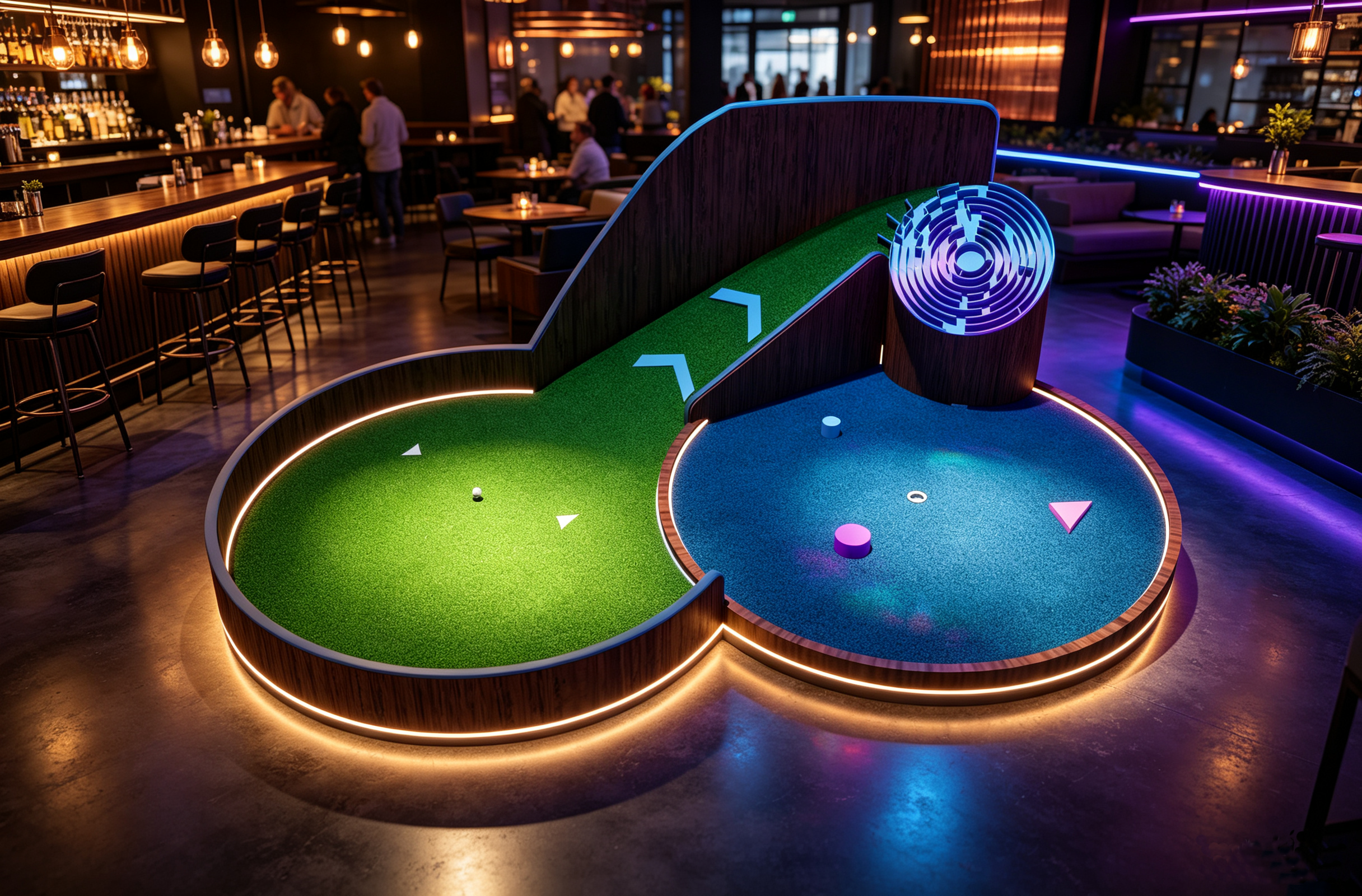
The cooperative anchor
Labyrinth Challenge - Interactive Putting Attraction
One shared ball through an interactive puzzle - the two-player format taken to its conclusion, and the station couples photograph most.
View Details ›
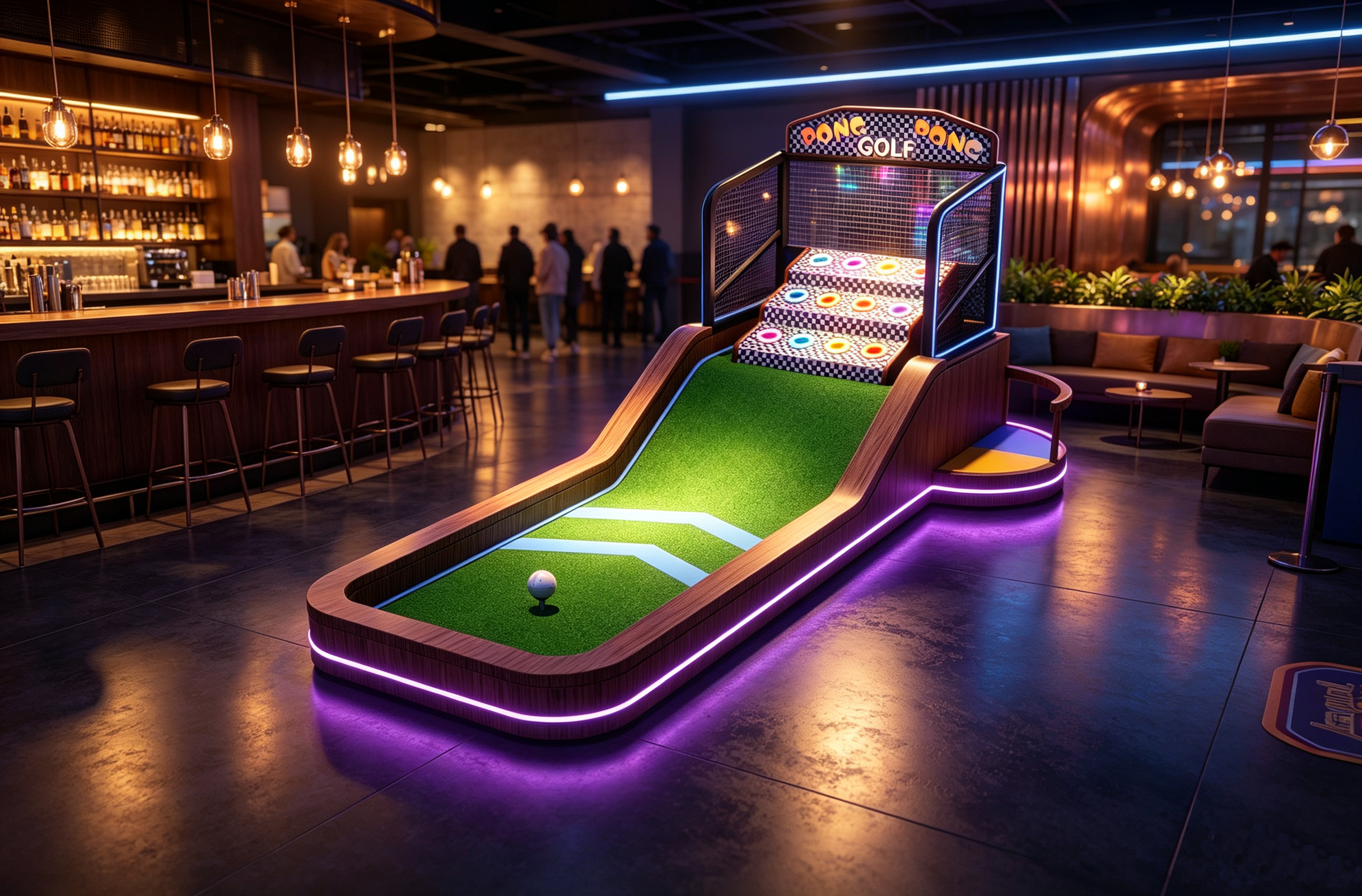
The drink-tier seller
Beer Pong Challenge - Social Mini Golf Station
The challenge and the beverage are the same moment - the station that makes the 18 percent drink attach happen by design.
View Details ›
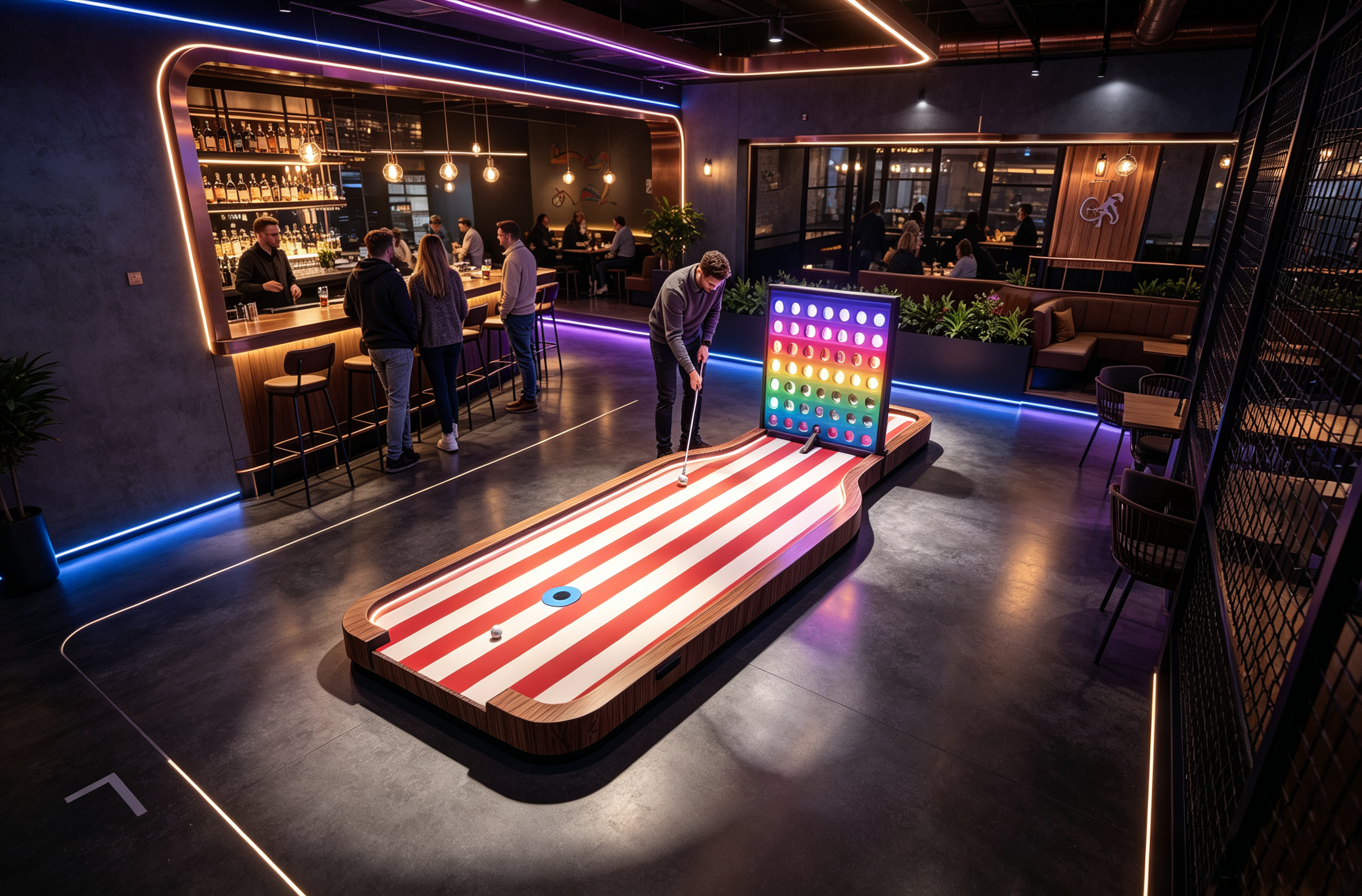
The self-running round
Rainbow Golf Challenge - Auto-Scored Interactive Mini Golf
Automatic smart-cup scoring keeps the two-player round at sensor speed with zero staff interaction - and the leaderboard photo is the keepsake.
View Details ›

