MINI GOLF FOR HOTELS AND RESORTS - THE GUEST-FLOW PLAYBOOK
Top 10 Indoor Mini Golf Plays for Hotels and Resorts? The Guest-Flow Playbook From Lobby to Spa
Ten plays ordered along the hotel guest flow - check-in decompression, kids hour, rain-day insurance, spa pairing, bar feeder, wedding block, spouse program, leaderboard wall, seasonal re-skin, locals membership - each anchored to a published cluster figure, closing on the three-wallet amenity math.
Guest flow Three wallets Event slots Capacity math Seasonal re-skin Locals pass
USD 22-25K/mo
Published Hotel Floor Cases
20-30 min
9-Hole Guest Loop
16-24/hr
Players per Course-Hour
1. Top 10 Indoor Mini Golf Plays for Hotels and Resorts? The Guest-Flow Playbook From Lobby to Spa
Hotel entertainment floors earn from three wallets - guests, locals and events - and the published hotel cases put playable-floor combinations between USD 22,000 and USD 25,000 a month (the hotel and resort golf revenue guide). Mini golf is the lowest-cost way into that model: no coach, no marshal at sensor speed, and a six-to-nine-hole footprint that starts where a gym expansion would end. The published hole-count analysis times 9 holes at 20 to 30 minutes for a small group (how many mini golf holes you need) - a slot that fits twice into a guest day. What follows are the ten plays, ordered along the guest flow, each anchored to a published figure.
The guest-flow rule: every play earns where the guests already walk - lobby-adjacent before back corners, sightlines before square meters, and a 20-to-30-minute loop that fits between check-in, dinner and the bar.
2. Plays 1-4: The Arrival and Downtime Slots
Play 1 - The check-in decompression loop. A 6-to-9-hole course placed lobby-adjacent catches the guest who has checked in but not yet unpacked an agenda. The 20-to-30-minute loop is exactly the gap between arrival and the first dinner reservation, and the front desk sells it with one sentence.
Play 2 - The kids-hour release valve. Between 5 and 7 PM the parents want the bar and the children want everything else; the published capacity analysis (mini golf course capacity) puts a compact course at 16 to 24 players per course-hour, so one marshal absorbs the entire kids wave while the bar collects the parents.
Play 3 - The rain-day insurance. Resort calendars live on weather; the published winter analysis shows indoor play is the segment with no weather risk at all. A covered or indoor course converts the rained-out excursions day into a playable floor instead of a refund queue.
Play 4 - The spa-pairing slot. The guest waiting for a treatment slot is a captive 20 minutes - the exact loop time. Place the course on the spa corridor and the loop becomes the waiting room; the spa desk books it as a paired ticket.
| Play |
Slot in the guest day |
Why it earns |
Published anchor |
| Check-in decompression |
Arrival to first dinner |
One sentence sells a 20-30 min loop |
Published 9-hole loop time, 20-30 min |
| Kids-hour release |
5-7 PM |
One marshal absorbs the kids wave |
Published 16-24 players per course-hour |
| Rain-day insurance |
Weather-cancelled days |
Indoor play has zero weather risk |
Published winter operations analysis |
| Spa-pairing slot |
Pre-treatment wait |
Captive 20 minutes on the corridor |
Published loop time matches spa waits |
3. Plays 5-7: The Evening and Social Slots
Play 5 - The after-dinner bar feeder. The published rate card prices the evening tier at USD 8.00 and names after-work and date-night demand as its customers; at a resort the same tier feeds the bar, because a couple finishing dinner takes the 20-minute loop and then the nightcap. The published bar analysis measures an 18 percent drink attach rate on lane play - the loop is the drink ticket.
Play 6 - The wedding-block activity. A wedding books the course as a group slot: the published team-building analysis shows a station carousel running 40 to 100 players without a course bottleneck, and a buyout earns roughly four times a walk-up evening (about USD 4,500 for three hours versus about USD 1,040 walk-up). The wedding block is that same buyout with a photographer.
Play 7 - The conference spouse program. Conferences sell the accompanying-person problem to the venue that solves it. A morning loop with coffee is the program: the published capacity math turns 16 to 24 players per course-hour into a 60-person morning on one course, priced per head as the corporate-night analysis prices its packages (about USD 26 to 36 per guest).
Evening and Event Economics (published anchors, indexed to the buyout)
Walk-up evening revenue
USD 1,040
Three-hour buyout
USD 4,500
Per-guest package band, low
USD 26
Per-guest package band, high
USD 36
Source: published corporate-night buyout analysis. Bars share one USD unit and are indexed to the USD 4,500 buyout; the per-guest package band is shown at minimum width because it is a per-head price, not a session total - read it as the rate the buyout is built from.
4. Plays 8-10: The Memory and Return Slots
Play 8 - The leaderboard photo wall. The published scoring comparison (manual scorecards vs sensor leaderboards) shows sensor leaderboards run about 18 rounds per hour versus about 12 on manual cards - and the leaderboard photo is the shareable keepsake. A print wall by the exit turns every round into a marketing asset the guest posts for free.
Play 9 - The seasonal re-skin. The published light-scheme rotation guide (LED hole themes) shows a themed rotation keeps the course fresh; at a resort the rotation follows the property calendar - holiday scheme, summer scheme, festival scheme - so returning guests meet a new course each stay. The Cyclone Spin Hole is the 360-degree loop ramp that takes LED theme rotations beautifully.
Play 10 - The locals membership. The three-wallet model needs the local wallet: the published simulator-market analysis reports more than three quarters of simulator venues selling memberships, and the same ladder applies to a resort course - a locals pass sold off-season, on weekday afternoons, at the published USD 5.00 afternoon tier, fills the floor the guests have left. Ten plays, one course, three wallets.
The hardware that serves all ten: the Labyrinth Challenge is the cooperative anchor that photographs well in the lobby slot; the Customized Obstacle Challenge is the resort-brandable course - the obstacle set takes the property theme, which is what plays 8 and 9 are built on.
5. The Amenity Math: What One Course Earns Per Room-Night
Close with the numbers a GM can run against the room forecast. The published capacity analysis puts a compact course at 16 to 24 players per course-hour; the published rate card prices the day at USD 5.00 afternoon and USD 8.00 evening; the published cases put hotel playable floors at USD 22,000 to USD 25,000 a month. A 100-room resort capturing even the kids-hour and the after-dinner slot on a six-to-nine-hole course is running the published three-wallet model at mini-golf staffing costs - no coach, no marshal at sensor speed, one attendant across the day.
| Planning line |
Value (published basis) |
Where it comes from |
| Loop time, 9 holes |
20 to 30 minutes |
Published hole-count analysis |
| Course capacity |
16-24 players per course-hour |
Published capacity analysis |
| Afternoon tier |
USD 5.00 per round |
Published weekday rate card |
| Evening tier |
USD 8.00 per round |
Published weekday rate card |
| Hotel playable-floor cases |
USD 22,000-25,000 per month |
Published hotel revenue guide |
| Buyout vs walk-up |
About 4x (USD 4,500 vs USD 1,040) |
Published corporate-night analysis |
If the property floor plan is still open, the free layout service at free 3D layout design maps the guest flow - lobby sightline, spa corridor, bar feeder - onto your actual square meters before a single hole is ordered. The plays above are placements, and placements are decided by the floor plan.
All figures trace to published cluster articles and first-party product pages, verified live 2026-09-23. Planning figures are published references, not guarantees of results.
6. Hotel Mini Golf FAQ
The questions hotel and resort GMs ask, answered with the published references.
Why does mini golf fit a hotel better than a second gym or a spa expansion?
The published hotel-and-resort golf analysis frames the case: a playable attraction behaves like a revenue line, not a cost center - it earns from guests, locals and events at once. Mini golf is the lowest-staffing version of that logic: no coach, no marshal at sensor speed, and a footprint that starts where a gym expansion would end.
How many holes should a hotel course run?
Six to nine for the guest loop. The published hole-count analysis times 9 holes at 20 to 30 minutes for a small group - a slot that fits between check-in and dinner, and again between dinner and the bar. Eighteen lanes is the tournament standard, which hotels almost never need.
Where should the course sit in the building?
Where the guests already walk. The plays in this guide order the placements by guest flow: lobby-adjacent first, because the published placement logic puts attractions on sightlines, not in back corners a guest never passes.
What revenue does a hotel entertainment floor earn?
The published hotel cases land between USD 22,000 and USD 25,000 a month for playable-floor combinations - bowling paired with shooting or VR. Mini golf is the low-cost entrant into that same three-wallet model: guests, locals and events.
Do resort courses need theming?
Theming is what makes guests photograph the course, and photos are the marketing. The published light-scheme rotation guide shows an LED theme rotation keeps a course fresh; at a resort the rotation can follow the season calendar the property already runs.
Can the course serve events as well as guests?
Yes, and events are the third wallet. The published capacity analysis puts a compact course at 16 to 24 players per course-hour, which is enough throughput for a resort buyout, a wedding-block activity or a conference spouse program without closing the guest loop.
7. Featured NextPlay Active Gaming Equipment
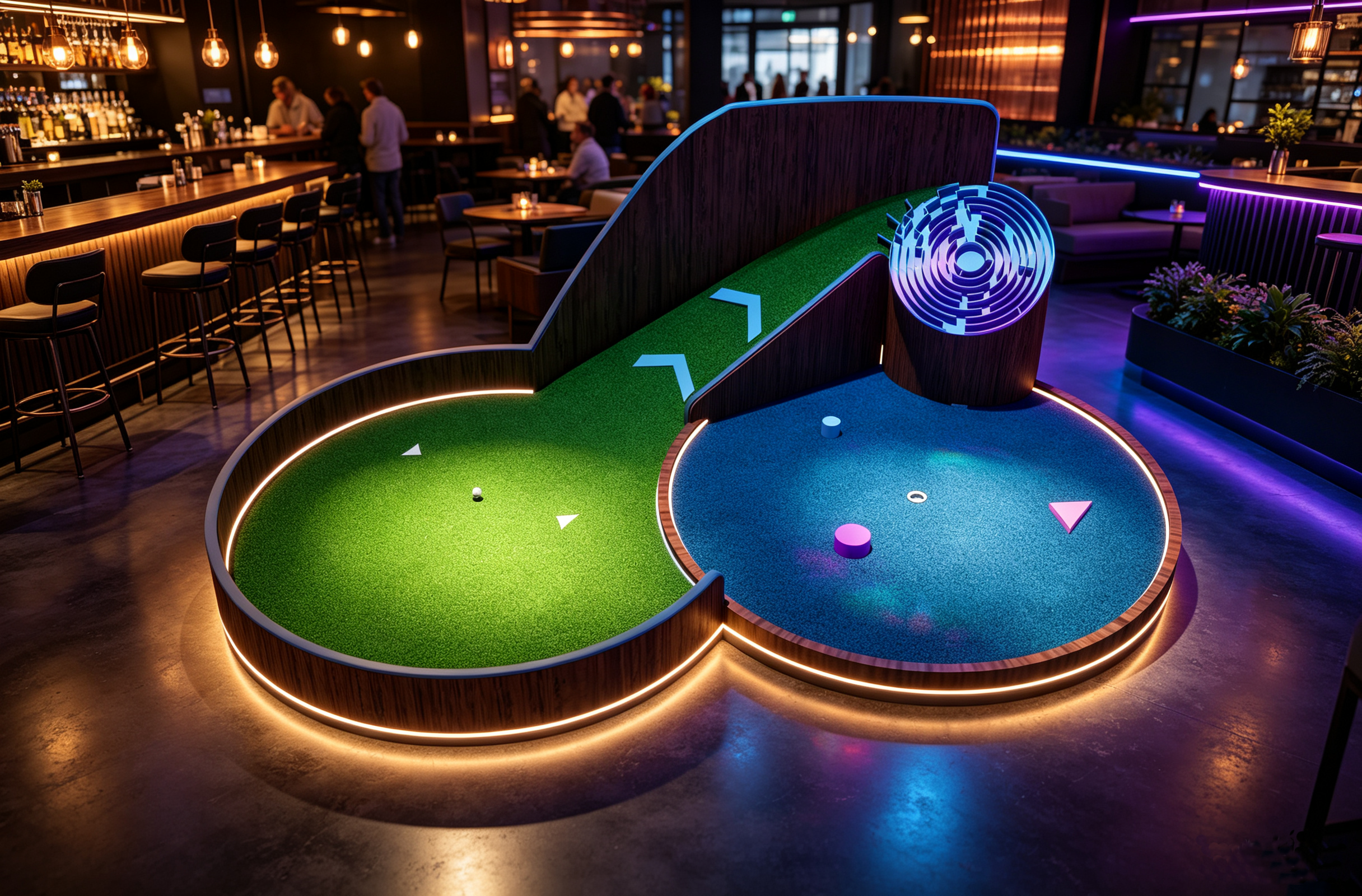
The lobby anchor
Labyrinth Challenge - Interactive Putting Attraction
The cooperative puzzle course that photographs well at check-in - the station the guest-flow slots are built around.
View Details ›
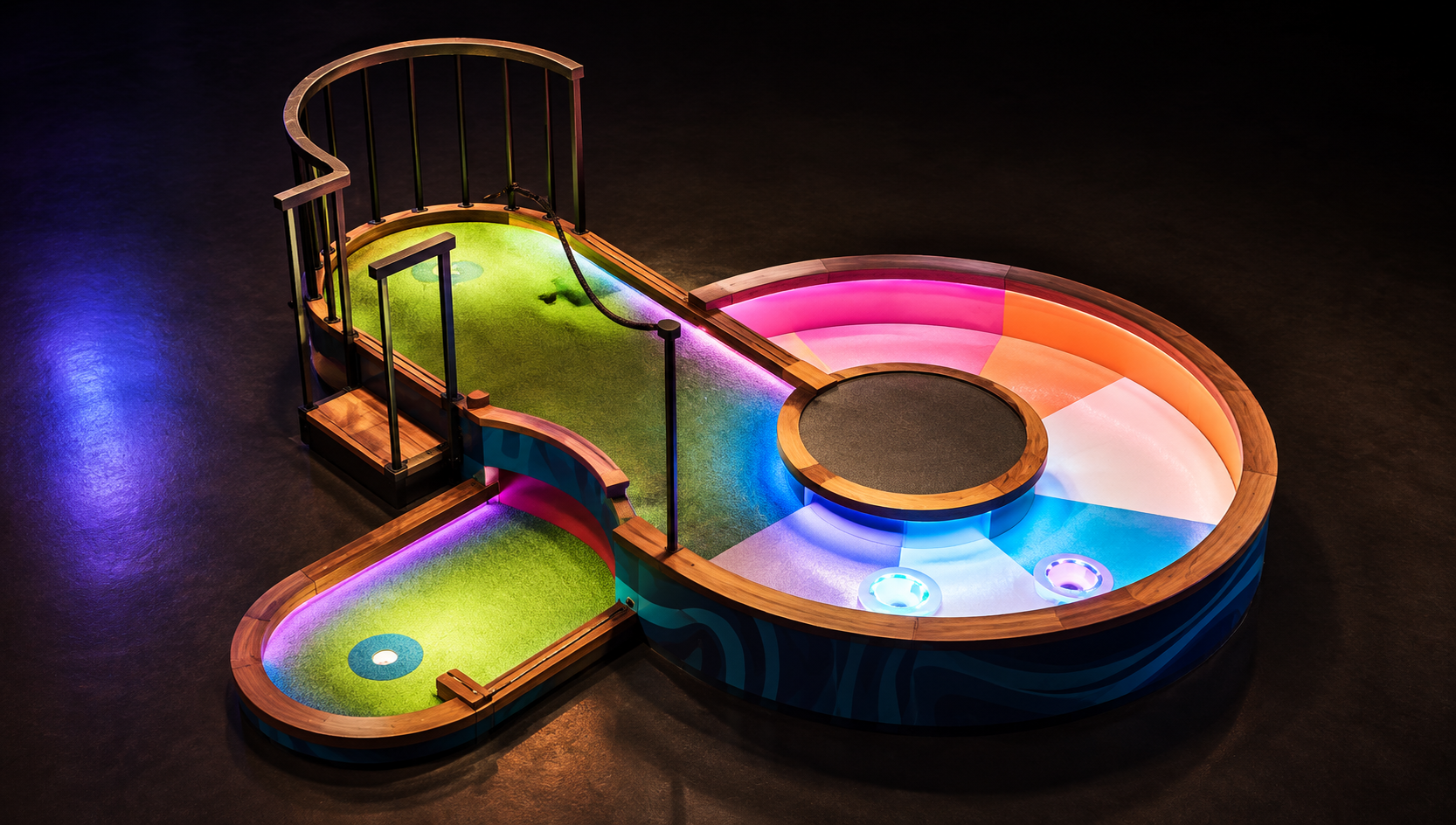
The re-skin centerpiece
Cyclone Spin Hole - 360 Loop Ramp Mini Golf
A 360-degree loop ramp that takes LED theme rotations beautifully - the spectacle hole behind the seasonal re-skin play.
View Details ›
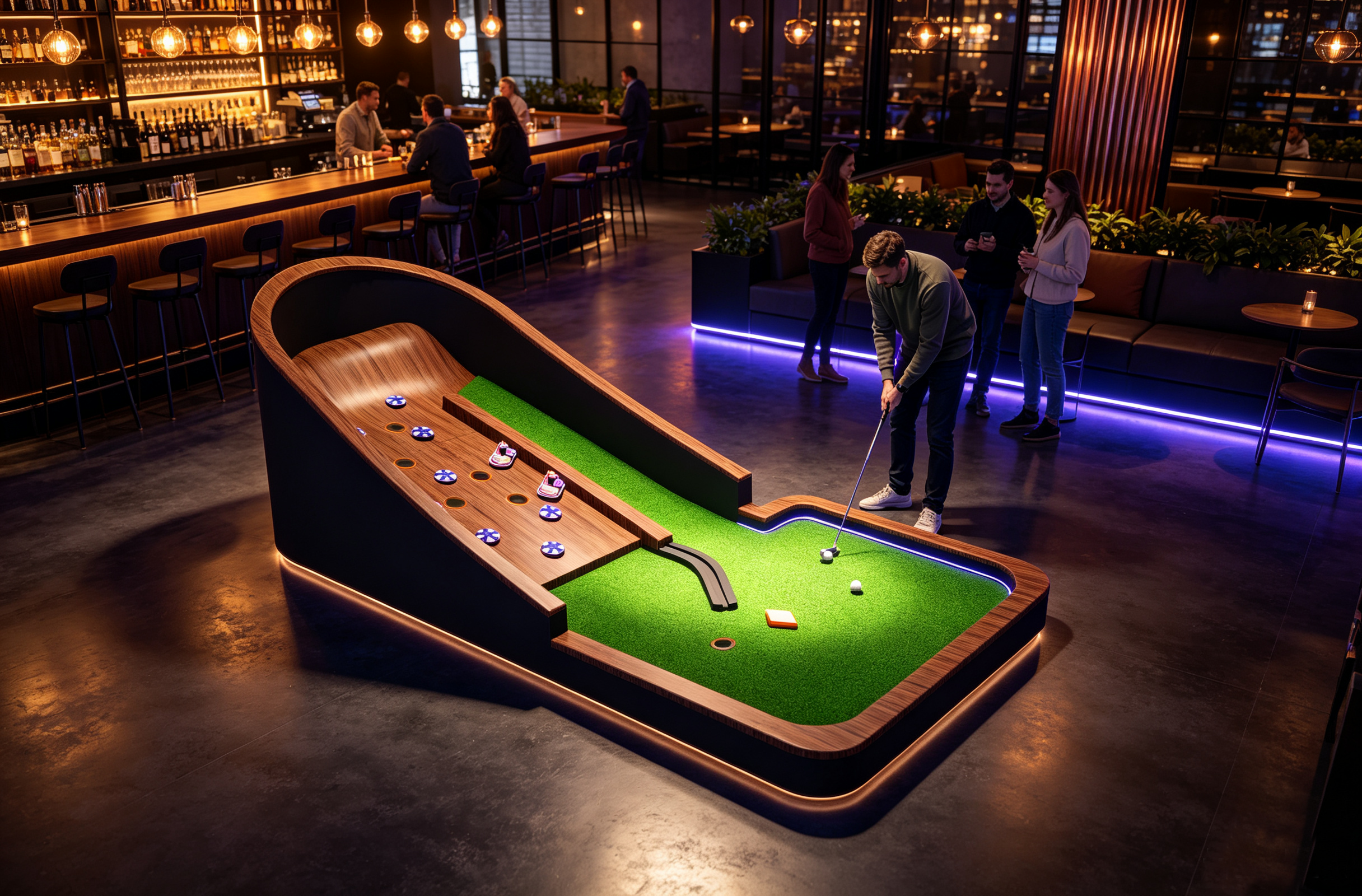
The property-brand play
Customized Obstacle Challenge - Resort-Branded Course
The obstacle set takes the property theme and footprint - the course the leaderboard wall and seasonal calendar are built on.
View Details ›

