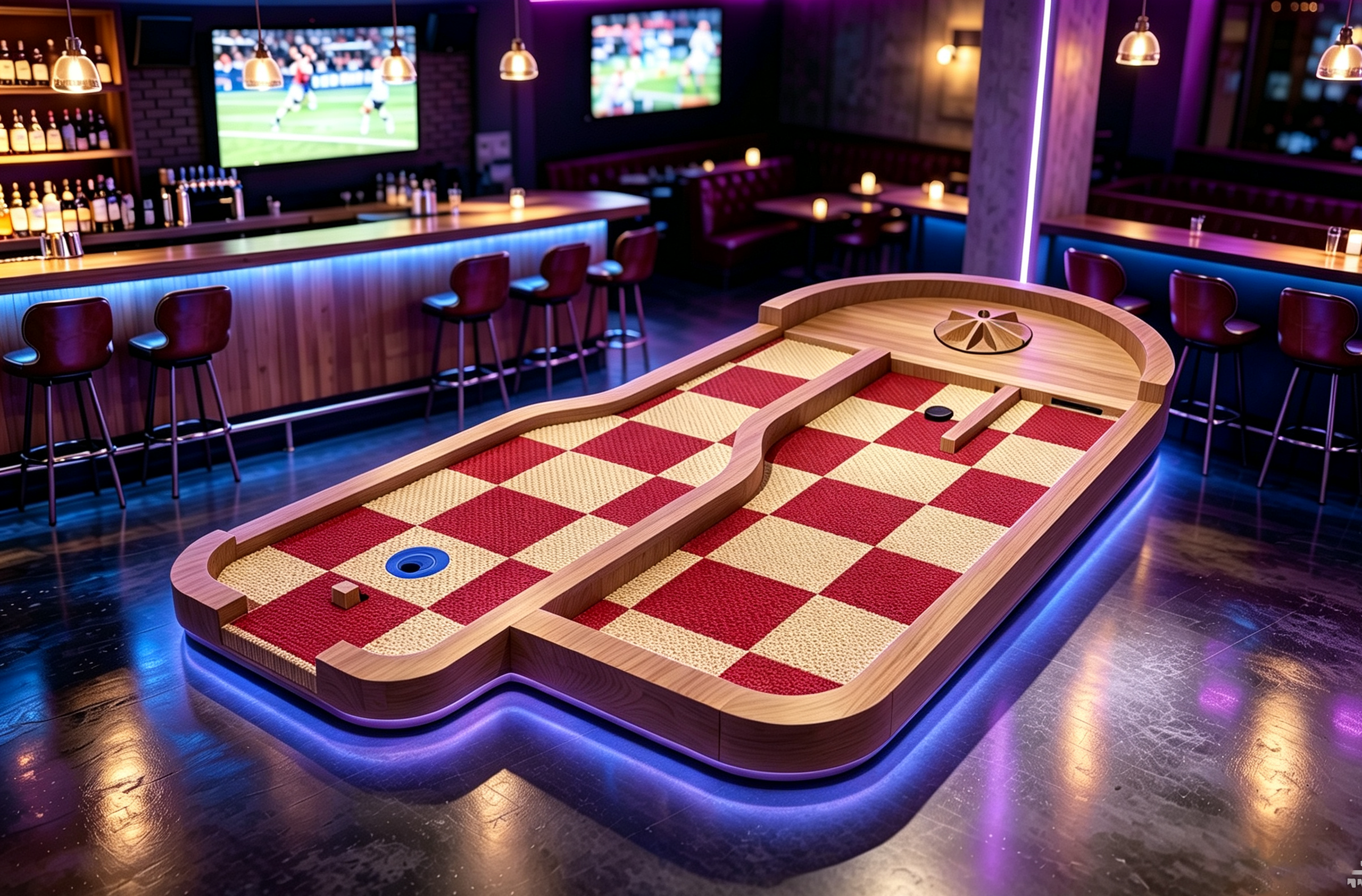
Why Operators Recommend Indoor Mini Golf for Your Venue
Operators recommend indoor mini golf because the demand is already there, the floor you have can usually hold it, and the revenue does not rest on one ticket. This page lays out the evidence chain peer venues use when they add it, with sources named and limits stated.
Oct 9th,20263 Puntos de vista
NEXTPLAY ENTRETENIMIENTO ACTIVO
Why Operators Recommend Indoor Mini Golf for Your Venue
Ask ten operators why they put mini golf on their floor and you will not get ten speeches about fun. You will get three recurring answers: the demand was already there, the room they had could hold it, and the money did not depend on a single ticket. This page is the evidence behind those three answers. It walks through what industry data actually says about demand, how the footprint math works on a real floor, how the revenue stack is layered at venues that publish their numbers, how the format sits next to other attractions instead of fighting them, what peer operators point to when they recommend it, and the checks serious buyers run before they sign. Sources are named, second-hand numbers are marked as "reported by", and where no reliable data exists, this page says so instead of inventing it.
DEMAND IS THEREFLOOR FITMULTI-STREAMPEER PROOFBUYER CHECKLIST
67%
of New U.S. FECs Now Build With Mini Golf On Site (reported by Dataintelo)
40.21%
Skill and Competition Games Share of FEC Revenue (Mordor Intelligence, 2025)
16-24
Players Per Session Hour on One Staffed Course (our capacity guide)
40-60%
Returning Guest Share Across Our Published Venue Models (first-party)
1. The Short Answer: Operators Recommend It Because the Demand Is Already There
The recommendation almost never starts with the course. It starts with the queue. An operator watching families walk past a floor of machines on a Saturday afternoon already knows what a second attraction has to do: pull a different age group, hold people longer than one drink, and not require a staff member per guest. Indoor mini golf keeps showing up in recommendations because it answers all three, and because unlike a new machine, it is a reason to come rather than a thing to do while you are there.
The demand side needs no education. Industry tallies reported by WiFi Talents put the number of Americans who play mini golf in a year above 130 million, with families making up roughly 55 percent of players and players aged 18 to 34 accounting for about 40 percent. Editorially reported guidance from ShunGolf adds the shape of the visit: a round runs 30 to 45 minutes, needs no skill and no equipment, and puts every age group on the same playing field. Those are the three properties an operator is looking for when the brief is something everyone can do together.
What the recommendation rests on
The number
Where it comes from
Grade
Demand already exists
130M+ annual U.S. players; 55% families (reported by WiFi Talents)
Aggregated industry statistics page, 2026
T2, reported by
Category is being adopted
67% of new FECs include mini golf, up from ~48% a decade ago (reported by Dataintelo)
Market research publisher, 2025
T2, reported by
Category position inside the venue economy
Skill and competition games = 40.21% of FEC revenue, 2025
Mordor Intelligence FEC market report
T1 research
Throughput a single course serves
16-24 players per session hour, 3-5 min per hole
Our own capacity guide
First-party
Repeat behaviour worth building on
40-60% returning guests in our published venue models
Our own cluster of published guides
First-party
One number in that table deserves a label rather than a headline. The 67 percent figure is reported by a market research publisher citing an industry association; the original association source is not public. Treat it the way you would treat any second-hand adoption stat: it points in a direction, it does not measure your city. The same discipline applies to the 20 percent repeat-visit lift floating around aggregated industry pages - there is no published methodology behind it, so this page does not use it as a promise.
Assumption. You operate an indoor venue with floor space you can allocate, and you are comparing mini golf against other candidate attractions on evidence rather than on a showroom demonstration. Formula. The recommendation test has three inputs: a demand that already turns up without your marketing, a footprint that fits the room, and a revenue stack with more than one layer. Result. Venues that publish their models tick all three, which is why the recommendation repeats across bars, community centres, hotels and full-size entertainment centres rather than belonging to one format of business. Limitation. No public survey asks operators why they chose mini golf; this page assembles the evidence operators cite, and it does not claim a recommendation rate that nobody has measured.
Two other questions are deliberately out of scope here. Whether the category fits your specific venue is the subject of our fit-test guide (is mini golf a good attraction for an indoor entertainment center), which runs the age bench, the family scenarios and the honest checklist. How much a venue earns is the subject of the revenue and business-plan guides, and this page links to them rather than redoing their arithmetic. What follows is narrower: the recommendation itself, and the evidence chain behind it.
The demand picture has one more property operators care about more than they admit: it does not need explaining. A family choosing an afternoon does not need a staff member to walk them through what mini golf is. Our family-side page collects why the format keeps winning with families (why indoor mini golf keeps winning with families), and the capacity side - how many people one course actually moves - is published in our capacity guide (mini golf course capacity: players per hour). The rest of this page takes the operator side of the same argument.
2. Reason 1: It Fits the Floor You Already Have
The second reason operators point at is arithmetic you can do before any sales conversation. A commercial mini golf hole occupies a footprint in the range of 12 to 48 square metres depending on lane length and mechanism, so a nine-hole circuit can be drawn inside a floor that a bowling lane or a trampoline park would consume before its lobby. Published builder guidance puts typical indoor courses at 6,000 to 12,000 square feet with a working target near 9,000, and recommends sizing the room around the course rather than compressing a course into whatever is left.
Fitting is not only area. It is also what the room does to the attraction and what the attraction does to the room. Indoor space removes weather from the equation, which is one of the demand drivers the Mordor FEC report names alongside group-event bookings - a course that plays the same in July and January is a course the operator can schedule against. It is also a single-route format: one staffed position can oversee a session running 16 to 24 players per hour without a marshal at every hole, which is the staffing property that turns a good idea into an affordable one.
Retrofitting space you already have
A back room, a mezzanine, the dead zone behind the bar. The retrofit route converts area you are already paying rent on, keeps the build inside a fixed footprint, and lets the course be drawn around existing columns and fire routes. The 3D layout pass is where this gets settled: hole count against usable area, queue path against entry, sightlines against the bar.
Building the room around the course
The purpose-built route starts from the course and sizes the room to it, which is how you get the themed sequence, the private-party corner and the circulation margin that a retrofit rarely fits. Builder guidance recommends the larger indoor band for exactly this reason. It costs more per square metre up front and buys the layout you would otherwise approximate.
The fit question itself - is this category right for my venue at all - has a published answer you can run in an afternoon: the three gates in our fit-test guide are the age bench, the skill bench and the budget bench (is mini golf a good attraction for an indoor entertainment center). Most indoor venues clear all three, which is why the recommendation is so common; the venues that do not are usually the ones with no room for a queue, not the ones with the wrong audience.
If you want the footprint argument settled against your own walls rather than a typical range, that is the fastest thing we do: send the floor plan and the hole count you are considering, and the drawing comes back with the circuit on it (a free 3D layout of your floor). Operators who take this step before requesting a quote tend to discover the constraint is the queue path rather than the play area, which is the kind of detail that is expensive to learn after installation.
One honest note on this section. There is no industry dataset ranking attractions by how easily they retrofit into existing space; the footprint ranges above come from published builder guidance and our own product specifications, and the 12 to 48 square metre band is our own figure for the holes we supply. The claim is narrower than a benchmark: a commercial course is one of the few attractions whose per-unit footprint you can verify room by room before committing.
3. Reason 2: The Revenue Does Not Depend on One Ticket
The third reason is the one that shows up in the business plan. Attractions with a single monetisation - one price, one visit, one throughput - carry all their risk in the utilisation rate. Mini golf, as operators actually run it, is a stack: paid rounds are the base layer, and above them sit party bookings, corporate buyouts, league and event nights, and the food and drink spend that a 30-to-45-minute social outing generates. The Mordor FEC report puts this in industry terms: skill and competition games, the category mini golf sits in, accounted for 40.21 percent of FEC revenue in 2025, and the report names weather-proof demand and group-event bookings as growth drivers.
Revenue layer
Published number
Where it is written down
Paid rounds at varying utilisation
$17,160 / $28,080 / $37,440 / $53,040+ per month at 15 / 25 / 35 / 50% utilisation ($12 x 120 x 26)
Our ROI reality guide and business plan guide
Party and group bookings
+20-40% on top of base round revenue at venues running birthday programmes
Our birthday party playbook cluster
Corporate buyouts
$4,500-7,500 per buyout event in our published models
Our corporate event guides
Repeat visits
40-60% returning guest share in our venue models
Our course design and layout guides
Food, drink and ancillary
Not modelled as a headline number here - venue-specific, and deliberately left to your own data
Your own operation
Read the first row carefully, because it is the one most often misquoted. The ladder is a reference model, not a forecast: a $12 ticket, 120 players a day, 26 operating days, and then the utilisation rate varied. What the ladder demonstrates is that the same room produces four very different businesses at four utilisation rates - which is why operators who recommend mini golf also recommend modelling utilisation honestly rather than buying the middle number. The full derivation sits in our revenue reality guide (indoor mini golf ROI: how much your venue can really earn) and the wider plan structure in the business plan guide (mini golf business plan: revenue models, costs and ROI explained); this page links instead of repeating them.
Global family entertainment centre market size, 2025 to 2031 (US$ billions)
2025 $32.6B2027 $37.1B2029 $42.2B2031 $47.9B
Endpoints are reported by the Mordor Intelligence FEC market report (2026-09 update): $32.62B in 2025 growing to $47.93B in 2031 at a stated 6.75% CAGR. The two middle points are interpolated at that stated rate, not separately reported. The chart sizes the category the attraction sits in; it says nothing about any individual venue.
There is a structural version of this argument that operators find more persuasive than the growth chart. A rounded social outing with a defined end - 30 to 45 minutes on the course, then tables - behaves differently from a marquee machine that a guest tries once. The outing gives the venue a natural place to attach secondary spend, and it gives the operator more than one lever when a daypart underperforms: price the round, package the party, sell the buyout, or run the league night. A stack survives a slow month better than a single line.
What this section will not do is promise that adding mini golf raises a specific metric. Our cluster has case figures, not controlled studies, and the honest statement is that venues running the stack above report the layers working together - not that any single layer is guaranteed. The growth chart is category context, the ladder is a reference model, and both are labelled as such for the same reason: an operator being sold an attraction deserves to know which numbers are measurements and which are models.
4. Reason 3: It Complements the Floor Instead of Competing With It
A recommendation made to a venue that already has attractions has to survive a specific objection: if we add this, what does it cannibalise? The comparison operators run most often in this category is against bowling, because both are group formats occupying a large footprint, and our own side-by-side of the two answers it directly (mini golf vs bowling revenue per square meter). The finding is a split verdict rather than a knockout: the golf side of the comparison usually generates higher revenue per square metre because a bay serves more sessions per hour on a smaller footprint, while bowling wins on group size and dwell time - it keeps bigger groups seated longer.
A split verdict is actually the answer an operator wants, because the two formats make money from different behaviour. Bowling monetises the group that wants to sit; golf attractions monetise turnover on a compact area. A venue with both does not double up - it programmes the floor so the same customer is served twice in one visit, once by each mechanic. The recommendation operators give is therefore rarely mini golf instead of something; it is mini golf alongside, with the floor plan deciding which side of the room each format sits on.
The second complementarity is generational, and it is where interactive holes change the conversation. The four-layer technology in a sensor-equipped hole - input, scoring, feedback, theme - is what separates a putt that lands in a cup from a putt that produces a number, a leaderboard and a reason to look up (what is interactive mini golf: tech-driven holes vs traditional lanes). That layer is also what lets the same physical floor host a family afternoon and a competitive evening without rebuilding anything between them.
The industry framing supports the placement. The Mordor report groups mini golf with skill and competition games inside the FEC revenue pool and identifies group-event demand as a driver - in other words, the category is positioned as a group spend, not a solo activity competing for a single guest. Weather-proof demand matters the same way: the attraction performs when outdoor options do not, which fills the dayparts other venues write off.
One caution before this reason gets oversold. Complementary does not mean free. Every square metre handed to a course is a square metre another use gave up, and the comparison page above is explicit that the answer depends on the floor plan. The recommendation is conditional in the same way a good contractor is conditional: it fits when the numbers fit your room, which is a drawing question before it is a purchase question.
5. Reason 4: Peer Evidence Is Everywhere and Repeatable
The most useful thing about peer recommendations is that they are not concentrated in one business model. Aggregated industry tallies reported by WiFi Talents put independent operation at more than 90 percent of U.S. courses - this is not a franchise system where the format only works with head office support. Bars, community centres, hotels and full-size centres all run versions of it, and the playbook transfers because the mechanics are the same everywhere: a priced round, a bounded session, a room with a queue path.
The clearest public statement of the logic comes from an operator, not a vendor. In a franchise-industry interview, the CEO of Monster Mini Golf described the product as a 60-to-90-minute escape from screens and pointed at the format's behaviour in a downturn - weekend spend holding while holiday spend compressed - together with multiple revenue streams from golf, parties and arcade. That is a T2 quote rather than a study, and it is worth exactly what operator testimony is always worth: not proof, but the argument in the words of someone whose money is in the room.
The other peer reference operators actually read is a published configuration they can compare against. The Puttshack Scottsdale case study lays out 25,000 square feet over two stories, four 9-hole courses, automatic scoring, dining and private event space, and a 30-to-45-minute round sitting inside a longer visit (the Puttshack Scottsdale case study). You do not need that budget to use the case: its three judgments about how play, dining and events fit together are the checklist a smaller venue is really borrowing.
Ticket context is another reason the recommendation travels. Editorially reported figures put a four-person family outing at $25 to $65 for mini golf, which places the format in the ordinary family-spend band rather than the splurge band - the pricing conversation with a customer is short because nobody needs to be convinced the category exists. Demand does not need a launch campaign; it needs a location.
The honesty requirement applies here too. Aggregated pages claim that FECs featuring mini golf see a 20 percent lift in repeat visits; no methodology is published with it, so this page treats it as directional colour and nothing more. The repeat figure this page stands behind is first-party: our published venue models run a 40 to 60 percent returning-guest share. That is a modelled range from venues we document, not a causal claim about adding holes - and the difference matters when you are building a pro forma.
6. What Operators Actually Check Before Signing Off
Behind the confident recommendations is a due-diligence routine that looks roughly the same whether the buyer runs a bar or a 500-square-metre centre. The checklist below is compiled from the questions our buyers ask before a quote becomes an order, matched against the figures we publish for each item. None of it requires trusting a salesperson, which is the point: every row has a document behind it.
What they check
The question they ask
The published answer they check it against
Audience fit
Will all our ages play the same game?
Age-neutral and skill-neutral: three-gate fit test in our attraction guide
Footprint
How many holes fit in the space we can give?
12-48 m² per hole, drawn on a 3D layout of the actual floor
Throughput
How many guests can one course move?
16-24 players per session hour, 3-5 minutes per hole (capacity guide)
Revenue model
What does the room make at our utilisation?
The 15/25/35/50% ladder: $17,160 to $53,040+ per month (ROI guide)
Refresh path
What happens when it starts to look tired?
Lighting reskins and modular hole swaps, not a rebuild
Supplier depth
Can we see the units working before we commit?
Demonstration evaluation questions, and a hole-by-hole spec sheet
Reference monthly ticket revenue by utilisation rate (first-party model)
15% utilisation
$17,160/mo
25% utilisation
$28,080/mo
35% utilisation
$37,440/mo
50% utilisation
$53,040+/mo
From our own reference model ($12 ticket x 120 players per day x 26 operating days), varied by utilisation as published in our ROI and business plan guides. A reference model, not a forecast: your ticket, days and utilisation replace these inputs.
Two items on that checklist are worth stating as limits rather than selling points. First, nobody has published a survey of operators explaining why they chose mini golf; the evidence chain on this page is assembled from market data, builder guidance and our own published figures, and a recommendation rate does not exist to quote. Second, none of the numbers here guarantees an outcome at your venue - the ladder is a model whose inputs you replace, and the demand figures describe a category, not a catchment. An operator who tells you a percentage will follow from a purchase is describing their pipeline, not your data.
What you can do with all of it is narrow the unknowns to the ones only your floor can answer: the hole count your area holds, the queue path your entry forces, the utilisation your dayparts realistically support. That is a drawing exercise, and it is the last step before a quote is worth reading. Start it on the plan page (the mini golf course solution page) and the numbers above will be applied to your walls rather than to a typical room.
The three hole types below carry the recommendation from argument to hardware, and each one covers a different part of the case above. The Golf Parkour Hole is the ramp-and-curve obstacle layout that shows up most often in first-time courses because it reads instantly and plays for every age - the demand-and-fit argument in one unit. The Interstellar Crossing Golf Hole is the themed visual anchor, the unit guests photograph and the reason the room looks designed rather than assembled. The Lucky Disc Golf Hole adds a mechanism guests have not seen on a standard green, which is the variety evidence that keeps a second visit plausible. Which of the three leads your order depends on which reason from this page is doing the work in your business case.
7. Equipos Destacados de NextPlay
DEMAND AND FIT
Golf Parkour Hole | Indoor Mini Golf Hole
Ramps, curves, rings and obstacles combined with precision putting, for a dynamic indoor mini golf experience. This is the unit that answers the fit argument: it needs no explanation at the start of play, every age group reads it immediately, and its footprint sits inside the 12-48 m² band the layout pass works from.
Ver Detalles ›
THE VISUAL ANCHOR
Interstellar Crossing Golf Hole | Indoor Mini Golf Hole
A space-themed hole combining immersive design with precision putting and interactive play. This is the photo guests take and the reason a room reads as a designed attraction rather than a row of lanes - the unit that supports the dwell and repeat side of the recommendation.
Ver Detalles ›
THE VARIETY PROOF
Lucky Disc Golf Hole | Indoor Mini Golf Hole
Precision putting combined with a unique disc obstacle, for a fun and challenging social-venue experience. The disc mechanism is the variety argument in hardware: a goal guests do not expect from mini golf, and the kind of difference a second visit is built on.
Ver Detalles ›
8. Preguntas Frecuentes (FAQ)
Why do operators recommend indoor mini golf over other attractions?
Because the three checks an attraction has to pass are usually already passed: demand exists without marketing (130M+ annual players in the U.S., reported by aggregated industry tallies), the footprint fits typical indoor rooms (12-48 square metres per hole), and the revenue stacks layers instead of resting on one ticket. The recommendation is about that evidence chain, not about fun as a sales pitch.
How much space does an indoor mini golf course need?
A commercial hole occupies roughly 12 to 48 square metres depending on lane length and mechanism, and published builder guidance puts typical indoor courses at 6,000 to 12,000 square feet with a working target near 9,000. The reliable way to answer it for your building is a layout pass against your actual floor plan rather than a range.
Is indoor mini golf only for families?
Families are the largest single group in the published tallies - about 55 percent of players, reported by an aggregated industry page - but roughly 40 percent of players are aged 18 to 34, and a round needs no skill or equipment. The format is programmed for adult evenings, leagues and corporate buyouts as well as weekend family sessions, which is one reason operators describe it as serving several audiences from one footprint.
Does mini golf work year-round in an indoor venue?
Indoor play removes weather from the demand pattern entirely, and weather-proof demand plus group-event bookings are named as growth drivers in the Mordor Intelligence FEC report. Seasonal programming is still required - the winter dayparts need pricing and events like any other venue - but the course itself performs the same in every month.
How many players can one course serve?
Our capacity guide publishes 3 to 5 minutes per hole for a group of three to four, which converts to 16 to 24 players per session hour on a single staffed course. That figure has a specific denominator - one serial route, one group in play per hole - and comparing it to per-hole parallel throughput figures from other sources without the denominator is how wrong forecasts get built.
What should I check before buying a mini golf course?
Run the three-gate fit test (age, skill, budget), get the hole count drawn against your real floor, model revenue at an honest utilisation rate rather than a middle-case one, and ask any supplier for lane length and mechanism in plain terms for every hole. If a supplier will not put a figure on paper, treat that as the answer.
Send us the room, the audience you run today and the dayparts you need to fill, and we will return the drawing that the numbers on this page are supposed to be applied to: how many holes the floor holds, where the queue walks, which units lead the order, and what the utilisation question looks like on your walls instead of a typical room. If you are still collecting options, ask for the lane length and the mechanism on any hole you are comparing and we will put both next to the spec sheet.