NEXTPLAY ENTRETENIMIENTO ACTIVO
Why Guests Love Indoor Mini Golf: What Turns a First Visit into a Five-Star Review
Nobody finishes a round and writes a paragraph about the carpet. They write about the hole that took four tries, the score that flipped on the last putt, and the photo their kid refused to leave without. Five-star reviews are written in specific scenes, which means they are produced by specific moments - and a venue can design those moments on purpose or hope one happens. This page follows the trip from the first visit to the posted review: which moments end up in the text guests write, what those guests were filtering on before they ever arrived, why a fresh review counts for more than an old one, and how a venue asks for reviews in the ways the platforms actually allow. The review data cited here comes from published consumer surveys, each one named, and where a statistic belongs to a neighbouring sector rather than to mini golf, it is labelled as such.
RETELLABLE MOMENTS 4.5-STAR BAR FRESHNESS WINS THE COMPLIANT ASK THE REPEAT LOOP
97%
of Consumers Read Online Reviews Before Choosing a Local Business (BrightLocal, 2026)
31%
Now Use Only 4.5-Star-and-Up Venues, Up From 17% a Year Earlier (BrightLocal, 2026)
74%
Read Only Reviews From the Past Three Months (BrightLocal, 2026)
89%
Expect the Business Owner to Respond to Reviews (BrightLocal, 2026)
1. The Short Answer: Five-Star Reviews Come from Moments Guests Can Retell
A review is a compressed story. The guest who posts one has about twenty seconds to turn an hour of play into a few sentences, so they reach for the scenes that carried emotion: the impossible bank shot, the leaderboard swing, the moment the kids beat the parents. Everything that did not carry emotion disappears from the text. This is the whole mechanism in one sentence - reviews describe moments, so a venue that manufactures retellable moments manufactures reviews, and a venue that runs a frictionless but featureless round gets a shrug.
The reason this matters commercially is that guests filter on those reviews before they book, and their filters have sharpened. The BrightLocal Local Consumer Review Survey 2026 reports that 97 percent of consumers read online reviews before choosing a local business, 31 percent now use only venues rated 4.5 stars or higher - up from 17 percent a year earlier - and 74 percent read only reviews from the past three months. A good review is therefore not just an opinion on file; it is the top of your funnel, and it expires.
| The filter a booking guest applies |
The number |
What it means for a venue |
| Reads reviews at all |
97% (BrightLocal, 2026) |
The review page is part of the storefront, not a feedback channel |
| Requires 4.5+ stars |
31%, up from 17% a year earlier |
Two one-star outliers now cost you a third of the market |
| Rejects venues with too few reviews |
47% avoid businesses with fewer than 20 reviews |
A brand-new listing has to reach volume before the rating matters |
| Reads only the recent window |
74% read only the past three months |
A strong history goes invisible if the flow stops |
| Expects an owner response |
89%; 80% prefer businesses that reply individually |
Silence is read as a verdict, and templates are read as silence |
The thresholds in that table are not aspirations, they are pass/fail gates that operate before anyone experiences your course. A venue at 4.8 stars with eleven reviews loses to a venue at 4.6 with ninety, because the volume gate runs first. A venue with a flawless first year and nothing since reads as closed, not as consistent, because the recency window runs before the score does. Neither failure is visible from inside the operation, which is exactly why they go unfixed.
Two things this page will not do. It will not re-argue why families enjoy mini golf in the first place - our family page already covers the demand side (why indoor mini golf keeps winning with families) - and it will not re-walk a first visit hole by hole; the eighteen-hole walkthrough exists for that (what a mini golf course feels like from check-in to the last putt). This page sits between the two: it takes the moments those pages describe and follows them into the text guests actually publish, then into the mechanics of collecting more of it.
One framing number for the economics of all this: a round takes 30 to 45 minutes and the review it produces is free merchandising that keeps working for about a quarter. That ratio - one short experience, three months of storefront value - is the reason operators treat the review page as an asset to be managed rather than a scoreboard to be glanced at.
2. The Moments That End Up in the Review Text
Run the last dozen reviews on any entertainment venue page through a highlighter and the same four categories come out. Arrival and set-up: was the place inviting, did someone explain the game, did the group start fast. A mid-round turn: a hole that fought back, a score gap that closed, a prop or light effect that made someone stop walking. A social beat: teammates, rivals, a birthday, an argument about a foot rule. And the ending: a final score worth saying out loud, a photo, a prize, a reason to look at the phone before leaving the building.
Our design-cluster pages catalogue which physical features produce these beats - twelve player moments across a twelve-hole course, from opener to scoring chance to duel to finale - and the wider catalogue of obstacles and gadgets explains the cycle-time budget each one costs (the best indoor mini golf course designs and the twelve player moments). The design job for reviews is narrower: make sure each round contains at least one beat with a beginning and an end, because an open loop - a score the group never sees settled, a photo nobody took - produces no text.
Beats that write themselves
A story line guests can summarise in one sentence: the treasure hunt that paid off on the last hole, the spin wheel that decided a tie, the comeback on the scorecard that the whole group watched. These beats have a result, an emotional peak, and usually a witness, which is the minimum viable story.
Experiences that never reach the text
A smooth round with no peak. Friendly staff, clean floor, correct scoring - all of it disappears in the rewrite, because nothing in it changed how the guest felt at a specific moment. Frictionless operations earn satisfaction; they do not produce paragraphs.
The distinction is why polish alone underdelivers on reviews. A perfectly maintained course with six identical straight lanes will collect reviews that say nice place, clean, a bit repetitive - and repetitive is the one adjective that kills a second visit as effectively as a bad rating. The counterweight is variety with visible results: holes where the outcome changed, mechanisms guests describe to friends, and a scoring layer that turns the round into a number the group compares.
The three units featured below are chosen against this section rather than against sales volume. Each one produces a beat with a shape: a narrative that resolves, a visual that stops people mid-walk, a contest that produces a winner. Which of them your course needs depends on what your current reviews are missing - silence about the middle of the round usually means the mid-round beats are missing.
3. What Guests Actually Filter On Before They Book
The moments get a guest to write; the filters decide whether anyone reads what they wrote. Published consumer research converges on a funnel. Almost everyone looks (97 percent, BrightLocal). Most arrive with a minimum rating in mind, and the share demanding 4.5 stars has nearly doubled in a year (31 percent, up from 17 percent). Nearly half discard venues with fewer than twenty reviews. Then they narrow to the recent window, and inside it they weight specificity: 60 percent of consumers told GatherUp that detailed, specific reviews are the most trustworthy kind - which quietly rewards venues whose experiences give reviewers details to be specific about.
What pushes a booking guest away is documented with the same precision. BrightLocal's search-behaviour research, published in July 2026, found negative reviews are the single largest deterrent (33 percent), 65 percent are put off by review-related reasons overall, and 62 percent by signals that the business is inactive. Reviews also move the next step rather than just the decision: 85 percent say a positive review makes them more likely to visit, and 54 percent go on to check the business's website after reading one.
What the reviews are about has been measured too, though the most-cited breakdown belongs to a neighbouring sector. An analysis of bowling-venue reviews reported that cleanliness accounted for 62 percent of review themes, staff friendliness 54 percent, and food and beverage 48 percent, with top-performing centres averaging 4.2 stars. Those are bowling numbers and this page files them as reported by a bowling-sector review analysis - mini golf has no published equivalent - but the shape transfers: reviews talk about the room, the staff and the drink long before they talk about difficulty curves.
| Signal |
Published number |
Source and grade |
| Reads reviews before booking |
97% |
BrightLocal Local Consumer Review Survey 2026 - T1 |
| Trusts detailed, specific reviews |
60% |
GatherUp, Beyond the Stars - T2 survey |
| Deterred by negative reviews |
33% (first deterrent); 65% review-related overall |
BrightLocal consumer search research, 2026-07 - T1 |
| Deterred by inactivity signals |
62% |
BrightLocal consumer search research, 2026-07 - T1 |
| Review themes in a comparable venue type |
Cleanliness 62% / staff 54% / F&B 48% |
Reported by a bowling-sector review analysis - T2, adjacent sector |
| Second chances after a resolved problem |
73% would give one; 54% will edit a negative review |
GatherUp, Beyond the Stars - T2 survey |
A social venue adds one filter of its own on top of the generic ones: bookability. Groups read a venue as an outing, so the reviews they act on describe the group experience - who enjoyed it, whether the kids kept up, whether the birthday worked. This is why the party programmes our cluster documents (a birthday uplift of 20 to 40 percent over base round revenue in our published models) double as review engines: a party of twelve produces the twelve-point perspective a booking family wants to read.
The case-study reference point operators use for a venue built around social, shareable scoring is Puttshack Scottsdale - four nine-hole courses inside 25,000 square feet with dining and event space, where a 30-to-45-minute round sits inside a longer visit (the Puttshack Scottsdale case study). The relevant lesson for reviews is structural: when play, food and events share one ticket, the review text naturally covers all three, and the venue gets graded on more than the course.
And one booking-behaviour note that belongs to the evening crowd rather than the family crowd: our date-night playbook programmes the Tuesday-night outing that this audience books from (the mini golf date night playbook). The guests it brings arrive already inclined to review evenings out, which makes it the cheapest segment to convert into review volume - provided the night itself produces the beat described in section two.
4. Velocity Beats Stock: Fresh Reviews Outnumber Old Ones
A review portfolio behaves like inventory with a use-by date. The 74 percent figure is the headline - three quarters of consumers read only the past three months - but the operational consequence is sharper than it looks: a venue can hold four hundred lifetime reviews and still present as dormant if the last thirty arrived six months ago. Aggregated practitioner guidance puts the working comparison as 200 reviews growing by ten a month outperforming 400 reviews that have been static for half a year, and that is the same finding from the supply side: velocity, not volume, is what keeps a listing visible.
The timeline for what moves, when, is published by reservation-software guidance drawing on local-search testing: business-category fields in the profile register in roughly two to four weeks, review velocity changes the picture in four to eight weeks, and broader ranking effects compound over three to four months. This is a T2 source and it is reported by, not guaranteed - but it matches how every platform describes its own systems: recency-weighted, continuously re-evaluated.
The most concrete public example of velocity working is a case published by a venue-management platform: a wake park went from 600 to 4,000 reviews in twelve months - a 567 percent increase - through a systematic collection programme rather than a change in the business. The venue is not a mini golf venue and the number is reported by the platform rather than independently audited, so it is evidence that a programme can move volume, not a projection for anyone else.
A published collection programme: review count over twelve months
Start of programme
600 reviews
After 12 months
4,000 reviews
Endpoints as reported by the venue-management platform case study (a wake park, +567% over twelve months). Only the start and end figures are published, so only those two are charted - the shape in between is unknown and not drawn. The illustration is of what a systematic programme did once, not a forecast for another venue.
The platform layer now sits on top of all of it. Google states that its AI-generated business summaries are drawn from reviews of the past year, and it offers structured questions - including one about price paid - that feed those summaries. The practical reading: the past year of your review text is not just what humans read, it is the source material the machine summarises to people who never open the list. A stale portfolio does not merely look quiet, it feeds an older story to the summariser.
This is also where the marketing calendar earns its place. Our marketing playbook documents light-and-theme relaunches run about twelve times a year, each one giving guests a visibly new reason to visit and, incidentally, a new round to review (top 10 mini golf marketing plays that fill the calendar). A venue that reprograms monthly does not have to manufacture review prompts as often: every campaign is a fresh occasion, and fresh occasions produce fresh text.
5. How to Ask for Reviews Without Breaking the Rules
There is a right way and a wrong way, and the wrong way is expensive. Platform policies prohibit incentivising reviews (the fake-engagement rules) and prohibit telling reviewers what to write - asking for a five-star rating, or for a mention of a specific phrase, is the kind of guidance that gets reviews filtered or the business penalised. The compliant version does not bargain and does not script: it removes friction for guests who already want to speak, and it lets the content take care of itself.
The compliant mechanics are unglamorous and effective: a direct review link sent after the visit, a follow-up email that arrives while the round is still fresh, a QR code at the exit or on the receipt, and a staff culture where the ask happens at the end of a great moment rather than as a script at the door. Timing is the whole trick - the same ask on a Tuesday afternoon for a Saturday visit produces a different review than an ask that lands an hour after the group walked out.
| Path |
Why it is allowed |
What makes it work |
| Direct review link (email or SMS) |
Guest chooses to write, on the platform, unguided |
Arrives within hours of the visit, not days |
| Exit or receipt QR code |
No incentive, no content instruction |
Caught at the emotional peak, before the drive home |
| Verbal ask after a peak moment |
Spontaneous, unscripted, content untouched |
The staff member asks because something just happened |
| Owner responses, written individually |
Expected by 89% of consumers; template replies deter 50% |
Named, specific, and about the review in front of you |
| Resolved-problem follow-up |
Standard service recovery |
73% give a second chance; 54% will revise a negative review afterwards |
The response side is not optional garnish. BrightLocal's 2026 data has 89 percent of consumers expecting the owner to respond, 80 percent more likely to choose a business that replies individually, 42 percent avoiding businesses that never respond - and half of consumers saying template-style replies put them off. Response is read as presence. A venue that answers every review in its own voice converts its review page from a verdict board into a conversation the next guest is watching.
The four numbers behind that argument, drawn from the same survey:
How consumers treat review responses (BrightLocal, 2026)
Expect an owner response
89%
Prefer businesses that reply individually
80%
Put off by template-style replies
50%
Avoid businesses that never respond
42%
All four figures from the BrightLocal Local Consumer Review Survey 2026 (published February 2026). Percentages are as reported; the last item measures consumers who avoid non-responding businesses outright.
What makes mini golf unusually easy to collect reviews for is the structure of the experience itself. It is short, it ends with a number, and it typically ends near a counter or a table - the three preconditions for an ask. Venues in our cluster that run the exit-QR-plus-follow-up combination treat the scorecard as the prompt: the guest already has a result in hand, and a result is the seed of a specific review. Our obstacle catalogue shows which holes give guests the story that result is attached to (top 10 mini golf obstacles and gadgets worth building around).
One boundary stated plainly, because it is the most common compliance error in this category: do not buy, trade or steer reviews, and do not ask guests to mention a promotion in theirs. Every path in the table above leaves the content entirely with the guest. A venue that needs better reviews than it is getting should start by checking whether the experience is producing the moments from section two - review problems are usually experience problems wearing a different hat.
6. From Reviews to Repeat Visits: The Loop You Can Measure
The last section closes the loop that gives the whole exercise a payoff. A guest arrives because the filters passed, experiences a moment, writes it down, and the writing recruits the next guest - who arrives with a trust baseline the venue did not have to build in the room. Then the venue reprograms, the guest returns, and the cycle repeats with a fresh event to review. Operators call this an asset because, unlike an ad, it keeps working after the budget stops.
What can be measured honestly in our own published models: returning guests run at 40 to 60 percent of the mix across the venue guides in our cluster, and party programming adds 20 to 40 percent over base round revenue where it is documented. What cannot be measured, and is not claimed here, is the causal arrow between star ratings and that repeat share - no published study links five-star ratings to repurchase rates for mini golf venues, and the review literature above measures consumer reading behaviour, not venue outcomes. The loop is a design proposition supported at each joint by separate evidence, not a proven flywheel.
The measurable joints, listed as joints rather than as a chain: consumers read reviews at 97 percent and punish staleness at 74 percent (measured); owners who respond are preferred at 80 percent (measured); programmes can raise review volume (documented case, reported by); our own venues run 40 to 60 percent repeat (first-party model). Each arrow between those joints is a reasonable operating hypothesis, and each one you should verify against your own booking data after a quarter.
There is a practical version of this section that works in any venue, and it starts with reading your own last thirty reviews as a set. If they praise only the staff and the cleanliness, your moments are missing. If they stop at the first hole, your mid-round beats are missing. If they are all from opening month, your velocity is missing. Three different defects, three different fixes - the design fix, the programme fix, and the collection fix - and none of them is visible from behind the counter.
When the fixes need a drawing rather than a policy, both entry points are open: the course solution page sketches how the sequence, the moments and the exit ask sit on one floor (the mini golf course solution page), and a free 3D layout will place the photo spot, the peak hole and the QR counter on your actual walls (a free 3D layout of your floor). Review strategy, it turns out, is mostly floor planning in disguise.
The three units below are specified for the moments this page depends on: a narrative that resolves, a visual that stops the walk, and a contest with a winner. The Golf Treasure Hunt Hole gives the round a story guests can retell in one sentence; the Cyclone Spin Hole supplies the visual that gets photographed mid-round; the Golf Target Shooting Hole ends with a score someone wants to announce. Together they are the raw material section one said reviews are written from.
7. Equipos Destacados de NextPlay
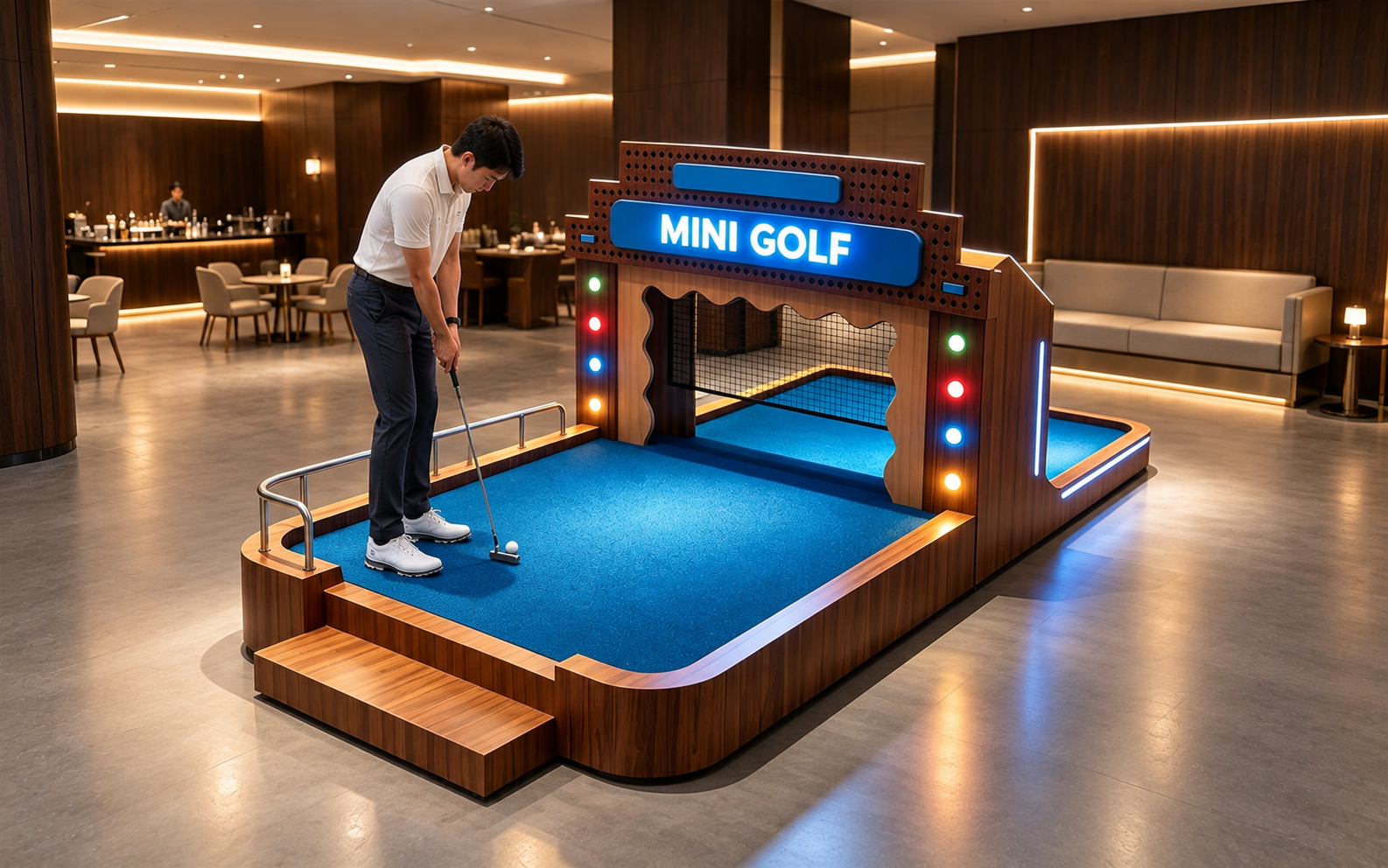
THE STORY LINE
Golf Treasure Hunt Hole | Indoor Mini Golf Hole
Adventure-themed design combined with interactive putting, for an engaging indoor mini golf attraction. The narrative resolves on the last attempt, which gives a reviewer the one-sentence story every good review contains: what happened, and how it turned out.
Ver Detalles ›
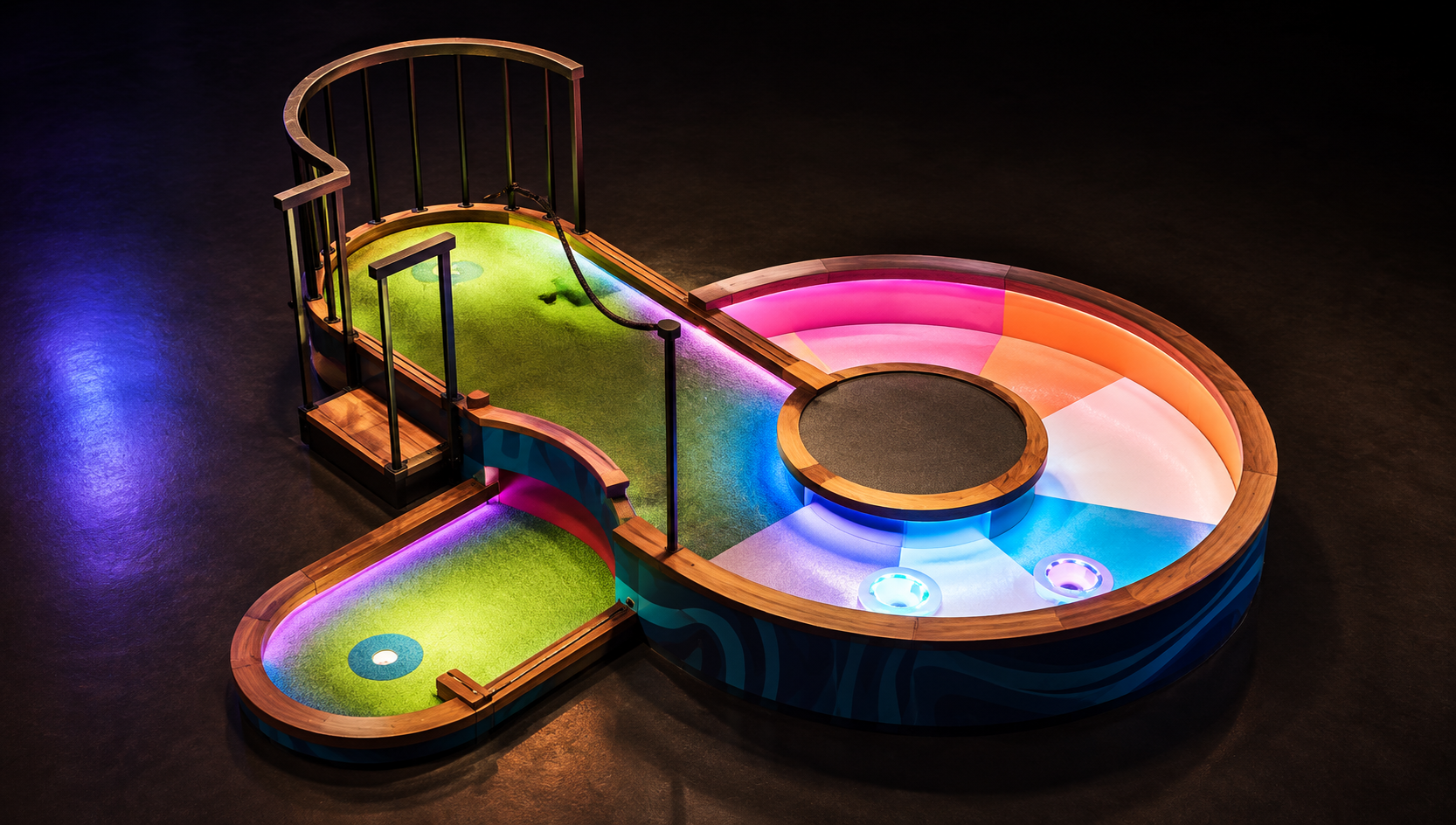
THE PHOTO MOMENT
Cyclone Spin Golf Hole | Indoor Mini Golf Hole
A curved lane and circular target area combining putting with control, for an engaging indoor mini golf challenge. The rotating visual stops people mid-walk - the pause before the phone comes out, and the image that ends up in the post.
Ver Detalles ›
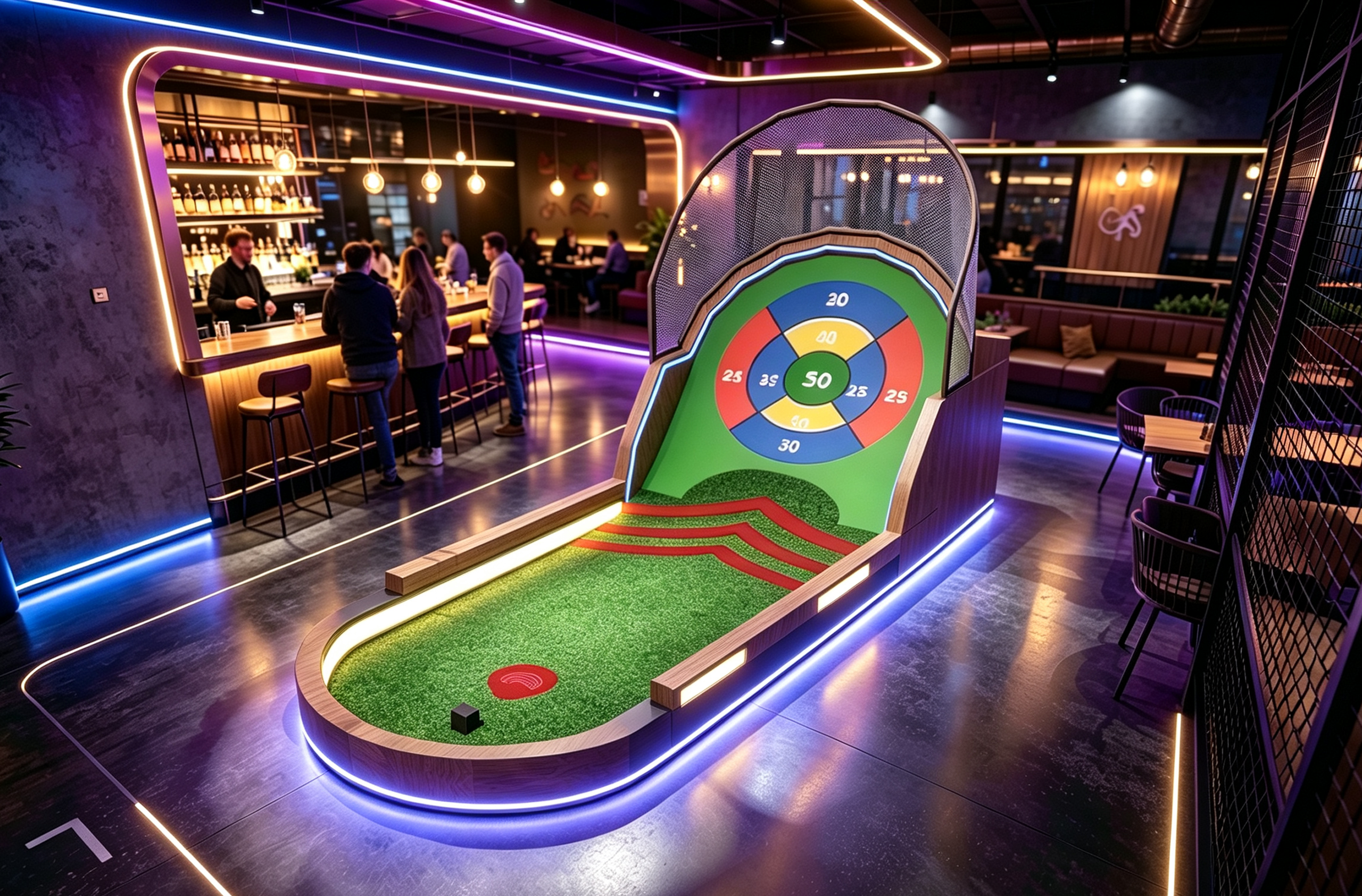
THE WIN TO ANNOUNCE
Golf Target Shooting Hole | Indoor Mini Golf Hole
Precision putting combined with multiple scoring targets, for a competitive and interactive indoor mini golf experience. Contests need a result, and a multi-target hole produces one on every ball - the score that a group reads out loud on the way to the counter.
Ver Detalles ›
8. Preguntas Frecuentes (FAQ)
Why do guests write five-star reviews about mini golf?
Because a round hands them specific scenes with results attached: a hole that fought back, a score that flipped, a photo the group wanted. Reviews compress an experience into its emotional peaks, so venues whose rounds contain visible peaks get specific, detailed text - and 60 percent of consumers say specific reviews are the most trustworthy kind.
How many reviews does a venue need before guests trust it?
The published gates are twenty reviews before a meaningful share of consumers will consider a venue at all (47 percent avoid venues below that), and a 4.5-star average before the largest single filter stops filtering you out (31 percent now require 4.5+, up from 17 percent a year earlier). Volume is the first gate; rating is the second.
Do old reviews still count?
Only as history. 74 percent of consumers read reviews from the past three months alone, and Google states its AI business summaries draw on the past year of reviews. A venue with a strong back catalogue and no current flow presents as inactive - velocity is what keeps both the human readers and the summariser supplied.
Can a venue offer discounts or gifts in exchange for reviews?
No. Platform policies prohibit incentivised reviews and prohibit directing what a review says - asking for a rating or a specific mention is equally off-limits. The allowed paths are a direct link after the visit, an exit QR code, an unscripted verbal ask after a good moment, and owner responses written individually.
Do responses to reviews actually matter?
To most readers, yes: 89 percent expect the owner to respond, 80 percent prefer businesses that reply individually, and 42 percent avoid businesses that never respond - while half of consumers are put off by template-style replies. Response is read as presence, so a specific two-sentence answer outperforms a polished form letter.
What is the fastest way for a mini golf venue to get more reviews?
Fix the experience first - rounds without a peak produce thin reviews no matter how the ask is worded - then remove friction from the capture: exit QR, same-day follow-up link, and a score the group is already holding when they are asked. Venues in our models that run this combination treat the scorecard as the prompt and leave every word to the guest.
Send Your Floor Plan, Get a Review-Worthy Route
Send us the floor plan and the hole sequence you run today and we will mark where the review material is supposed to come from: which hole carries the peak, where the group collects for the photo, where the score is finally settled, and where the exit ask lands while the round is still warm. If the course is already fixed, the same drawing shows which mid-range units add the missing beat without touching the layout.

