RIDER EXPERIENCE
What Does a VR Egg Chair Feel Like? The Closed-Capsule 9D Ride Explained
A VR egg chair is a closed capsule on a motion platform: you sit inside, put on a headset, and for two to ten minutes the seat tilts, drops and vibrates while wind and sound land with the film, so your body feels a ride that goes nowhere physically. This guide walks the experience step by step - boarding, the shell, each effect by name, session rhythm, motion sickness, kids and height, and how to pick a first film.
What It Feels Like Step by Step The Shell Effect Motion Sickness Kids and Height First Film
3DOF
Motion Platform That Tilts and Drops
35 in
Height Minimum on Operating Rides
9D
Closed-Capsule Immersive Ride
1. The First Five Seconds Inside an Egg
Before the ride you are in a hallway, an arcade or a mall aisle. Then you step up to what looks like a giant white egg on a pedestal, the door swings back, and you lower yourself into a seat inside a shell. An operator straps you in, fits a headset over your eyes, and settles earphones over your ears. The shell is not completely closed - there is a gap where you enter - but it does something deliberate: it cuts the outside world down to the machine and you.
The headset goes dark first. Then a countdown or a logo plays, and for the next two to ten minutes the shell around you barely registers because you are not in the shell anymore. You are on a roller coaster, in a dino valley, on a space launch, or falling down a virtual shaft - while your seat tilts, drops, vibrates, nudges your back and sweeps your legs on cue, and air blows toward your ears at exactly the moments the film says you are moving fast.
The short answer to "what does a VR egg chair feel like": a short, intense ride in a sealed seat that replaces the room with a headset, then tells your body the picture is real by matching motion, wind and sound to what you see.
This guide walks that experience step by step: what the closed shell does to your senses, what each effect feels like, how long a session actually runs, who should skip it and who will love it, and how to pick your first film so the ride lands well. If you are the one planning to buy a machine for a venue rather than ride one, the companion piece for operators is how to choose between the egg chair and other 9D cinema formats.
2. Step by Step: From Open Door to Disembark
The whole encounter is short - usually two to ten minutes of ride time plus boarding - and knowing the sequence removes most of the mystery. Here is what actually happens from the moment you step up.
- Board. Step in, sit down, feet flat. The seat is a snug chair with a shoulder or lap restraint depending on the model.
- Get fitted. Staff adjust the headset lens spacing and the strap. A blurry image is almost always a lens-spacing fit issue, and staff can fix it in seconds - say something if the picture is soft.
- Pick a film or accept the default. On most machines the ride is chosen on a touch panel or by the operator.
- Darkness. The headset lights up a title, then drops you into the first scene of the film.
- The ride. For two to ten minutes the platform moves under you, the effects fire on cue, and you steer by looking or with a handle depending on the title.
- Exit. The film ends, the headset screen goes home, straps release, and you step out. Most riders take a few seconds to re-anchor to the real room.
The boarding and fitting are the same across egg chairs, but the ride titles are not. Coaster, dino, zombie, space and family titles all use the same platform - the film decides the intensity. That is why the single most useful question to ask before you ride is not whether the machine is big or small, but which title is the gentlest for a first-timer.
Operating detail is drawn from the rider experience of 9D egg machines as described by manufacturers: a 3DOF motion platform with seat vibration, back push, leg sweep and wind effects, titles running roughly 2-10 minutes, and an average of about 8 riders per hour on the machine (source: VART product listing, reported by vendor). General information, not a guarantee for every machine.
3. The Closed Capsule: What the Shell Is Actually Doing
The single biggest difference between an egg chair and a normal VR headset session is the shell. It is not decoration. By blocking out side-room light and nearby noise, the capsule removes the visual and auditory anchors that usually break the illusion - the ceiling light you can see from the corner of your eye, the sound of the arcade machine behind you.
With those anchors gone, your brain has less reason to say "I am sitting in a machine in a mall", so when the platform pitches forward the stale cues are no longer competing with the picture. That is why most people describe the egg feeling as more immersive than a standing VR demo: the skin of the shell and the headset combine into one sealed world.
The trade-off is that some people find the enclosure itself a little intense on the first ride. Two honest ways to handle it: choose a calm first title, and know that the shell is not full width - you can feel the edge of the seat and ask to stop any time. Everyone I know who runs these machines repeats the same advice to first-timers: do not close your eyes during the drop. Keeping your eyes on the scene gives your brain the visual reference it expects, which is usually the difference between a fun drop and a queasy one.
4. What Your Body Feels: The Effect Rack, Named
The platform and the shell combine into a set of effects that fire to match the film. On a typical 9D egg chair the ones you will actually notice are these.
| Effect |
What It Does |
What It Feels Like |
| Seat vibration |
The seat hums or shakes during turns, launches and impacts |
The rumble under you as if the ground is actually moving fast |
| Back push |
A pad nudges your lower back at a slam or impact moment |
A firm tap telling your body "you have been hit" |
| Leg sweep |
A bar or cushion brushes under your legs on cue |
A sudden tickle that breaks the "I am just sitting" spell |
| Wind |
A fan blows air toward your face and ears |
Speed you feel even when the platform is still |
| Surround sound |
Audio wraps around the shell, direction matches the scene |
Dino roars locate behind you before the creature is on screen |
| Platform motion |
The seat tilts, drops and heaves on 3 axes |
The drop and the pull that make the picture feel like physics |
Two things are worth noting about how these effects are timed. First, they are triggered by the film itself, so the same machine can feel completely different between a calm ocean title and an inverted coaster title. Second, none of them is a gimmick on its own - the magic happens because they land together at the same moment as the picture. When motion, sound and wind agree, your body takes the shortcut and reads the whole package as "real".
The one skill first-timers underestimate: keep your head still and let the seat do the moving. Loose eyes and a swiveling head fight the film; a relaxed posture lets the motion feel smooth.
5. Two to Ten Minutes: The Real Rhythm of a Session
"How long is the ride?" is usually asked with two different fears underneath: "will it be over too fast to be worth the ticket" and "will I be stuck in there for twenty minutes". The truth is deliberately short. Typical titles run two to ten minutes, and the machine is designed to cycle most riders in around eight per hour - which means the queue moves, the machine earns, and you never sit long enough for motion buildup to get the better of you.
The flip side is that the short length is exactly why the ride feels dense. Every second of a three-minute coaster title is packed with motion and effects because there is no filler. If you are comparing this to a longer seated VR movie, treat the egg chair as a ride, not a film: you are there for a burst of sensation, not a slow-burn story.
For the venue owner reading this, that cycle time is also the point: a machine that turns riders over every few minutes keeps a line moving and a floor earning. The cycle math is identical whichever VR egg chair model you look at - the closed-shell design is what keeps a session short, contained and repeatable. If you want the operator-side breakdown of how that plays out in floor space and throughput, the guide explaining which 9D format fits a small venue first covers footprint and riders per hour in detail.
6. Will It Make You Sick? The Honest Answer
Some people feel off balance after a motion VR ride, and it is not weakness and it is not the machine being bad. The cause is a mismatch: your inner ear reports one thing and your eyes report another, and the disagreement can register as queasiness. A 9D egg chair actually handles this better than a static headset, because the moving platform makes your body sense the same motion the picture shows - the key is that the two have to arrive together.
That is why ride length is short, why gentle titles exist, and why the operator will swap you to a calmer film if the first one is too much. If you have a history of motion sickness, a calm first title, an early-in-the-visit ride rather than after a heavy meal, and one ride before committing to a second will do most of the work.
Who should skip it this visit, seriously and without embarrassment: anyone pregnant, anyone with a heart condition or uncontrolled blood pressure, anyone with neck, back or bone concerns, anyone recently out of surgery, anyone prone to motion sickness, and anyone with photosensitive epilepsy. Venues publish these restrictions on the signage next to the ride, and the staff will always let you sit it out or choose a gentler title.
Medical-exclusion and height guidance is drawn from the operating rider requirements of COSIs motion-seat VR attraction (riders at least 35 inches tall, under-14s accompanied by an adult; exclusions include motion sickness, pregnancy, heart/neck/back conditions, recent surgery, photosensitive epilepsy). Your venues signage and staff instructions take precedence. This is general information, not medical advice.
7. Can Kids Ride? Height, Age and the Parent-Child Pair
Kids can absolutely ride, and parent-child pairs are the most common boarding pattern on a dual-seat egg. The useful numbers come from a science museum running a motion-seat VR attraction and from a walking-VR operator, and they land in the same region: a minimum height around 35 inches (about 90 cm) on the motion-seat ride, an under-14s policy of riding with an adult at that museum, and a 130 cm minimum with 10+ family content recommended by the walking-VR operator - whose hardware is heavier because players walk around rather than sit.
The egg chair's advantage for kids is that you sit, you are strapped in, and the motion is short and contained - there is no arena to wander and no pack to carry. What matters more than the age on paper is whether the child wants to be there, whether they have a calm first title, and whether there is an adult in the seat beside them. A dual-seat shell exists precisely so the nervous first-timer and the confident adult ride together: they are the Dino-themed dual-seat VR egg chair, made for exactly that pair. For a birthday group that wants to ride all at once rather than in turns, some venues pair the egg with a larger closed-capsule cabin that seats the whole party together - the ride is the same family, just a bigger shell.
Height and age practice: COSIs seated motion VR attraction sets a 35-inch minimum and requires under-14s to ride with an adult; Zero Latency (walking VR) recommends a 130 cm minimum with family content from age 10+ and shooter content from 13+, with under-13s supervised. Both are reported operating practice, not legal limits. Your chosen venues policy wins.
8. Picking Your First Film: From Gentle to Full Coaster
The machine is intensity-neutral; the film is not. This is the most useful thing to know before you sit down, and it means you have a lever between "scared" and "fine" that has nothing to do with the hardware.
- First-timer and a little nervous: pick a calm ocean, dinosaur-by-distance, space-drift or nature title. The motion is gentle and the point is proving the seat feels fine.
- Confident but untested: a moderate coaster title is the sweet spot - the drop tells you what the platform can do without pushing the full inversion intensity.
- Thrill-seeker: go straight for the coaster, inversion or combat titles. This is what the machine is built for.
- Motion-sensitive: same advice as above but stricter - calm title, ride before lunch, one ride, eyes on the scene, speak up if it builds.
If you ride once and it was fine, the natural next ask is a step up in intensity. If it was intense, stay on a calm title - most of the machines fans found their level by working up one rung at a time. And if the ride genuinely was not your thing, that is a normal outcome too: the shell makes it easy to just say so. Nobody at the counter will be surprised.
Verdict one-liner: a VR egg chair is worth it for anyone who likes short, intense, immersive rides and is honest with the staff about nerves or motion sensitivity - most first-timers come off smiling, and the film choice is the lever that decides which way it goes.
9. Featured NextPlay Active Gaming Equipment
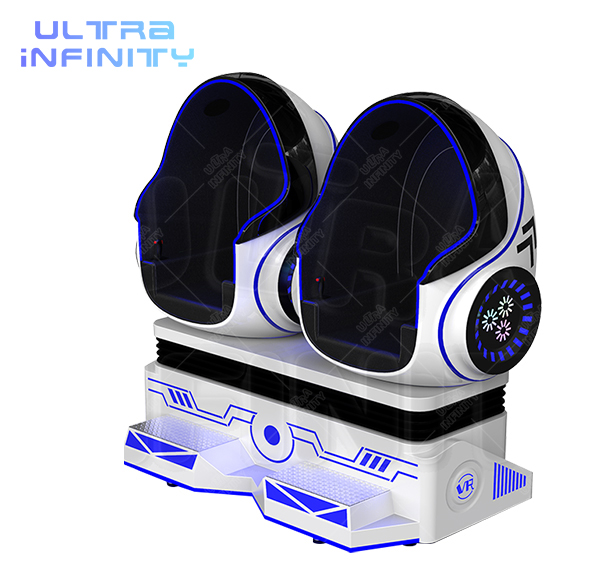
The Closed Ride
VR Egg Chair - 9D Cinema VR Chair Simulator
A compact closed-shell egg chair with a headset, motion platform and wind and vibration effects. The machine inside which this whole experience happens - a closed capsule that turns a corner of a room into a world.
View Details ›
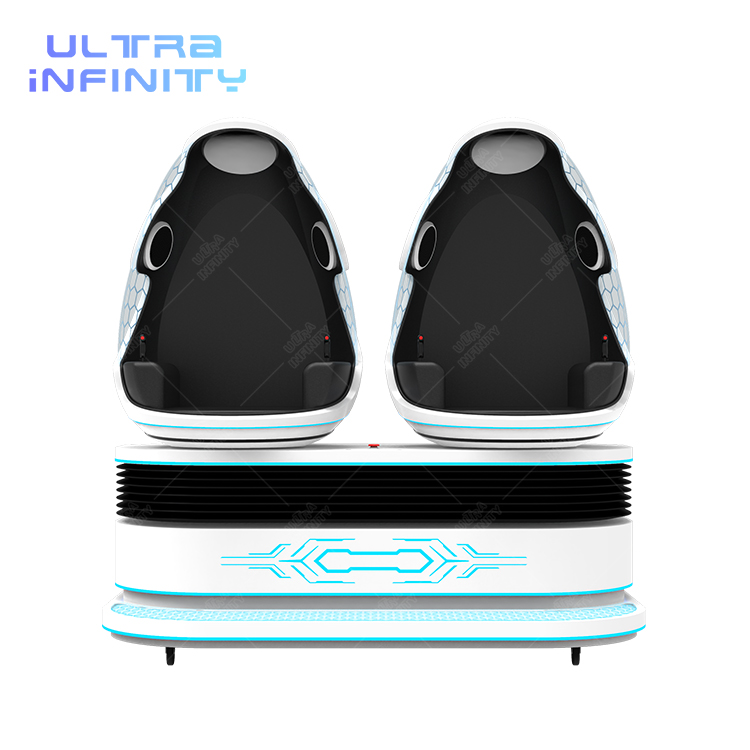
Ride as a Pair
Dino VR Egg Chair - 9D Cinema VR Chair Simulator
A dual-seat Dino-themed egg shell, built for a parent and child or a couple to ride together. The confident adult and the nervous first-timer in one seat - the classic first ride for a family.
View Details ›
10. VR Egg Chair FAQ: Feel, Motion Sickness and First Ride
The questions first-timers actually ask before they climb into an egg chair, answered plainly.
What does a VR egg chair feel like?
You sit inside a closed shell, put on a headset, and for two to ten minutes the platform tilts, drops and vibrates to match the film while wind blows toward you and sound wraps the shell. The closed capsule removes the outside world, so the experience feels more immersive than a standing VR demo and less overwhelming than a full roller coaster.
Is a VR egg chair scary?
The machine is not scary by itself; the film decides the intensity. A calm ocean or nature title is gentle, a coaster title has a real drop, and combat titles are intense. First-timers can pick a gentle title and work up - nobody has to ride the intense content.
Will I get motion sick?
Some people feel queasy, usually from the mismatch between what your eyes and inner ear report. A motion platform actually reduces the mismatch compared to a static headset, and short titles, a calm first film, and one ride before deciding again keep it manageable. Anyone with a serious motion-sickness history, pregnancy, heart or neck/back conditions, or photosensitive epilepsy should skip it or ask the staff.
How long does one ride last?
Typically two to ten minutes of ride time plus boarding and fitting. The short cycle keeps the queue moving and keeps sensitive riders from staying on long enough for discomfort to build. Riders average out to about eight per hour on a typical machine.
Can children ride a VR egg chair?
Yes, generally with a height and supervision policy. Operating venues set minimums around 35 inches (about 90 cm) and require younger riders (under about 14) to be with an adult. A dual-seat egg is built for exactly this parent-and-child pairing. Check the venues own signage.
Is it claustrophobic?
The shell looks more closed than it feels. The seat is open at the entry gap, you can feel the edge of the seat under your hands, and the ride is short. Sensitive riders can have the operator skip them or give them a calm first title.
The screen looks blurry - is the machine broken?
Almost never. A blurry image is usually the headset lens spacing matching your eyes, which staff can adjust in seconds. Say something during the fitting rather than riding blurry - it is the single most common first-ride fix.
Why does the machine move when the picture is on a screen?
The platform moves to match the film, and when the motion, sound and wind land at the same moment as the picture, your body reads the whole thing as real. That agreement is what makes a short ride feel dense and immersive.
Do I control anything or just sit?
Depends on the title. Some titles are riding-only: you watch and feel. Others use head-tracking or a handle to shoot or steer. Ask the operator - for a first ride, a watching title is the gentler choice.
How is this different from a regular VR headset at home?
The headset alone gives you the picture but your body sits still, so the mismatch is bigger and the sensation is weaker. The egg adds a motion platform plus wind, vibration, back push and leg sweep that fire with the film, which is what turns a video into a ride.

