MINI GOLF SPARE PARTS - THE WEAR LIST AND THE SHELF PLAN
Top 10 Mini Golf Spare Parts and Wear Items to Stock Before Opening Day
Ten wear families ordered by what the failure takes out of service, with published list prices, warranty terms and lead times: balls and grips by the dozen, turf seams and infill, perimeter LED strip and the scored ball fleet, sensors, validator belts, power supplies, moving props and front-of-house consumables - then the four-tier shelf plan and the five numbers no supplier publishes.
Balls Grips Turf seams LED strip Sensors Payment path Shelf plan
15 doz
Balls in the Harris Starter Pack
USD 14.99
Per Dozen: Mini Golf Balls
50,000 h
LED Strip Rated Life (L70 basis)
12 mo
Scoring Electronics Warranty Term
1. Why a Mini Golf Course Is a Fleet of Consumables
The builder Harris Miniature Golf says it in one line on its FAQ page: "Scorecards are the only daily consumable supply." That sentence is true of the desk and false of the lanes, and the same FAQ proves it: the start-up package Harris ships there "contains 100 putters, 15 dozen floating golf balls, 6 ball retrieval nets, 18 numbered flags and poles, blue lake water dye, 10 gross of pencils and a course rules sign", six supply lines where the sentence claims one. A course is a fleet of mini golf spare parts wearing through its first year, and the pages in this cluster that price machines do not cover the parts budget, and the parts budget is what decides whether a hole stays open on a Saturday. Here is the shelf: ten wear families, ordered by what the failure takes out of service (a lane, then the electronics in it, then the payment path and what powers it, then the mechanisms a guest can touch, then the desk), with the list prices, warranty terms and lead times that named suppliers publish. The buying methodology lives in our commercial mini golf equipment guide; this page starts after opening day.
The one-line rule: if a part fails weekly, stock it; if it fails yearly but takes twelve weeks to arrive, stock it anyway; if it fails yearly and ships in two days, keep a phone number.
Two anchors before the list, starting with a professional operator: the Dave and Busters FY2025 annual report describes a maintenance program rather than a repair habit - "our routine preventative maintenance program, designed to prevent game failure and extend the functionality of our games" - and reports "$5.3 [million] related to increases in non-capitalizable games maintenance, systems costs and other preventative maintenance costs at our comparable stores". Second, the Harris start-up package quoted above: the day-one kit, and the gap between those two lists is this article.
| Item |
Published wear or supply evidence |
What the guest sees |
| 1. Mini golf balls |
Two piece Surlyn cover (Turf Net 2020 catalogue); USD 14.99 sold by the dozen (Wittek Golf); the ball maker yihonggolf rates its own Surlyn cover at 500 plus impacts, with visible cover wear at 800, in its own test on practice-size balls |
A cracked or faded ball, then a lost ball in a water hazard |
| 2. Putters |
A nitrile head sold because a "Softer head reduces the damage to fairway carpet, landscaping, and obstacles" (Turf Net Sports Supplies) |
A putter that no longer sits true, and a scuffed lane |
| 3. Replacement grips |
Grips sold as a commercial part against "the abuse or constant tapping and pounding" (Turf Net 2020 catalogue) |
A tacky or splitting grip in the hand |
| 4. Turf seams, patch and infill |
Seam glue and jointing tape sold as a bundled repair kit (golfandgreens.eu); infill top-up "Around every 6 months" in high traffic (Lush Turf Cleaning) |
A slow ball track and a lifting seam line |
| 5. Perimeter LED and the ball fleet |
L70 lumen maintenance and a 50,000 hour average lifespan (LEDYi); 250 LED balls plus chargers per retrofit, 12-Month Electronics Warranty (Putt Mania) |
A dim hole, then a ball that does not light |
| 6. Sensors and scoring electronics |
No mini golf sensor MTBF published; 50,000 hour demonstrated MTBF on adjacent Elo kiosk displays (via SUZOHAPP) |
A putt that silently scores nothing |
| 7. Coin acceptors and bill validators |
Exploded parts list with orderable part numbers, including a center drive belt (Coinco BillPro manual) |
A rejected note at the door |
| 8. Power supplies |
569,600 hours minimum per MIL-HDBK-217F (25) and a 3 year warranty (MEAN WELL) |
A hole that goes dark, not dim |
| 9. Moving props and mechanisms |
"Under no circumstances should the golf obstacles be stood or jumped on" (Mini Crazy Golf); motors and boards in warranty, belts and nets as consumables (EPARK) |
A jammed target mid-round |
| 10. Front-of-house consumables |
Scorecards sold 1000 per package, pencils per gross, allowance of 2 weeks for personalized print (Turf Net 2020 catalogue) |
No pencil, no scorecard, a complaint |
Source: the supplier and OEM lines are quoted or summarized in the sections below, each with its own unit basis. Failure clocks exist only where a source publishes one: items 2, 3, 7 and 9 print no clock at all, item 10 none beyond depletion, and items 1 and 6 carry only clocks from outside mini golf - a ball maker impact test on practice-size balls and an MTBF quoted for adjacent Elo kiosk displays - which is not a spare-part clock for a lane.
The ten wear families, in the order this page covers them:
- Mini golf balls
- Putters
- Replacement grips
- Turf seams, patch material and infill
- Perimeter LED strip, diffuser conduit and the LED ball fleet
- Sensors and scoring electronics
- Coin acceptors and bill validators
- Power supplies, wiring and connectors
- Moving props, motors and mechanisms
- Front-of-house consumables
2. Wear Items 1 to 3: Balls, Putters and Replacement Grips
1. Mini golf balls. The highest-count consumable and the cheapest per unit. The Turf Net Sports Supplies 2020 catalogue describes the construction that sets the wear clock: "Featuring Surlyn covered,two piece construction. Sold in dozens." Wittek Golf lists solid miniature balls at USD 14.99, and the listing prints the unit string "Sold by the dozen" (read from the supplier page 2026-09-23). SGD Golf prices novelty balls on its miniature-golf tag from "One Dozen 11.95" up to USD 15.95 per dozen, and because that tag mixes full-size novelty with miniature the size class needs confirming on a quote. Mini Golf Supply lists white balls at USD 6.99 without printing the unit on the page, so quote that line before budgeting from it. The only published ball wear clock in this evidence set is a ball maker: the yihonggolf practice-ball page claims a "Surlyn" cover "can last 500+ impacts" with "At 800 impacts, cover wear becomes visible", and puts a PU foam ball at failure after "200" to "300" full-speed driver impacts - a manufacturer test on practice-size balls, and driver impacts do not map to putts, so it is a material contrast that no mini golf supplier has replicated. Balls also set the freight arithmetic: the Turf Net catalogue states "Shipping Weight: Golf balls weigh 1lb./dozen", which is why a replenishment order is a parcel and not a pallet. Two sub-classes matter operationally. Floaters exist because water hazards lose balls - "We're not kidding when we say our balls rise to the top over the others, after all, they're Floater Balls!" - and on a scored course the ball fleet is electronics, which is item 5.
2. Putters. Putters are the line where the consumable and the asset touch: the supplier sells a nitrile-head putter on the grounds that a "Softer head reduces the damage to fairway carpet, landscaping, and obstacles" (Turf Net Sports Supplies), so the putter is a wear item that also wears your lanes. Mini Golf Supply lists a 37-inch green putter at USD 13.75 and a "Set of 6 putters" at USD 79.99, which works out at about USD 13.33 a putter as our arithmetic.
3. Replacement grips. The part you will replace by hand, and the one the guest holds, so it is the item a clubhouse judges before it judges the carpet. The same 2020 Turf Net catalogue lists commercial grips as a part in their own right: "Specially designed for commercial use. Grips feature a custom designed butt cap made of durable plastic molded to the grip. A metal washer is molded into every cap for added strength", against "the abuse or constant tapping and pounding". Tiered list prices in that 2020 catalogue run from USD 3.90 to USD 5.75 per grip by quantity band - 2020 money, quoted as printed, and the reason to re-quote before you order.
| Wear item |
Published list price, with the unit the supplier prints |
What we expect to fail, on our reading |
Named source, access date |
| Mini golf balls, solid |
USD 14.99 per dozen |
Cracked cover, lost to hazards, faded print |
Wittek Golf, 2026-09-23 |
| Novelty balls, mini golf tag |
USD 11.95 to USD 15.95 per dozen, size class mixed on that tag |
Cover wear plus print abrasion on theme balls |
SGD Golf, 2026-09-23 |
| Mini golf balls, unit unstated |
USD 6.99, unit not printed on the page |
Unknown until quoted - do not budget on it |
Mini Golf Supply, 2026-09-23 |
| 37 inch putter |
USD 13.75, unit not printed on the page; USD 79.99 per set of 6 |
Bent head, cracked loft, chewed grip |
Mini Golf Supply, 2026-09-23 |
| Replacement grip |
USD 3.90 to USD 5.75 each, 2020 catalogue tiers |
Split rubber, detached butt cap |
Turf Net Sports Supplies, 2020 list |
| 4 inch cup |
USD 9.95, unit not printed on the page |
Split rim, chipped lip from spike and stomp damage |
Mini Golf Supply, 2026-09-23 |
| Laminate minigolf cup |
EUR 10, ex-list, VAT excluded |
Same wear path on a European lane standard |
minigolfconstruction.eu, 2026-09-23 |
| Repair lane board |
EUR 268 per straight board, EUR 238 at five or more |
Worn lane substrate |
minigolfconstruction.eu, 2026-09-23 |
Prices are web list prices as published by the named supplier on the access date, in the currency each prints. Each line states its own unit and lines are not comparable to one another; per-dozen, per-each and per-board bases sit side by side here deliberately, because that is how the suppliers print them. The 2020 grip prices carry their 2020 vintage on purpose.
3. Wear Items 4 to 6: Turf Seams, Perimeter LEDs, Scored Balls and Sensors
4. Turf seams, patch material and infill. The lane surface is the part you cannot ship in a parcel, and its wear is bought back in consumables: seam glue, jointing tape, patch lengths, infill. Two named suppliers price that job as an orderable repair, which is what turns it into a stock line. The European supplier golfandgreens.eu bundles it as one kit - a Mapei turf glue tube of 600 ml, a 4 m roll of artificial grass jointing tape and a free glue comb - for EUR 29.04. The Czech lane manufacturer minigolfconstruction.eu prices the same category as separate parts: EUR 96 for a 15 kg two-component adhesive bucket and EUR 18 per square meter of replacement turf, ex-list and VAT excluded. On the maintenance side the cadence is short and specific: Lush Turf Cleaning says high-traffic areas "tend to lose infill more quickly" and gives a "Recommended frequency: Around every 6 months." The weekly hole-side tasks that decide whether that interval holds live in our mini golf hole maintenance checklist; the infill is the consumable behind them.
The warranty fine print is where the real cost sits. Synthetic Grass Warehouse covers "artificial turf landscape products ... under a 15-year warranty, and our synthetic grass putting green products are under warranty for 8 years", then excludes "surface deterioration resulting from normal wear and tear" and any "issues stemming from the installation", and states the warranty is "non-transferable". Its UV-failure test measures the material under light: the product "shall be deemed to have failed in ultra-violet stability if the original tensile strength of the product decreases by more than 50 percent". On the mini golf lane pages the warranty nouns are narrower still - Turf Net Sports Supplies sells its course carpet with a "5 year fade Warranty and a 5 Year wear Warranty", its deluxe turf with a "Five year limited fade warranty", and its One Putt line with a "Five year limited warranty against discoloration and ultraviolet degradation". A fade warranty is a color warranty. Foot traffic is a different failure with a different clock, and no supplier in this set publishes that clock.
5. Perimeter LED strip, diffuser conduit and the LED ball fleet. Two of these mini golf spare parts never appear on a lane-side list and both belong on it: the strip and the ball fleet. Lighting is the wear item a guest notices as a mood change before a defect, and its clock is published in hours. The industry rating is a maintenance curve: LEDYi states that "After the rated lifespan, the LED maintains 70% of its stated lumen rating" under the L70 convention, measured by LM-80 and projected by TM-21, with 50,000 hours quoted as an average lifespan. The scoring vendor Putt Mania ships hole perimeter LED lights with diffuser conduit, at up to 100 ft per hole, and with the same system "250 Color Changing LED Golf Balls" plus "Ball Chargers" and a "Backup Server" - the ball fleet, the chargers and the strip are all spares on a scored course, and the electronics behind them carry a "12-Month Electronics Warranty". Scoreboard modules run longer: the display maker behind the szledworld scoreboard page rates its "LED module ... for 100,000 hours" on the to-half-brightness convention, and adds the service line that matters more than the rating - "LED replacement on modular boards usually calls for recalibration."
6. Sensors and scoring electronics. The failure is invisible to the vendor and obvious to the queue: a ball rolls under a prop and nothing scores. The mechanism is documented plainly - "A sensor is placed inside a prop that guests can putt through recognizes when the ball passes under it" (Putt Mania) - and the honest part is that no mini golf supplier publishes a sensor MTBF. The nearest rated number is the one from adjacent kiosk hardware, the closest published rating we could find: the Elo touch-display brochure sold by SUZOHAPP states a "50,000 hour demonstrated MTBF" and a "3-year standard global warranty", which is three times the 12-month term on the Putt Mania scoring system, and the two are different kinds of number - one rates a component in hours, the other is a repair-coverage period. That gap is the argument for the shelf: the warranty says twelve months, the component sheet says fifty thousand hours, and the queue only notices the difference when scoring stops.
Rated life on the component sheet (hours, indexed to 569,600 h)
Power supply, MIL-HDBK-217F minimum
569,600 h
Scoreboard LED module rating
100,000 h
LED strip (industry rating), average lifespan
50,000 h
Elo touch display demonstrated MTBF
50,000 h
Source: the MEAN WELL power-supply datasheet, the szledworld scoreboard page, the LEDYi LED education page and the Elo brochure via SUZOHAPP. All four bars share one unit, rated hours, indexed to the 569,600 hour figure; the two 50,000 hour bars are different conventions (an average lifespan, a demonstrated MTBF) and are not interchangeable. The mini golf scoring warranty is a 12-month coverage period and is deliberately not a bar here, because months are not hours - see the warranty column in the table below.
The same MEAN WELL datasheet also carries a far larger number, "2918.8K hrs min. Telcordia SR-332 (Bellcore)", which we excluded from the scale deliberately: two prediction standards on one part give figures five times apart, which is the same trap our own per-lane maintenance breakdown warns about on bowling lane maintenance cost per year numbers, where the machine type changes the total completely.
4. Wear Items 7 and 8: The Payment Path and the Power Behind It
7. Coin acceptors and bill validators. The payment path is the highest-frequency mechanical part on the site that we could evidence, and the one that can stop revenue at the door itself. It is also the best-documented wear set on this list, because the OEM publishes an exploded parts list: the Coinco BillPro manual carries a "SECTION 6: PARTS LIST" with individually orderable part numbers such as 409502, and lists what it builds in against jams - a "Center drive belt" and a "Scalloped bill path for wet bill acceptance" - which is also the set of parts that wears out. That reading is confirmed outside the manual: the parts dealer Tiger ATM Parts lists "MEI/CPI SCR Advance SCNR 8327/8328 Banknote Validator Gears" as a standalone repair item, which is the commercial evidence that validator internals are orderable rather than disposable. And the warranty clock does not start when you install it: "The first four digits of the serial number contain the manufacturing date code which indicates the beginning of the warranty period." A validator that has been sitting in a warehouse is already part-way through its coverage, which is a purchasing decision rather than a maintenance one.
8. Power supplies, wiring and connectors. The least glamorous line and the one our own maintenance guide puts on the critical-spares list beside sensors and control boards. It is also the only part here with a published reliability figure in the same units as the LEDs it feeds: the MEAN WELL datasheet states "569.6K hrs min. MIL-HDBK-217F (25)" and offers a "3 years warranty" - a longer term than the scoring electronics it powers. Treat that as a component-class benchmark, not a mini golf part: nobody in this set sells a "mini golf power supply" with a rating, and when the power supply goes the hole does not dim, it dies.
| Part family |
Published service evidence |
Warranty position as printed |
What we would keep on the shelf |
| Bills and coins: validator belts, rollers, gears |
Coinco exploded parts list with orderable part numbers; gears sold separately by Tiger ATM Parts |
Clock starts at manufacture, per serial date code |
Critical class, 1 per high-traffic lane |
| Power supplies |
MEAN WELL 569,600 h minimum per MIL-HDBK-217F (25) |
3 years, same OEM |
Critical class, 1 spare per scoring bank |
| Perimeter LED strip and conduit |
L70 rating convention; 50,000 h average lifespan claimed by LEDYi |
Tied to the 12-month electronics term on a Putt Mania retrofit |
Critical class, keep 100 ft per stocked hole type (LED strips sit on the supplier critical list) |
| Sensors and control boards |
Elo 50,000 h demonstrated MTBF on adjacent kiosk hardware only |
12 months on the Putt Mania scoring system |
Critical class, 1 per hole type |
| Turf, seam glue, jointing tape, infill |
golfandgreens.eu kit at EUR 29.04; infill top-up "Around every 6 months" per Lush Turf Cleaning |
Fade and UV warranties; Turf Net prints a 5 year wear warranty on course carpet; Synthetic Grass Warehouse excludes normal wear and tear |
Repair stock, ordered per repair event |
| Balls, grips, putters, cups, flags |
Wittek, SGD Golf, Mini Golf Supply and Turf Net print dozen, set and each pricing |
Consumables "may not be covered by the standard warranty" (EPARK) |
Volume consumable, bought by the dozen and the gross |
Each line cites the named supplier or OEM document behind the figure. The last column is our recommendation for the shelf, not a supplier specification: it names the class a supplier publishes where one exists, then the quantity we would keep.
5. Wear Items 9 and 10: Moving Props and Front-of-House Consumables
9. Moving props, motors and mechanisms. Anything a guest can touch, climb or lean on is a wear item, and the manufacturer says so: the FRP course builder Mini Crazy Golf warns that "Under no circumstances should the golf obstacles be stood or jumped on. They are not structurally designed for this purpose". There are two paths here. Guests convert a decorative prop into a climbing frame, and the prop fails in the way a consumer product used commercially fails - outside its design case. And drainage is a wear decision rather than a one-time install: the same builder notes an added drain "would require drilling through the carpet", which leaves a permanently perforated surface in that hole. For powered props - rotating targets, spinning loops, ball returns - there is no published cycle rating for the bearings, hinges or gear trains, so the only honest engineering evidence is the adjacent class: EPARK's failure list for scored basketball machines reads "Sensors, scoring board, ball-release parts, nets", an adjacent class rather than mini golf data, and its parts-by-category table puts motors and control boards in the warranty tier while belts, nets and buttons sit in the consumable tier.
10. Front-of-house consumables. Scorecards, pencils, flags and poles, retrieval nets, pond dye - the lines that keep running out, in the same Harris FAQ that calls scorecards the only daily supply. Four of those five lines ship in the Harris start-up package quoted above. The catalogue units are unglamorous and exact: the Turf Net 2020 catalogue prints scorecards "Sold 1000/package", pencils "Sold per gross (144 pencils)", and personalized pencils with a production note, "Allow 2 weeks for delivery." Tee-off pads are sold as a consumable too: "Our durable pads are designed for high volume commercial use." None of these lines fails a hole, which is exactly why they are the items a purchasing list forgets and a guest comments on.
What the Harris start-up package contains, by piece count (18 holes, inferred from the 18 numbered flags)
- Pencils (10 gross) 1,440
- Balls (15 dozen) 180
- Putters 100
- Flags and poles 18
Source: the start-up package contents published by Harris Miniature Golf, converted to piece counts as our arithmetic (gross = 144, dozen = 12). The 6 ball retrieval nets and the dye and rules sign round to under one percent and are not sliced. The point of the chart is the shape of the list: the highest-count items are commodity print and packaging, and none of them is the part that closes a hole.
6. The Shelf Plan: Tiers, Warranty Lines, Lead Times and What We Could Not Source
The mini golf spare parts plan has two warranty classes and four stocking tiers, and that split is the one the FEC equipment maker EPARK publishes. Consumables on one side: "Buttons Joysticks Belts Ticket paper Locks Keys Paddles Nets Decorative stickers", with the sentence that should be printed above every parts budget: "Consumables may not be covered by the standard warranty." Critical spares on the other, and the same supplier's small-venue shelf is a usable starting list: "Common buttons Coin acceptors Power supplies LED strips Locks and keys Basic sensors". Our own commercial entertainment equipment maintenance guide sets the same tier line and adds the contractual half: "Maintain a 7-day dispatch agreement with your supplier and track inventory levels monthly", with the critical list named as "sensors, motors, control boards, screens, buttons and power supplies". The shelving discipline itself is the arcade version in our storage and spare parts piece; this page is the mini golf translation of it.
- Volume tier, ordered in dozens and grosses: balls, putter grips, pencils, scorecards, flags. Domestic list prices exist for every one of these, and Wittek Golf ships them "From Illinois" with a warehouse promise: "Orders placed by 1pm CT ship same business day, Mon-Fri. Subject to stock availability."
- Repair tier, ordered in kits and rolls: seam glue, jointing tape, patch turf, infill, diffuser conduit, LED strip lengths. Priced per repair event, as the golfandgreens.eu and minigolfconstruction.eu lines above show.
- Critical tier, ordered one per failure mode: a validator belt kit, a power supply, a sensor or control board per hole type, a ball charger, and on a scored course a backup server. This tier is where the warranty clock and the lead time both bite.
- Contract tier, ordered in writing rather than on a shelf: the dispatch agreement, the parts tier schedule, and the recalibration clause. Our equipment SLA guide covers what to insist on; the one-line version is that a spare you cannot get is not a spare.
Lead times, printed as suppliers state them. Domestic distribution: same business day before a 1pm CT cut-off at Wittek Golf, with the warning that matters - "these estimates do not include production time or items that are drop-shipped from our vendors". Custom consumables run two weeks (personalized pencils in the Turf Net catalogue). Putt Mania quotes "Our current lead time is around 12 weeks." for new scoring systems and covers their electronics for 12 months. And a builder's warranty is one year of materials and workmanship - "A full-year, no-cost warranty on materials and workmanship is extended to each owner of a Harris-built miniature golf course", with phone support "guaranteed for as long as you own the course" - which means years two through five of grips, balls, seams and sensors are entirely your budget line. The reorder line and the lead-time-as-schedule-cost argument belong to sections 5 and 8 of our commercial mini golf equipment guide; the mini golf equipment buying guide and our course cost page carry the capital side; this is the operating side.
Five numbers this article exists to give you, and no supplier publishes them:
- Mini golf ball loss per course per season. Not stated anywhere we could find. The only defensible baseline is the builder's starter package (15 dozen for the course), so any replenishment percentage you see quoted is an assumption.
- Sensor MTBF for mini golf scoring hardware. The published terms are warranty periods - 12 months on the Putt Mania system - not failure rates; the 50,000 hour MTBF above is Elo kiosk hardware from an adjacent class and is labeled as such.
- Cycle ratings for prop hinges, rollers and ball-release belts. No mini golf supplier prints one, so item 9 stays qualitative.
- A small-parcel air-freight cadence for a spare-parts carton from an overseas FEC supplier. Container and LCL rates are published; the carton is not. Put it in the RFQ, in writing, next to the dispatch clause.
- A third-party downtime cost per hole per hour. Ours is derived from our own model: our mini golf payback in a 300m2 FEC model puts a 9-hole course at about USD 216 in its peak hour, so one hole down in that hour is about USD 24 as our arithmetic, read against the throughput assumptions in our mini golf course capacity analysis. The interactive-scoring side of the same shelf - which LEDs, cups and balls a scored course actually carries - is in our interactive mini golf piece.
What to do with a list like this: order the volume tier from a domestic distributor on a purchase order you can repeat, put the repair tier on the same invoice as the turf, and put the critical tier into the contract before the equipment is shipped. Everything else is a phone call on a Saturday with a queue at hole six.
Prices, warranty terms, rated lives and lead times are web-published list figures from the named supplier or OEM document, accessed 2026-09-23, in the currency each prints; 2020 catalogue prices carry their year. List prices are not quotations. Piece-count and per-hole conversions are our arithmetic. Supplier warranty exclusions are quoted as published and are not legal advice.
7. Mini Golf Spare Parts FAQ
The questions operators ask when they build the parts budget, answered with the published supplier terms.
What spare parts should a mini golf course stock before opening?
Stock the ten wear families in the summary table in section 1, in the two classes section 6 splits them into on the FEC equipment maker EPARK's warranty wording: a per-hole critical set, which is the list our own maintenance guide names ("sensors, motors, control boards, screens, buttons and power supplies"), and a volume consumable set (balls, putter grips, cups, seam tape and glue) - the side EPARK's wording covers only tentatively: "Consumables may not be covered by the standard warranty." The rest is shelving discipline, which our storage and spare parts piece for arcades already covers.
How many mini golf balls should an operator buy at once?
No supplier publishes a loss rate, so start from the package Harris Miniature Golf ships: "15 dozen floating golf balls" for the course, which is 180 balls, about 10 balls per hole in circulation as our arithmetic. Wittek Golf lists solid mini balls at USD 14.99 with the unit string "Sold by the dozen", so the builder starter quantity alone is roughly USD 225 of balls as our arithmetic - a consumables line item. Treat any replenishment percentage as an assumption, not a benchmark.
Are wear parts covered by the warranty?
Usually not. The FEC equipment maker EPARK states it plainly: "Consumables may not be covered by the standard warranty." The US turf supplier Synthetic Grass Warehouse goes further and excludes "surface deterioration resulting from normal wear and tear", and states the warranty is "non-transferable". Read the exclusion list before you budget, then budget for the parts the exclusions name.
What lead time should the shelf be sized against?
Size it against the worst number in your chain, not the best. Wittek Golf dispatches domestic stock the same business day for orders placed "by 1pm CT", and warns that transit estimates "do not include production time". The scoring vendor Putt Mania quotes "around 12 weeks" for new systems. Anything that can only come from the second category needs to live on your shelf.
What does a closed hole actually cost per hour?
Our own payback model prices a 9-hole, 300 square meter course at about USD 216 in its peak hour, which is about USD 24 per hole per peak hour as our arithmetic; no supplier publishes that figure. That is the number a spare on the shelf is insured against, and it is why the shelf is cheap relative to the hole it keeps open.
Does the ball fleet count as a spare part on a scored course?
Yes, and on an interactive course it is the largest one. Putt Mania ships "250 Color Changing LED Golf Balls" with a 9 or 18 hole retrofit, charges them on ball charger docks, and covers the electronics for 12 months. LED balls are inventory with a battery, a charger and a warranty clock.
8. Featured NextPlay Active Gaming Equipment
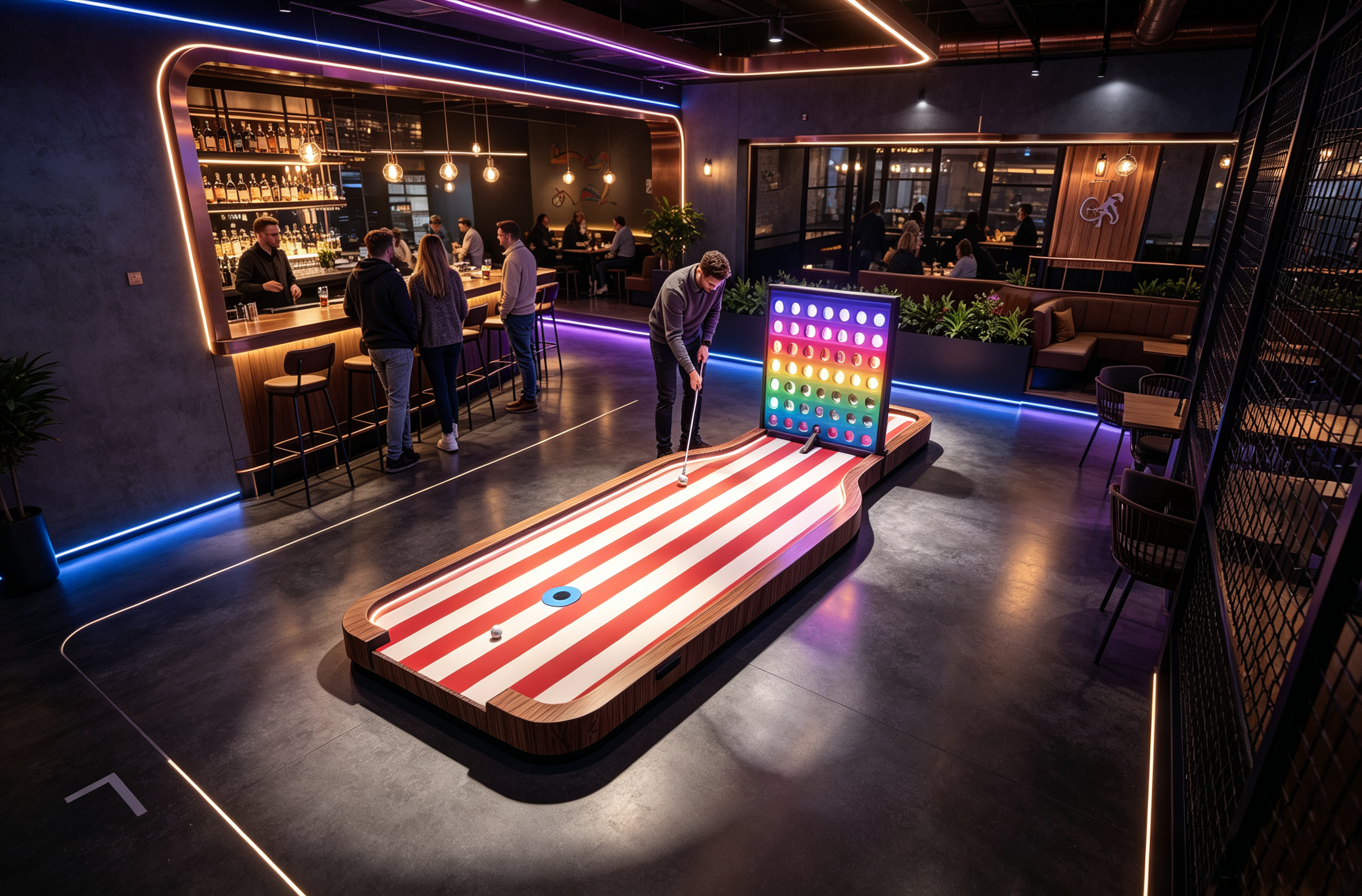
The LED and sensor fleet
Rainbow Golf Challenge - Auto-Scored Interactive Mini Golf
The scored hole that puts perimeter LED, sensors and a ball fleet on your spare list - and a 12-month electronics warranty clock in your budget.
View Details ›
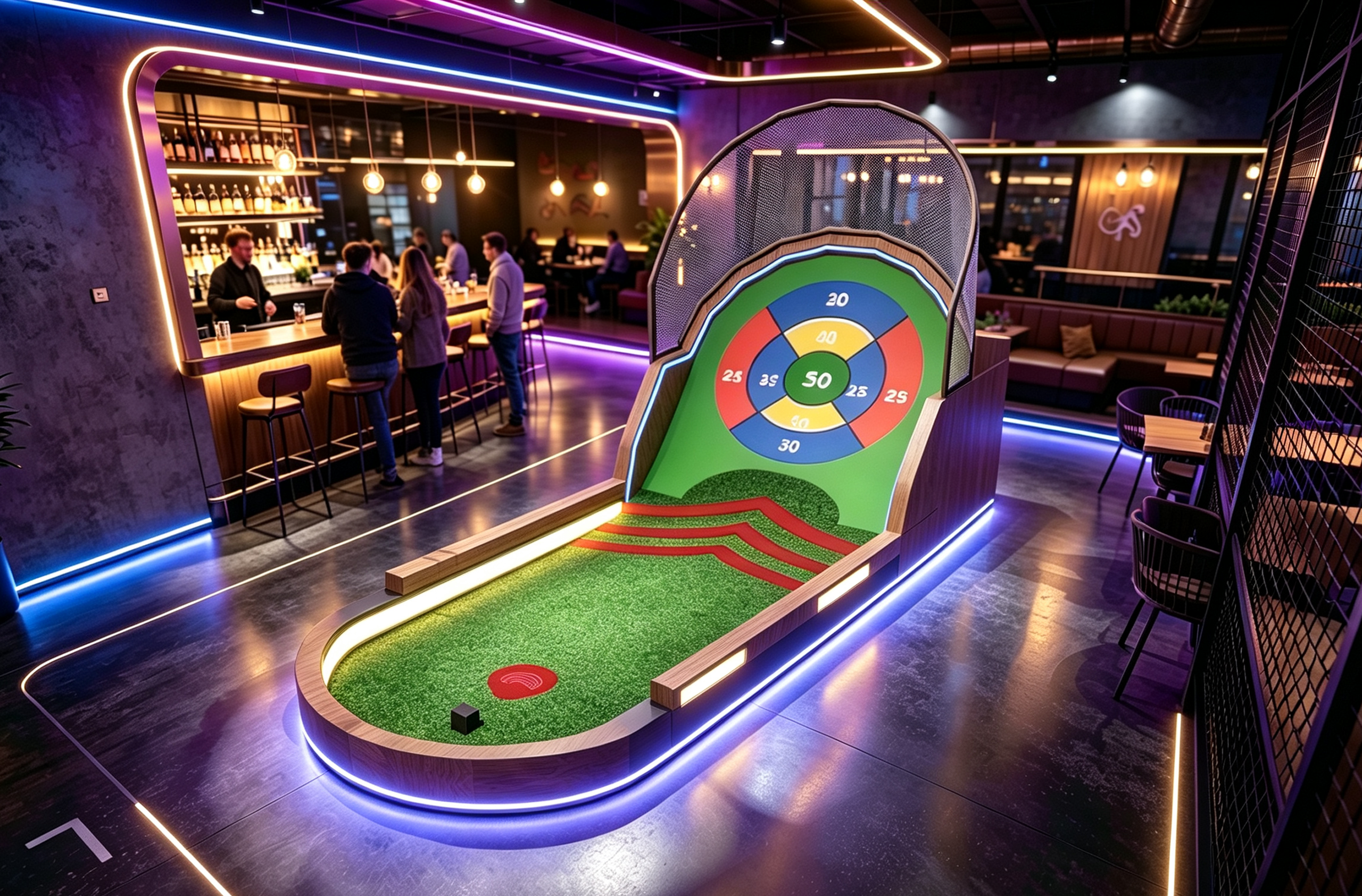
The moving mechanism
Golf Target Shooting Hole - Multi Zone Scoring Mini Golf
A target that moves is a motor, a bearing and a belt. This is the hole type that needs the critical tier on the shelf.
View Details ›
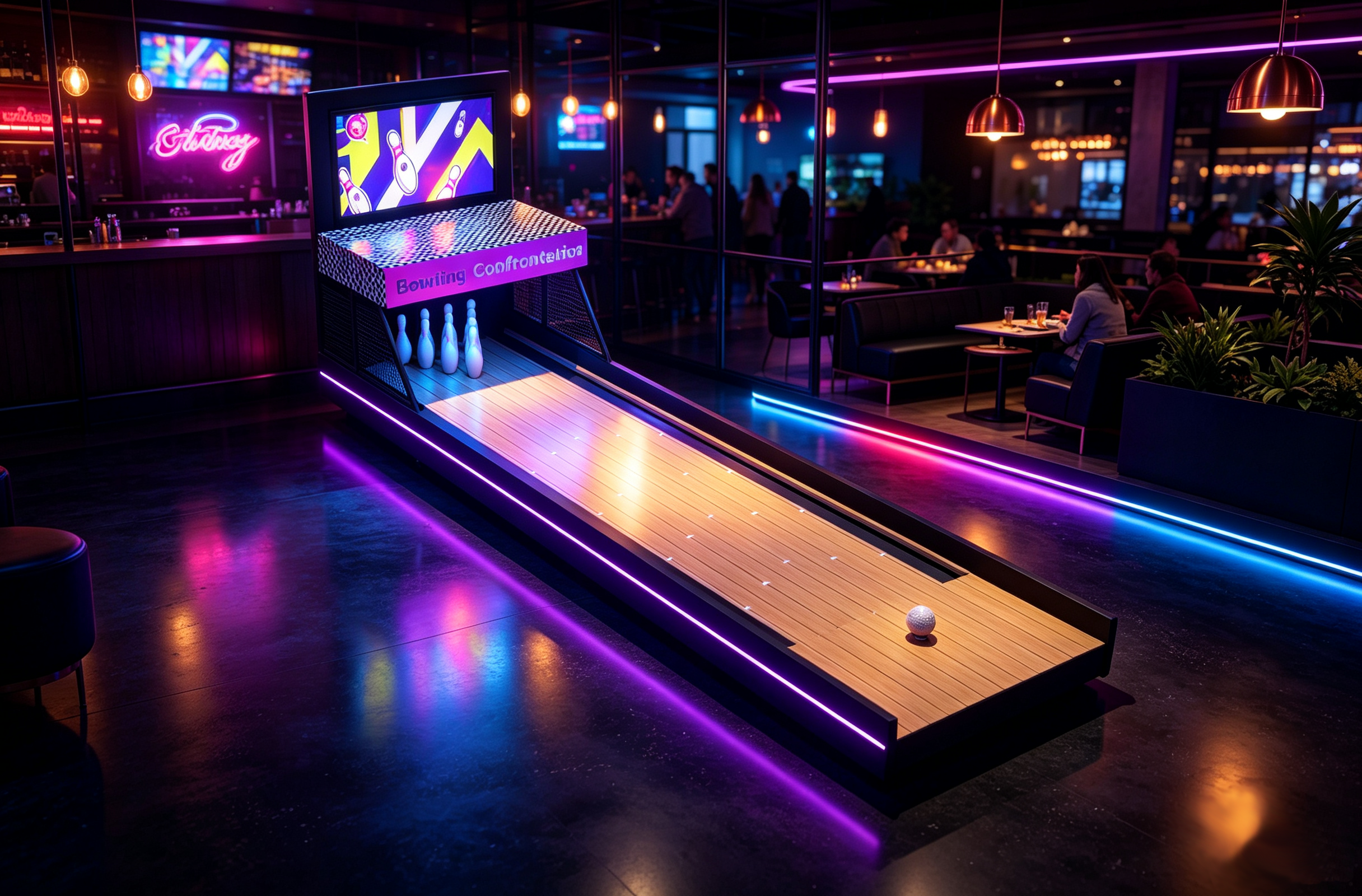
The ball path wear
Bowling Theme Mini Golf Challenge - Ball Return Hole
Ball release and return parts wear first on a lane that throws a heavy ball - the failure list a scored arcade machine already publishes.
View Details ›

