INDOOR GOLF SIMULATOR - HOTEL & RESORT REVENUE GUIDE
Indoor Golf Simulator for Hotels and Resorts: A Revenue Guide for 2026
A revenue guide for the golf simulator hotel buyer and the resort operator: the guest-experience value, footprint and ceiling constraints, the 2026 revenue model across guests, locals and events, pricing and F&B attachment, published hotel and resort case studies, the AR golf hardware specification for hospitality, and a 1-bay / 2-bay / 4-bay configuration comparison.
Hotel amenity value Footprint and ceiling 2026 revenue model Pricing and F&B Published hotel cases Configuration tiers
$95-115K
Per-Bay Revenue/yr
1. Why Hotels and Resorts Are Adding an Indoor Golf Simulator in 2026
For the golf simulator hotel buyer, an indoor golf simulator is the rare amenity that behaves like a revenue line. Unlike a pool, a spa or a squash court, a golf bay asks a guest to pay a session fee, meets the demand of a large off-course golf audience, and keeps the same four walls earning at 9 p.m., in rain season and in winter. Read that as a signal: this is a small venue wearing an amenity costume. Hospitality operators who treat it as another guest perk miss the point, while the ones who run it as a priced, bookable zone capture both halves of the value.
The demand is real and it is indoor. Golf industry research counts about 19 million Americans who play golf exclusively off course - a figure roughly 41 percent higher than in 2019 - and screen-based simulators are the fastest-growing slice of that off-course market. Market research projects the simulator market near USD 3.3 billion by 2027. In hospitality terms that is a guest segment that already expects an indoor golf option at a quality property, and the expectation is no longer a premium-only fringe.
The property pattern is also proven. Published NextPlay cases show hotels and resorts turning underused floor into a USD 22,000 to USD 25,000 per month entertainment zone - a hotel-and-resort floor combining bowling with shooting games at the hotels and resorts USD 22K/month case, a 3,500 sq ft resort hub at the USD 24K/month resort case, and a Miami luxury hotel pairing ten-pin bowling with a VR flight experience at the USD 25K/month luxury hotel case. Swap the bowling pair for a golf bay and the same playbook runs: a first-floor amenity zone that pulls guests, walk-ins and event bookings.
An indoor golf bay is an amenity that sells. Give it a session price, a local membership option and an event slot, and the same four walls earn during the hours a hotel lobby is empty.
2. Footprint, Ceiling and Placement: Where a Golf Simulator Fits
The first mistake a hospitality buyer makes is assuming a golf simulator needs a full driving-range room. On the contrary, the type of launch detection decides the depth: camera-based photometric monitors read the ball at impact and need only about 10 to 13 ft (roughly 3 to 4 m) of room depth, while radar monitors that track the ball in flight need 14 to 22 ft (roughly 4 to 7 m). An interactive projection suite with a short-depth camera detector is a deliberate fit for a hotel floor; radar-first systems are the ones that fight real estate.
On footprint, the published NextPlay planning model sizes a single high-value AR golf bay at about 15 m2 with the economics documented in the 15 m2 AR golf bay case, and the four-bay layout formula lands around 45 m2 as covered in the 45 m2 four-bay floor space guide. A one-bay guest amenity therefore starts small enough for a lobby-adjacent lounge, a leisure-floor corridor or a converted meeting room, while a serious resort club runs two or three bays plus seating. Ceiling height is the second number to check: a full-swing setup wants roughly 2.7 to 3.0 m (9 to 10 ft) to the lowest beam or light fitting, and the launch-monitor depth above is the other hard constraint.
Placement decides whether the bay earns. The same logic that the boutique hotel venue-fitting decision guide applies to bowling applies to golf: put the playable zone where guests and locals see it in motion, give it a sightline and a bar connection, and price it as a room amenity rather than a dark corner. The larger hotel-and-resort pattern is laid out as a full entertainment floor in the 1,000 m2 luxury hotel and resort sportainment hub blueprint, which shows how a bay, a couple of lanes and an interactive zone share power, staffing and guest flow.
Source basis: the 3-4 m camera-detection depth and 4-7 m radar depth ranges follow the published launch-monitor briefing already in the registry (Foresight Sports / Trackman / SkyTrak). The 15 m2 single-bay economics and the 45 m2 four-bay formula follow the published NextPlay planning models (ue790, ue709). The ceiling band is a Venue-prep guideline repeated across the cluster, not a vendor spec. No new statistics here.
3. The 2026 Revenue Model: Guests, Locals and Events
A hotel golf bay earns from three wallets, and the operators who build all three in from day one out-earn the ones who price it like a spa amenity. Wallet one is the paying guest buying a session at checkout; wallet two is the local member who treats the property bar as a neighborhood clubhouse; wallet three is the corporate or social event that books the bay (or the whole floor) off hours.
The published benchmarks give the machine size. Staffed venue research puts a golf simulator bay at roughly USD 95,000 to USD 115,000 of revenue a year at a median USD 55 per hour and about 36 percent utilization, with break-even near 25 percent utilization - the seasonality and break-even math lives in the registry alongside the franchise disclosure figures, where a leading US indoor golf brand reports median revenue near USD 95,000 per simulator, USD 154,620 in its top quartile and over USD 247,000 at the top. The National Golf Foundation operator survey adds that around 80 percent of operators report profitability within the first year.
Inside a hotel the mix shifts. Published NextPlay economics for a single high-value AR golf bay run near USD 38 per hour alongside a 14 to 20-month payback at a modest upfront - see the 15 m2 bay revenue case - and the hospitality versions of that math arrive in the USD 22,000 to USD 25,000 per month property cases linked above, which is how a golf simulator hotel turns one bay into a third revenue center. The operating rule is pricing discipline: charge the session, sell the membership, and let the bar attach itself. A bay that only takes walk-in guests is working at a fraction of its capacity.
Model the revenue in three lines: guest sessions, local memberships, event buyouts. A bay priced for all three sources clears the 36 percent utilization benchmark faster than a bay priced as a hotel extra.
4. Pricing Strategy: Rates, Bundles and Food-and-Beverage Attachment
Pricing for an indoor golf simulator is a published game. US booking-platform data puts the median hourly rate at about USD 55, with typical venue pricing in the USD 40 to USD 65 band and peak urban rates above USD 80. That is the commercial reference; the hotel adds its own levers.
The guest lever. Fold a session into a stay package, sell guest credits at the front desk, and reserve prime evening bays for walk-ins. Because the bay clears around 25 percent utilization at break-even and typically runs 36 percent across a year, even a modest guest take-rate is enough to carry the asset; the margin is then pure local and event upside.
The food-and-beverage lever. Golf is a dwell-time sport. The National Golf Foundation operator survey puts average F&B spend near USD 40 per visit - roughly 73 percent of a USD 55 session fee - and the published NextPlay AR golf commercial case measures a +35 percent F&B lift with a sub-eight-month payback at the AR golf F&B lift case. In a hotel that ratio is engineered, not hoped for: the bay sits on the bar floor, the session card includes a drink, and the kitchen closes later on simulator nights.
The event lever. The highest-value hours are the ones a room was empty before. Book the bay (and the neighboring lanes or interactive zone) as a corporate night, an anniversary suite or a resort guest event, and price the buyout above the sum of individual sessions. Keep the pricing card simple: an hourly walk-in band, a membership tier for locals, and a buyout format for events.
Source basis: the USD 55 median hourly rate and USD 40-65 typical band follow Tabski 2026 booking-platform data in the registry; the USD 80+ urban peak is the same source. The ~USD 40 F&B spend per visit and the 73 percent share follow the National Golf Foundation operator survey (354 operators). The +35 percent F&B lift and sub-eight-month payback follow the published NextPlay case (ue379, deep-linked above). No new statistics.
5. Case Studies: What Published Hotel and Resort Setups Earn
Nobody has to trust a pro forma. The cluster has published the operating cases, and the pattern is consistent enough to plan a bay against it.
The luxury hotel floor. A Miami luxury hotel runs ten-pin bowling and a VR flight experience to about USD 25,000 a month (Miami luxury hotel USD 25K/month case). The structure - a playable first-floor zone with a bar - is the same chassis a golf bay mounts onto, and the golf version adds its own session yield.
The resort hub. A 3,500 sq ft resort entertainment hub built on a VR arena and duckpin lanes reaches about USD 24,000 a month (the USD 24K/month resort hub case), and the hotels-and-resorts entertainment floor case hits USD 22,000 a month with bowling and shooting games (the USD 22K/month hotels and resorts case). In both, the playable square meters, not the room count, drive the revenue.
The golf-anchored variant. When golf is the anchor, the same numbers appear in club and lounge formats: an AR golf boutique lounge pairing a simulator with smart darts reports about USD 25,000 a month in the AR golf Toronto lounge case, and a mall-anchor AR golf configuration runs stronger again (the USD 35K/month Dubai mall anchor case). For a hotel, the takeaway is that a bay plus one or two co-attractions out-earns a lonely bay - which is exactly the distribution logic of the 1,000 m2 hotel-and-resort blueprint cited in the footprint section. The co-attraction does not need to be expensive: a compact wave-ramp minigame such as the Speed Wave Hole mini golf or a gamified add-on like Golf Parkour Master gives a second playable zone for the same guest traffic.
How to read these cases for your own property: the revenue in each one is carried by playable, priced square meters, not by room count. The common denominator is a two-wallet or three-wallet model - a paying guest base on top of a local repeat layer - and the failure we see most often in hospitality planning calls is pricing a golf bay as a complimentary amenity and then wondering why it never shows up on the profit-and-loss statement. Keep the session priced from day one, build the local membership in month two, and let the bar attach itself, and every case above becomes a realistic planning frame rather than an outlier.
Read the cases as patterns, not promises: playable square meters carry the revenue, priced sessions create the wallet, and an un-priced amenity bay never appears on the P&L.
Source basis: all case figures (USD 22K-35K/month) trace to the published NextPlay cases deep-linked above, first published in the cluster and re-verified HTTP 200 today. Revenues are reported operating outcomes of those configurations, not guarantees; the cluster itself notes execution dependence. No new statistics introduced.
6. The Hardware: AR Golf Specification for a Hospitality Setting
For hotel and resort buyers, the specification that matters is the one built for an indoor room: camera-based ball detection with a short depth requirement, a 4K laser projector for the image, and interactive projection play that needs no range balls and no outdoor netting. The reference product at the Indoor AR Golf Simulator full set is exactly that package - a commercial, training-grade simulator with a high-speed camera detector and a 4K laser projector, sized to drop into a compact bay.
On cost, the registry separates the equipment from the room, and what it prints is per-bay build totals and single-bay component bands, not a commercial tier ladder. The National Golf Foundation operator survey puts the average cost to build a bay at about USD 45,000, and a disclosed six-to-eight bay simulator package of USD 407,850 to USD 536,850 works out to roughly USD 62,000 to USD 68,000 a bay including proprietary hardware and installation. The single-bay parts list in the room-setup guide prices the launch monitor at USD 3,000 to USD 25,000+, the enclosure and screen at USD 3,000 to USD 10,000+, the projector at USD 1,000 to USD 4,000 and the software at USD 1,000 to USD 3,500 - a purchase that guide notes may also carry an ongoing subscription. The broader room buildout - enclosure, turf, audio-visual and HVAC - runs roughly USD 40,000 to USD 75,000 a bay on top; the complete golf simulator cost guide publishes the full line items. Our own first-party planning number is about USD 45,000 turnkey to open a high-value AR golf bay, with the 14 to 20-month payback path documented in the 15 m2 case; it lands in the same order as the operator average above, but the two are independent figures and neither confirms the other. Read the enclosure as priced in both the parts list and the room buildout - overlapping views of the same purchase, not additive line items.
Maintenance in a hotel is a line item, not a crisis. Screen and projection surfaces are a capital purchase here, not a scheduled replacement: the published component bands price the enclosure and screen at USD 3,000 to USD 10,000+ and the projector at USD 1,000 to USD 4,000, and no source we hold prints a fixed replacement interval for either, so budget them at purchase rather than as a recurring annual line. A camera-based short-depth system avoids the calibration sensitivity that radar rooms face indoors. Staffing is light because the play is guest-operated: the AR golf suite runs on a session card and a leaderboard, the same lean staffing logic the cluster documents across its interactive attractions.
Specify short-depth, camera-based detection with 4K laser projection for a hotel floor: it fits the room, it is guest-operated, and it costs materially less than a radar-first buildout that fights the ceiling height.
7. Configuration Comparison: 1-Bay, 2-Bay and 4-Bay Setups
The right configuration is a function of the property, not the product. The three tiers below read like the pattern the cluster already validates: an amenity that earns at the entry size, a club that earns more with a lounge, and an event machine at four bays. The cost column below names its own published source in each cell. Those are separate per-bay references, not an entry / mid / premium ladder: no source we hold prints a per-bay simulator price ladder.
| Configuration |
Bay setup + footprint |
Revenue model |
Per-bay cost reference (sourced) |
Payback logic |
| Guest amenity |
1 AR golf bay, ~15 m2 |
Pay-per-play + guest credits + light F&B |
First-party planning ~USD 45K turnkey; NGF operator average ~USD 45K a bay |
14-20 months on the published single-bay case |
| Resort club |
2 bays + lounge seating, ~30 m2 |
Guest sessions + local memberships + bar |
Single-bay parts bands: launch monitor USD 3-25K+, enclosure and screen USD 3-10K+, software USD 1-3.5K |
Clear 36% utilization benchmark with two revenue wallets |
| Event center |
4 bays, ~45 m2 four-bay formula |
Walk-in + membership + corporate buyouts |
Room buildout USD 40-75K a bay on top; disclosed six-to-eight bay package ~USD 62-68K a bay |
Event buyouts carry the off-peak hours the smaller tiers leave empty |
Read the table against three published references. The single-bay economics and the 14 to 20-month payback follow the 15 m2 AR golf bay case; the four-bay geometry follows the 45 m2 four-bay floor space guide; and the buildout reality that sits on top of every equipment figure is in the golf simulator cost guide. A property below a full event pitch should still start with one well-placed bay - the amenity tier pays back on its own - and expand when the local membership and event pipeline justify a second.
Source basis: the ~USD 45K per-bay operator average is the National Golf Foundation survey figure and the USD 407,850-536,850 six-to-eight bay package is the X-Golf Item 7 disclosure, both quoted in the per-bay revenue guide in the registry; the launch monitor, enclosure-and-screen, projector and software bands are the one-time purchase prices printed by the Foresight Sports room-setup guide in the registry. The USD 40-75K per-bay room buildout follows the operator buildout guides in the registry. The USD 45K single-bay turnkey planning figure and the 14-20 month payback follow the published NextPlay 15 m2 bay case (ue790). No new statistics. Updated 2026-09-22: the per-bay simulator price ladder and the 18-36 month screen replacement price formerly printed on this page were removed - neither figure appears in any source in the registry.
8. Indoor Golf Simulator for Hotels and Resorts FAQ
The questions hospitality buyers ask when they size an indoor golf simulator, answered with the published references.
How much space does a hotel golf simulator need?
A camera-based, short-depth system needs about 3 to 4 m of room depth and a parking space around 11 to 15 m2 for a one-bay amenity; the published NextPlay planning model sizes a single high-value AR golf bay at about 15 m2, and the four-bay layout lands around 45 m2. Radar-first systems need 4 to 7 m of depth, which most hotel floors do not have.
What ceiling height is needed for an indoor golf simulator?
A full-swing setup wants roughly 2.7 to 3.0 m (about 9 to 10 ft) to the lowest beam or light fitting, plus the short-depth camera detection range above. Measure both numbers in the actual room before evaluating a quote.
How much does an indoor golf simulator cost for a hotel?
Published per-bay references put the build cost at about USD 45,000 a bay on the National Golf Foundation operator survey, and roughly USD 62,000 to USD 68,000 a bay on a disclosed six-to-eight bay package that includes proprietary hardware and installation. Single-bay component pricing runs USD 3,000 to USD 25,000+ for the launch monitor, USD 3,000 to USD 10,000+ for the enclosure and screen, USD 1,000 to USD 4,000 for the projector and USD 1,000 to USD 3,500 for software, which may also carry an ongoing subscription. The room buildout - enclosure, turf, audio-visual and HVAC - adds roughly USD 40,000 to USD 75,000 a bay on top of the equipment, and our own first-party single-bay planning figure is about USD 45,000 turnkey.
How much revenue can a golf simulator add to a property?
Staffed-venue benchmark puts a bay near USD 95,000 to USD 115,000 a year at about 36 percent utilization with break-even near 25 percent. In published NextPlay terms, a single high-value AR golf bay runs near USD 38 per hour in the 15 m2 case, and hotel-and-resort playable-floor cases land between USD 22,000 and USD 25,000 a month.
How long does an indoor golf simulator take to pay back?
The published single-bay AR golf case reaches a 14 to 20-month payback at a modest upfront. Faster is possible when the F&B attachment is strong - the published AR golf commercial case shows a sub-eight-month payback with a +35 percent F&B lift - and slower if the bay is priced as a passive amenity with no session pricing.
Does a hotel need extra staff to run a golf bay?
No. Camera-based interactive play is guest- and leaderboard-operated, matching the lean-staffing logic used across the other interactive attractions in the cluster: one bay runs on a session card, a bar station and a scoreboard without a dedicated instructor.
9. Featured NextPlay Active Gaming Equipment
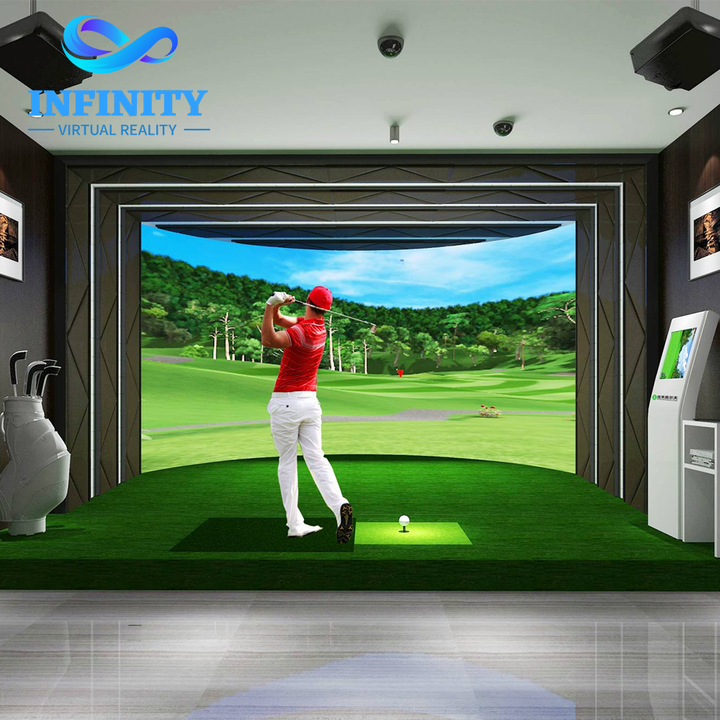
The hospitality-grade full set
Indoor AR Golf Simulator
Commercial and training-grade AR golf: high-speed camera ball detection, a 4K laser projector and interactive projection play in a short-depth bay - the configuration this guide recommends for hotel and resort floors.
View Details ›
10. Key Takeaways: Building the Hotel and Resort Golf Line
Five lines to carry into an indoor golf decision for a hotel or resort.
- Price it as a venue, not an amenity: guest sessions + local memberships + event buyouts, with the bar attached on top.
- Specify short-depth camera detection with 4K laser projection: it fits a 3-4 m hotel room and is guest-operated with minimal staffing.
- Size the tier to the property: a 15 m2 single bay for guest amenity, ~30 m2 two-bay resort club, ~45 m2 four-bay event center.
- Build the revenue case on published numbers: ~USD 55/hr median, 36% utilization with ~25% break-even, USD 95-115K per-bay benchmarks, and the 14-20 month single-bay payback path.
- Plan the F&B side in advance: golf is a dwell-time sport and F&B attachment is roughly 73 percent of the session value in the operator survey, with the published +35 percent lift case as proof.
Start with the room: measure depth, ceiling and sightline, and drop the bay onto the actual floor plan with the free 3D layout design. The step-by-step sportainment equipment buying guide holds the full purchasing routine, and the 15 m2 bay economics at the AR golf bay case is the honest planning anchor for the first bay.

