How to Package Archery for Birthday Parties and Corporate Events
Block the lane, not the session: 60-90 minute party and corporate packages built on the published $12-20 session band - host, tournament format, food slot and photo moment, priced at 2-3x the walk-in hourly equivalent.
Sep 27th,202618 Puntos de vista
ARCHERY PACKAGING - PARTIES AND CORPORATE EVENTS
How to Package Archery for Birthday Parties and Corporate Events
Block the lane, not the session: 60-90 minute party and corporate packages built on the published $12-20 session band - host, tournament format, food slot and photo moment, priced at 2-3x the walk-in hourly equivalent.
Block, not session$25-35 per guest (EXAMPLE)Tournament as the main eventCorporate weekday fillCalendar over discountTwo-lane party logic
$25-35
Per-Guest Birthday (EXAMPLE)
90 min
The Block
2-3x
vs Walk-In Hourly
12
Guests per Block
1. What It Is: Blocking the Lane, Not Selling the Session
The walk-in session and the party block are different products sold from the same lane. The walk-in books the published $12-20 per 15-minute session; the party books the lane itself for 60-90 minutes, with a host, a tournament format and a food slot - and prices out at two to three times the session band's hourly equivalent. That premium is the whole packaging game: the hardware sells the arrows, the package sells the schedule (the published profitability model prices the corner the packages run on).
Archery's packaging advantage is the turn-based format. Ten guests watch every arrow, the score climbs in public, and the finals moment lands without any added production - the tournament modes from the published games list are the party's main event, not a side quest. Corporate events buy the same mechanic with a different story: coached progression, a scored tournament, a debrief that writes itself.
In one line: sell the lane as a 60-90 minute block at 2-3x the session band's hourly equivalent - host, tournament, food slot, photo moment - and the same hardware books twice.
2. How It Works: The Party Package, Line by Line
The birthday block, built from the published anchors: eight to twelve archers on a 90-minute block, tournament rounds every ten minutes, food at halftime, finals in the last fifteen. Priced at $25-35 per guest on the $12-20 session band (EXAMPLE frame), a twelve-guest party books $300-420 for the block - against the $48-80 an hour the same lane earns at full walk-in pace ($12-20 per 15 minutes, back to back). The premium is not a markup; it is the host, the format and the exclusivity the walk-in never buys.
The corporate block tells the same story to a different buyer: ninety minutes of coached progression, a team tournament with a named prize, and a debrief slot. Corporate tickets clear the birthday band because the buyer is not a parent - it is a budget line - and the weekday daytime calendar they fill is the lane's dead zone at walk-in rates. The published how-to-play guide is the coach's script for both formats.
Package line (EXAMPLE frame)
Birthday (8-12 guests)
Corporate (10-16 guests)
What it costs the venue
Lane block
90 min weekend block
90-120 min weekday block
Calendar, not cash
Host and coaching
Included host
Coached progression
One staff hour
Tournament format
Modes + finals
Team tournament + prize
Scores run themselves
Food and drink slot
Halftime table
Catered or F&B credit
Passes to the F&B register
Per-guest price
$25-35 (EXAMPLE)
$35-50 (EXAMPLE)
vs $12-20 walk-in session
Planning assumptions, stated: the package table is an EXAMPLE frame on the published $12-20 session band - package prices are planning references, not a rate card, and food economics follow your own F&B register rather than this table.
Lane Revenue Per 90 Minutes by Booking Type (EXAMPLE, mid-band)
Walk-in sessions
65
Birthday block
360
Corporate block
420
Source: worked scenario (EXAMPLE) - walk-in row is the published $12-20 session band at walk-in pace; block rows are the package frames above on a twelve-guest booking. Planning references, not quotes.
3. Who It Is For: The Calendar That Pays for the Corner
The party calendar is why the second station exists. One lane can host a weekend afternoon birthday and lose the walk-in wave at the same time; two lanes run the party on one and the wave on the other - which is the exact capacity logic the stations guide works through. The published corner math (16-24 guests per lane-hour, 10-15 square meters per lane) sizes the room; the package calendar fills it.
The weekly shape, as a planning frame: weekend afternoons belong to birthdays, weekday daytime belongs to corporate, weekday evenings stay open to leagues and walk-ins, and one weekend block per day stays open for the impulse party. A lane that follows that shape books the packages where they pay a premium and never cannibalizes the session traffic that feeds the payback model.
Sample Lane Calendar - Blocked Share of Lane-Hours by Slot (EXAMPLE)
Mon day 40Wed day 55Fri eve 10Sat am 30Sat pm 75Sun pm 70
Source: worked scenario (EXAMPLE) - share of lane-hours sold as party/corporate blocks across a sample week; weekend afternoons and weekday days are the block slots, evenings stay at session rates. Planning references, not measurements.
4. Where It Fits: Operations, Hardware and the Next Block
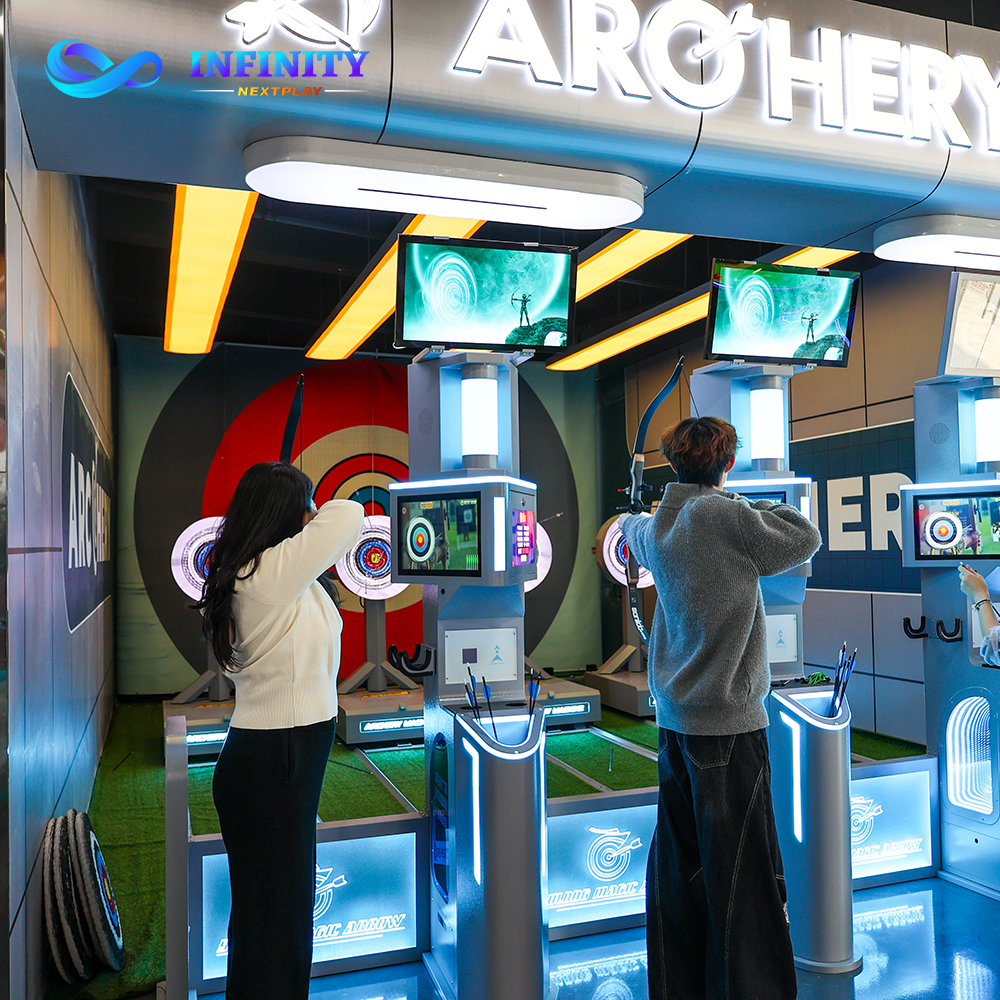
Operations: the party runs on one host and a visible scoreboard. Stage the waiting group in front of the lane (the spectator geometry the sportainment zoning pattern prices), run the score display outward so the room watches, and hand the food slot to the F&B register - the party's halftime is the counter's best half hour. The hardware does not change between a session and a block: the Archery Simulator A4 runs the boutique party and the Archery System A6 runs the multi-lane corporate final with auto voice scoring.
Where the packaging sits in the venue: the archery block is the precision anchor of the party offer - the adrenaline packages put the LED floor or the arena wall beside it, and the full-venue pattern is the published sportainment guides subject. The floor plan that makes the block work is a layout question: the free 3D layout design stages the lane, the staging area and the food path together.
The next block is the business model: every party host collects the contact list for the next booking, the corporate debrief ends with the next quarter's team event, and the photo moment is the social proof that fills the calendar without ad spend. Packaging is a repeatable product, not an event.
Where a $360 Birthday Block Lands (EXAMPLE split, 12 guests)
Lane block premium 55
Host and coaching 20
F&B halftime 18
Consumables and prizes 7
Source: worked scenario (EXAMPLE) - revenue-side split of a sample twelve-guest birthday block at $30 per guest; F&B lands in the register, not the lane line. Planning references, not prescriptions.
5. The Defended Answer
Package the lane, not the session: a 60-90 minute block with a host, a tournament format, a food slot and a photo moment, priced at $25-35 per guest for birthdays and $35-50 for corporate on the published session band (EXAMPLE frames). Two lanes run the block and the walk-in wave at once; the calendar - weekend afternoons to birthdays, weekday days to corporate - is what pays the corner back faster than the published payback window assumes.
The buyer's one-line brief: block the lane at 2-3x the session band, let the tournament be the entertainment, and let the calendar - not the discount - fill the dead slots.
6. Frequently Asked Questions (FAQ)
How do you package archery for a birthday party?
Block the lane, not the session: a 60-90 minute birthday block on the published $12-20 session band prices out at roughly $25-35 per guest for eight to twelve archers, with tournament modes from the published games list running as the party's main event and the food table doing the halftime.
What makes archery work for corporate events?
The skill narrative. Corporate buyers pay for coached progression - everyone improves visibly inside an hour - and the lane's turn-based format keeps the whole team watching, which is the team-building mechanic. Add a scored tournament with a named prize and the debrief writes itself.
How many guests can one archery lane handle for a party?
Twelve to sixteen guests in a 90-minute block works comfortably: the lane clears 16-24 guests per hour at session pace, but parties run on tournament rounds rather than raw throughput - plan the block backward from the round count, not the walk-in rate.
What should an archery party package include?
Four things: a blocked lane with a host, a tournament format with finals, a food-and-drink slot, and a photo moment. The hardware sells the arrows; the package sells the schedule - the difference between a $12 session and a $30 per-guest booking.
How far in advance should archery parties be booked?
Weekend afternoon blocks fill first - two to three weeks ahead in a healthy room. Keep one weekend block per day open to same-day bookings; the impulse party is a real segment once the calendar is visible at the counter.
Can archery parties run during peak hours?
They can, but they should not have to: a party block pays a premium precisely because it occupies the lane the walk-in wave wants. Price the block above the session band's hourly equivalent and the calendar resolves itself - peak blocks are expensive, shoulder blocks are fair.
7. Featured NextPlay Active Gaming Equipment
The party lane
Digital Archery Simulator A4 - Adjustable Track Distance, Dual Screen
Dual screens and turn-based modes make the birthday block run itself - host optional, fun mandatory.
View Details ›
The corporate final
Professional Arcade Archery System A6 - Auto Voice Scoring, Dual Display
Auto voice scoring runs the multi-lane corporate tournament without a referee per lane.
View Details ›
The halftime slot
Immersive Interactive LED Floor Game
Carries the party's off-lane minutes - the adrenaline add-on in the same package.