FREE ROAMING VR ARENA - THE MULTIPLAYER FORMAT FAMILY, PARTY-SIZE LADDER AND FOOTPRINT TRUTH
Free Roaming VR Arena: The Complete Multiplayer Guide
Multiplayer VR is five different machines wearing one name. Here is the format family, a 2 to 16 player ladder, the three footprints that get confused, the session clock that decides throughput, and the four papers to demand from any supplier.
Five multiplayer formats Party-size ladder Three footprints Session clock Supplier papers Failure table Age and safety
2 4 8 16
The Party-Size Ladder
3
Footprints You Must Not Confuse
6 / Hour
Published Machine Cycle Clock
1. The Short Answer: Multiplayer VR Is A Family Of Formats, Not A Machine
Ask a supplier for "multiplayer VR" and you are asking for one of five quite different machines. A walking arena where a team moves through a defined tracked space under its own power. A standing platform where four players shoot from fixed cages in linked rounds. A row of cabinets wired together so each guest fights the others rather than the software. A motion chair that seats a group and moves them as one. An active gaming floor where the headsets come off and the guns stay in hand. They share a word and almost nothing else: different floors, different staff, different session clocks, different reasons to fail.
So the buying decision is not "should we add multiplayer VR", it is a sequence of three choices that have to be made in order. Which format fits the floor you actually have. What party size you want to be able to seat without splitting strangers into a match. And what session length you are willing to run, because that single number decides both your hourly capacity and whether the people who came as a group leave as one.
This guide is the map for that buying decision, and for anyone sizing a multiplayer VR attraction rather than shopping for a machine. It does not restate the cost, payback or revenue-per-hour arithmetic of any individual format, because each of those already has a page on this site that owns the numbers and shows its working; those pages are linked at the point where you would otherwise want them. What this page adds is the classification itself: the five formats side by side, a party-size ladder from two players to sixteen, and a distinction between three different footprints that venues routinely confuse.
One line worth setting early, because it is the most common way a venue buys the wrong machine. The biggest number in a product title is not a capacity. A format that can run ten players at once and a format that can seat your typical walk-in party in one match are different properties, and only the second one protects your Saturday.
- Decide the format before the model number: walking arena, standing platform, linked cabinets, multi-seat motion chair or headset-free active gaming.
- Decide the party size you must serve in one match, then read the machine upward from that number rather than downward from its maximum.
- Decide the session length you will program, because that is the lever that sets throughput, queue behavior and staff count at the same time.
2. Five Ways To Run Multiplayer VR
The table below is the whole family of multiplayer VR attractions. Each row is a real product class we or our peers sell, and the columns are the four things that actually differ between them: what the guests do with their bodies, how many of them the format can put in one match, what the floor has to give up, and how many staff the format needs to run a round safely.
| Format |
What the guest does |
One match seats |
Floor it demands |
What it is genuinely good at |
| Free-roaming arena |
Walks a defined space with a headset, a wireless controller and a lightweight gun prop |
Our current 2.0 sheet lists 4, 6, 8 and 10 player configurations; the 1.0 sheet it replaced lists 4, 6 and 8 |
A clear, tracked, obstacle-free combat volume plus a queue and a host station |
Groups who want to be inside the same game together; the format people mean when they say multiplayer VR |
| Standing platform |
Stands in an open frame, moves on a small deck or in place |
The platform sheet we publish is a four player configuration |
A machine box and a safety cage line, not a walking volume |
High throughput in a mall footprint where a walking arena is not permitted or not affordable |
| Linked shooting cabinets |
Sits or stands at one cabinet, shoots against the neighbouring cabinet |
Depends on how many cabinets you link |
One cabinet pitch per player, in a row you can watch |
Walk-in pairs and small groups; spectating from the bar line; cheap per-seat scaling |
| Multi-seat motion chair |
Sits, is moved by the machine, watches a scripted ride |
A four seat chair runs a group as one unit |
Machine box plus a clear swing envelope |
Impulse tickets, families with young children, queues that need to move |
| Active gaming floor (laser CS and similar) |
Walks a real arena with a tracking vest and no headset |
Team sizes are set by the game mode, not the machine |
A partitioned play space with lighting, hazards and a referee |
Birthdays, leagues and corporate teams; see how a laser CS battle arena works before comparing it to VR |
Notice that the first two rows are the only ones where the product page itself states the player count. That is not an accident of our catalog. In the arena and platform classes, capacity is a property of the machine you buy. In the other three, capacity is a property of how many units you install and how you program the session, which is why those classes are cheaper per seat and harder to sell as "a multiplayer experience".
If your question is specifically whether a linked row beats an arena per meter of floor, that comparison has its own pages, and they are worth reading before you commit: two VR arenas vs a row of shooters per meter and VR arena vs five shooting cabins on table turns. If you already run single cabinets and are wondering at what traffic level linking them pays, when to upgrade single cabinets to linked multiplayer rows answers it with a threshold rather than an opinion.
3. The Party-Size Ladder: Two, Four, Eight And Sixteen Players
This is the ladder we use when we size an arena for a client, and it is the part of the decision most spec sheets leave out. Each rung is not just a bigger room; it changes who can be sold the experience, what the host has to do, and how long a round takes to reset.
| Rung |
Who books it |
What the format has to provide |
What breaks first if you skip it |
| 2 players |
Couples, one parent and one child, the impulse ticket |
A match that is fun at two, not a diluted version of an eight player mode |
Content. Two players in a game designed for eight is a quiet, empty room and a bad review |
| 4 players |
The standard walk-in group and the smallest birthday booking |
One session that seats the whole group together. Our arena sheets run their published round figures at four persons per round |
Nothing yet. Four is the rung the whole category is built around |
| 6 to 8 players |
Team building, the full birthday party, the after-work group |
A larger tracked volume, a host who can brief eight people at once, and match modes that balance two teams |
The queue. Eight person groups split into two sessions arrive as two angry halves |
| 16 players |
Corporate buyouts, leagues, school groups |
Two eight-player sessions running in parallel or back to back, plus a booking system that holds a slot |
Your assumption that one machine can do it. Nothing we build or publish is a sixteen player walking arena |
The top rung deserves the honest version, because it is where sales conversations go wrong. A venue that must serve sixteen people at once is not buying a bigger arena; it is buying a layout, and that top rung is our own layout model rather than a machine specification published by any vendor. The largest simultaneous figure on our own arena sheet is ten players, and the largest per-session figure published anywhere on this site is a corporate pitch built around eight to twelve players per session, which is a booking window, not a room.
A 16 player party is two 8 player sessions in a planned venue, or one 8 player session and a waiting list. It is never one machine, and you should treat any supplier who quotes it as one as a layout conversation, not a purchase.
Below the ladder sits the arithmetic that turns party size into capacity, and this is where we have to be careful about which clock we are quoting, because our own published pages use two of them. The product sheet for both arena generations states four persons per round, a round of about three to five minutes, and six rounds an hour. The scheduling model behind our arena day-plan page uses an eight minute game plus a two minute reset, which is the same six turns an hour. The model behind our ROI blueprint uses a twenty to thirty minute format including briefing, and it publishes its peak-hour output as ten to twelve player bookings an hour per pod, which is a count of people through the door rather than a count of turns.
| Basis |
What it states |
Where it comes from |
How to use it |
| Machine cycle |
4 persons per round, about 3 to 5 minutes per round, 6 rounds per hour |
Both of our arena product sheets, read on 2026-09-20 |
The physical ceiling. It is what the equipment can do, not what your guests will buy |
| Short session plan |
8 minute game plus 2 minute reset equals 6 turns an hour |
Our published 60 square meter arena day plan model |
A walk-in operation running the machine cycle with gearing and de-gearing folded in. What that clock produces per hour is carried on the linked page and is not restated here |
| Premium session plan |
Sessions of 20 to 30 minutes including briefing and fitting, up to 8 players per session. The blueprint publishes its peak output as 10 to 12 player bookings an hour per pod, which is people, not turns |
Our published free-roaming VR ROI blueprint model |
Booked, hosted, higher-ticket operation. Two to three turns an hour on that clock, our own division of 60 minutes by the session length, so fewer turns than the six above and the money has to come from the ticket |
| Vendor comparison |
A competing operator states 15, 30 and 45 minute formats, up to 8 players every 30 minutes, and typically one to two staff per arena |
Reported by Zero Latency in its investor FAQ |
A sanity check on your host ratio and your session length, from a company that has run this format for years |
| Vendor comparison |
A cabinet-based system reports about 40 players an hour from five minute games |
Reported by Hologate |
What the fixed-position class looks like at the same clock, for contrast |
Our own model on the ladder, stated as a model: at six turns an hour, the four, six, eight and ten player configurations that our arena sheet lists correspond to 24, 36, 48 and 60 players an hour at full occupancy. The four player figure is the one the sheet evidences. The 36, 48 and 60 are straight extrapolation of the same clock onto bigger teams, and in a real venue they will not hold, because longer team prep, a longer briefing and a slower reset all grow with party size.
Players Per Hour At Six Turns, Our Model, Full Occupancy
4 player configuration
24 / hour
6 player configuration
36 / hour
8 player configuration
48 / hour
10 player configuration
60 / hour
Based on our models, not a measured figure: the product sheet evidences 4 persons per round at 6 rounds an hour; the higher tiers extrapolate the same clock and will be reduced in practice by longer briefing and reset at bigger party sizes. Utilization, not this number, is what decides your takings.
Read that against the two published throughput bands for this category rather than trusting our extrapolation: why free-roam VR arenas hold guests 40 extra minutes works a per-hour band for grouped walk-in parties, and how many players one arena hosts per hour works a fuller band at higher occupancy. Both are on those two pages with their assumptions shown and neither is restated here. What matters for the ladder is the shape of the agreement: both start at the four player rung and separate above it, and where they separate is where your session design lives.
Source basis: the round length, rounds per hour and player configurations are quoted from our own live product pages on 2026-09-20. The 24, 36, 48 and 60 figures are our arithmetic on the sheet clock and are labelled as a model in the text. The competing-operator session formats, the 98 and 128 square meter arena footprints and the one to two staff figure are reported by Zero Latency. The cabinet throughput comparison is reported by Hologate. The two published throughput bands for this category are linked in the paragraph above and are not restated on this page; their figures, their denominators and their assumptions live on the pages that own them.
4. Three Footprints, And Only One Of Them Is Sellable
Venues buy an arena off a single number on a spec sheet and then discover that the number was one of three different areas. It is worth learning to tell them apart before you sign anything, because the gap between them is paid for in rent every month of the venue life. In the layout model this section builds further down, a four player arena that reads 64 square meters on the sheet needs about 121 once the lane around it is counted, which is most of the floor again on top of the number you were quoted.
| Footprint |
What it is |
Who controls it |
How it is misused |
| Clear combat volume |
The tracked, empty, walkable space players are inside during the match, with no column, wall pad or cable run in it |
The tracking system and the game content |
Sold as "the space you need" when it excludes everything guests actually touch |
| Machine and kit box |
The physical structure: platform frame, cage, gun rack, charging and storage, host desk, screens |
The supplier drawings |
Ignored entirely at lease stage, then discovered during fit-out when the fire route is already fixed |
| Gross guest zone |
Combat volume plus gearing and briefing area, the queue, the spectator band, staff access and the evacuation route |
Your landlord, your fire officer and your operation |
Subtracted from the argument by everyone who wants to say yes to a smaller room |
Our own two arena generations disagree about the first of these, and we are not going to average them into a number that appears on neither page. The 2.0 sheet gives an 8 by 8 meter area for a four player configuration, a 10 by 10 for six and a 10 by 15 for eight or ten. The earlier 1.0 sheet gives 6 by 6 or 7 by 5 for four players as its worked example. Same nominal party size, roughly 36 square meters against 64, and the difference is exactly the difference between a combat volume and a playable room.
| Stated area |
What the source is actually describing |
Party size |
| L6 by W6 m or L7 by W5 m |
Our 1.0 arena sheet, given as an example footprint |
4 players |
| L8 by W8 m |
Our 2.0 arena sheet, the current generation |
4 players |
| L10 by W10 m |
Our 2.0 arena sheet |
6 players |
| L10 by W15 m |
Our 2.0 arena sheet |
8 or 10 players |
| 98 m2 (1,055 sq ft) |
Reported by Zero Latency as a six player arena |
6 players |
| 128 m2 (1,378 sq ft) |
Reported by Zero Latency as an eight player arena |
8 players |
| 6 by 6 m (20 by 20 ft) as a standard minimum |
Reported by the Synthesis VR arena space guide for free-roam titles |
up to 4 players |
| 10 by 10 m (33 by 33 ft) |
Reported by the same guide as the scaled-up footprint for eight player titles |
8 players |
Put the four sources in order of who has to defend the number and it becomes useful rather than confusing: your game publisher tells you the minimum playable volume for their title, your equipment supplier tells you the volume they can track and insure, and your landlord, fire officer and queue tell you the gross zone. The first number is always the smallest and it is never the one you budget.
Our own gross-zone model, stated as a model. Take the three 2.0 sheet combat boxes, 8 by 8, 10 by 10 and 10 by 15, and put the 1.5 meter safety lane that our own payback-mistakes page publishes all the way around each one. The 8 by 8 becomes 11 by 11, which is 121 square meters for four players. The 10 by 10 becomes 13 by 13, which is 169 for six. The 10 by 15 becomes 13 by 18, which is 234 for eight to ten. Based on our layout model, that is 56 to 89 percent more floor than the number printed on the sheet, or 23 to 30 square meters of gross zone per player. Two things about that premise before you use it. We read the sheet box as clear combat floor, and no arena sheet on this site says which of the three areas it prints, so if a supplier number already contains the lane you would be adding it twice. And our 169 square meters for six is a lane-added model, while the 98 square meters that Zero Latency reports for a six player arena is what an operator publishes about rooms it runs, so the two are not rival estimates of the same quantity and only one of them has an operating venue behind it. It is a first-pass planning ceiling, not a design target, and a room with a column grid, a fire route through the middle or a spectator wall on one side will land somewhere else.
Source basis: all eight area lines are quoted from either our own live product pages (read 2026-09-20) or a named third party, and none of them is our measurement of a working venue. The 121, 169 and 234 square meter gross figures, the 56 to 89 percent gap and the 23 to 30 square meters per player are our own layout model built on one stated premise, that the sheet box is clear combat floor, and the arithmetic is printed in full: 1.5 meters added to all four sides of each 2.0 sheet box, then divided by the party size printed on that sheet, which gives 121 divided by 4 equals 30.25, 169 divided by 6 equals 28.2, 234 divided by 8 equals 29.25 and 234 divided by 10 equals 23.4. Note which direction the ratio runs, because our own pages look contradictory if you do not. The payback-mistakes page works the other way, from a 96 square meter room down to about 70 square meters of combat floor, a loss of about 27 percent, and that is because its 96 already contains equipment pods, a host desk and spectator seating. A combat-to-gross ratio and a gross-to-net ratio are not the same quantity and are not averaged here. The lane allowance itself, a 1.5 meter safety lane around a four player combat round, is quoted from that same page. For the sizing decision itself, read how big a small venue VR arena should be and the five mistakes that kill arena payback rather than trusting a single number here; how much space each attraction needs covers the arena alongside the rest of the floor.
5. What A Multiplayer Session Actually Runs Like
The session is where a multiplayer attraction either earns its premium or wastes its floor, and it has four parts that venues price as if they were one: briefing, gearing, the match, and the reset. The match is the shortest of the four and the only one the product sheet measures.
Two clocks exist in our own published material and they are not interchangeable, so it is worth naming both. The product sheet clock is three to five minutes per round at six rounds an hour. The programming clock, on the page that deals with payback mistakes, is that a five minute arena round turns the arena into a gimmick ride and the length that works is a fifteen minute group match. Both are true statements about different things: the first is what the equipment can cycle, the second is what a group will pay for and tell a friend about.
The operational consequence is that you choose your session length first and then let it dictate your equipment, not the other way round. A fifteen minute format with briefing and gearing is roughly a half hour per group, which is two groups per slot per hour, which is a booking business with a host and a schedule. A five minute ride-the-machine format is a turnstile business with a queue and no booking. Both can work in the same venue; neither works on the staffing model of the other.
| Session part |
Typical planning allowance |
Who does it |
What it decides |
| Briefing and safety talk |
3 to 5 minutes per group, longer for first-timers and corporate teams |
Host, from a fixed point outside the play volume |
Whether your staff ratio is one host per session or one per two |
| Gearing and de-gearing |
2 to 4 minutes, and it grows with party size |
Staff fitting headsets, pads and gun props; hygiene step inside this window |
How much of your capacity is consumed between matches |
| The match |
The content decides. Our sheets state 3 to 5 minutes; published venue formats run 15, 30 and 45 |
Players, refereed |
Ticket price and word of mouth |
| Reset, score display and handover |
1 to 2 minutes plus whatever the leaderboard takes |
Staff and the screen |
Whether the next group sees a result or a blank wall |
The host ratio is the line item that quietly kills arena economics. The competing operator we cite above states typically one to two staff for an arena; that is a small-venue figure for a format with a briefing, a safety watch and a gearing station. If your session design needs a third person on the floor every peak hour, that is the difference between an attraction margin and a wage bill with a headset on it.
Two parts of the session have their own published pages on this site and you should read them rather than take our word for the sizing: how long groups stay and what group combat does to dwell time (why free-roam arenas hold guests forty extra minutes), and what the queue and the people not playing are worth to the bar (how spectator screens lift arena drink sales). Repeat behavior, which is the whole argument for a longer format, is covered on why VR arenas see higher repeat rates.
Source basis: 3 to 5 minutes per round and 6 rounds per hour are quoted from our arena product pages as they stood on 2026-09-20. The 15 minute group match and the criticism of the 5 minute round are published on this site. The 15, 30 and 45 minute formats and the 1 to 2 staff figure are reported by Zero Latency. The per-part allowances in the table are our own planning ranges for a hosted four to eight player session, not measured timings.
6. The Build Behind The Multiplayer Promise
Everything in the previous three sections is decided by what is behind the wall: the content license, the tracking method, the network and the hygiene loop. Four papers to ask any supplier for, and what each one tells you.
One. Content license, per title, per site. The consumer license on a game you can buy on a store covers one person playing on their own headset; Synthesis VR states plainly that it does not cover a business running that game across multiple stations for paying customers, day after day, and the Meta Quest storefront terms of sale restrict a consumer purchase to personal, non-commercial use. Commercial location-based licensing is a separate purchase, and it is priced per session, per credit, per concurrent seat, per location or per event. Ask which model applies to your title list and what happens to your content library if you move or resize the arena.
Two. Tracking method and what it needs in the room. Our 2.0 sheet describes the arena as a first-person shooter without backpacks, wires and other restrictive accessories, with free movement on a defined area, a wireless headset and a lightweight gun prop, and our standing platform sheet lists a laser positioner, an iron frame and headsets in the same block. Other published pages in this cluster, such as the 2026 VR arena setup cost breakdown, budget a backpack PC and ceiling tracking as separate lines. The point is not which architecture is better; it is that these are different bills of materials with different ceilings, floor loads, cable routes and maintenance owners, and a quote that does not name the tracking method is not comparable to yours.
Three. Network design, and it is a latency question not a bandwidth question. Synthesis VR puts this usefully: for all-in-one free-roam headsets the wireless does not carry video frames, it carries multiplayer session data, which keeps bandwidth requirements relatively low but makes latency and reliability critical. The same provider separates headset traffic onto its own band and its own VLAN, and states that most of that configuration work happens on site, physically in the space, which is not work a platform or a remote support team can do on your behalf. The Cisco Meraki high-density design guidance gives planning figures worth asking your installer to design against: around 25 clients per radio or 50 per access point in a high-density deployment, and a maximum of three SSIDs, which in a high-density environment the vendor describes as a requirement rather than a recommendation, because additional SSIDs burn airtime with management frames. Varjo states around 20 milliseconds as the engineering threshold at which latency becomes meaningful in a headset; treat it as a stated figure from one manufacturer, not a scientific constant.
| Paper to ask for |
What a complete answer contains |
What a bad answer looks like |
| Content license schedule |
Title by title, the commercial model, the territory, the term, and what happens to the library if you change venue |
A game count with no license basis behind it |
| Tracking and infrastructure bill of materials |
Positioning method, host or PC chain, ceiling and power requirement, mounting responsibility, who supplies the network gear |
A player count and a floor area and nothing else |
| Network design note |
Band and VLAN plan, access point count and placement, expected concurrency, an on site commissioning visit |
A router model number |
| Hygiene and consumables plan |
Pad and cover system, wipe chemistry the headset maker accepts, replacement cadence and unit cost |
A spray bottle |
Four. Hygiene loop and consumables, because in a shared headset this is a between-players task, not a closing-time task, and it sits inside the reset window you already priced. The published pages on this site cover the replacement interval (how often commercial VR headsets need replacing), the choice of a commercial unit (how to choose a commercial VR headset) and the routine itself (how often to sanitize headsets between sessions and what sanitization routine keeps headsets safe). Ask one question of any supplier here: which pads are consumable, what do they cost per thousand sessions, and does the wipe they recommend match what the headset maker says about that material.
One supply caution worth knowing before you build a hardware plan around a specific headset brand, including the brand named on our own sheets. Independent commentary reported in this cluster is that Meta stopped selling dedicated commercial Quest hardware and stopped onboarding new managed-service customers in February 2026, which means units bought now are consumer devices with consumer warranty terms attached. Write it as reported rather than as a manufacturer announcement, and confirm the current position with your own supplier before you commit a fleet size.
Source basis: the license boundary is quoted wording from Synthesis VR and the consumer storefront restriction is quoted from the Meta Quest store terms of sale; both are vendor-stated readings of their own paperwork and neither is legal advice. The session-data-not-video-frames description, the VLAN and on-site commissioning statements and the band separation are reported by Synthesis VR. The 25 clients per radio, 50 per access point and three SSID figures are reported by Cisco Meraki as high-density design practice, not code. The 20 millisecond figure is a stated engineering threshold from Varjo. The Quest commercial hardware line is independent commentary reported by a managed platform vendor. All headset interval, hygiene and selection figures live on the published pages of this site and are linked rather than restated.
7. What Breaks A Multiplayer Session
A single-player cabinet fails quietly. A multiplayer session fails in front of five people who all paid, and the failure list is short enough to run as a floor card. Each row below is a symptom your staff will see before the system reports anything, with the action that belongs to the operator rather than to the supplier.
| Symptom on the floor |
What it usually is |
The operator action |
| A player stops moving or walks into a wall |
Volume conflict: a guest inside the buffer, a prop left in the play space, or a boundary the briefing never covered |
Reset the boundary before the next session, and treat buffer depth as a design item, not a habit; the published sizing work is blunt about undersized buffer zones |
| One gun stops registering hits or a player seems to shoot the air |
Tracking coverage or occlusion at a specific spot, or a controller that has lost its reference |
Map the dead spot, log it, and raise it as a coverage question with the supplier rather than swapping hardware one unit at a time |
| Players describe the world as swimming, or one player pulls the headset off early |
Latency and frame delivery, mismatched IPD (interpupillary distance), or a guest who should not have been in that session |
Shorten the format for that guest group, check the unit and the fit, and keep the incident note; the first-aid and sickness protocol is a published page, not a rumour |
| Pad smell, fogged lens, a guest asking for a different headset |
The hygiene loop running behind the session clock |
Take the unit out of rotation rather than wiping and returning it mid-session; a shortage of ready units is a stock problem, not a cleaning problem |
| The room goes quiet before the match ends |
Unbalanced teams, or a mode that punishes the weaker side into quitting |
Fix it in the host script, not the hardware: team balancing and mode choice are content settings you control between sessions |
| The queue becomes the reason a group leaves |
A session length that no longer matches your booking model |
Either book the format or shorten it, but do not run a walk-in clock against a booked group |
| Heat and noise build through a Saturday |
Extract and equipment load planned from the catalog figure rather than the duty cycle |
The published heat work on this site covers headroom warmth, equipment airflow and HVAC load together; read it before you size a room, not after |
Two of those rows are hardware decisions in disguise. Coverage and latency are properties of the tracking chain and the compute chain, which means they were bought, not inherited, and the paper trail for both is in the build documents from the previous section. If a supplier cannot tell you where the coverage boundary sits in your room, you are buying an unknown with a player count on it.
8. Safety, Age Limits And Duty Of Care
A walking multiplayer arena is the one attraction in the venue where the guest cannot see the room, is holding an object, and is moving toward other people. The controls are not exotic, but they have to be written down, posted and enforced by staff who are not the host.
Start with the age line, because our own paperwork is a good example of why one number is not enough. Our arena product sheets state a suitable age of 3 plus. Meta and Sony set a much older minimum in their headset account policies, and the guidance recorded in this cluster is ten and up, with a parent-managed account for the ten to twelve band. Those two statements are not the same kind of rule: one is about whether a body fits the kit, the other is about who is permitted to hold an account and what the platform allows. Post the stricter of the two, in writing, at the desk, and make your staff enforce the posted number rather than the sheet.
| Control |
What it must be before opening day |
Where the detail lives on this site |
| Posted age and height rule |
One number per attraction, on a board, matched to the strictest applicable source: the machine sheet, the headset platform or your insurer |
The zoning chart on age and height rules each VR attraction should enforce |
| Pre-opening safety checks |
A signed daily list: boundary, floor, padding, cable routes, lighting, emergency stop, headset condition |
safety checks before opening a VR arena and the checks before the first rider in a VR zone |
| Incident response |
Who stops the session, who enters the volume, what happens for a fall, a collision or a sickness episode |
the first-aid protocol for a VR arena |
| Guest eligibility |
Pregnancy, heart condition, photosensitivity, recent alcohol, and the under-age decision, all on the waiver and all read by staff |
The published session design pages rather than this hub |
One boundary to hold: this is a planning guide, not a code, safety-standard or legal opinion. Occupancy classification, means of egress, fire loading and the licensing your jurisdiction may require are decisions for your local authority and your own consultants, and no equipment supplier can carry them for you. The venue pages above give you the operating checklist; the permission route is genuinely local, and the permit application itself names which party carries it, so get the architect and the contractor of record settled before anything is filed.
Source basis: the suitable age of 3 plus is quoted from our own arena product sheet, read 2026-09-20. The older minimum, the ten and up guidance and the parent-managed ten to twelve band are headset platform account policies, recorded in our fact register on 2026-09-20 from Meta and Sony documentation. The zoning chart that turns those policies into per-attraction rules is the linked page in the table above. Nothing in this section is a safety code, an occupancy limit or a legal opinion, and the point of naming three different age numbers is to stop the smallest one being read as permission.
9. Choosing The Right Multiplayer Format For Your Venue
Every multiplayer VR attraction is bought on the same three inputs and in the same order: the party you can reliably fill, then the floor you can genuinely give up, then the staff you can train. The machine comes last. Reversing that order is how venues end up with a ten-player arena that runs at four.
| If your venue looks like this |
The format to shortlist first |
Why, and what to read next |
| Mall kiosk or corridor unit, high walk-in flow, no booking desk |
Standing platform or linked cabinets |
Fixed footprint, no gearing bay, and the session clock is short enough to clear a queue. Compare the per-meter maths in which wins per meter |
| Bar, social club or arcade corner where the party is two to four adults |
Linked shooting cabinets with a spectator line |
Pairs and threes stay visible to their friends, and the drink sales argument is a published page: what the queue is worth |
| Destination venue with its own entrance, a booking desk and floor you can keep clear of a queue |
Free-roaming arena at the 6 or 8 player configuration |
Only this class holds a birthday or a corporate team in one match. Start the money conversation at how to launch a profitable VR arena |
| Family venue with young children and short attention spans |
Multi-seat motion chair plus one small arena, not an arena alone |
The chair takes the under-age demand the arena must refuse; the age work above is why |
| Team-building and league market, weekday demand to fill |
Arena plus a headset-free active gaming option |
Groups of eight to sixteen need sessions they can be booked into; see what corporate bookings need and why corporates pay double for buyouts, and how to fill a VR arena on weekdays |
Three questions to put to any supplier, in this order, and treat the willingness to answer them as information. Which of the three footprints does your quoted area describe. What is the license basis for the content at my player count, per title. And who commissions the network, on site, and against what concurrency.
If you want the format decision made against your actual floor plan rather than a table, that is exactly what our free 3D layout design service is for: send the plan and we come back with which configurations fit, where the buffer and the spectator band go, and what the room cannot hold.
10. What This Guide Does Not Cover
Deliberate omissions, so that nothing here is mistaken for the page that owns the number. There is no cost, payback, revenue-per-square-meter or per-head price in this article. Those figures exist on the arena cost blueprint, the setup cost breakdown, the commercial VR equipment budget lines, the revenue per square meter report, the launch model and the arena pricing guide, each with its own working shown, and a hub that repeated them would only make them drift.
There is also no measured performance. The 24, 36, 48 and 60 player figures, the sixteen player two-session layout, the 121, 169 and 234 square meter gross zones and the per-session part allowances are our planning models built on published product-sheet numbers; they are a starting point for a sizing conversation, not an operating forecast. The vendor figures are attributed to the vendors that publish them, and where an operator such as Zero Latency or a platform such as Synthesis VR states a number, that number describes their system and their formats, not yours.
Two areas are outside this site entirely and are not answered anywhere in here: what your local authority will require to permit this attraction, and what your insurer will condition cover on. Both are jurisdiction-specific, both are answerable, and both belong to a licensed professional in your market rather than to an equipment supplier anywhere in the world.
What this page does hold is the classification: five formats, a party ladder that stops honestly at the machine boundary, and three footprints that should never be traded against each other. Start from those, then read the owner page for whichever format survives them.
11. Free Roaming VR Arena And Multiplayer VR FAQ
The questions that decide a purchase, answered with the sheet figures, the attributed vendor figures and our own models marked as such.
What is a free-roaming VR arena?
A multiplayer VR format where a team wears a headset and a lightweight gun prop and walks a defined, tracked space under its own power, with no cable tether and usually no fixed seat. How the compute reaches the player is a question about the bill of materials rather than about the definition: our own pages describe an arena run without backpacks and, on the 2026 VR arena setup cost breakdown, budget a backpack PC as a separate line. Our current sheet describes it as a first-person shooter without backpacks, wires and other restrictive accessories, with free movement on a defined area, and lists 4, 6, 8 and 10 player configurations. What separates it from every other multiplayer VR class is that the guests cover the floor themselves, which is what makes the clear combat volume the number that matters.
How many players can a free-roam VR arena hold?
Our 2.0 arena sheet states configurations for 4, 6, 8 and 10 players, the 1.0 sheet it replaced lists 4, 6 and 8, and both generations publish their round figures at 4 persons per round. The largest per-session figure this site publishes is eight to twelve players inside a corporate booking window, and Zero Latency states up to 8 players every 30 minutes. So a machine that can track ten is not the same claim as a session that seats ten; read the party size you have to fill, then work upward.
Is a 16 player VR arena possible?
Not as one machine, and you should be suspicious of anyone who quotes it as one. Our largest published configuration is ten players. Sixteen simultaneous players is a layout: two eight-player sessions in parallel, or one eight-player session and a second slot, with a booking system and a host ratio planned for both. Treat it as a floor-plan question and get the layout drawn before anyone quotes hardware.
How much floor does a multiplayer VR arena need?
Three answers to the same question, and you need all three. Our 2.0 sheet gives 8 by 8 meters for four players, 10 by 10 for six and 10 by 15 for eight or ten, while the earlier sheet gives 6 by 6 or 7 by 5 for four. Zero Latency reports 98 square meters for a six-player arena and 128 for an eight-player one, and the Synthesis VR arena space guide reports a 6 by 6 meter catalogue minimum scaling to 10 by 10 for eight-player titles. What none of those necessarily includes is the briefing bay, the queue, the spectator band, staff access and the evacuation route, which is the number your landlord will hold you to.
How long is a multiplayer VR session?
Our sheets state about 3 to 5 minutes per round at six rounds an hour, which is the machine clock. The formats Zero Latency publishes run 15, 30 and 45 minutes, and this site has argued that a 15-minute group match is the length that works commercially while a 5-minute round reads as a gimmick ride. Choose the programming clock first, then size equipment, staffing and booking around it.
How many players per hour can one arena handle?
At the sheet clock of six turns an hour, four per round is 24 players an hour; that is our starting model and it agrees with the lower bound of the two throughput bands published on this site, on the free-roam dwell page and the arena capacity page. Our own day-plan model uses an eight-minute game with a two-minute reset, which is the same six turns. A booked premium format on our free-roam ROI blueprint runs 20 to 30 minute sessions with a hosted briefing and carries up to eight players a session. That page states its peak output as player bookings an hour rather than as turns, and 20 to 30 minutes a session is only two to three turns an hour on one pod. Fewer turns, a higher ticket, and never the two at once. Utilization is what decides your takings, not the theoretical figure.
Do I need a commercial license for multiplayer VR games?
Yes, and it is a separate purchase from the hardware. A consumer license covers one person playing on their own headset, and the Meta Quest storefront terms restrict it to personal, non-commercial use, so running the title across stations for paying customers is outside it. Location-based licensing is billed per session, per credit, per concurrent seat, per location or per event. Ask for the license schedule title by title, and ask what happens to the library if you resize or move the arena.
What staff does a multiplayer VR arena need?
Plan for a host who can brief a group, fit gear, watch the volume and stop a session, plus a second pair of hands at peak. Zero Latency states typically one to two staff for an arena. Party size, session length and whether you take bookings are what move you off that, and if you need a third person every peak hour your model is a staffing model with a headset on it.
Which is better for a venue: a VR arena or linked shooting cabinets?
Neither classically. An arena holds a group in one match and earns a premium ticket and a booking culture; a linked row is cheaper per seat, scales one unit at a time, keeps the party visible to the bar and turns tables faster on a short session. This site has published both sides of that comparison with the maths shown, and the deciding variables are your party size, your floor shape and whether you can staff a host at all times.
What breaks first in a multiplayer VR install?
Usually not the hardware. It is the volume: a guest inside the buffer, a boundary the briefing missed, a dead spot nobody mapped, and a hygiene loop that fell behind the session clock. Then the network, where the failure is latency and dropped session sync rather than raw bandwidth, which is why the design note you asked for is about concurrency and placement rather than megabits.
12. Featured NextPlay Active Gaming Equipment
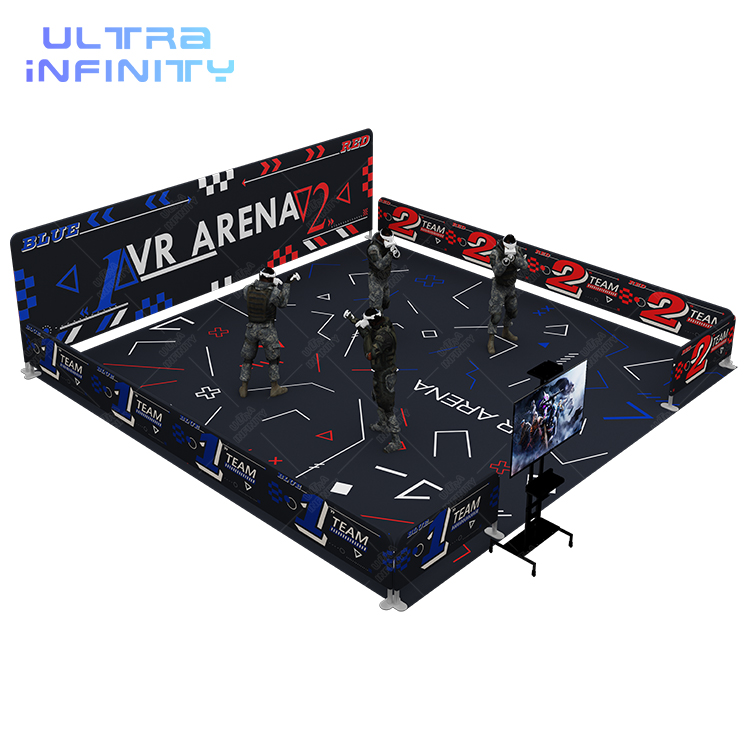
The top of the ladder: 4, 6, 8 and 10 player configurations
Free Roaming VR Arena 2.0 - Multiplayer VR Walking Shooting Simulator
Our current free-roaming generation, described on the sheet as a first-person shooter without backpacks, wires and other restrictive accessories, with free movement on a defined area, a wireless headset, a lightweight gun prop that children can control, and arena sizes customised to the player count. The published footprint starts at 8 by 8 meters for a four player build and runs to 10 by 15 for eight or ten, which is the configuration where the party-size ladder stops being a spec question and becomes a layout question.
View Details ›
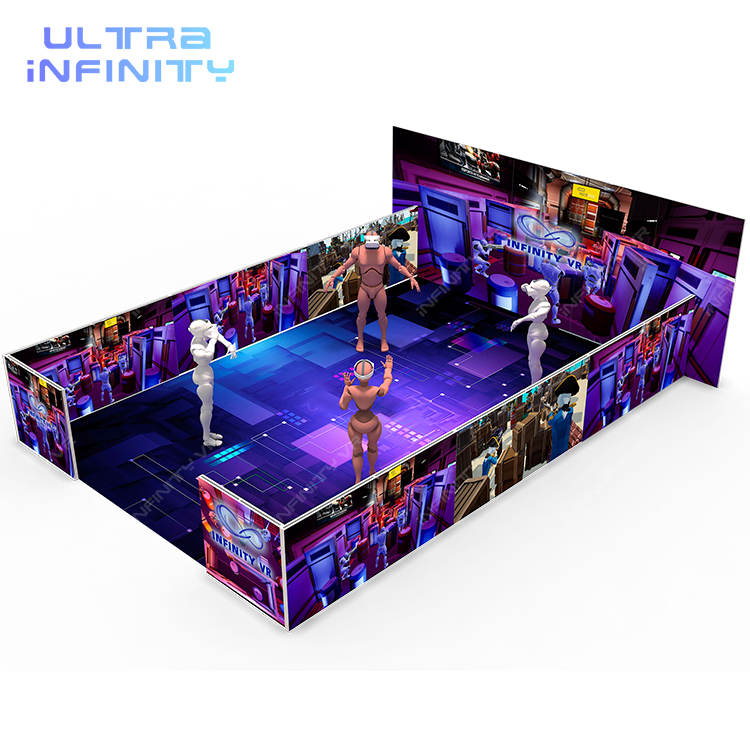
The smaller combat volume, and the honest way to compare the two
VR Arena - VR Multiplayer Game Simulator - Free Roaming Space
The earlier arena generation lists 4, 6 and 8 player configurations and gives a 6 by 6 or 7 by 5 meter example footprint for four players against the 8 by 8 meter figure on the current sheet. Read the two side by side before you buy any arena, from anyone: same nominal party size, materially different combat volume, and the difference is the room you have to lease. Round figures, 4 persons at about 3 to 5 minutes at six rounds an hour, are shared by both sheets.
View Details ›
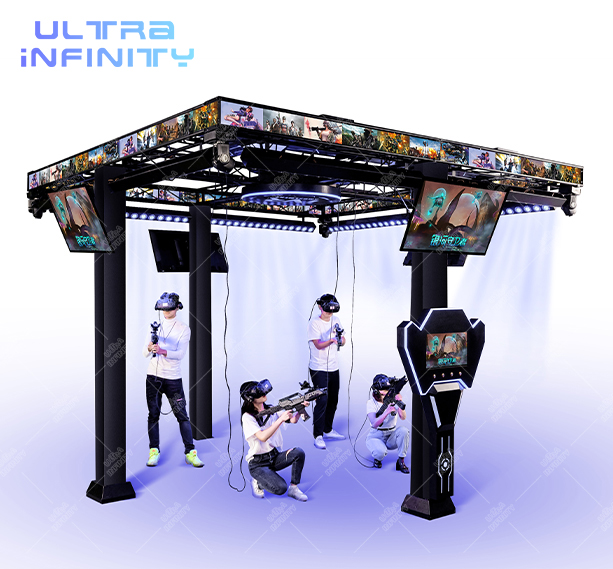
Multiplayer without the walking volume
VR Multiplayer Game Simulator - VR Standing Platform - Free Roaming Space
A four player standing platform: console and 42 inch display, laser positioner, iron frame, walking platform, headsets and gun props in one structure. This is the rung for venues that cannot give up a clear 8 by 8 meter combat floor but still want a group in one match, and it trades the walking space for a machine box you can site against a wall and staff from one position.
View Details ›

