Why Does VR Make You Dizzy? The Sensory Conflict Explained in Plain Language
VR nausea is a measurable disagreement: eyes say moving, inner ear says still, brain flags the mismatch. Published research shows matched motion cuts sickness scores - up to 33% from synchronized cues alone.
Sep 24th,202619 Puntos de vista
VR COMFORT SCIENCE - PLAIN LANGUAGE
Why Does VR Make You Dizzy? The Sensory Conflict Explained in Plain Language
VR nausea is a measurable disagreement: eyes say moving, inner ear says still, brain flags the mismatch. The published research shows matched motion cuts sickness scores - up to 33% from synchronized cues alone - and the fix is physics, not willpower.
Sensory conflict explained33% cut from motion cues15-30 s canal settle2-5 min chair rides12-15 min first sessions60-70% return when done right
33%
Cut by Motion Cues
15-30 s
Canal Settle
2-5 min
Chair Ride Length
12-15 min
First-Timer Cap
1. Why Does VR Make You Dizzy? The Sensory Conflict Explained in Plain Language
VR dizziness is not a hardware defect and it is not in your head in the dismissive sense - it is a measurable disagreement between two of your senses. Your eyes report movement. Your inner ear reports stillness. Your brain, evolved to treat that exact combination as food poisoning, responds with nausea. Understanding that one mechanism explains why some people never feel it, why some headsets are more comfortable than others, and why the fix is physics rather than willpower. This guide explains the mechanism in plain language, what the research says actually helps, and how riders and venues put it into practice.
The mechanism in one sentence: eyes say "moving," inner ear says "still," brain says "something is wrong" - that disagreement is what VR motion sickness measures.
2. The Sensory Conflict, Explained Like You Are Five
Your sense of balance lives in your inner ear, in three fluid-filled loops called the semicircular canals. When your head turns, the fluid lags behind, tiny hairs sense the drag, and your brain reads it as rotation. For most of human history this system worked flawlessly, because everything your eyes saw moving was something your body was actually doing. VR breaks that contract: a headset pins a pin-sharp moving world in front of eyes that cannot tell the image is fake, while the chair under you stays perfectly still. The published motion-sickness guide describes the result as sensory conflict - and the brain treats a virtual roller-coaster drop as real motion the body is not doing. That mismatch is the trigger, and every real fix works by shrinking it.
The science caught the mechanism on camera. A 2021 EEG study exposed riders to increasing levels of mismatch between vestibular and visual input and traced the queasiness in brain activity - the same visual-vestibular conflict the classical theory predicted, now visible as brain signatures. The laboratory fix has consistently been to shrink the mismatch, not to will yourself past it.
3. What the Research Says Actually Helps
Three findings from the published research stack point the same direction: match the motion, and the nausea shrinks.
Matched rotation beats mismatched rotation. A 2023 study in Frontiers in Virtual Reality put riders on a swivel chair watching robot-camera footage and compared rotations that matched the video against rotations that did not. The matched rotation significantly reduced simulator-sickness scores. Knowing when the rotation was coming helped further - preparation removed another layer of surprise.
Body alignment matters. A 2025 postural-alignment preprint found that misaligning the trunk with the virtual trajectory raised discomfort, while aligning the body with the virtual motion helped - the human version of telling the inner ear "yes, we really are rotating."
Peripheral cues are cheap medicine. A 2026 in-car VR study showed that motion-synchronized peripheral cues cut total simulator-sickness scores by 33% without harming task performance. Even a stationary cockpit can borrow this trick: a moving dashboard edge, a synchronized vignette, a steering-wheel shaker.
The principle behind all three is the same, and it is the reusable takeaway of this guide: match the movement, reduce the nausea. It is also exactly the product logic behind the rotating VR chair - the 360 motion chair analysis documents a ride pair of 360-degree yaw plus 45-degree pitch running 70-plus titles at 2-5 minutes per ride, which puts the matched-rotation behavior the studies isolate directly into the seat.
Condition
What the Inner Ear Gets
Reported Comfort
Static VR (fixed seat)
Nothing - pure mismatch
Lower (conflict-driven)
Swivel chair, mismatched rotation
Rotation, wrong timing
Middle
Rotating chair, matched rotation
Rotation, matched timing
Higher (in studies)
Rotating chair + known cue
Prepared rotation
Highest
What the Published Research Cut (relative sickness-score reduction, indexed)
Peripheral motion cues (2026 in-car study)
33
Matched rotation vs mismatched (2023 study)
25
Known cue before rotation (preparation effect)
15
Source: published studies summarized in the motion-sickness guide (blog 2564 / ue 813): the 2026 in-car study reports a 33% total score reduction from motion-synchronized peripheral cues; the 2023 Frontiers study reports significant reduction from matched rotation (indexed here at 25 for comparison) with a further drop when the rotation cue was known in advance (indexed at 15). Index values are illustrative comparisons of direction and magnitude, not raw cross-study equivalents.
4. Why the Chair Trick Works - and When It Still Loses
A rotating chair attacks the conflict at its source: it gives the inner ear a real rotation to match the screen. But the chair is a reducer, not a delete key. The published guide names three losing conditions. First, fast reversals: when the virtual track snaps direction while the chair is still decelerating, eyes and inner ear disagree during the ~15-30 seconds the canal fluid needs to settle. Second, content too aggressive for your adaptation level - a first-time rider who jumps straight to a hard 360-degree inversion starts with zero adaptation. Third, and biggest, personal inner-ear sensitivity: people who get car-sick carry that sensitivity into VR, and age shifts it - younger riders often adapt faster, older riders and people with balance conditions are more susceptible.
Inner-Ear Settle Window vs Ride Length (seconds)
Canal settle floor 15 sCanal settle ceiling 30 sChair ride, short end 120 sChair ride, long end 300 sFirst-timer VR session 720 sFirst-timer session cap 900 s
Source: published timing anchors - canal settle window ~15-30 s and chair rides 2-5 min (blog 2564 / ue 813); first-timer sessions 12-15 min max with sickness peaking at minute 3-5 (blog 1018 / ue 552). Log-scale intuition: the settle window is a fraction of the ride, and the ride is a fraction of a safe first session.
The timing chart shows why venue pacing works: the 15-30 second canal-settle window is tiny against a 2-5 minute ride, and the ride is short against a 12-15 minute first-timer session. Gaps between rides give the canals their settle window; short rides end before nausea can build; and the first five minutes of any first session remain the danger zone to watch.
5. The Venue Playbook: Comfort as an Operating Discipline
Picture a concrete scenario: a family walks up on a Saturday, the attendant asks the sickness question, offers the free face mask and starts the first-timer on the gentlest title. At minute five - the peak risk window - the attendant checks in; the kid is laughing, so the session extends, and the family books the return visit on the way out. Now replay the same Saturday without the script: the operator sells the full 25-minute session, the sickness peaks at minute five, the guest leaves at minute ten, and the refund is written off. Same machine, same content - the script is the difference between a 60-70% repeat rate and under 20%. Good venues treat motion comfort as operations, not luck. The first-day guest analysis puts numbers on the stakes: a first-timer whose session runs without sickness, stutter or hygiene doubt returns at a rate of 60-70%, while a guest who hits any one of the three failures returns at under 20%. The toolkit stacks in order - a 2-5 minute ride length for chairs, a content ladder that starts easy and escalates, brief gaps between rides so canals can settle, ventilation and a cool boarding area, and a clear "step out anytime" policy. The first-timer script adds the rest: a sickness question at the counter, the gentlest title first, smooth-turning instead of snap-turning, and the five-minute symptom check with an exit path that costs a partial credit instead of a lost customer.
Hardware hygiene matters as much as ride design. The published VR loop analysis sets the frame budget at about 11 milliseconds per frame at 90 Hz with a 90-120 Hz comfort band, and the first-day guide sets the latency ceiling at 20 milliseconds round trip for head tracking - the loop explainer shows exactly why a headset that misses those numbers makes riders sick within minutes, no matter how good the content is. The first-aid protocol guide covers the last mile: what trained staff do when a rider does feel unwell, from the immediate exit to the hydration-and-break rhythm.
6. Practical Advice for Riders and Parents
For riders: tell the operator it is your first time, ask for the mildest title, keep the first session short, and stop the moment anything feels off - adaptation compounds over sessions, so there is nothing to win by pushing through. For parents: follow the headset age gates, which exist because the vestibular system is still developing - Meta rates Quest for 10 and up, PlayStation VR2 is marked unsuitable under 12 - and follow venue zoning charts, where the published age-and-height rules put free-roam arenas at 8+ and 120 cm, motion seats at 10+ and 130 cm, and seated cinema at 4+ and 100 cm with an adult beside younger children. Machine choice follows the same zoning logic: a 9D egg chair with its gentle envelope fits the youngest zone, while a VR karting simulator or a VR motorcycle ride sits in the older-kid tier where matched motion can run stronger. And if you are choosing a headset for home racing rather than a venue ride, the sim racing headset guide covers the comfort side of that decision separately.
The friends-and-families guide makes the last point about why any of this matters: VR racing and VR rides are among the fastest-growing shared experiences in entertainment precisely because first-timers feel safe enough to try them. Every rider who leaves comfortable is a repeat customer; every rider pushed past their limit becomes the story that keeps the next family away.
Health note: this guide explains common VR discomfort, not medicine. If you are pregnant, or have a heart, inner-ear or balance condition, ask a doctor before riding - and always tell the operator.
7. Frequently Asked Questions (FAQ)
Why does VR make some people dizzy and others fine?
It comes down to sensory conflict and personal tolerance. VR nausea happens when your eyes report movement and your inner ear reports stillness - the brain flags the mismatch. People who rarely get car-sick or sea-sick adapt fast in VR, while people with sensitive inner ears carry that sensitivity in. Age matters too: younger riders often adapt faster, and older riders or people with balance conditions are more susceptible.
How long does VR dizziness last?
Most mild VR queasiness fades within minutes of taking the headset off, once the eyes and inner ear agree again. The inner-ear fluid needs about 15-30 seconds to settle after rotation stops, which is why symptoms can briefly continue right after a ride ends. Persistent dizziness after leaving the venue is a signal to rest, hydrate and skip the next session.
Can you build tolerance to VR motion sickness?
Yes - adaptation compounds over sessions, not within one. The published guidance for first-timers is a short session, the gentlest title, and stopping the moment anything feels off. Riders who felt fine twice can escalate slightly; riders who felt off should take the gap between sessions rather than pushing through.
What settings reduce VR motion sickness the most?
Three settings do most of the work: keep the frame rate at the 90-120 Hz comfort band with round-trip latency at or under 20 milliseconds, choose smooth content with no snap direction reversals, and match motion to the picture - a moving chair or synchronized cues. The published in-car study cut total sickness scores by 33% just by adding motion-synchronized peripheral cues.
Are kids more or less prone to VR motion sickness?
Younger riders often adapt faster than adults, but the headset age gates exist for a different reason: the vestibular system is still developing. Meta rates its Quest headsets for ages 10 and up, and PlayStation VR2 is marked unsuitable for under-12s. Venue zoning adds height minimums - 120 cm for free-roam arenas and 100 cm for seated cinema - because headset fit matters as much as tolerance.
Is motion sickness in VR dangerous?
For healthy riders, VR nausea is uncomfortable, not dangerous, and it stops when the sensory conflict stops. The responsible move is the same at home or in a venue: stop immediately when anything feels off, hydrate, and sit in fresh air. Riders who are pregnant or have heart, inner-ear or balance conditions should ask a doctor first - this is comfort guidance, not medical advice.
8. Featured NextPlay Active Gaming Equipment
The lowest-discomfort entry
9D VR Egg Chair - Family & Kids Ride
Gentle motion envelope and short ride time - the published first-timer pick for kids and hesitant riders, where matched motion stays mild.
View Details ›
Body-aligned motion
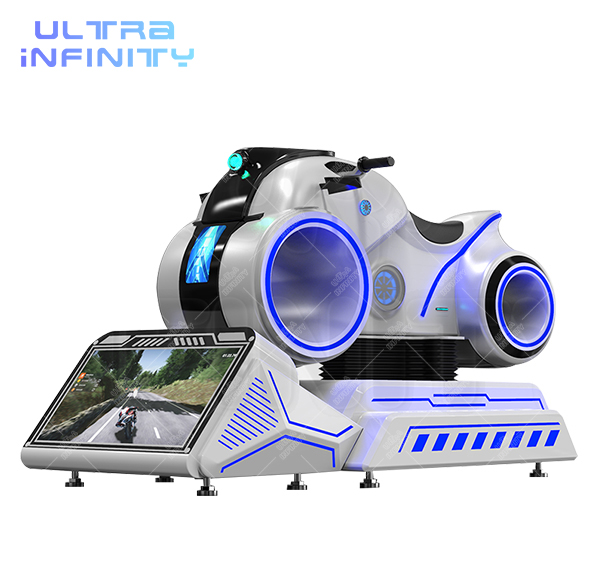
VR Motorcycle Simulator - 9D Motor Racing
Leaning with the bike aligns your trunk with the virtual trajectory - the published posture finding, built into a ride.