Local top five is a customer decision set, not a Google ranking. What puts a mini golf venue into it: proximity signals, star and review entry lines, freshness, complete information and a product face worth choosing.
Oct 9th,20265 Puntos de vista
NEXTPLAY ENTRETENIMIENTO ACTIVO
What Makes a Mini Golf Venue a Local Top-5 Choice
Start with what the phrase does not mean. There is no Google top-five: the map shows a three-pack, and nobody outside the ranking systems can promise you a position in it. What does exist is a customer top-five - the shortlist a guest assembles in one evening from search results, the map, and whatever the review page tells them. Being on that shortlist is a measurable project, because every input to it has been studied: how proximity, stars, volume, freshness, information and price clarity rank in consumer research, how the map shortlist behaves, and what finally makes one venue win over the four beside it. This page works through those inputs in order, marks each number with its source, and is explicit about the one factor you cannot change and the four you can.
THE DECISION SETENTRY LINESVELOCITYPROFILE GAPSPRODUCT FACE
44%
Pick Their Venue Primarily by Proximity - The Largest Single Factor (BrightLocal, 2026)
40-60%
Of Near-Me Map Clicks Go to the Three-Pack (Local Falcon, 50M searches)
4.3-4.5
Star Rating Entry Line Reported for Competitive Local Categories
76%
Of Nearby Searchers Arrive the Same Day (reported via Think with Google)
1. The Short Answer: Top Five Is a Customer Decision Set, Not a Google Ranking
The useful definition is behavioural: a venue is a local top-five choice when a guest who searched for something to do found it, considered it, and kept it in the small pile of options they would actually contact. That pile is assembled from research - search results, the map listing, the review page, the website - and only afterwards does anyone pick one. The research that measures this says the picking is rarely a first-result reflex: BrightLocal's 2026 search-behaviour study found only 6 percent of consumers simply click the first result, while 78 percent report using online search to decide where local entertainment happens (the latter reported by an industry statistics compilation of Think with Google figures).
Holding the two columns side by side stops the whole project from being misread as an SEO race. Google's map shows three businesses and distributes clicks by its own signals; the customer's list runs five or six deep and is assembled from evidence the venue controls. The venue's job is not to argue with the three-pack - it is to make the guest's list, and then be the entry on it with the clearest offer.
What Google shows
What the customer holds
What you actually control
A three-pack on the map, position decided by relevance, proximity and prominence
A five-deep shortlist from search, map, reviews and word of mouth
Evidence on every surface the shortlist is built from
Position varies by query, location and device, and is never promised
Membership is stable: guests add venues that look complete and current
Star entry line, review volume and freshness, profile completeness
Clicks concentrated at the top (40-60% to the three-pack, reported)
Only 6% click the first result without comparing
The comparison your listing wins once you are visible
The demand side of the shortlist is not in question for this category: the family case for why indoor mini golf keeps drawing visits is already documented on our own pages (why indoor mini golf keeps winning with families). The open question is competitive - among the venues a family could choose this Saturday, what puts yours in the pile. Two gates come before any cleverness: the category has to fit the guest (the three-gate test in our attraction guide, is mini golf a good attraction for an indoor entertainment center), and your listing has to survive the filters in sections three through five below.
One scope note carried from the start: nothing here promises a ranking, a map position or a percentile. The phrase top-five in this page means a guest's shortlist, and every recommendation is written so that it improves the evidence a guest sees - which is the only surface a venue can affect.
2. Factor 1: Proximity You Cannot Change, Signals You Can
The largest single factor in the 2026 BrightLocal consumer research is proximity: 44 percent of consumers pick their venue primarily by distance, ahead of star rating (38 percent) and review count (37 percent). Local search practitioners organise the same space as three signals - relevance, proximity and prominence - and proximity is the one with no optimisation. You cannot move the building, and no amount of content changes where a guest is standing.
What the ranking research says instead is that prominence carries the other two thirds of the work. Local Falcon's whitepaper across 50 million searches frames ranking as relevance, proximity and prominence, and its practical finding for businesses is that visibility can be bought with signals rather than with location: a complete profile, active review flow and consistent information are what the systems lean on when two venues sit equidistant from the searcher. The venue's version of proximity is being the option that looks most relevant at the moment of choice.
How consumers pick a local venue, by factor (BrightLocal, 2026)
Proximity
44%
Star rating
38%
Review count
37%
Information completeness
34%
Price clarity
30%
Photos
24%
Category match
24%
Map position
16%
All eight factors as reported in the BrightLocal consumer search behaviour study (published 2026-07-15). The ranking matters more than any single bar: proximity leads but does not dominate, and the four factors a venue fully controls - stars, volume, completeness and price clarity - together describe most of the decision.
The local-context application for entertainment venues is worth one link rather than a rehash: our community-centre guide works through how a venue embeds into its immediate catchment - programming, school ties, walk-in hours - which is proximity expressed as presence rather than as distance (top 10 community centre mini golf plays). A mall atrium and a bar room run the same logic with different neighbours.
One more number from the same study calibrates what the list position is worth: 56 percent of consumers report having struggled to find a suitable local business at all, and 52 percent gave up contacting anyone after their most recent search. A visible, complete, well-rated listing is competing against competitors who fail at the basics - which is the opportunity, and the reason sections three to five exist.
3. Factor 2: Stars and Volume Clear the Entry Line
After proximity comes the gate: stars and volume decide whether a venue stays on the shortlist. The reported entry line for competitive local categories is 4.3 to 4.5 stars, with the top-performing band sitting at 4.8 to 4.9 (Local Falcon, from its 50-million-search dataset). Volume runs alongside it - category medians in that dataset range from roughly 50 to 300 reviews depending on how often people transact, and metropolitan venues need an estimated 1.5 to 2 times the review volume of rural ones for the same effect.
There is a data gap to state before anyone quotes a benchmark: the published category tables do not contain mini golf or family entertainment as line items. The correct move is method, not number - open the map in your own city, look at the five venues a guest would compare you against, and read their star line and review count. That set of six numbers is your actual entry line, and it moves with your catchment rather than with a national table.
The consumer-side gates stack on top: 47 percent of consumers will not consider a business with fewer than 20 reviews, and 31 percent now use only venues rated 4.5 or higher, up from 17 percent a year earlier (BrightLocal, 2026). Read the two together and the sequence is clear - volume first, rating second, because a rating nobody has enough data to trust is filtered before it is evaluated.
Gate
Reported number
Source
Your move
Star entry line
4.3-4.5; leaders 4.8-4.9
Local Falcon 50M whitepaper - T1 dataset
Read your city's top five, not a national average
Volume floor
~20 reviews before most consumers consider you
BrightLocal 2026 - T1 survey
Reach the floor first, then work the rating
Volume target
Category medians 50-300; metro needs 1.5-2x rural
Local Falcon 50M whitepaper - T1 dataset
Compare against venues of your catchment size
Rating pressure
31% require 4.5+, up from 17% in one year
BrightLocal 2026 - T1 survey
Two bad responses now cost a third of the market
How those numbers are produced is the subject of our companion page rather than this one: where review volume comes from, how to ask, and what responses do to the rating is the review-mechanics guide in this batch (why guests love indoor mini golf: what turns a first visit into a five-star review). This page takes the gates as given and stays on the shortlist question: given the review programme lives next door, what else decides the pick.
And the boundary that keeps this honest: ratings and volume are outcomes of the visit, not dials. The fastest legitimate way to move both is the exit-ask and response routine on the companion page, executed consistently - there is no other route worth describing, and no route at all through incentivised or scripted reviews, which platform rules prohibit.
4. Factor 3: Freshness and Replies Beat Old Stock
A venue can clear every gate in section three and still lose on time. 74 percent of consumers read only reviews from the past three months, 67 percent sort by newest, and Google states its AI-generated business summaries are drawn from the past year of reviews - so both human readers and the summariser are working from a moving window. An account rich in history and poor in the current quarter reads as dormant to nearly everyone evaluating it.
The velocity rule from practitioner testing is the operational version: 200 reviews growing by ten a month outperform 400 reviews untouched for six months, and stopping the flow is followed by visibility decline (Local Falcon; similar timelines published by reservation-software guidance). The same guidance puts numbers on the lag: profile category changes register in roughly two to four weeks, review-velocity effects in four to eight weeks, and fuller compounding over three to four months - all reported by, none guaranteed, and all consistent with systems that re-evaluate continuously.
Freshness has a companion in activity signals: 62 percent of consumers are deterred by signs a business is inactive, and 33 percent name negative reviews as the top deterrent (BrightLocal, 2026-07). Inactivity is the cheaper failure to fix - an updated season photo, a current holiday schedule, a response posted last week - and it is read as evidence about the venue before anyone reads the reviews themselves.
Reported time-to-effect for the local profile work (weeks)
Midpoint weeks drawn from the published local-SEO timeline reported by reservation-software guidance (Rex Reservations, 2026-05) - a T2 source reporting practitioner tests, not a platform guarantee. The shape of the message matters more than the exact weeks: profile work registers first, review flow second, compounded visibility last.
The programming answer for entertainment venues is already documented in our marketing catalogue: light-and-theme relaunches run about twelve times a year, and each one is both a reason to visit and a reason to write (top 10 mini golf marketing plays that fill the calendar). A venue with a campaign month produces new visits, new photos and new review material in one motion - which is why the calendar and the review flow are the same project run by two names.
The reply side is where many venues lose the freshness win: 89 percent of consumers expect the owner to respond, 80 percent prefer businesses that answer individually, and 42 percent avoid venues that never respond at all (BrightLocal, 2026). The response rules and the collection mechanics live on the companion page; the shortlist consequence here is simpler - a venue that answers last week looks alive, and the one that answered in March does not.
5. Factor 4: Complete Information and Clear Prices Remove the Opt-Outs
The quiet attrition on a shortlist happens on information: 32 percent of consumers are put off by unclear pricing and 20 percent by missing information (BrightLocal, 2026), and practitioner audits report that 40 to 60 percent of Google Business Profiles are incomplete in ways that suppress visibility, while profiles with more than 100 photos draw measurably more views (reported by Rex Reservations). Nothing here is a ranking trick; it is the removal of reasons to close the tab.
For an entertainment venue the profile checklist is concrete, and each line maps to a number above. Hours for the week including the holiday change. The price of a round - or the four-tier card if the venue runs one, so the guest sees the off-peak tier before they see nothing. A short description that says what the place is in one sentence. Category set correctly. Photos of the actual floor, updated with the season. A booking or enquiry link that resolves. Responses on the recent reviews. Every empty line is a filter someone else passes.
Price clarity deserves its own sentence because this category has an unusual advantage: the offer is legible. A guest comparing three venues wants to know what an evening costs, and a venue that publishes the session price - and can be believed about capacity, because the throughput is documented - has already answered the question the competitor left open. Our capacity guide is the kind of proof that makes a listing concrete: 3 to 5 minutes per hole, 16 to 24 players per session hour on one staffed course (mini golf course capacity: how many players can you serve per hour).
Profile line
Guest question it answers
Reported consequence when missing
Category and description
Is this the thing I am looking for?
Wrong or absent matches never enter the shortlist
Hours, including season changes
Are they open when I could go?
Inactive signals deter 62% of consumers
Price or price tier on the listing
What will tonight cost me?
Unclear pricing deters 32%
100+ photos, seasonally refreshed
What does the room look like?
Thinner profiles get measurably fewer views (reported)
Recent reviews with replies
Do people go here now, and does anyone care?
Stale window: 74% read only three months
Working booking/enquiry link
How do I commit?
52% gave up contacting after a poor search experience
The price tier itself is published on our marketing page rather than invented here: a four-tier card ($4.50 / $5 / $8 / $9.50 in our models) gives the listing something concrete to show at every daypart, and it converts the price-clarity factor from a weakness into a reason to choose the off-peak slot. Clear pricing does not cheapen the offer; it removes the last hesitation before contact.
Where the floor plan enters: the solution page is the surface where a guest's practical questions get the full answer - how the venue is laid out, what a session includes, how to book a group (the mini golf course solution page). The listing earns the click; the page has to close it, which is the transition into the final factor.
6. Factor 5: A Product Face Worth Choosing
Everything so far qualifies you for the comparison; this factor wins it. Four venues now sit on the guest's list, all adequately rated, all with reviews from the last month - and the guest picks the one whose face they can picture. The product face is the visible difference: what the floor looks like, what there is to do that the place two suburbs over does not have, and what a group will be doing in the first ten minutes.
The clearest public reference for what a deliberately built face looks like is the Puttshack Scottsdale configuration - 25,000 square feet over two stories, four nine-hole courses, automatic scoring, dining and private event space, with a 30-to-45-minute round nested inside a longer evening (the Puttshack Scottsdale case study). You do not copy the budget; you copy the principle: the product is a programme of formats and moments, not a single attraction with a price.
For a smaller venue the same principle scales down to mechanism variety: a maze that reads as a puzzle, a crossover hole that gives the bar a talking point, a target game that produces a score worth posting. The venue two over does not have your exact three - and since guests shortlist on difference rather than on average quality, three legible differences beat ten interchangeable holes.
The deterrent side of the ledger, drawn from the same 2026 research, shows what still removes venues from the pile after they were found:
What removes a venue from consideration, after discovery (BrightLocal, 2026)
Negative reviews
33%
Unclear pricing
32%
Low star rating
30%
Too few reviews
24%
Reviews feel stale
21%
Missing information
20%
All six deterrent percentages from the BrightLocal consumer search behaviour study (2026-07-15). Read against the five factors: five of the six are fixed by sections three to five, and the remaining one - negative reviews - by the response routine on the companion page. Almost nothing on this chart requires a better course; it requires a better-operated listing.
The category number that keeps this factor grounded in demand rather than in marketing: 76 percent of consumers searching for something nearby arrive the same day (reported via Think with Google), which means the product face you present in the listing is being evaluated against tonight, not against next month. The shortlist is assembled fast, which rewards venues that look specific.
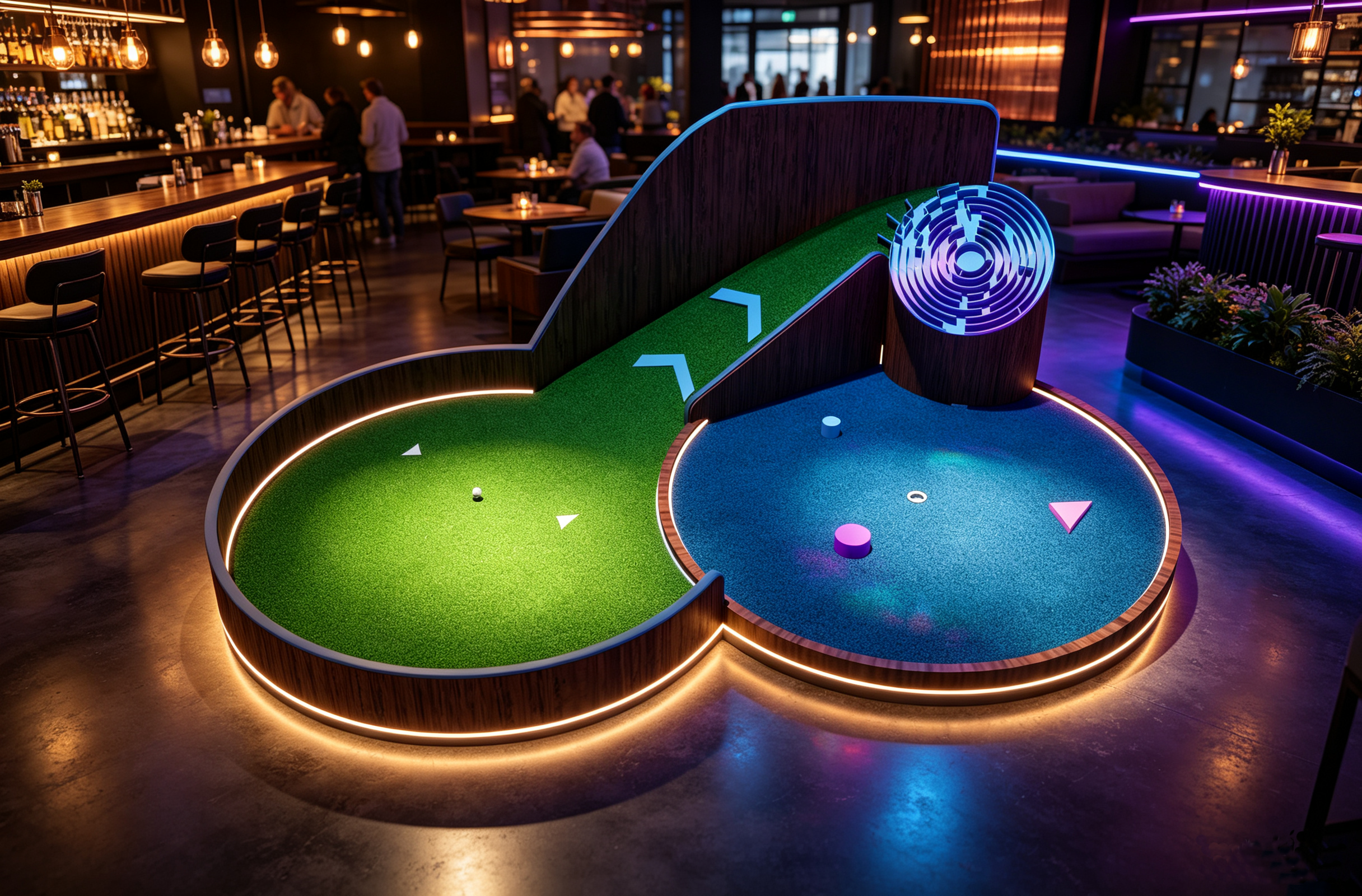
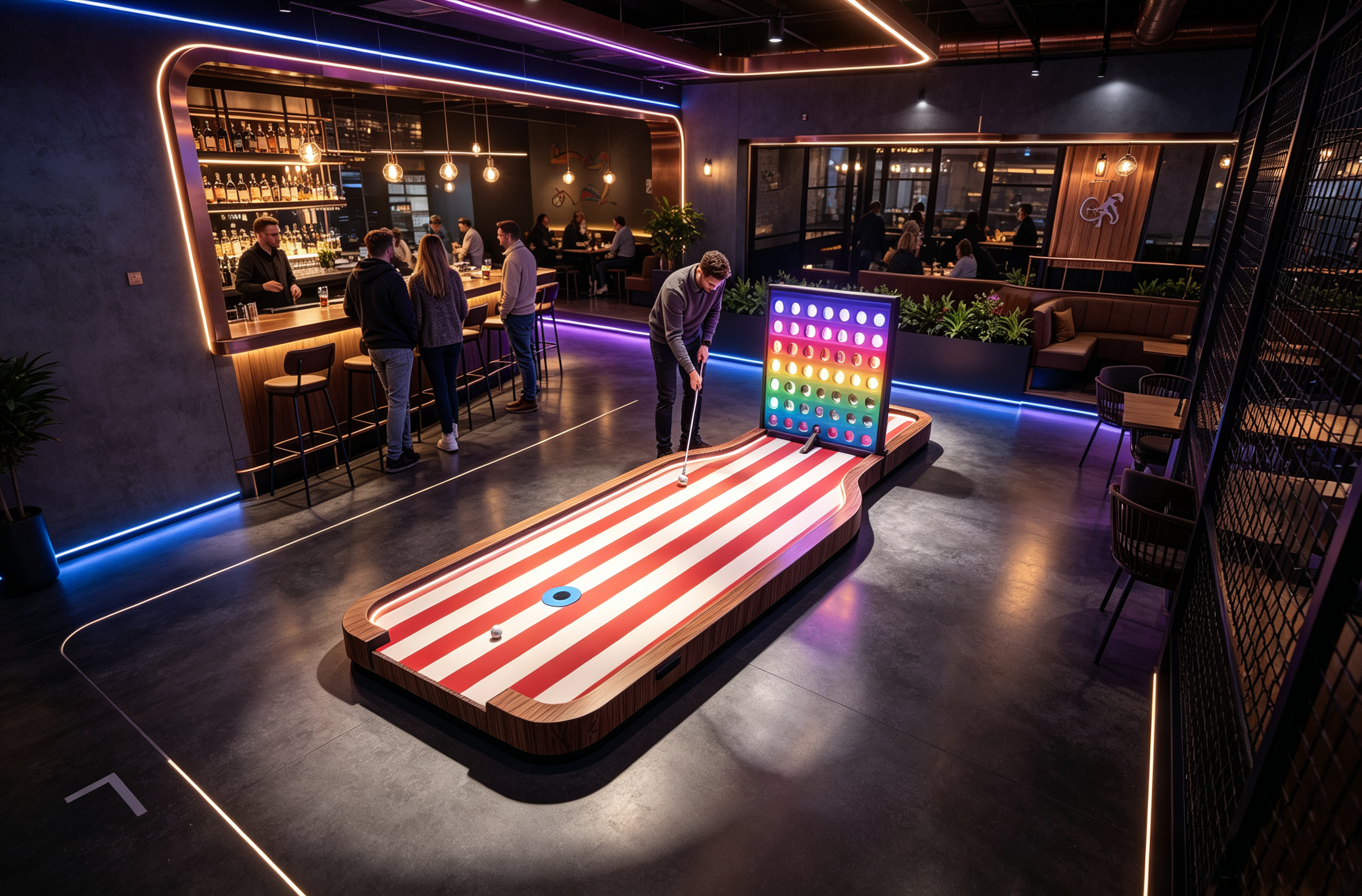
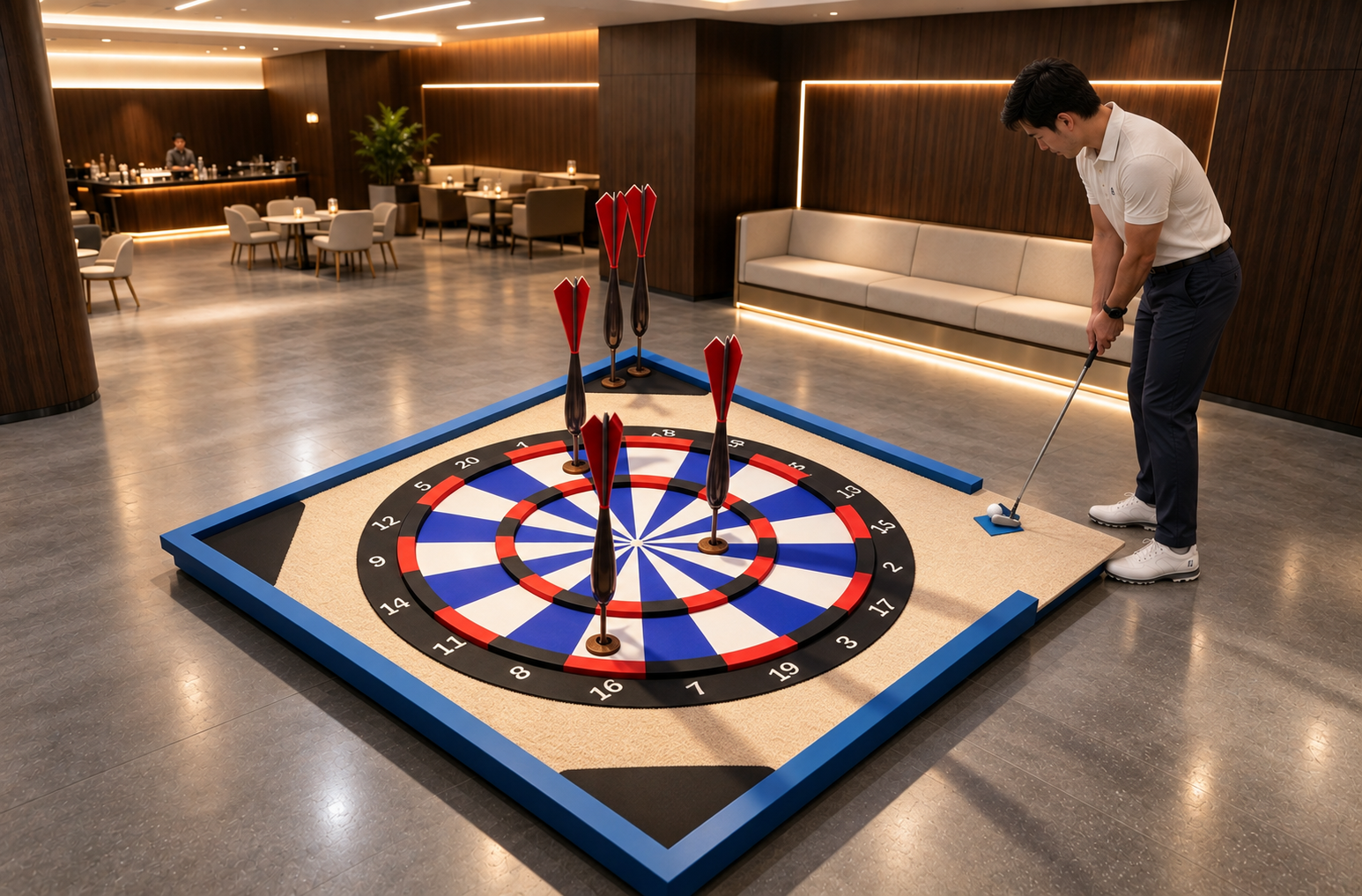
Which closes the loop back to the floor. A product face is ultimately drawn before it is photographed - the run of holes, the photo wall, the scoreboard position, the bar sightline onto the play (a free 3D layout of your floor). The three units below are the face this batch's equipment section ships with: the Labyrinth Challenge Indoor Mini Golf Game, whose puzzle shape is the signature-photo unit; the Rainbow Golf Challenge, the high-saturation scoring wall that reads across a room; and the Darts Golf Hole, the crossover mechanic that gives a guest a reason to name your venue instead of the one down the road.
7. Equipos Destacados de NextPlay
THE SIGNATURE PHOTO
Labyrinth Challenge | Indoor Mini Golf Interactive Putting Attraction
An interactive indoor mini golf game with skill-based putting, maze obstacles and reward challenges, built for bars and social gaming spaces. The puzzle shape is what a guest pictures when your venue comes up - the unit that carries the product face in a listing photo.
Ver Detalles ›
THE SCORING WALL
Rainbow Golf Challenge | Indoor Theme Golf Game
An indoor theme golf game with colourful targets and different scoring values, for a fun and competitive putting experience. High-saturation colour reads across a room and across a phone screen - the visual that separates your profile photos from the row of beige carpets below you.
Ver Detalles ›
THE DIFFERENCE TO NAME
Darts Golf Hole | Indoor Mini Golf Hole
Golf putting combined with dartboard-style targets and scoring, for a fun, skill-based attraction for social venues. A crossover guests can explain in one sentence - which is exactly the sentence a shortlist needs to remember you by.
Ver Detalles ›
8. Preguntas Frecuentes (FAQ)
What does local top five mean if Google only shows three map results?
It means the customer's shortlist, not a ranking. Consumers assemble five or six options from search, the map and reviews before choosing - and only 6 percent click the first result without comparing. The map three-pack is one surface feeding that list; the list itself is built from stars, volume, freshness, information and the venue's visible product face.
Is proximity really the most important factor?
It is the largest single factor in the 2026 BrightLocal research at 44 percent - but it is also the one you cannot change. The controllable factors in the same study (star rating 38 percent, review count 37 percent, information completeness 34 percent, price clarity 30 percent) describe most of the decision, which is why prominence work is the practical project even though proximity leads the table.
How many reviews does a venue need before guests choose it?
Two published gates: 47 percent of consumers will not consider a business with fewer than 20 reviews, and 31 percent now require a 4.5-star average. Beyond the floor, competitive volume depends on your catchment - reported category medians run 50 to 300 reviews, with metropolitan venues needing an estimated 1.5 to 2 times rural volume. Read your own city's top five for the real entry line.
How quickly do review and profile changes show up?
Reported practitioner timelines put profile category changes at two to four weeks, review-velocity effects at four to eight weeks, and compounded visibility at three to four months. These are reported figures from local-search testing rather than platform guarantees, and they assume the flow continues - stopping is associated with decline, which is why velocity beats stock.
Does responding to reviews change whether guests pick you?
Yes, as evidence of presence: 89 percent of consumers expect the owner to respond, 80 percent prefer businesses that reply individually, and 42 percent avoid venues that never respond. Half of consumers are also put off by template-style replies, so a specific two-sentence answer is worth more than a polished form letter.
What actually separates the venue guests pick from the other four on the list?
A face they can picture. Once stars, volume, freshness and information are comparable, the choice turns on what is different about the room - a signature hole, a scoring wall, a crossover mechanic, a programme of formats - because shortlists are built on difference rather than on average quality. The Puttshack Scottsdale case study is the large-scale reference for a product face assembled deliberately.
Send the floor plan and your listing as it stands today and we will map both against the five factors: what a guest sees when they compare you to the four venues beside you, where the product face is generic, which profile lines are still empty, and which units on the floor carry the difference the listing should be advertising. If you are still choosing the floor itself, the same pass shows where the signature photo, the scoreboard and the crossover hole belong.