Every question has a published answer: the $250K build at ~10 months payback, the $37,440 base case, the four-tier rate card, +22-35% package lift and the 12-rotation freshness calendar. This Top 10 arms the pitch before the Q&A starts.
MINI GOLF INVESTMENT - THE TOP 10 Q&A
Top 10 Questions Investors Ask Before Funding a Mini Golf Venue
Every question has a published answer: the $250K build at ~10 months payback, the $37,440 base case, the four-tier rate card, +22-35% package lift and the 12-rotation freshness calendar. This Top 10 arms the pitch before the Q&A starts.
~10 months payback $37,440 base case 16-24 players/hr capacity +22-35% packages $4,500 buyouts 12 rotations/yr
$37,440
Base-Case Monthly
1. Top 10 Questions Investors Ask Before Funding a Mini Golf Venue
A mini golf pitch deck dies in the Q&A, not the slides. The operator has a render and a rent number; the investor has ten questions, each one a ratio between two numbers the operator quoted too casually. Every question on this list has a published answer on this site - which is exactly why the pitch should quote them first: the payback model, the rate card, the capacity analysis. A plan that answers with published references gets funded on arithmetic instead of enthusiasm.
The list in one line: ten questions, each answerable with a published number - payback, base case, rate card, package lift, rotation calendar.
2. The Ten, Ordered as Investors Ask Them
The order follows the money: payback first, then the revenue engine that drives it, then the cost and durability lines that protect it. The payback question opens every meeting - the published model runs a $250K build to roughly ten months - and the base-case question follows immediately, because the published 120 players per day at $12 into $37,440 a month must reconcile with the published 16-24 players per course-hour capacity or the meeting ends.
| Rank |
Investor Question |
The Published Answer |
| 1 |
What is the payback period? |
$250K build -> ~10 months (published model) |
| 2 |
What is the revenue base case? |
120 players/day x $12 -> $37,440/mo |
| 3 |
Does the capacity math reconcile? |
16-24 players per course-hour; 9-hole = 9 rds/hr |
| 4 |
How is pricing structured? |
Four-tier card: $4.50/$5.00/$8.00/$9.00 |
| 5 |
What lifts revenue beyond tickets? |
Packages +22-35%; buyouts ~$4,500/3h |
| 6 |
What drives repeat visits? |
12 LED rotations/yr, 30-minute changes |
| 7 |
What does scoring cost in staff? |
Ladder: 10/12/16/18 rds/hr from none to sensor |
| 8 |
How big is the party market? |
6-9 hole loop, 18-45 min, photo-hole anchors |
| 9 |
What is the freshness capex? |
LED re-theme runs on the 30-minute change cycle |
| 10 |
Where is the risk concentration? |
Weekend peak dependency - the tiered card diversifies it |
3. The Three Line Items That Decide the Meeting
Three of the ten answers are equipment decisions an investor can see. The scoring line is the Rainbow Golf Challenge: the published sensor rate of 18 rounds per hour is the throughput ceiling of the route, and it replaces a scoring-staff line item at the same time. The differentiation line is the Labyrinth Challenge - the signature hole that defends the foot-traffic forecast against the competitor two blocks away. The freshness line is the Dream Castle Hole on the published 12-rotation LED calendar - the repeat-visit engine with no annual rebuild cost.
Payback and Base Case: The Two Numbers of the Meeting (published)
Base-case monthly revenue
$37,440
Payback period
~10 months
Source: published payback model and base case. Bars are indexed to the monthly revenue figure; the payback bar expresses 10 months on the same index. Illustrative scaling, units differ by row.
4. One Q&A, Assembled From Published Numbers
Picture the published figures assembled into the ten-minute Q&A. Payback: the published $250K to roughly ten months, defended by the base case - 120 players a day at $12, $37,440 a month, reconciled against the published 16-24 players per course-hour. Pricing: the published four-tier card, with the $5.00 afternoon tier already pre-selling the slot investors worry about. Revenue beyond tickets: the published +22-35% package lift and the $4,500 buyout calendar. Durability: the published 12-rotation LED calendar on the Dream Castle Hole, the Rainbow Golf Challenge running the 18-rounds-per-hour ceiling with no scoring staff, and the Labyrinth Challenge as the differentiation hole. Ten questions, ten published answers, one funded plan.
The scenario is illustrative, but every number in it is a published reference: the payback model, the base case, the capacity frame, the rate card, the package lifts and the rotation calendar.
5. Planning Assumptions Behind Every Number
Every figure here is a published planning reference: the $250K-to-ten-months payback and the 120-player, $12, $37,440 base case come from the published payback and planning models; the 16-24 players per course-hour and 9-hole 9-rounds-per-hour capacities come from the published capacity analysis; the four-tier rate card comes from the published pricing analysis; the +22-35% package lift and the ~$4,500 three-hour buyout come from the published party and corporate-night playbooks; and the 12-rotation, 30-minute LED calendar and the 10-18 rounds-per-hour scoring ladder come from the published themes and scoring guides. All are planning references, not guarantees - restate each against your own build before adopting them.
6. Frequently Asked Questions (FAQ)
The questions investors ask, answered with the published references.
What payback period should the plan model?
The published payback model runs a $250K build to roughly ten months - the number the plan should defend with the published capacity and rate-card assumptions behind it.
What revenue does the base case carry?
The published base case runs 120 players per day at a $12 average ticket into $37,440 per month - investors will re-derive it from the published 16-24 players per course-hour capacity, so the two must agree.
How is pricing defended across dayparts?
The published four-tier rate card - $4.50 morning, $5.00 afternoon, $8.00 evening, $9.00 peak - shows pricing that fills every slot; a flat rate in the plan reads as an unpriced afternoon.
What non-ticket revenue does the model carry?
The published party design anchors tiered packages at +22-35% over single rounds, and the published corporate-night playbook books three-hour buyouts at about $4,500 - the two lines that lift revenue without adding capacity.
What keeps month-twelve revenue equal to month-one?
The published LED rotation guide re-themes the course 12 times a year in 30-minute changes - the freshness calendar investors read as the repeat-visit engine.
What equipment line do investors scrutinize?
The scoring system: the published ladder runs 10 to 18 rounds per hour from none to sensor - the difference is a staffing line item and a throughput ceiling in the same budget row.
7. Featured NextPlay Active Gaming Equipment
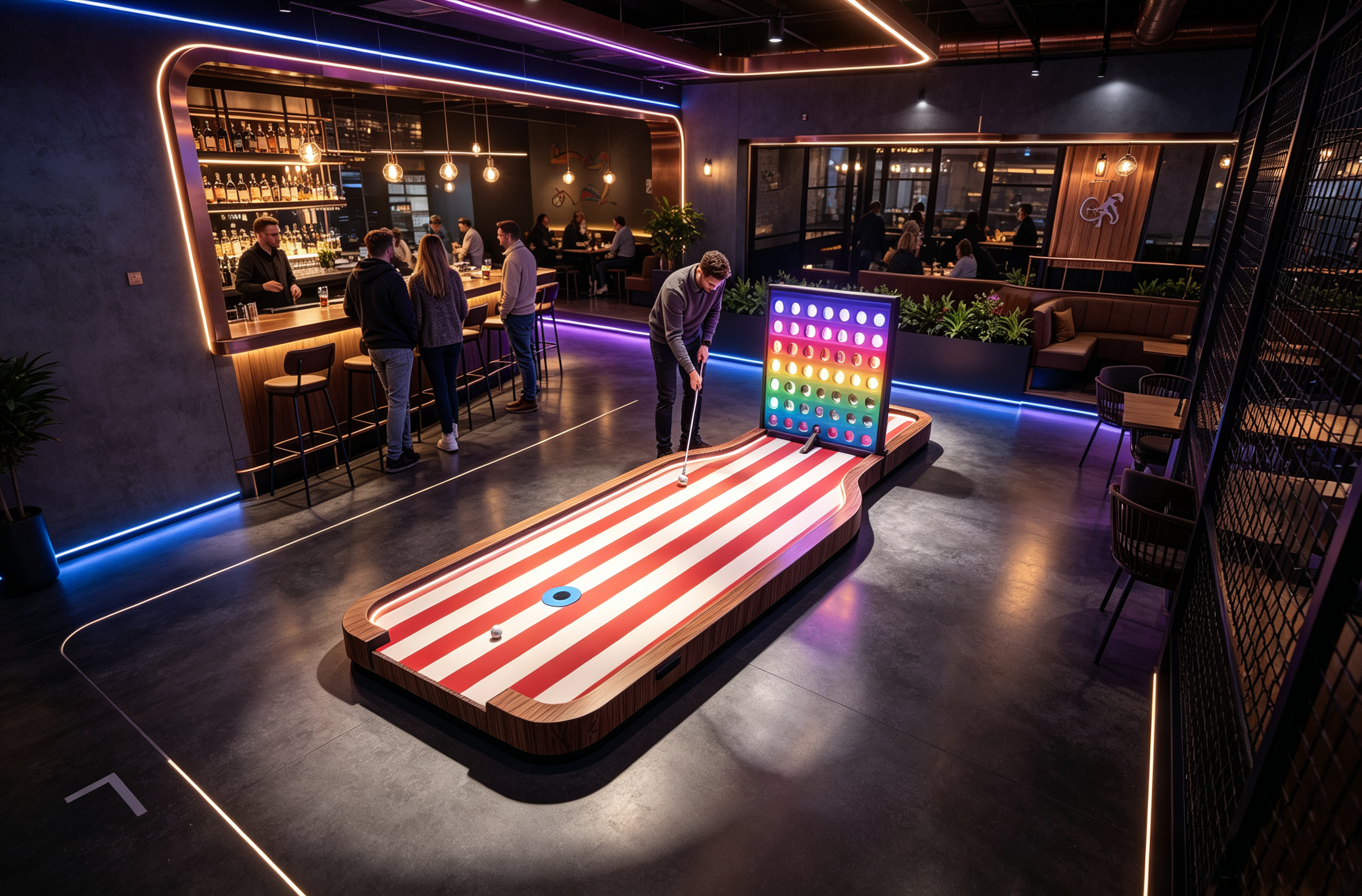
The throughput line
Rainbow Golf Challenge - Auto-Scored Interactive Mini Golf
The published 18-rounds-per-hour ceiling - the throughput and staffing answer in one budget row.
View Details ›
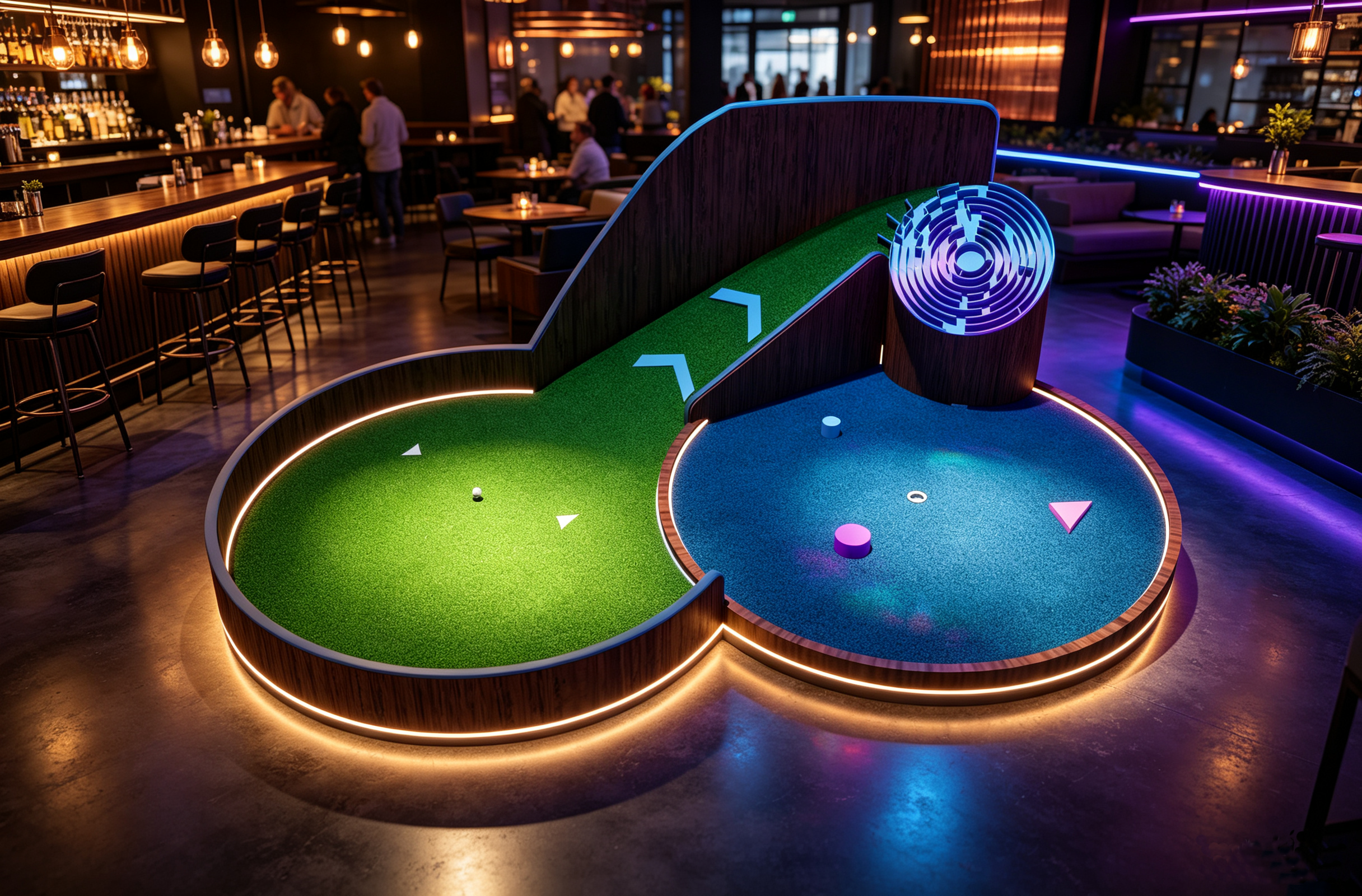
The differentiation hole
Labyrinth Challenge - Interactive Putting Attraction
The signature puzzle that defends the foot-traffic forecast against the competitor down the street.
View Details ›
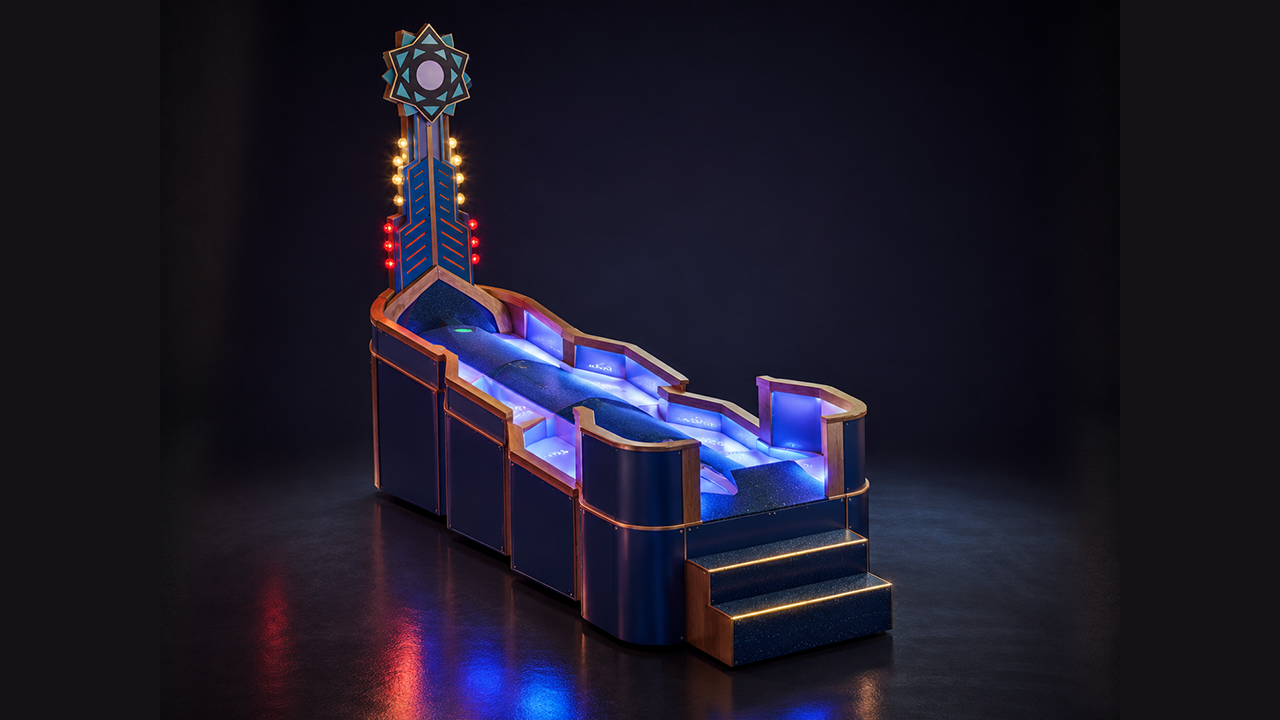
The freshness engine
Dream Castle Hole - Themed Putting Attraction
Twelve published LED rotations a year on one hole - the repeat-visit answer with no rebuild cost.
View Details ›

