NEXTPLAY ENTRETENIMIENTO ACTIVO
Static vs. Moving Mini Golf Obstacles: Which Fits Your Venue?
Static vs. moving mini golf obstacles is a buying decision that runs on three inputs, not on taste: what has to move inside the hole and how often, what your staff can realistically check every week, and what your guests read at a glance. This page walks an operator through both classes in that order - what a motorless hole buys, what a moving hole charges you in inspection cadence, which floor profile suits which mix, the middle option with a static body and an electronic layer, and the six questions to settle before a single moving part is signed for. Every figure is sourced, third-party guidance is marked reported by, and where no public data exists this page says so instead of inventing it.
DUTY CYCLE FIRST WHAT STATIC BUYS THE CADENCE YOU BUY FOUR FLOOR PROFILES SIX QUESTIONS TO ASK
12-48 m²
Per Commercial Hole, Footprint Range (our product range)
Daily
Function Test Cadence for Moving Parts (reported by ShunGolf)
3-5 min
Play Budget Per Hole (our capacity guide)
16-24
Players Per Session Hour, One Staffed Line (our capacity guide)
1. The Short Answer: The Decision Runs on Duty Cycle, Not Preference
Every obstacle purchase eventually lands on the same three checks, and none of them is about which hole looks better in a render. Safety sits underneath all three as the floor rather than as a fourth option you can trade away for cost.
- What inside the hole has to move, and how often it has to move: the duty cycle you are agreeing to when you sign.
- Which tier of maintenance your staff can genuinely run every week once the novelty of opening month has worn off.
- What your guests read at a glance, because a hole nobody understands holds up the line standing behind it.
The choice between static vs. moving mini golf obstacles has one public comparison in the sources checked for this page, and it is a qualitative table. The obstacle mini golf guide published by fobwp in May 2025 sorts obstacles into static, moving, water, interactive and themed prop classes, then scores the static and moving classes across five dimensions in words rather than numbers. It is a content-site framework, so this page prints it as reported by and never as industry data, and it uses the rows as directions rather than as measurements.
| Decision dimension |
Static obstacles |
Moving obstacles |
Source grade |
| Durability over a season |
Higher direction: there is no actuator inside the unit to fatigue |
Lower direction: every powered part is a wear point |
T3 content site, qualitative, reported by fobwp |
| Maintenance load |
Lower: surface, seam and cup wear only |
Middle: a daily function test sits on the roster |
T3 reported by fobwp; cadence detail reported by ShunGolf (T2) |
| Lifetime cost of the hole |
Lower direction: no actuator, battery or sensor layer to keep buying into |
Higher direction: parts, batteries and sensors run with the venue |
T3 reported by fobwp; no public price benchmark exists |
| Engagement |
Middle: the challenge reads immediately and needs no explaining |
Higher direction: motion is the first thing an eye lands on |
T3 reported by fobwp; no published engagement measurement |
| Safety surface |
Higher direction: fewer failure modes to inspect each week |
Middle: moving parts need guarding and periodic inspection |
T3 reported by fobwp; our weekly safety-check discipline aligns (first-party) |
Two things the table does not say matter as much as what it does say. It gives no failure rates, no downtime and no price gap, because nobody publishes those. And it does not change your floor plan: a commercial hole occupies 12 to 48 square metres in our product range whether the obstacle inside it spins or sits still. The decision is about what happens inside that footprint after opening day.
Assumption. You are choosing an obstacle mix before installation, you can state how many maintenance hours your roster owns each week, and safety compliance is already a requirement rather than a differentiator. Formula. Duty cycle = the number of moving parts in a hole multiplied by the cadence at which those parts must be tested, and the five dimensions above are read as directions rather than scores. Result. A hole with no actuator removes one entire inspection class from your week, while a hole with motion buys attention at the price of a standing daily check - which is why the decision follows duty cycle rather than preference. Limitation. No public comparison of failure rates, downtime or price gaps between the two classes exists, so every direction in the table stays qualitative and no percentage appears anywhere on this page.
Two neighbouring questions already have their own pages, and this one does not repeat them. How many minutes a hole may take before it costs you the line sits inside the published 3 to 5 minute play budget, which is part of our obstacle and gadget ranking (top 10 mini golf obstacles and gadgets that keep players coming back). The sensor layer that turns a moving hole into an interactive one is defined in the four-layer explainer (what is interactive mini golf: tech-driven holes vs traditional lanes). Both are cited here as constraints, not re-argued.
That is the whole short answer. If your roster can own a daily test, the moving column is available to you. If it cannot, the static column is not a compromise, it is the correct answer for that floor - and the rest of this page is about what each side actually buys and what it actually charges.
2. What Static Obstacles Buy You: Geometry Without a Motor
Difficulty in a static hole comes from geometry, and geometry is the cheapest form of difficulty to keep. Editorially reported guidance from ShunGolf puts a 15 degree ramp at the general-purpose angle for commercial play and reserves anything above 25 degrees for advanced layouts, which means a course can escalate in challenge using nothing but slope, angle, block position and line. The same guidance warns against stacking too many obstacles inside one hole, because a hole that asks three questions at once reads as unfair rather than as hard.
The maintenance consequence is the headline of this class. A hole with no actuator has no actuator to test, no battery to change on a quarterly rhythm and no hinge to lubricate monthly; wear lives in the surface rather than in a machine. What a static hole does consume is ordinary venue wear, and that is exactly how our spare parts guide orders its list - by what a failure takes out of service rather than by part size (top 10 mini golf spare parts and wear items to stock before opening day).
- Surface: turf and seams take the friction every round, so a static course is inspected as a surface rather than as a mechanism.
- Cup and pin: the liner and the pin are the contact points each group hits, and they are the first things worth scheduling.
- Balls and grips: consumables with published list prices in our spare parts guide, ranked by how long a failure takes out of service.
- Read of the hole: a static unit still has to make sense to a first-time guest, which is a design check rather than a maintenance one.
The beginner-friendly band we publish runs 12 to 25 square metres per hole, and static geometry is the reason a first course can stay inside that band: no mechanism needs a service envelope behind the obstacle, so the drawing spends its area on the play line instead of on access. That is also why static holes are the natural home for the difficulty distribution: they are the units that take the traffic, and the units you can re-cut later without booking an engineer.
Compact and low-staff floors
A bar running a compact line inside a 100 square metre venue (our bar guide) typically has one person on the floor, and that person is also serving. On that floor every actuator is a daily test with nobody clearly assigned to it, so static obstacles buy you the entire class of work you cannot staff. Geometry difficulty keeps the course interesting without adding a cadence to the roster, and the spare parts stay on a shelf behind the bar instead of in a service contract.
Destination venues
A destination themed venue has a roster, a technician and a reason to build set pieces, which is where moving obstacles earn their place. The same venue still builds its backbone from static holes: they carry the difficulty distribution, they absorb the traffic, and they leave the daily test budget for the two or three units that justify it. Static first, motion as punctuation, is where our framework starts a destination floor.
The vocabulary for what a static hole may ask of a player comes from the per-hole design sheet, which sorts six mechanisms out of the governing body text and keeps accessibility geometry as a hard rule rather than a preference (mini golf hole design: building a course hole by hole). Use that page to sequence the static backbone; this page is about choosing the class, not about drawing the holes.
Static is not free, and two costs should be named before anyone calls it the safe choice. The first is surface wear, which arrives on every class of course and is handled as stock and seams rather than as service calls. The second is the boredom risk: a course built only from geometry can flatten for repeat guests, and that is a variety problem rather than a motion problem, which section 5 picks up through the electronic layer. The class has a physical example in our own line: the Curve Block Golf Hole, where curved putting paths and block obstacles create a technical round with nothing inside the unit turning at all.
3. What Moving Obstacles Cost You: The Cadence You Are Buying
A moving hole is not a purchase, it is a schedule. Editorially reported maintenance guidance from ShunGolf separates the work by interval: moving and mechanical holes get a daily function test, cup liners get a weekly change, safety checks run every two weeks, hinges are lubricated monthly and batteries are changed quarterly. Our own maintenance calendar is organised on the same daily, weekly and monthly rhythm by component (maintenance guide for indoor mini golf holes), and the weekly detail - pin, rails and sensors, and how long each check takes - is published separately (what mini golf hole maintenance should cover weekly). Those two pages own the lists; this section is about what agreeing to them costs you in staff hours.
Convert the cadence into a monthly count and the shape of the commitment becomes visible. A daily instruction across a 26 day operating month is 26 checks, a weekly one is 4, every two weeks is 2, monthly is 1, and quarterly is about a third of a month. None of those conversions is a measurement. They are arithmetic applied to published cadence, which is why the chart below says derived rather than observed: a count derived from an instruction is not the same thing as a field study of workload.
Checks per month by cadence tier (derived from published cadence, our arithmetic)
Daily function test, moving parts
26 per month
Weekly inspection tier
4 per month
Biweekly safety check
2 per month
Monthly hinge lubrication
1 per month
Quarterly battery change
approx. 0.3 per month
Cadence tiers reported by ShunGolf maintenance guidance and matched by our own maintenance calendar. The monthly counts are our arithmetic on that published cadence - daily counted over 26 operating days, weekly over four weeks, quarterly over one third of a month - not measured workload. Bar length is relative to the daily tier, which is the tier nobody can defer.
Feature level is the multiplier nobody prices at the showroom. Natural Play Company reports the relationship from the builder side: a simple course without sculpted water features needs little routine attention, while a venue that adds animatronics, water features and lighting multiplies the routine, with animatronics recommended on a weekly check (reported by Natural Play Company). It is direction only - the piece does not tell you how many hours - but it does tell you which way the roster grows the moment a moving element is added.
Two gaps should be stated rather than papered over. First, nobody publishes failure rates, mean time between faults or downtime statistics for moving versus static holes; there is no comparison study in the industry, so this page gives direction only: the moving class carries a larger maintenance surface and a higher running cost, and it returns a participation ceiling that nobody has measured either. Second, there is no public price benchmark for the gap - not on purchase and not per year - so any percentage a supplier quotes you is that supplier giving you a number, not a market rate. What you can do instead is put the cadence on paper before you sign, which is section 6.
The class also has a real unit to hold the argument against. The Cyclone Spin Hole runs a 360 degree loop ramp into a circular target area, and the timing challenge it sets is exactly the kind of feature that needs the daily function test, the monthly hinge check and the quarterly battery change above. It is the unit we point at when a buyer asks what the cadence looks like in hardware rather than in a table.
4. The Venue-Match Matrix: Four Floor Profiles (Our Framework)
Here is the part no study can hand you. There is no industry research matching venue types to obstacle classes, so the matrix below is our own framework, assembled from the maintenance cadence, safety and throughput guidance cited on this page. Treat it as a starting position to argue with rather than as a standard, and replace any cell your own roster contradicts.
| Floor profile |
Staff you actually have |
Cadence you can staff |
Suggested static / moving / sensor mix |
Anchor it rests on |
| Bar or compact line (about 100 square metres) |
One host who is also serving |
Weekly surface work only |
Static-led, with one moving anchor only if a named person owns the daily test |
Compact lane formats for a 100 square metre venue (our bar guide) |
| Family entertainment centre main floor |
A small team across shifts |
Daily function test plus weekly inspection |
Static backbone, moving set pieces, one sensor-static hole for scoring |
16-24 players per session hour on one staffed line (our capacity guide) |
| Atrium pop-up or short lease |
Rotating or shared staff |
Whatever fits into a single weekly visit |
Static-first, with moving only if the lease covers the service window |
A compact course on a 150 square metre atrium footprint (our atrium playbook) |
| Destination themed venue |
A roster with a designated technician |
Daily, weekly, biweekly and monthly all staffed |
Mix set by difficulty distribution and story, moving allowed |
Hole count drawn against the actual floor (our 3D layout pass) |
Two first-party numbers do the sizing behind that matrix. A commercial hole occupies 12 to 48 square metres in our product range, so the band multiplied by the holes you want tells you how many fit before anyone argues about class. And one staffed line runs 16 to 24 players per session hour against a 3 to 5 minute play budget per hole (our capacity guide), which tells you whether the roster you already have can carry the cadence you are considering. Class selection is a staffing question that happens to be answered with floor area.
The mix column is a difficulty question as well, and that is where the second constraint enters. Mechanism - what the hole makes the ball do, which is where obstacle type sits - is one of the four published levers that move difficulty, and difficulty itself is a distribution across the course rather than a single setting (mini golf course difficulty: how to balance a commercial course hole by hole) - so a mix that puts every moving hole in the back third breaks the curve no matter how good each individual unit is. Settle the drawing first: send the floor and the hole count you are considering and the circuit comes back on your own walls (a free 3D layout of your floor), because a mix is far cheaper to change on a plan than after installation.
Example nine-hole mix, family entertainment centre main floor (EXAMPLE)
- Static holes: geometry difficulty, no actuators 5 holes
- Moving holes: one actuator each, daily function test 3 holes
- Sensor-static holes: static body, electronic scoring 1 hole
EXAMPLE only, not a recommendation for every venue. Assumptions: family entertainment centre main floor, one staffed line, a roster that can own a daily function test, nine holes at 12-48 square metres each. Shares are hole counts (5, 3 and 1 of nine) rounded to sum to 100. Our framework, not an industry standard.
Read that example as worked arithmetic rather than as advice, because the assumptions are doing the work. Remove the person who owns the daily test and the moving slice goes to zero while nothing else about the venue changes. No published research supports a universal ratio and this page will not invent one; what the matrix gives you is a defensible starting position plus the two numbers needed to test it against your own floor.
5. The Third Option: Static Body, Electronic Layer
There is a middle class that gets skipped whenever the argument is framed as two sides. The hole body does not move, but the scoring does. A sensor-static hole keeps the geometry-first maintenance profile of a static unit and adds an electronic layer that produces numbers, targets and a reason for a guest to look up. Sensors still need checking, and our maintenance calendar puts a score-sensor response check on the daily sweep, cable, mount and battery work on the weekly round and a full-round calibration each month - but none of that adds an actuator, a hinge or a scheduled battery change to a unit that never turns.
| Class |
What moves during play |
Maintenance surface |
What it proves |
| Pure static |
Nothing: ball, ramp, block and cup only |
Surface, seams, cup, balls and grips |
Difficulty can come from geometry alone |
| Moving |
An actuator, a rotating element or a mechanism, plus any electronics |
Daily function test, lubrication, batteries and part swaps |
Timing and motion can be built into the hole itself |
| Sensor-static |
Nothing physical: sensors and scoring only |
Score-sensor response on the daily sweep, cable and battery checks weekly, calibration monthly; no actuator tier |
Participation can come from the electronic layer without a moving body |
The published scoring ladder sits on this side of the line. Our published scoring comparison runs about 10 rounds per hour with no scoring system, about 12 with a manual scorecard, about 16 with a hybrid and about 18 with a sensor leaderboard (our capacity guide), and the same cluster sets the 3 to 5 minute play budget per hole against those rates. Read the ladder as a comparison of scoring modes rather than as a promise for your floor: that table names no hole count beside any row, so the four figures rank scoring choices against each other instead of measuring a route, and that is precisely why the sensor-static class is where a venue adds variety without adding a motor to the hole.
The 2026 feature list is a useful cross-check on where the category is adding work. Of the six features venues are adding this year - obstacle runs, 360 loops, sensor scoring, interactive targets, social theming and modular re-theming - two sit squarely in this layer, because sensor scoring and interactive targets both add participation while the body stays still (new interactive mini golf holes 2026: six features venues are adding). Two of the six add motion and therefore cadence, and two are theme work. That split is the practical argument for treating the sensor-static class as its own line item instead of as a cheaper moving hole.
It also answers the refresh question, which is the other reason venues pick the middle class. Mechanism mix is one of the six published paths for introducing variety into a course that is already open, and it is the one that changes what a hole does rather than what it looks like (top 6 ways to introduce variety into a mini golf course). A sensor-static swap changes the play pattern on a static footprint, which is why the class belongs in refresh conversations as much as it does in new builds.
The unit most often mistaken for this class is the Golf Target Shooting Hole. It is bought for exactly what this section describes - multiple scoring targets and an electronic scoreboard that the venue operates - but the mechanism that moves those targets is a motor, a bearing and a belt, and our spare parts guide files it that way (section 2): the moving mechanism, the tier that needs the critical parts on the shelf. So it is maintained alongside the moving class on the daily function test while its scoring layer delivers the participation described above. A true sensor-static hole is the other way round: the electronic layer is the only powered thing in the unit, and nothing in it turns.
6. The Supplier Checklist: Six Questions Before You Buy a Moving Part
Everything above compresses into six questions, and they are worth asking in writing before an order exists rather than after an installation date is already booked. Each row pairs the question with where a published answer lives, so you are comparing claims against documents rather than against a sales conversation.
| Check item |
What you ask |
Where the published answer lives |
| Actuator life and spares |
What is the actuator rated for, and which parts are on the spares list? |
Our spare parts guide orders the list by what a failure takes out of service (section 2) |
| Guarding and the two-weekly check |
How are the moving parts guarded, and who signs the safety check every two weeks? |
Biweekly safety check reported by ShunGolf; our own safety-check discipline is first-party |
| Service access in the drawing |
Is maintenance access drawn into the layout before installation, or added afterwards? |
Championship standards from Amusement Products: flow lines and maintenance access belong in the plan (reported by) |
| Demonstration hours |
How are demonstration hours read off the machine, and what is each reading compared against? |
Our demonstration evaluation page: a six-row sheet of what to ask and what to watch |
| Acceptance of moving parts |
How is each moving part tested on installation day, and who signs it? |
Our handover checklist: 14 acceptance points on installation day, each with a pass criterion |
| Cadence on paper |
Put the inspection cadence in the contract, with intervals and a named owner for each tier |
Daily, weekly, biweekly, monthly and quarterly tiers reported by ShunGolf, matched by our maintenance calendar |
One industry standard is worth stating even though it arrives as a sentence rather than a number: commercial courses are built around playability and operations, obstacles have to stay maintainable under daily traffic, and the maintenance route is supposed to live in the drawing instead of being discovered on site (Amusement Products championship standards, reported by). Everything else on this page is either first-party or a labelled direction, because the honest statement is that the industry runs no study comparing the two obstacle classes, publishes no failure rates and offers no price benchmark. A supplier who answers a cadence question with a percentage instead of an interval is giving you something this page cannot check.
The last step is the drawing rather than the conversation. Take the mix you have argued your way onto the plan page (the mini golf course solution page) and hold it against your hole count, your queue path and the cadence your roster just agreed it can own. Six questions, one plan, and a decision that rests on duty cycle instead of preference - which is where section 1 started.
7. Equipos Destacados de NextPlay

MOVING CLASS
Cyclone Spin Hole | Indoor Mini Golf Hole
Cyclone Spin Golf Hole features a curved lane and circular target area, combining precision putting and control for an engaging indoor mini golf challenge. It is the moving-class exemplar used in section 3: the loop ramp inside it is the hardware version of the daily function test, the monthly hinge check and the quarterly battery change discussed above.
Ver Detalles ›

STATIC CLASS
Curve Block Golf Hole | Indoor Mini Golf Hole
Curve Block Golf Hole combines curved putting paths and block obstacles to create a technical and engaging indoor mini golf experience. It is the static-class exemplar from sections 1 and 2: the difficulty comes from geometry rather than from a motor, so the unit adds no actuator tier to your week and consumes only surface, seam and cup wear.
Ver Detalles ›
MOVING + SCORING
Golf Target Shooting Hole | Indoor Mini Golf Hole
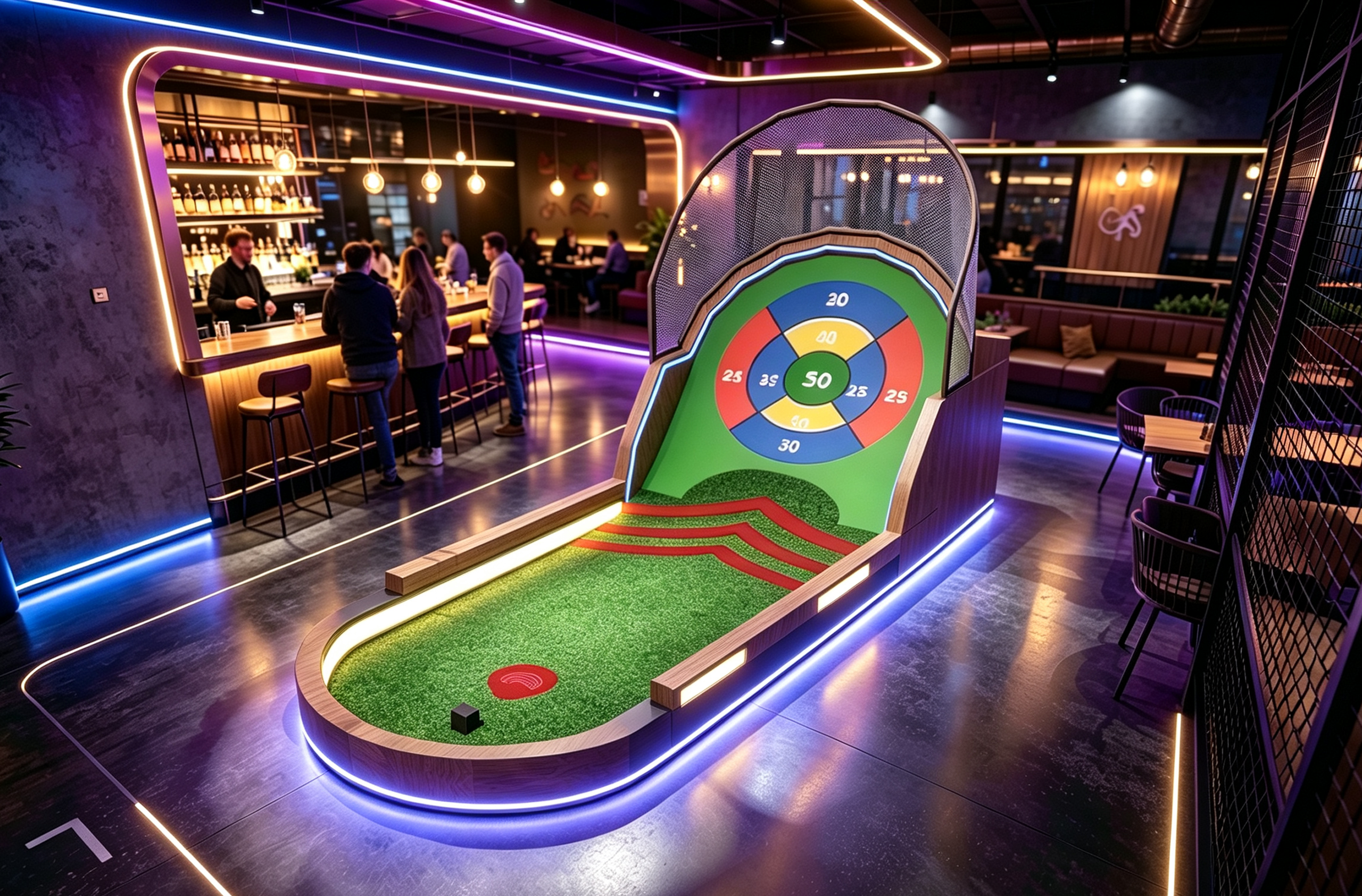
Golf Target Shooting Hole combines precision putting with multiple scoring targets to create a competitive and interactive indoor mini golf experience. It is the combination unit from section 5: an electronic scoring layer the venue operates, with a target mechanism our spare parts guide files in the critical tier.
Ver Detalles ›
8. Preguntas Frecuentes (FAQ)
What is the difference between static and moving mini golf obstacles?
Static holes produce their difficulty from geometry - slope, angle and block position - and have nothing powered inside the unit. Moving holes contain an actuator or mechanism that runs during play. The qualitative comparison published by fobwp puts static ahead on durability, maintenance, cost and safety and moving ahead on engagement, but that is a reported-by direction rather than measured industry data, and no public failure-rate or price comparison exists.
How much maintenance does a moving mini golf hole add?
Reported maintenance guidance from ShunGolf separates the work by interval: a daily function test on moving and mechanical holes, weekly cup liners, a safety check every two weeks, monthly hinge lubrication and quarterly battery changes. Counted over a 26 day operating month, the daily tier alone is 26 checks, which is arithmetic on published cadence rather than a measurement. Our maintenance calendar and our weekly checklist own the full lists.
Which class should a small venue with one staff member buy?
Static-first. A compact floor where one host also serves cannot reliably own a daily function test, so the moving class should be limited to one anchor unit with a named owner or left out of the order entirely. That is our framework rather than an industry standard: no research matches venue types to obstacle classes, so replace any cell of the matrix that your roster contradicts.
Do moving obstacles cost more to run?
Directionally yes, because they add actuators, batteries and sensors to the running cost, and the comparison reported by fobwp places them at the higher-cost end. There is no public price benchmark for the gap, on purchase or per year, so this page gives direction only and quotes no percentage. Ask the supplier to put the cadence and the spare parts list into the contract instead.
Can we add moving obstacles later?
Yes, and static-first is the usual order. A static backbone carries the difficulty distribution from day one, and moving units can be added as set pieces once a roster exists to own the daily test. The other upgrade path is the sensor-static class, which adds scoring and targets without adding an actuator tier: our published scoring comparison runs from about 10 rounds per hour with no scoring system to about 18 with a sensor leaderboard.
How do we decide the right mix for our floor?
Start with the two first-party numbers. 12 to 48 square metres per commercial hole tells you how many holes the floor holds, and 16 to 24 players per session hour against a 3 to 5 minute play budget tells you what one staffed line can carry. Then set the mix against the cadence your roster can own and the difficulty distribution you want. Send the floor plan and we will return the static, moving and sensor-static mix drawn on your walls.
Send Your Floor Plan, Get an Obstacle Mix
Send us the floor plan, the hole count you are considering and who is on the floor during a weekday session, and we will return the obstacle mix drawn on your own walls: which holes stay static, where a moving set piece earns its daily test, and where a sensor-static unit adds scoring without adding a motor. If the roster question is still open, tell us the maintenance hours you can commit each week and we will size the mix to that instead.

