NEXTPLAY ACTIVE ENTERTAINMENT
Mini Golf Supplier Quote Comparison: How to Read Three Bids Line by Line
The most expensive difference between three bids is almost never the total. This mini golf supplier quote comparison puts three documents on one eleven-row sheet - holes, putting surface, lighting, scoring, installation, freight, duty, payment milestones, warranty, lead time and spares - marks what each one includes or leaves out, and reads a real public three-bid tab line by line.
11 LINE GROUPS THREE BIDS NORMALIZE FIRST LANDED COST RESPONSIVENESS
11
Must-Itemize Quote Line Groups (NextPlay Framework)
$5,600-9,000
Gap Beyond a $16,800 Gate Price (ue872)
30 days
Standard Quote Validity (USACD / KSB Terms)
$224,665
Spread in a Public Three-Bid Tab (Cedar Rapids, 2020)
1. The Short Answer: Three Quotes Are Three Documents, Not Three Prices
Three mini golf supplier quotes land on the same desk and the totals do not match, so the instinct is to open all three at the last page and read the price. That instinct is the expensive one. Two of the three documents are usually describing different work: one prices per hole, one prices the whole project as a single package, and one prices the equipment only and leaves your floor, your power and your freight to somebody else. A missing line does not make a quote cheaper, it moves that cost into a later invoice with no negotiation attached to it.
The illustration used all through this page is a hypothetical pair: a bid written at $140,000 (EXAMPLE: a hypothetical quote used only to demonstrate normalization, not a published or real figure) may exclude leveling, electrical upgrades, freight, duty and technician travel, while a bid written at $165,000 (EXAMPLE: same hypothetical basis) already carries them. Read as totals alone the first document looks better. Read line by line it may be the more expensive of the two before a single ball is rolled.
You are also not comparing because someone is being polite. Public procurement research puts the median threshold at which buyers begin asking for at least three quotes at about $10,000 (NIGP, Public Procurement Benchmark 2019 Survey Report), and a mini golf course sits far above that line. Three bids on the desk is the normal state of this project, which is why the method of reading them matters more than the number of them.
This is also the gap the page was built for. Two families of published material exist on the subject: procurement software vendors publish normalization methods that never name a single amusement line item, and municipal bid tabs plus builder sales pages publish numbers with no method at all. Nobody publishes a piece that takes three mini golf quotes and lines them up row by row. The table below is that row list, and it is ours: an eleven-line framework we publish, not a regulation and not an industry standard.
| Line group (NextPlay 11-row framework) |
What the quote must print |
Who carries the cost |
| 1. Holes and modules |
Count per hole, module model, and the per-hole unit price |
Seller on the equipment line; anything outside that line is your site |
| 2. Putting surface |
Turf type, seam method, infill, and whether the surface is priced per square metre |
Seller for the surface, buyer for the floor it is fixed to |
| 3. Lighting and blacklight |
Fixture list, power draw, and whether the distribution board is inside scope |
Seller for the fixtures, buyer for the feed and the panel |
| 4. Scoring system |
Electronic cup count per hole, leaderboard hardware, software licence, warranty term |
Seller for the hardware and the licence |
| 5. Installation |
Crew days, what is assembled on site, commissioning hours, training hours |
Mixed and negotiable: the row where most of the price spread hides |
| 6. Freight |
Incoterms with the named place, chargeable volume, who books the haulage |
Splits at the named place; FOB does not mean free |
| 7. Tax and duty |
HS code used, duty rate assumed, whether import VAT sits inside the price |
Buyer on import; itemize it, never accept one lumped line |
| 8. Payment milestones |
Deposit, shipment, arrival and retention events with their percentages |
Seller drafts the schedule, buyer lives with the cash flow |
| 9. Warranty |
Separate terms for surface, electronics and consumables, plus the start date |
Seller for defects, buyer for the downtime between them |
| 10. Lead time |
Production weeks, transit weeks, and the site-readiness condition |
Seller for production, buyer for everything that gates it |
| 11. Spare parts |
Priced parts list, shelf quantities, restock lead time |
Seller for availability, buyer for the shelf |
Read the last column before you read the price. In the quote families we have checked, two groups appear almost every time - specifications and unit price - and two groups almost never appear at all: site preparation and destination charges (ue872, our VR arcade quote checklist). Those two absences are where a comparable-looking total stops being comparable.
Our VR arcade quote guide reads one document and shows the same shape from an adjacent industry: nine line groups, Incoterms with a named place, freight, duty and an on-site cost that is not in the sticker price. This page takes that discipline and applies it to three mini golf documents at once, because one document can be read in an evening while three have to be reconciled before anyone can answer which one is actually cheaper.
Budget context lives on other pages and is deliberately not recomputed here: the three budget tiers for an indoor minigolf course run $50,000 to $150,000 for a small nine-hole course, $150,000 to $350,000 for a twelve to eighteen hole venue, and $350,000 to $800,000 and above for a large immersive build (ue761). The scope side is published too: the commercial mini golf guide that deliberately prices nothing publishes specifications and refuses to publish a cost (ue889), which is exactly why the burden of itemizing sits on the quote in front of you rather than on a guide.
Assumption. You are holding three real quotes for one venue, each written by a different seller, and you have not yet accepted any of them as the baseline.
Formula. Missing line does not equal lower price; it equals a cost moved to you later. Comparable total = quoted total + every line the document did not agree to.
Result. Eleven line groups that must each carry a value or an explicit "not quoted", and a who-carries column that decides who pays for the gaps.
Limitation. This eleven-row list is our framework for reading documents, not a contract checklist and not a legal requirement. Your tender or financing package may demand more rows, and a row that matters to your lender is not optional because it is missing here.
CTA. Send the floor plan and the three documents, and the sheet in the next section comes back filled in.
2. Normalize Before You Compare: The Eleven-Row Comparison Sheet
Three quotes arrive in three shapes: a unit price per hole, a half-package with installation inside it, and a fully installed package that also carries design and training. Comparing those totals directly is the mistake the whole page exists to prevent. Normalization is the act of rewriting all three into one scope first, and it is published procurement practice rather than a house style: unify the unit of measure, unify the delivery terms, discount the payment terms onto one basis, and align the warranty periods before any total is allowed to be read (AuraVMS, Quotation Comparison Techniques, 2026-06-30).
The reason is stated bluntly by people who price software for a living: "a quote that is 30% cheaper is almost always for a different scope, not a better deal" (HPI, Salesforce Quote Comparison, 2026-07-30). When a number moves that far, the first hypothesis is not a bargain, it is an omission, and the sheet below is the instrument that finds it.
The four normalization steps, applied to this project.
- Unify the unit of measure. Convert every figure to one basis - per hole, per module, or per project - and state which one you chose at the top of the sheet. A per-hole price from one seller and a project total from another are not two prices, they are two different questions.
- Unify the delivery scope. Put every bid on one named place and one site condition. Incoterms decide who pays for the carriage and who carries the risk: FOB transfers risk at loading, CIF makes the seller pay carriage while risk still passes at the port of shipment, and DDP is the only term that brings everything to your door (ue872, citing the International Trade Administration Incoterms page, 2026-09-19).
- Discount the payment terms onto one basis. If one bid asks 50% on order and another asks 25% on order, 35% at first shipment, 35% at the later of last arrival or start of work, and 5% ninety days after final approval (Kannegiesser ETECH Terms and Conditions of Sale, 2024-08-12), the totals are not yet comparable. Either discount them to one date or add a separate cash-timing row so the difference is visible instead of absorbed.
- Align the warranty periods. Compare like parts against like parts, not one label against another label, and write the start date next to every term.
The payment milestone row, with published terms. Custom and non-standard systems are commonly scheduled 25% on order, 35% at first shipment, 35% at the later of last arrival or start of work, and 5% ninety days after final approval; in-stock goods run 50/50; parts under $50,000 run net 30 (Kannegiesser, 2024-08-12). Against that, a published amusement equipment quotation gives you 30 days of validity, progress payment requirements on orders above USD 300,000, a 3% discount for full wire in advance under cash with order terms, FOB destination with freight stated separately, and a standard lead time of six to eight weeks (GameTime Quote #174343-01-03, 2025-08-01). Validity itself is standard wording on both sides of the Atlantic: "Quotations expire in 30 days" (USACD quotation terms) and "valid for 30 days" (KSB, 2024-03-04). The rule that follows is simple - milestones must match before totals match, and if they cannot match, the cash difference gets its own row.
The warranty row, split three ways. Twelve months is the published baseline for commercial hardware (ue872). Industrial equipment is commonly warranted twelve months from shipment or 2,080 operating hours, whichever comes first, with freight and labor excluded (Kannegiesser, 2024-08-12), while a published amusement quotation carries one year on installation labor even though the product warranty may not cover that labor (GameTime, 2025-08-01). Surface and electronics are different clocks again: five years against twelve months appear as separate terms in our own published material (ue907, ue889). Two bids that both say "three-year warranty" can therefore be covering different parts of the same course, which is why the row is split into surface, electronics and consumables before any comparison is made.
The lead time row, written as three dates. A published domestic shipping cutoff of 1pm CT applies to same-day dispatch and explicitly excludes production and drop-shipment, custom consumables take two weeks, and Putt Mania publishes a lead time of about twelve weeks (ue907). Standard build time on the amusement quotation side is six to eight weeks (GameTime, 2025-08-01). Write the row as three dates - order placed, equipment arrives, doors open - because a single lead-time number hides the two weeks that decide your opening.
Unit price against package price. A published package scope is four blocks: course design, equipment (lanes, obstacles, scoring, turf, lighting), installation (on-site assembly, alignment, anchoring, wiring), and training and support including spare parts supply (ue761). Site preparation - leveling, electrical, clear height, fire exits - is explicitly outside the equipment quote (ue761), and clear height, power and buffer figures are published separately on our own checklist (ue872: 3.6 m minimum clear height, 3.8 to 4.2 m recommended; 380 V three-phase, 15 kW dedicated rising to 22 kW recommended; buffer zone 1.2 m minimum, 1.5 to 2.0 m recommended). A package price and a unit price can only be compared after both have been exploded back into the same eleven rows.
The sheet below is the reusable asset of this page. The entries are EXAMPLE values chosen to show the shape of the instrument, not quotations from any supplier, and any cell with no value is filled with "not quoted" rather than zero, because zero is a price and "not quoted" is a fact.
| Line item |
Bid A as written |
Bid B as written |
Bid C as written |
Normalized figure and who carries it |
| 1. Holes and modules |
$12,500 per hole |
Lump sum for 18 holes |
not quoted |
Unit price x one agreed hole count; seller carries the equipment line |
| 2. Putting surface |
Included |
Excluded, priced per square metre later |
Included |
Add the per-square-metre rate over the same floor area; seller carries surface, buyer carries floor |
| 3. Lighting and blacklight |
Included |
Included |
not quoted |
Compare at one fixture list; buyer carries the electrical feed |
| 4. Scoring system |
Included, 12 months electronics |
Included, term not stated |
not quoted |
Write the electronics term in months; seller carries hardware and licence |
| 5. Installation |
Included |
Excluded |
Included |
Where excluded, add install at 5-15% of the machine price (ue872) |
| 6. Freight |
FOB origin |
FOB destination |
not quoted |
Convert both to one named place before any total is read |
| 7. Tax and duty |
not quoted |
not quoted |
Included |
Itemize duty, MPF, HMF and import VAT separately; buyer carries import cost |
| 8. Payment milestones |
50 on order, 50 on shipment |
25/35/35/5 |
Net 30 |
Discount to one basis, or add a cash-timing row and keep it visible |
| 9. Warranty |
3 years, parts only |
2 years, surface and labor |
12 months |
Split into surface, electronics, consumables, plus start date |
| 10. Lead time |
6-8 weeks production |
12 weeks production |
not quoted |
Write order, arrival and opening as three dates, not one number |
| 11. Spare parts |
Priced list attached |
not quoted |
not quoted |
Check against a published priced parts list; seller carries availability |
Two of those eleven rows decide most arguments. Row 6 converts two bids onto one named place, which is where a bid that looked cheaper stops being cheaper (AuraVMS, 2026-06-30, on FOB origin versus FOB destination shifting freight cost between buyer and seller). Row 9 converts two warranty labels into terms you can actually compare, which is the row that later decides who pays for a failed leaderboard in month fourteen.
Scope naming has its own published source: the equipment scope a mini golf buying guide should name sets out what a complete package contains and what an 18-hole modular course is quoted at before site work (ue772), while the commercial mini golf guide that deliberately prices nothing (ue889) is the reminder that scope documentation and price documentation are two different documents. Neither of them will fill in your sheet; only the three quotes will.
Assumption. All three quotes are written for one venue, one hole count and one set of site conditions, and you are willing to write "not quoted" where a document is silent.
Formula. Normalized value = stated value plus or minus scope adjustments plus or minus the payment adjustment, evaluated on one named place.
Result. One eleven-row sheet with three bid columns plus a normalization column, in which any empty cell is a fact rather than a zero.
Limitation. The sheet aligns written scope only. It cannot verify build quality, crew competence or the accuracy of a seller's own assumptions, and it is not a substitute for a site survey or a contract review.
CTA. Send the three documents and the floor plan; the sheet comes back filled with your own numbers rather than illustrative ones.
3. The Landed-Cost Arithmetic, Printed Line by Line
A supplier's sticker price and the price at which the equipment can be installed and opened are two different numbers, and the distance between them is itemized rather than mysterious. We publish that distance for a single machine unit so that the shape of the adders is visible before you apply the same shape to a course quote. Every figure in the table comes from our own published checklist, and every derived figure is marked as arithmetic on published inputs rather than as a new statistic (ue872, our VR arcade quote checklist).
| Stage |
Published value |
Formula and note |
Source |
| Factory gate |
$16,800 |
The unit price line, before anything else is added |
ue872 |
| Ocean freight |
LCL $40-60/CBM to the US, $110-190/CBM to Europe; crate 8.4 CBM and 300 kg |
EXAMPLE, arithmetic on published inputs: 8.4 x $40-60 = $336-504, about $400-500 per unit on the US lane; 8.4 x $110-190 = $924-1,596, about $1,000-1,600 on the European lane |
ue872 |
| 40ft container reference |
$2,800-3,600 China to US West Coast, late 2025; spot low $1,900-2,600 |
Whole-container pricing is charged per box, not per unit, so it does not divide down per machine |
ue872 |
| Destination charges |
$1,000-1,300 |
Terminal handling $680-780 per 40ft plus chassis $250-500 ($600-900 at Los Angeles and Long Beach), broker $100-300, inspection $50-200 |
ue872 |
| Import duty, tax and entry fees |
Itemized, never one lumped line |
US HTS 9508.24 and 9504.50 are duty-free at general rates, but Chinese origin stacks to an effective 7.5-35%, plus merchandise processing fee 0.3464% (floor about $33.58, cap about $651.50) and harbor maintenance fee 0.125%; the EU runs 1.7% MFN on 9508 plus import VAT of 19-27% |
ue872 |
| Install and commissioning |
$2,000-3,000 including electrical work |
Install also runs at about 5-15% of the machine price; electrical audit $400-800; technician about $100 a day for 3-5 days with travel on the buyer |
ue872 |
| Total at the door |
$22,400-25,800 |
EXAMPLE, arithmetic on published inputs: 22,400 - 16,800 = $5,600-9,000 over the gate price. EXAMPLE premium, same basis: 5,600 / 16,800 = 33% and 9,000 / 16,800 = 54%. The published 25-40% premium band is quoted on the cluster basis and is not the average of those two percentages, so the two bases are kept apart rather than merged |
ue872 |
One unit from factory gate to site door (EXAMPLE: midpoints of published bands, ue872)
Factory gate price
$16,800
Import duty at 7.5-35%
$1,260-5,880
Install and commissioning
$2,000-3,000
Destination charges
$1,000-1,300
Ocean freight, US LCL
$400-500
Bar length is each component midpoint divided by the $16,800 gate price. The midpoints add to about $24,500, which sits inside the published $22,400-25,800 landed range. Arithmetic on published inputs, not a new statistic.
The duty row is the one that most often arrives as a single number in a quotation and as a stack of numbers on your customs bill. The honest instruction is the one written into the table: duty at the published effective 7.5-35% plus the merchandise processing and harbor maintenance entry fees, itemized per shipment, with import VAT kept on its own line because it is recoverable in a way a duty payment is not. On the European lane the same discipline applies with 1.7% MFN duty and import VAT at 19-27%. A quotation that prints one combined "duty and fees" figure has not quoted your duty; it has guessed at it.
Now apply the same shape to a course quote. Take the lower bound of our published mid-tier figure, $150,000 (ue761), as the equipment line of a bid. Install at 5-15% becomes $7,500 to $22,500 (EXAMPLE: $150,000 x 0.05 = $7,500 and $150,000 x 0.15 = $22,500, arithmetic on published inputs). Destination charges are published as a per-unit band of $1,000-1,300 and are shown here as a reference band only, since field-level freight for course modules is not published by us and you should ask your supplier to itemize it per shipment instead of accepting an estimate. The electrical audit reference of $400-800 and the technician at about $100 a day for 3-5 days travel at the buyer's cost are the same two adders on both sides of the comparison (ue872).
The consequence for three bids is arithmetic rather than opinion: the comparable base is each bid's equipment line plus the same set of adders. If one quote already carries installation and destination charges and the other two do not, the two lower totals are not lower prices, they are unfinished quotes. Put the adders on all three and the ranking frequently reverses.
Numbering rules for your own sheet: check the ten-digit HS code and the relevant Chapter 99 provision against the order date, not the date you received the quotation, because tariff measures move (ue872). Container rates move faster still, which is the mechanical reason quotations expire in thirty days (USACD; KSB, 2024-03-04).
Budget tiers are not recomputed on this page: the $150,000 to $350,000 tier of those indoor minigolf budgets (ue761) is the source for the $150,000 input above, and it stays there rather than being restated as a new calculation here.
Assumption. The published single-unit pipeline is used as a reference band for the shape and order of the adders, and the $150,000 equipment line is an input taken from a published tier rather than from your bid.
Formula. Landed = gate + freight + duty and entry fees + destination charges + install. Gap = landed - gate.
Result. $16,800 at the gate becomes $22,400-25,800 at the door, a gap of $5,600-9,000, with the published premium band at 25-40%. Applied to a course line, install alone is $7,500-22,500 on a $150,000 equipment row.
Limitation. This is a published single-unit pipeline used to demonstrate the shape of the adders. It is not a mini golf course quotation, it is not a forecast of your landed cost, and no field-level freight or per-hole installation day count is published by us - ask your supplier to itemize those per shipment instead of accepting an estimate.
CTA. Take your three documents and run each one through this pipeline; the adders you cannot find in a document are the questions you send back.
4. Included vs Excluded: The Four Traps That Make a Cheap Quote Expensive
Four exclusions appear so consistently across equipment quotations that they can be searched for by name. Each one below is written as the same three parts: what the exclusion looks like on the page, the published wording that proves it, and the normalization action you take when you find it.
- Trap one, site preparation. Levelling, electrical supply, clear height and fire exits sit outside the equipment quote (ue761), while the dimensional assumptions that decide whether your floor qualifies are published separately: 3.6 m minimum clear height with 3.8 to 4.2 m recommended, 380 V three-phase at 15 kW dedicated rising to 22 kW recommended, and a buffer zone of 1.2 m minimum (ue872). Normalization action: add a site-preparation column to the sheet marked quoted or buyer, and refuse to compare totals until both columns are filled.
- Trap two, freight and destination charges. FOB is not cheaper, it only moves ocean freight, insurance, destination charges, duty, clearance and delivery onto your side of the table (ue872 FAQ); the same shift is stated plainly in general practice, where FOB origin versus FOB destination moves freight cost between buyer and seller (AuraVMS, 2026-06-30), and a published amusement quotation lists FOB destination with freight stated separately (GameTime, 2025-08-01). Normalization action: convert every bid to one named place before reading any total.
- Trap three, tax and duty. Quotations almost never carry your customs bill (ue872). On the EU lane the published components are 1.7% MFN duty plus import VAT at 19-27%, and the two are never merged because one is a cost and the other is generally recoverable (ue872). Normalization action: require the duty line, the entry fee line and the import VAT line as three separate rows.
- Trap four, installation labor and travel. Install runs at about 5-15% of the machine price, the technician is about $100 a day for 3-5 days with visas, flights and accommodation on the buyer, and the electrical audit is $400-800 (ue872). Product warranties on installation labor are commonly excluded or separately limited (GameTime, 2025-08-01), and disassembly labor and transport are commonly excluded outright from equipment warranties (Carrier Terms and Conditions of Sale, 2025-10-22). Normalization action: add install labor, travel and audit as three named lines wherever a bid says "installation included" without naming crew days.
There is a published sentence you can demand verbatim in reply, and it is worth copying word for word: "Only the equipment and accessories listed in this quote are included (wiring, controls, or installation are not included unless specifically listed in this quote)" (USACD quotation terms). Ask each seller to write an equivalent sentence into their document. Once the exclusions are named in their own words rather than inferred by you, the argument about what was included ends at the page instead of at the site.
The warranty and spares trap sits underneath all four. Published spare-parts material states that consumables may not be covered by the standard warranty (EPARK, via ue907), that synthetic turf carries 15 years for landscape and 8 years for greens with normal wear excluded (Synthetic Grass Warehouse, via ue907), and that electronics run twelve months (ue907, ue889). A warranty row that prints one number therefore hides three clocks. Split it into surface, electronics and consumables, and write the start date beside each one.
The prices below exist so that a spares line inside a quotation can be checked against something published rather than accepted. They are external catalogue figures quoted on our own spare-parts page, and the per-hole figure is our own arithmetic on those inputs.
| Spare item |
Published price |
Source |
| Golf balls |
USD 14.99 per dozen (Wittek) |
ue907 |
| Putter grips |
USD 11.95-15.95 per dozen |
ue907 |
| Putters |
USD 13.75 each, or USD 79.99 for six |
ue907 |
| LED balls |
USD 3.90-5.75 each (2020 catalogue tiers) |
ue907 |
| Turf repair kit |
EUR 29.04 (golfandgreens.eu) |
ue907 |
| LED boards |
EUR 268 each, EUR 238 each at five or more |
ue907 |
| Consumption per peak hour |
EXAMPLE, our arithmetic on published prices: about USD 216 for a nine-hole, 300 square metre floor, roughly USD 24 per hole per peak hour |
ue907, our arithmetic |
Moving-obstacle holes are exactly where a quoted line and a delivered hole diverge, because the mechanism, its power feed and its commissioning hours are three separate scopes that a single per-hole number cannot describe - which is what Rapid Strike, our electric moving obstacle hole, is built to make visible on a walkthrough. Ask which of those three the per-hole price contains.
Two more sources belong in this section. A priced spare-parts list gives you something to check the spares line against (ue907), and what we measure before the quote is the record that fixes the site conditions every one of these exclusions is measured from.
Assumption. All three documents were written against the same site conditions, or none of them were, and you are about to find out which.
Formula. Excluded cost = site preparation + freight and destination + duty and entry fees + install labor and travel, added to every bid that did not include them.
Result. Four named exclusions, one verbatim exclusion sentence to demand in writing, and a warranty row split into surface, electronics and consumables.
Limitation. Exclusion terms differ seller by seller and this list is not a contract review. It tells you what to search for and what to ask back; it does not tell you what your contract means, and none of the external warranty or price wording here is a commitment we make to you.
CTA. Send the four exclusions back as four questions and wait for the written answer before comparing any total.
5. A Real Three-Bid Tab, Read Line by Line
Everything so far has been method. This section applies it to a document anyone can read: the City of Cedar Rapids bid tabulation for Twin Pines Miniature Golf, bid PUR0720-001, opened 2020-08-05. It is a genuine three-bid tabulation for a miniature golf project, published as a municipal record, and it is used here for one purpose - to show how a reader works through a tabulation - rather than as a price basis for your project.
| Line item |
Adventure Golf & Sports |
Harris Miniature Golf |
Cost of Wisconsin |
| Total price |
Non-responsive |
$553,000 |
$777,665 |
| Warranty |
See bid |
1 year workmanship |
2 years |
| Lead time after purchase order |
Not applicable |
10 days |
21 days |
| Time to complete |
Not applicable |
12 weeks, weather permitting |
130 days |
Source: Cedar Rapids bid tab PUR0720-001, opened 2020-08-05. Base scope and add or alternate component figures are not reproduced here because only the totals, warranty, lead time and duration were verified for this page.
Read it in this order. Responsiveness first: one bidder did not respond to the invitation in a way that made it comparable, so it is removed from the price comparison entirely before anyone quotes a number. Then price, then the rows that price does not explain. The lowest responsive total is $553,000 against $777,665, a spread of $224,665 (EXAMPLE: 777,665 - 553,000, arithmetic on published figures). The lower total also carries the shorter lead time, 10 days against 21, and the shorter duration, 12 weeks against 130 days. What it does not carry is the warranty: one year of workmanship against two years on the higher bid.
Warranty term on the two responsive bids, in months
Harris Miniature Golf, 1 year workmanship
12 months
Cost of Wisconsin, 2 years
24 months
Source: Cedar Rapids bid tab PUR0720-001, opened 2020-08-05. Lead time on the same two bids was 10 days against 21 days, and totals were $553,000 against $777,665.
That is the whole argument of this page in one public document: the cheaper total was not better on every row, and a buyer who read only the price column would have made a different decision from a buyer who read the warranty column. The third bidder is the second half of the lesson. A non-responsive bid cannot be normalized, discounted or repaired, because there is no scope to normalize - which is why responsiveness is checked before price in the steps on this page and not after.
Published rules say the same thing without needing a worked example. Award does not have to go to the lowest bid; life-cycle cost rather than initial purchase price should be used for everything except one-off consumables; scoring that is relative to the lowest quoted price deserves particular scrutiny; and abnormally low tenders must be examined specifically (GOV.UK, Assessing Competitive Tenders, Procurement Act 2023 guidance).
Four situations, four different rows to read first.
- Opening date locked before a season: read lead time and time to complete first, and decide in writing how many days of warranty you are willing to exchange for them. Here that trade is 11 days of lead time against a year of workmanship.
- First venue with no maintenance crew: read the warranty row and the spare parts row together, and prefer the bid that separates surface, electronics and consumables and attaches a priced parts list.
- Site conditions not yet confirmed: run the site survey we measure before a quote is written, then require all three sellers to reprice against the same readings. Quotes written against three different floors are not three quotes for one project.
- Cash flow tight: read the payment milestone row - 25/35/35/5 against 50/50 against net 30 (Kannegiesser, 2024-08-12), with a 3% cash-with-order discount published on the amusement side (GameTime, 2025-08-01) - and discount each schedule to one date before comparing the totals.
What this section does not do is restate the numbers owned by other pages. Build budgets live in the three published budget tiers we already costed for indoor minigolf (ue761), and the revenue that pays these invoices lives in the indoor minigolf rate card (ue1047). Neither is recalculated here; both are read when a decision about value is made, and this page is about reading the documents that ask for the money.
The base hole a bid line usually starts from is worth seeing before you read another line: Golf Parkour, our one-piece obstacle challenge module, is the kind of single unit a per-hole figure is built from, which is why its specification, its electrical requirement and its install hours should each appear as their own row rather than as one number.
Assumption. A published municipal tabulation is used as a worked sample of how to read three bids, with its date, project type and jurisdiction left attached.
Formula. Bid spread = highest responsive total - lowest responsive total. Read order = responsiveness, then normalized price, then the rows price does not explain.
Result. A spread of $224,665 between two responsive totals, an 11-day lead time difference, and a warranty difference of one year against two - with the third bid removed before any price is quoted.
Limitation. This is a 2020 municipal record for an outdoor cast-in-place course. It demonstrates how to read a tabulation and nothing more; it is not a price basis, not a benchmark for an indoor modular course, and not a tender for your project.
CTA. Have your three bids re-reported against these same four rows and read them in the same order.
6. Run the Normalization Yourself (and What This Page Refuses to Restate)
The whole method collapses into four steps that can be finished in one evening with a spreadsheet and the three documents. Order matters: responsiveness before normalization, and normalization before price.
- Copy the three documents into one eleven-row sheet. Every cell takes either a value from the document or the words "not quoted". Never write zero, because zero asserts a price and "not quoted" asserts a fact about the document.
- Put every bid on one basis. One hole count, one named place, one set of site conditions - clear height, power and levelling confirmed first, which means the site survey that fixes those readings before the quote has to exist before this step can be completed honestly.
- Discount the money and split the warranty. Discount each payment schedule onto one date, or leave the schedules apart and give cash timing its own visible row. Split every warranty label into surface, electronics and consumables, each with its own start date.
- Check responsiveness, then compare. A bid that is non-responsive leaves the comparison before any total is read. Only the surviving bids are compared, and only after normalization.
Nine questions to send back, one per line.
- Does the per-hole price include the putting surface and turf, or is that priced per square metre afterwards?
- Are lighting, blacklight fixtures and the electrical distribution inside the price or on your side of the named place?
- How many electronic scoring cups per hole, and what is the warranty term on the scoring system?
- Who performs site preparation, and what clear height, power and levelling assumptions were used to build this price?
- What unit is freight quoted in, and when does the freight rate quoted here expire?
- Do the quotation validity date and the freight validity date end on the same day?
- What event does each payment milestone attach to: production, shipment, arrival, or acceptance?
- Does the warranty start at shipment, at arrival, or at your signature on acceptance?
- Is there a priced spare parts list, and what is the restock lead time on the items in it?
What this page deliberately does not do. It does not restate the three build budget tiers, because those belong to the cost page. It does not restate the rate card and monthly revenue figures, because those belong to the pricing page. It does not reprint the spare parts price list beyond the reference rows above, because that list has its own page. It produces no cost calculator and no price forecast, because this is not a pricing question. It offers no verdict on which seller is cheapest, because a verdict on written scope without a survey is a guess. And where we do not publish a number, the page says so in words rather than filling the gap with an estimate: field-level freight for course modules and per-hole installation days are not published by us, so ask your supplier to itemize them per shipment.
Limitation, and it is the one that governs everything above. A quotation is a snapshot. Freight rates move, which is why quotations expire in 30 days (USACD; KSB, 2024-03-04) and why a 40ft container published at $2,800-3,600 in late 2025 is a dated figure rather than a standing rate (ue872). Tariff measures can change between the day a quote is issued and the day an order is placed, so the ten-digit HS code and the applicable Chapter 99 provision are checked against the order date (ue872). Warranty start dates, site conditions and the electrical audit all change once a survey has been run, which is the mechanical reason what we measure before the quote comes first: every normalization on this page is performed on paper, and the survey is what can rewrite it.
The themed hole is where a per-hole line and a scope line diverge most, because the housing, the lighting effect and the scoring hardware are three scopes inside one price tag - which is what Cyclone Spin Hole, our 360-degree loop ramp module shows on a walkthrough. Ask which of the three your per-hole figure contains, and you will know within one reply whether the bid in front of you is priced on the same basis as the other two.
Assumption. You already hold three documents and one floor plan, and you have one evening to spend before the next conversation with any seller.
Formula. The four steps run in order and cannot be reordered: responsiveness check, then scope normalization, then money and warranty adjustment, then price comparison.
Result. One printable eleven-row sheet - eleven rows, three bid columns and one normalization column - every cell either a sourced value or "not quoted", with the responsiveness verdict recorded above the totals.
Limitation. The result is a reading of documents, not an assessment of delivery. Rates expire, tariff lines move, and the survey can change the inputs - so the sheet is dated when you send it and re-run when the readings change.
CTA. Send your three quotes and your floor plan, and we return one eleven-row sheet: same scope, same named place, same site conditions, and every gap written down instead of absorbed - or start from a free 3D layout of your floor while the bids are still open. The three buttons below are the fastest route to that.
7. Featured NextPlay Active Gaming Equipment

Moving obstacle
Rapid Strike
An electric moving obstacle hole. Its mechanism, power feed and commissioning hours are three separate scopes, which is why a single per-hole figure never answers this line on its own.
View Details ›
Course module
Golf Parkour
A one-piece obstacle challenge module and the base hole a bid line usually starts from. Read its specification, electrical requirement and install hours as three rows, not one number.
View Details ›

Themed hole
Cyclone Spin Hole
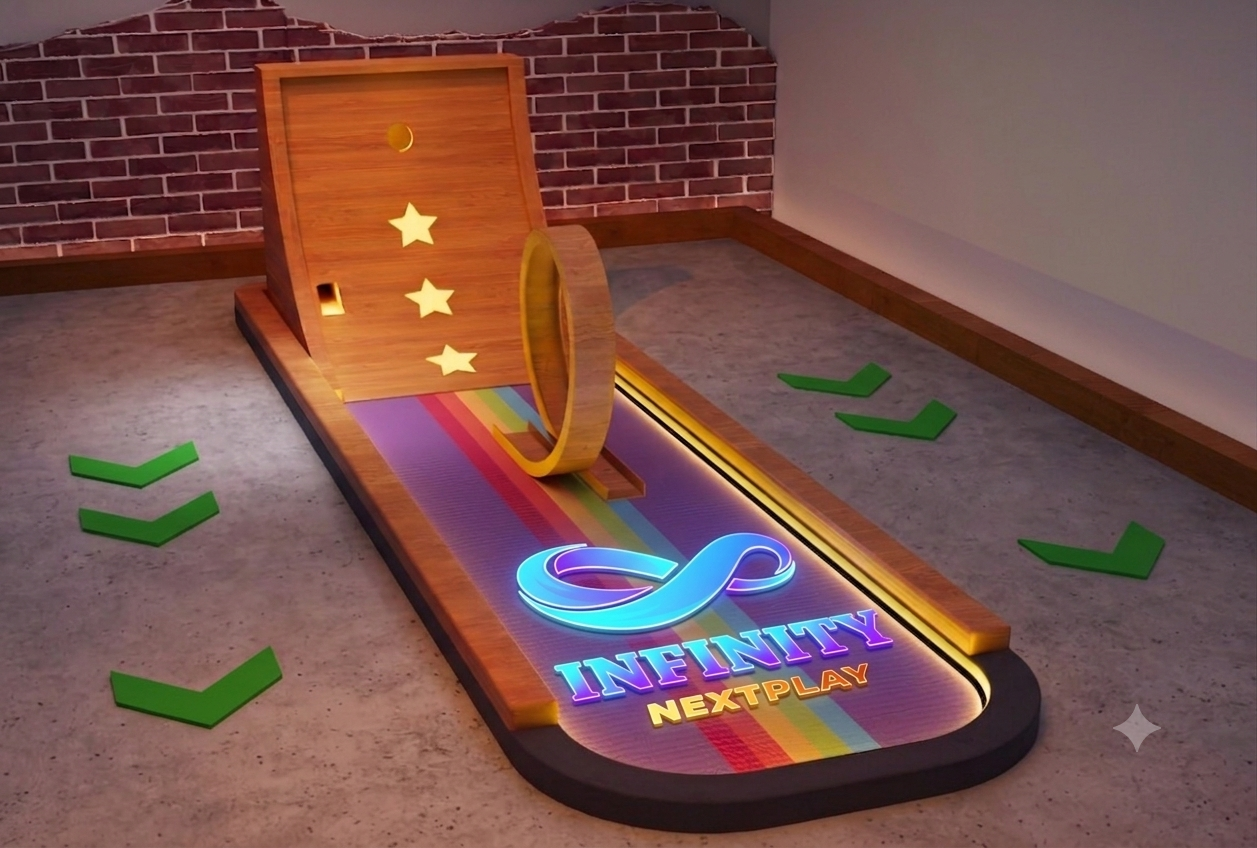
A 360-degree loop ramp module. Housing, lighting effect and scoring hardware travel inside one price tag, so ask which of the three your per-hole figure contains.
View Details ›
8. Mini Golf Supplier Quote Comparison FAQ
What must a mini golf supplier quote include line by line?
Eleven line groups: holes and modules, putting surface, lighting and blacklight, scoring system, installation, freight, tax and duty, payment milestones, warranty, lead time and spare parts. Each group must carry a value or the explicit words "not quoted". Specifications and unit price are present in almost every quote, while site preparation and destination charges are present in almost none (ue872, our VR arcade quote checklist; scope blocks from ue761), and a line that is missing does not become cheaper - it becomes an invoice later.
How do I compare three mini golf quotes that are priced differently?
Run the four normalization steps before reading any total: unify the unit of measure, unify the delivery terms onto one named place, discount the payment terms onto one date, and align the warranty periods (AuraVMS, 2026-06-30). Explode any package price back into the same eleven rows, since "a quote that is 30% cheaper is almost always for a different scope, not a better deal" (HPI, 2026-07-30). Cells with no value are written as "not quoted", never as zero, so silence is not mistaken for a price.
What is the difference between unit price and a fully installed package price?
A published package scope is four blocks - course design, equipment, installation, and training and support including spare parts supply (ue761) - while site preparation such as levelling, electrical work, clear height and fire exits sits outside the equipment quote (ue761). A unit price carries the equipment line only, and installation on top of it runs at about 5-15% of the machine price, plus an electrical audit of $400-800 and a technician at about $100 a day for 3-5 days with travel on the buyer (ue872). Compare them only after both are exploded into identical rows.
Is the cheapest bid always the best bid?
A real public three-bid tabulation says no. On the Cedar Rapids record for Twin Pines Miniature Golf opened 2020-08-05, the lower responsive total was $553,000 against $777,665, a spread of $224,665 (EXAMPLE: 777,665 - 553,000), and it also had the shorter lead time at 10 days against 21 - but it carried one year of workmanship against two, and a third bidder was non-responsive and therefore left the comparison before price was discussed. Published guidance says the same: award need not go to the lowest bid, life-cycle cost rather than initial purchase price should be applied outside one-off consumables, and abnormally low tenders must be examined specifically (GOV.UK, Assessing Competitive Tenders, Procurement Act 2023 guidance).
How long is a mini golf quote valid, and why does it expire?
Thirty days is the standard published term: "Quotations expire in 30 days" (USACD quotation terms), "valid for 30 days" (KSB, 2024-03-04), and a 30-day validity on a published amusement quotation (GameTime Quote #174343-01-03, 2025-08-01). The mechanical reason is that the freight inside the quote expires sooner than the equipment does - a 40ft container published at $2,800-3,600 China to US West Coast in late 2025 moves faster than a price list (ue872) - while the build side of the same quotation runs six to eight weeks standard lead time (GameTime, 2025-08-01).
What should I check before signing?
Four checks, in this order. First, the warranty start date - shipment, arrival or your signature on acceptance - and the split into surface, electronics and consumables, since consumables may not be covered by a standard warranty (EPARK, via ue907) and electronics commonly run twelve months (ue907, ue889). Second, a priced spare parts list and its restock lead time, checked against a published list of mini golf spare parts and prices (ue907). Third, what event each payment milestone attaches to: 25/35/35/5, 50/50 or net 30 (Kannegiesser, 2024-08-12). Fourth, the site readings themselves, which is why what we measure before the quote comes before any signature.

