GOLF SIMULATOR SESSION PRICING - THE RATE CARD
How Much Should You Charge for a Golf Simulator Session?
The golf simulator rate card on published numbers: the $40 median and $25-$55 band, what sets a venue's position in it, the per-bay-not-per-person split, the daypart card, and the session's full attached value approaching $100 a visit.
Median $40/hr Band $25-$55 Platform median $55 Per-bay, not per-person 3-rate daypart card 73% F&B uplift
$25-$55
Interquartile Band
$55/hr
Booking-Platform Median
~$100
Per-Visit Value (NGF)
1. The Answer Band: Three Medians and Why They Differ
How much should you charge for a golf simulator session? The honest answer is a band, not a number, and the band has been measured. Across 794 venues that publish their pricing, the national median rate is $40 per hour with an interquartile range of $25 to $55 and a mean of $51 - according to the Tabski 2026 benchmark compilation. Booking-platform data across 200-plus operating venues puts the median higher, at $55, because venues on a modern booking system skew larger and more urban. MyGolfSpy's sweep of the market agrees from the golfer's side: US venues charge between $20 and $80 per hour for a bay, with entertainment venues in major cities trending toward the top of that range.
The three medians disagree on purpose. The $40 figure is what the whole published market prints, including self-serve bays in suburban strip units; the $55 figure is what booked, staffed, urban venues actually transact at; and the mean of $51 sits between them because a handful of premium downtown cards pull it up. Read them as three different questions - what the market advertises, what the booking economy clears, and where the average card lands - and pick the question your venue answers before picking the number.
| Published benchmark |
Rate |
What it measures |
Source |
| National median |
$40/hr |
794 published rate cards, all venue types |
Tabski 2026 |
| Interquartile band |
$25-$55/hr |
The middle half of the published market |
Tabski 2026 |
| Mean published rate |
$51/hr |
Average card, pulled up by premium metros |
Tabski 2026 |
| Booking-platform median |
$55/hr |
200+ venues on booking systems - larger, more urban |
Tabski 2026 |
| Market sweep |
$20-$80/hr |
The full observed range, golfer side |
MyGolfSpy 2026 |
| Bar-and-restaurant guidance |
$40-$60+/hr |
Public commercial time with F&B |
21foregolf 2026 |
In one line: $40 is the market's median card, $55 is what booked urban venues clear, $25-$55 is the honest band - and where you sit inside it is a decision, not a guess.
One boundary keeps the band honest: these are bay-time rates only. Everything that rides on top of an hour of simulator - the food and beverage attach, club rentals, events and memberships - prices separately, and the per-visit arithmetic in section five shows how far beyond the sticker a session actually runs. A venue reading the $40 median as a ceiling on its whole customer relationship has misread the survey the same way the franchise-portal sites misread per-bay revenue as per-store: the rate is the floor of the transaction, not the size of it.
2. What Sets Your Position in the Band
Four levers decide where inside the band a venue lands, and every published rate card shows at least one of them working. Market comes first: state medians run from $25 in Maryland and Vermont to $90 in South Carolina, and Henderson, Nevada is the highest-priced metro at an $87 median - the same bay re-prices by ZIP code. Staffing comes second: the 24/7 self-serve card at TeeTime Indoor in Glenview runs $18-$25, roughly half the staffed urban median, because an unmanned bay sells time and a staffed bay sells an experience.
Technology is the third lever - premium tracking platforms command their own tier, which is why the premium-bay cards cluster at $50-$75 - and daypart is the fourth, large enough that it gets its own section below. The practical use of the levers is comparative, not theoretical: find the three or four published cards nearest your market and staffing model, and price against them. The cards below are exactly that reference shelf, printed with their sources.
| Venue (as published) |
Rate card |
The lever it shows |
| X-Golf Schaumburg, IL |
$45 weekday before 4pm / $55 after / $65 Fri-Sun |
Daypart |
| X-Golf Portland, OR |
$55 midday / $65 evening / $70 weekends |
Daypart, pushed higher |
| Five Iron Golf, NYC |
$50-$55 |
Urban staffed standard |
| Chelsea Piers Golf Club, NYC |
$60 |
Premium urban location |
| GOLFZON Social Brooklyn |
$50 |
Entertainment-format venue |
| Ready Golf Club, East Village |
$25 |
Value position in a premium metro |
| TeeTime Indoor, Glenview IL |
$18-$25 |
Unmanned 24/7 self-serve |
The Published Rate-Card Shelf ($/bay-hour)
TeeTime self-serve (top)
25
X-Golf Schaumburg weekday
45
GOLFZON Social Brooklyn
50
X-Golf Portland weekend
70
Sources: rate cards as compiled by Tabski 2026 benchmarks (vendor-published prices). Per bay-hour, not per person. The self-serve card spans $18-25; the top of its band is plotted.
One caution about copying a card: every venue above sells its own room, staffing and market. The shelf tells you the shape of the market, not your number - and the sibling piece on the bar and entertainment venue pricing strategy shows how the F&B side changes the arithmetic again.
3. Per-Bay, Not Per-Person: The Six-Player Split
Every rate in this article is per bay per hour, and the distinction is where most first-time operators misread the market. A bay holds up to six players; the survey average is three players per session; and more than 40% of groups split the cost - so the $55 bay-hour that looks expensive on a rate card is about $18 a head for the group that actually stands in it. The per-bay convention is also what makes group formats the quiet bestseller: the more players a bay stages, the lower the per-person price falls without the bay rate moving at all.
The first-party six-player format takes the split to its limit: the Indoor AR Golf Simulator full set publishes a 7 x 12 x 4 meter hitting zone staging six players, which at a $55 bay-hour is under $10 a head for a full six - a per-person price no standalone attraction in the venue can match, sold from floor the bay already occupies. Price the bay, stage the group, and let the per-person number do the marketing; the throughput arithmetic behind group formats is the same one the multisport zone work runs at 20-40 guests per bay-hour.
- Published rates are per bay-hour; the guest sees a per-person price.
- Average session: three players; 40%+ of groups split the bill.
- $55 bay-hour / 3 players = about $18 a head (EXAMPLE division, published inputs).
- Six-player formats push the per-person figure under $10 at the same bay rate.
- Charge for the bay, market the per-person price - both numbers printed on the card.
The split rule: one bay, one hourly rate - and the per-person price falls every time the group grows, which is why groups, not golfers, fill the calendar.
4. Off-Peak, Peak and the Daypart Card
The single rate card is a lost opportunity printed in three numbers, and the published cards show what the multi-rate version looks like. X-Golf Schaumburg runs $45 on weekdays before 4pm, $55 after, and $65 on Fridays through Sundays; X-Golf Portland pushes the same structure to $55 / $65 / $70. The structure exists because demand is violently uneven across the day: on weekdays, the 9am to 4pm block is 57% of available bay-hours but nowhere near 57% of bookings, while demand peaks at 6pm (13% of all booked weekday hours) and 7pm (10%). Weekends peak at 1pm with no evening spike at all.
A daypart card converts that shape into revenue instead of idle time: the off-peak rate exists to move the 57%, the peak rate exists to ration it, and the weekend rate prices the one block that sells itself. The bands are published - off-peak cards cluster in the $25-$45 range, weekday evenings and weekends at $45-$75 - so an EXAMPLE worksheet reads: weekday before 4pm at $40 (mid of the off-peak band), weekday after 4pm at $55 (the booking-platform median), weekends at $65 (the X-Golf Portland weekend card). Three rates, one bay, every hour priced for the demand it actually faces.
| Daypart (EXAMPLE worksheet) |
Rate |
Published anchor |
| Weekday before 4pm |
$40/hr |
Mid of the $25-$45 off-peak band |
| Weekday after 4pm |
$55/hr |
Booking-platform median (200+ venues) |
| Weekends |
$65/hr |
X-Golf Portland weekend card |
| Late-night pocket |
Consider self-serve or staffing trial |
Shift-worker demand 11pm-3am (operator report) |
The card is a living document, and the demand data tells you when to re-open it. Review the booking mix at ninety days against the published demand shape: if the weekday 9am-to-4pm block is still selling near nothing while the 6pm peak turns parties away, the off-peak rate is still too high or the peak rate is too low - and if weekends are turning groups away while weekday evenings sit half-full, the weekend card is underpriced by the distance between your market and the X-Golf Portland card. The published inputs for the review are the same shares that built the card: the 57% weekday gap, the 6pm and 7pm peaks, the 1pm weekend peak. A card that has not been re-priced against its own booking data in six months is a card written for a market someone else opened.
Daypart rule: one rate per hour is a decision to let 57% of your weekday inventory go unsold - the published cards all refuse it, and so should yours.
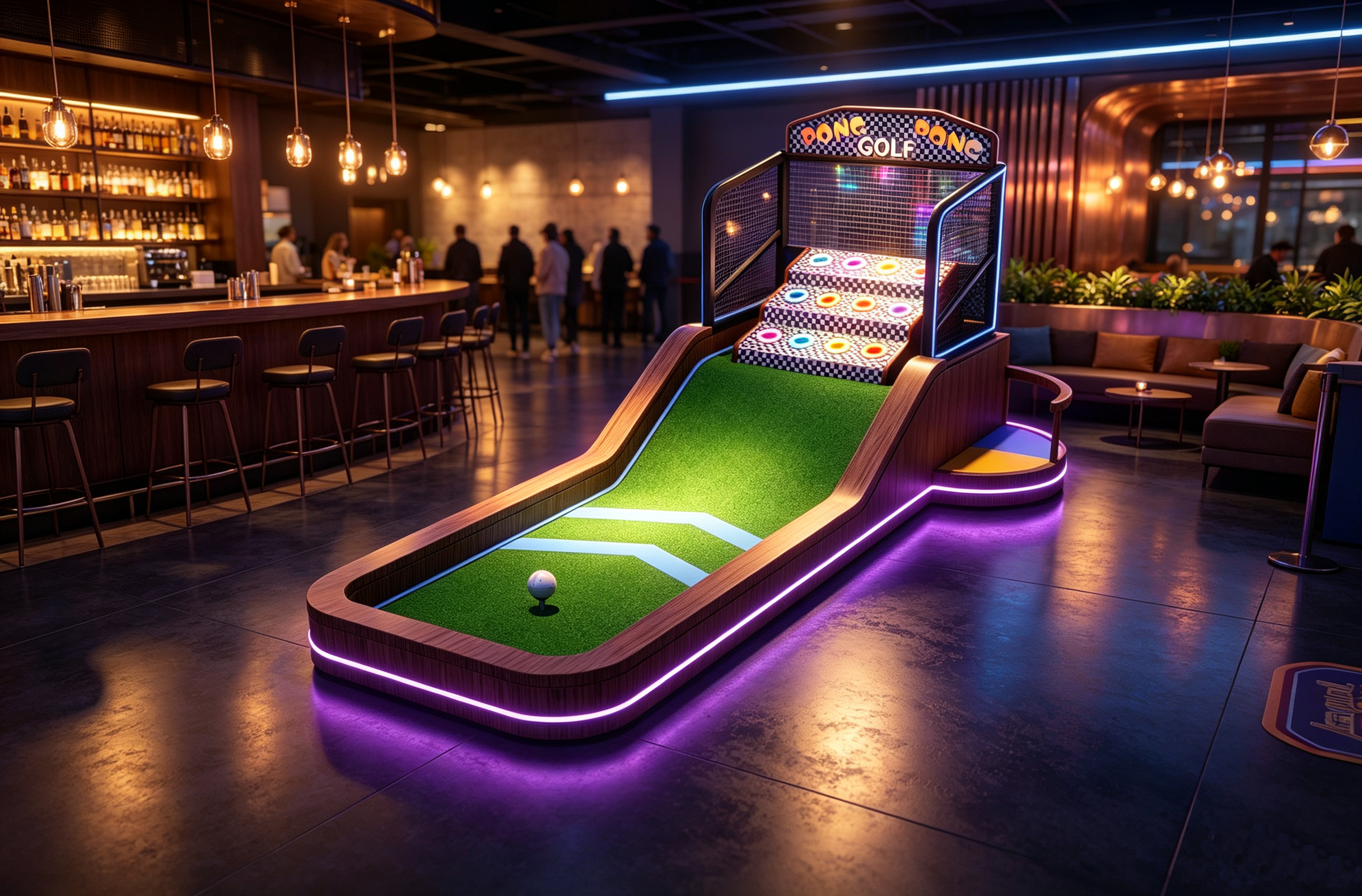
The full strategy layer on top of the daypart card - leagues, events, and the F&B attach that makes a bar's simulator twice as valuable - is the sibling piece on the bar and entertainment venue strategy, and the second act on the bar floor is often a second format: the Beer Pong Golf Hole runs the same group logic at mini-golf prices while the bay hosts the serious rounds.
5. What a Session Is Worth With Everything Attached
The bay rate is the sticker price, not the transaction. The National Golf Foundation surveyed 354 facility operators and 569 golfers in late 2024, and the attached picture reads: the average session runs just over one hour at an average fee of $55; average food-and-beverage spend per visit is $40; the F&B uplift on bay time is 73%; and total per-visit customer value approaches $100. More than 40% of public-facility customers exceed $70 per session. Every dollar of bay time drags roughly 73 cents of food and beverage behind it.
Two honesty notes travel with those numbers. First, the NGF sample is 74% public golf courses and 26% private clubs adding simulators - not standalone urban golf bars - so it probably understates the attach at a venue with a real kitchen and a cocktail program, and dramatically overstates it at an unmanned facility with no F&B at all. Second, the small lines count too: club rentals run $10-$15 per session at venues that offer them, which on a three-player group is $30-$45 of nearly pure margin sitting in the rack by the door.
| Per-visit line (published averages) |
Value |
Source |
| Session fee (just over one hour) |
$55 |
NGF 2024 survey via Tabski |
| F&B spend per visit |
$40 |
NGF 2024 survey via Tabski |
| F&B uplift on bay time |
73% |
NGF 2024 survey via Tabski |
| Club rental (where offered) |
$10-$15 per session |
Tabski published pricing |
| Total per-visit value |
Approaching $100 |
NGF 2024 survey via Tabski |
Where the Session Money Comes From (published averages, $)
Sources: NGF 354-operator survey (late 2024) and published venue pricing, as compiled by Tabski 2026. The uplift caveat: NGF sample is 74% public courses - a real bar with a kitchen likely attaches higher, an unmanned bay lower.
The attached-value lens is also where this page hands off: the bar-version of the strategy - kitchen programs, event nights, the 73% uplift engineered upward - is the venue pricing strategy piece, and the demand-side question of whether to sell the session at all versus a monthly plan is the membership versus pay-per-play comparison.
6. Building the Card, Step by Step
Assemble the card in five steps, each anchored to a published reference rather than a feeling. Step one: place the market - find the state median and the nearest metro card. Step two: place the staffing model - self-serve cards run roughly half of staffed urban cards, so an unmanned bay starts at the bottom of the band and a full-service bar starts above the booking-platform median. Step three: set the technology tier honestly - the premium-tracking tier is real, but it prices the bay, not the brand. Step four: split the dayparts on the 57% weekday-gap structure and write the three rates down. Step five: print the per-person arithmetic next to the per-bay rate, because that is the number the group actually reads.
- Step 1 - Market: state median and the two nearest published cards.
- Step 2 - Staffing: self-serve half-band; staffed bar above the platform median.
- Step 3 - Technology: premium bay tier, priced per bay, never per brand.
- Step 4 - Dayparts: three rates on the weekday 9am-4pm gap structure.
- Step 5 - Per-person line: bay rate over expected players, printed on the card.
Two neighboring disciplines close the loop. The cost side of the ledger - what the bay, the room and the fit-out cost to buy - is the published golf simulator price guide, and the payback math that turns this rate card into an investment case is the 15 m2 bay payback work (a ~$38 blended bay-hour and 14-20 months to payback). The pricing mechanics transfer across attractions too: the mini golf rate-card architecture and the multisport equipment cost guide run the same published-anchor method, and the hotel version lives in the hospitality revenue guide.
Card rule: five steps, every rate anchored to a published reference, and the per-person line printed next to the per-bay price - then the card defends itself in the meeting.
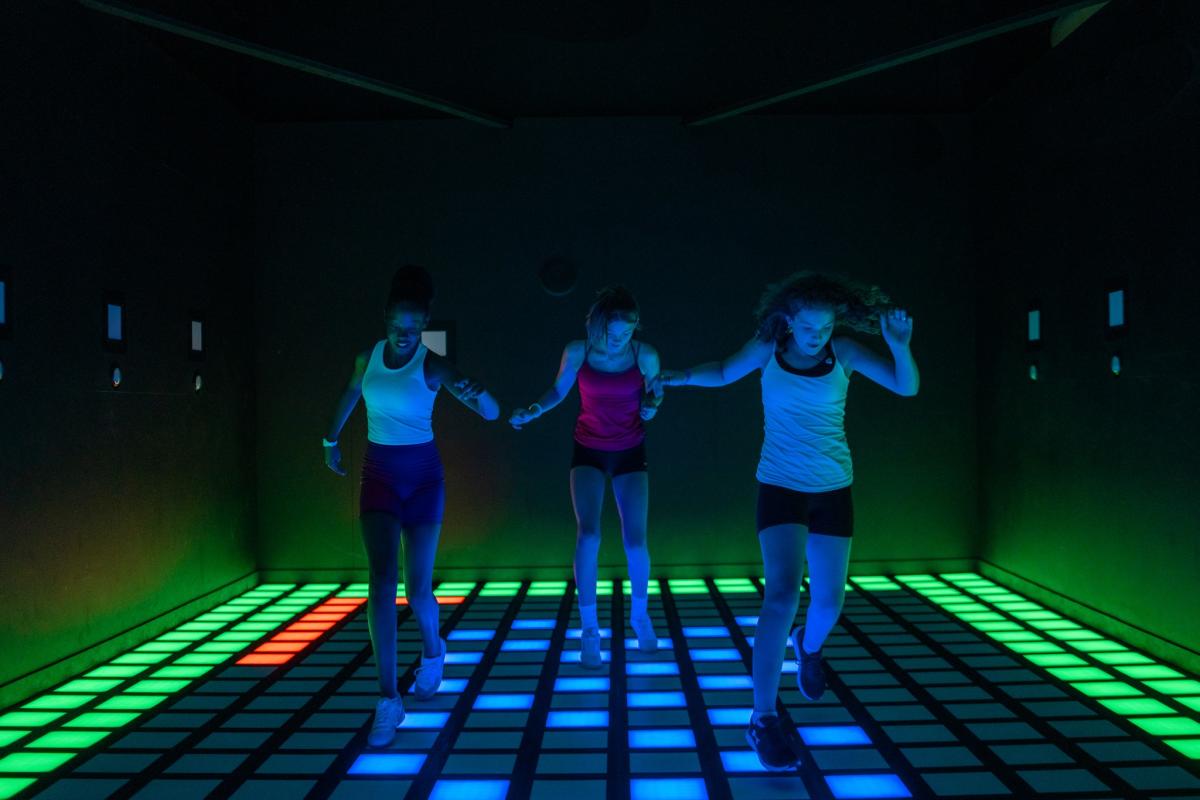
Four card mistakes finish the page, because every one of them appears in the published record of venues that priced wrong. Pricing per person instead of per bay breaks the six-player economics that make group formats sell. Printing one flat rate erases the 57% weekday gap and converts it from an opportunity into idle time - idle time the Interactive LED Floor can partially rescue by earning from the waiting groups, but never fully. Hiding the per-person arithmetic makes a $55 bay-hour look expensive to a group that would divide it to $18 a head without blinking. And ignoring the self-serve tier is a positioning error: the $18-$25 unmanned card is not your competitor unless your staffing model is unmanned too - but if it is, your card has to say so, because the guest at 11pm is comparing exactly that.
7. Frequently Asked Questions (FAQ)
How much should you charge for a golf simulator session?
Start inside the published national band: the median rate is $40 per hour with most venues between $25 and $55 (794 published rate cards, Tabski 2026), booking-platform venues skew to $55, and full-price urban entertainment venues run higher. Position inside the band comes from market, staffing, technology and daypart - the four levers this page works through.
Is simulator pricing per bay or per person?
Published rates are per bay, not per person: the survey average is three players per session and more than 40% of groups split the cost. A $55 bay-hour divided across three players is about $18 a head, and a six-player format drops the per-person figure further - which is exactly why group formats book so well.
What is a reasonable hourly rate for a bar with a simulator?
The published guidance for public commercial time with a bar and restaurant lands at $40 to $60 plus per bay-hour (21foregolf), consistent with the booking-platform median of $55. The bar also earns roughly 73 cents of food and beverage per dollar of bay time - the attached-value math is in section five and the full bar strategy is the sibling piece.
Should off-peak sessions be cheaper?
Yes, and the published rate cards already do it: X-Golf Schaumburg runs $45 before 4pm on weekdays against $65 on Fridays through Sundays. The structural reason is that 9am to 4pm on weekdays is 57% of available weekday bay-hours but nowhere near 57% of demand - the daypart card in section four turns that gap into sold hours.
How long is a simulator session, and does that change the rate?
The NGF operator survey puts the average session at just over one hour with an average fee of $55. Rate by the hour but think in sessions: an hour-long session at $55 plus about $40 of food and beverage takes the per-visit value toward $100, which is the number a bar actually banks per seat-hour.
8. Featured NextPlay Active Gaming Equipment

The bay you price
Professional Training Commercial Use Indoor AR Golf Simulator Full Set - High-Speed Camera Detector, 4K Laser Projector
The six-player envelope - 7 x 12 x 4 m hitting zone, dual cameras at 3,000+ FPS, 4K laser projector - the bay that turns a $55 bay-hour into a per-person price no rival attraction matches.
View Details ›
The bar-side second act
Beer Pong Golf Hole - Indoor Mini Golf Hole
The group-format hole that shares the bar's floor and its F&B engine: one more per-person price point on the same card.
View Details ›
The waiting-time earner
Immersive Interactive LED Floor Game
The attraction that monetizes the queue between sessions - the hours a rate card cannot sell, sold anyway.
View Details ›
Price Your Bay With Real Numbers
Send your market, staffing model and floor plan and we will return the bay specification, the six-player format check and the layout behind the rate card via the free 3D layout design, anchored on the Indoor AR Golf Simulator.

