MINI GOLF BIRTHDAY PARTY PRICING - THE PACKAGE MATH
How Do You Price a Mini Golf Birthday Party? The Per-Head Package Math
The birthday-party package on published numbers: the $300-800 all-in range and $13-per-head city anchor, the per-head EXAMPLE worksheet that books a party of twelve at $288, the three-tier ladder, the minimum-and-deposit policy lines, and the step-by-step package build.
All-in $300-800 $13/head city anchor EXAMPLE: 12 kids = $288 3-tier ladder 10-guest minimum +22-35% package lift
$300-800
Venue All-In Range
$13/child
City Course Anchor
$24/head
EXAMPLE Package (12 kids)
>4x
Block vs Walk-Up (corporate pattern)
1. The Block, Not the Rounds: What a Party Actually Is
A birthday party is not twelve rounds of mini golf. It is a hosted block: course time for the group, a room or reserved zone, a host who runs the flow, food and drink, and the cleanup nobody's parent wants. Price it as rounds and the arithmetic collapses into walk-up math - twelve kids times $8 is $96, which does not cover the room, the host or the hour the course stops selling to anyone else. Price it as a block and the same group books at $288 on EXAMPLE per-head math of $24 across twelve guests - the difference is the price of certainty, and the market has already priced that premium.
The market evidence sits in three published layers. The Chuck E. Cheese Kids' Birthday Party Cost Guide (updated May 2026) puts the average total spend on a child's birthday at $200-500, and the venue party all-in - package, food and add-ons together - at $300-800. The City of Gaithersburg's miniature golf course publishes a cleaner per-head anchor: $13 per child with a $130 minimum for ten guests, paid at booking. And the general FEC market clusters party packages around $15-$30 per head - a market observation, not a named benchmark, but consistent with both published anchors above.
| Published anchor |
Number |
What it measures |
Source |
| Kids' birthday total spend |
$200-500 |
The average family budget for the event |
Chuck E. Cheese cost guide 2026 |
| Venue party, all-in |
$300-800 |
Package + food + add-ons at a venue |
Chuck E. Cheese cost guide 2026 |
| Per-head, city course |
$13/child |
Municipal course group rate |
Gaithersburg group outings |
| Minimum booking |
$130 (10 guests) |
The block floor - paid at booking |
Gaithersburg group outings |
| FEC party band |
$15-$30/head |
Market observation across FEC packages |
Market observation 2026 |
In one line: the parent buys a handled afternoon, not rounds - the all-in market runs $300-800, per-head anchors run $13 to $30, and the package is the product.
One boundary keeps the numbers honest: these are party-package prices for hosted blocks. The walk-up rate card, the daypart tiers and the blended $12 ticket price the regular business and live on the sibling rate-card page; the corporate block - the $26-36-per-guest buyout that shares the block logic with bigger budgets - is the corporate night work. The party package sits between them: the same certainty the corporation buys, at family scale.
2. The Per-Head Math: An EXAMPLE Worksheet
The per-head package is the unit that survives the parent's comparison shopping, because it answers the only question being asked: what does the whole afternoon cost per kid? An EXAMPLE worksheet makes the arithmetic visible - a party of twelve at $24 per head books at $288, sits inside the $300-800 all-in range once the birthday family's own extras arrive, and prices each kid at three times the $8 walk-up round. The $24 lands mid-band in the $15-$30 FEC market observation, with room to move up as add-ons attach.
The cost side explains why the per-head number holds. The room and the host are fixed costs - they cost the same for eight kids as for sixteen - which is exactly why the minimum exists: the Gaithersburg pattern books ten guests at $130 minimum because below ten the block stops covering its own fixed floor. The course time is the opposite kind of cost: it is capacity, and the capacity work shows the loop's players-per-hour arithmetic absorbing a ten-to-sixteen group in one comfortable rotation. Fixed floor plus elastic capacity is the textbook shape for per-head pricing - the floor sets the minimum, the capacity sets the ceiling.
| EXAMPLE worksheet: party of 12 |
Per head |
Block total |
Note |
| Base package (course + room + host) |
$18 |
$216 |
Mid of the market band, inputs published |
| Food line (pizza + drinks pattern) |
$6 |
$72 |
The standard FEC food rider |
| Package as booked |
$24 |
$288 |
Inside the $15-$30 band; $300-800 all-in with extras |
| Gaithersburg comparison (10 kids) |
$13 |
$130 |
Municipal floor: course only, no hosting |
Per-Head Party Anchors ($)
Gaithersburg city course
13
Sources: Gaithersburg group outings ($13/child, $130 min); FEC $15-$30/head market observation; corporate $26-36/guest (corporate night work). The EXAMPLE $24 is mid-band, party of 12 = $288.
The worksheet is a planning model, not a promise - the published anchors are inputs, and the package that books in your market is the one your room, your course and your add-on menu support. But the shape travels: per-head pricing against a published band, a minimum that covers the fixed floor, and a block total the parent can compare against the $300-800 all-in range without a calculator.
Math rule: the per-head price answers the parent's question, the minimum covers the fixed floor, and the block total lands inside the published all-in range - three numbers, one package.
3. The Three-Tier Package Ladder
One package price is a choice forced on the parent; three are a path walked upward. The published market shape supports a three-tier ladder: a base package at the floor of the per-head band - course time, the reserved zone, the host and the food rider - priced so a ten-kid minimum clears the fixed floor the Gaithersburg pattern shows; a standard package mid-band that adds the second-attraction session and the food upgrade; and a premium package at the band's top that adds exclusive-zone time or a buyout-style private block for the group. The ladder works because the parent who upgrades is buying the same certainty with more of it - not a different product.
The ladder's job is to make mid-band the obvious choice, and the rate-card discipline explains why: the rate-card architecture work measures package lift at +22-35% over flat play, and that lift is collected between tiers, not at the floor. The base tier anchors the comparison; the premium tier makes the standard tier look reasonable; the standard tier is where most parties actually book. Each tier rides the same floor and host - so every upgrade lands almost entirely on the margin line.
- Base: course time + reserved zone + host + food rider, at the band floor.
- Standard: adds a second-attraction session and the food upgrade - the volume tier.
- Premium: adds exclusive-zone or private-block time at the band top.
- Every tier above the floor rides costs the base already paid - upgrades are margin.
- Print the per-head price for all three; the parent reads per head, not per package.
The second-attraction session is the ladder's engine, and it prices from floor the venue already owns. An interactive-hole corner - the Beer Pong Golf Hole runs the group logic at mini-golf prices, and the Labyrinth Challenge putting attraction takes a corridor instead of a bay - gives the standard tier its second act without a dollar of new real estate. The Balance Challenge Golf Hole slots the same way as the compact competition format. The attractions are the upgrade; the package is how the upgrade sells.
Ladder rule: three tiers, one fixed floor, and the mid-band tier positioned to win - because the parent who upgrades buys more certainty, not a new product.
4. Minimums, Add-Ons and the Deposit
Three policy lines make the package durable. The minimum: ten guests at the Gaithersburg pattern - a published floor that covers the room and host before the first kid arrives. The deposit: the Gaithersburg minimum is paid when the request form is submitted, which converts the booking from an intention into inventory - a no-show party costs the venue a Saturday slot it cannot resell, and the deposit is the price of that certainty running both directions. The add-on menu: priced lines that ride the party's existing staffing - food upgrades, return-visit passes, attraction sessions - because an add-on sold during the party costs nothing the package has not already paid for.
The add-on menu is also where the ladder's +22-35% lift is actually banked. The rate-card work measures that lift over flat play, and the party is the flat play's most concentrated form: every parent in the room is deciding in one sitting, against one deposit, with one birthday clock. A return-visit pass sold at the party books the next visit at near-zero acquisition cost; an attraction session sold on-site earns from floor the party already occupies. The published afternoon-player pattern - the $5 round dragging a $6 snack behind it - scales up to the party: the block drags a whole add-on menu behind it.
| Policy line |
Published pattern |
What it protects |
| Minimum |
10 guests / $130 (Gaithersburg) |
The fixed floor: room + host |
| Deposit |
Paid at booking (Gaithersburg) |
The Saturday slot - inventory, not intention |
| Add-ons |
Food, passes, extra sessions |
The +22-35% package lift, banked on-site |
| Headcount window |
Book headcount 3 days out |
Food ordering vs the per-head rate |
Policy rule: the minimum covers the floor, the deposit owns the slot, and the add-on menu banks the lift - a package without all three is a discount wearing a party hat.
The deposit discipline closes the loop the block arithmetic opened: a party booked without a deposit is walk-up revenue wearing a reservation, and the >4x premium the block commands - the corporate night's published multiplier on hosted evenings - only exists because the block is certain. Certainty is the product; the deposit is where the customer signs for it.
5. When the Group Grows: The 20-Kid EXAMPLE
The EXAMPLE worksheet scales, and the scaling tests the capacity line. Twenty kids at the same $24 per head book at $480 - inside the $300-800 all-in range before a single add-on - but whether one rotation or two hosts them is a capacity question, and the players-per-hour arithmetic across the loop answers it: a course absorbs a twenty-kid group in two comfortable waves. Wave one plays the course while wave two owns the second attraction - the interactive corner or putting lane the standard tier includes - and the waves swap at the halfway mark. The party that books twenty is not a bigger party; it is two parties in one block, and the host the base package already pays for runs the handoff.
The two-wave shape is also the quiet margin win. The room and the host spread across twenty heads instead of ten: the fixed floor that set the ten-guest minimum now costs half as much per kid, which is why the 20-kid package at the same per-head rate nearly doubles the block total while adding only the second wave's staffing hour. The guardrail comes from step five of the build: confirm the capacity check before confirming the date - a block larger than the loop can absorb in waves turns the party into a queue, and a queue is the one product a birthday never buys.
Scale rule: every doubling of headcount halves the fixed floor per kid - right up to the wave the loop cannot absorb, and that line is a capacity check, not a guess.
6. Building the Package, Step by Step
Assemble the package in five steps, each anchored to the published pattern rather than a feeling. Step one: set the block definition - what the base package includes, written as the parent reads it (course time, room, host, food, cleanup). Step two: place the per-head price inside the band - mid-band as the EXAMPLE worksheet does, with the Gaithersburg floor and the all-in range as the guardrails. Step three: set the minimum and the deposit on the published pattern - ten guests, paid at booking. Step four: build the add-on menu from attractions and food that ride existing staffing. Step five: diary the capacity check against the course's players-per-hour arithmetic before the first Saturday sells out.
- Step 1 - Block: write what the parent buys, not what the venue sells.
- Step 2 - Price: per head, mid-band, inside the $300-800 all-in frame.
- Step 3 - Floor: ten-guest minimum, deposit at booking.
- Step 4 - Add-ons: second attraction + food + passes, riding existing staffing.
- Step 5 - Capacity: players-per-hour check before the calendar fills.
Four package mistakes finish the page. Pricing the party as rounds hands the parent walk-up math and makes the package look like a surcharge. Skipping the minimum leaves the fixed floor - room and host - uncovered below ten heads. Skipping the deposit turns Saturdays into inventory held for free. And itemizing the receipt pushes the parent back into comparison shopping against the walk-up card - the exact arithmetic the package exists to escape. The hosted block, like the simulator-versus-mini-golf comparison shows for formats, wins by selling the thing the other channel cannot: here, certainty.
Two neighboring disciplines close the loop. The course-side design that makes parties flow - staging zones, flow paths, the party-hole themes - is the published birthday-course design work, and the capacity arithmetic behind step five is the players-per-hour capacity guide. The base card the package upgrades from is the rate-card piece, and the layout that fits the party staging into the floor plan starts from the free 3D layout design - anchored, like every block the venue sells, on the Indoor AR Golf Simulator family that shares the floor with the course.
Package rule: five steps, every line anchored to a published pattern, the block written the way the parent reads it - then the package sells the certainty it delivers.
7. Frequently Asked Questions (FAQ)
How do you price a mini golf birthday party?
Price the hosted block, not the rounds: a per-head package that bundles course time, a party space, a host and food. The market evidence puts venue all-in parties at $300-800 (Chuck E. Cheese 2026 cost guide), city-course per-head rates near $13 with a 10-guest minimum (Gaithersburg), and FEC party packages cluster around $15-$30 per head. An EXAMPLE 12-kid party at $24 a head books at $288 - inside the all-in range and four rounds above walk-up arithmetic.
What should the per-head price include?
Everything the parent does not want to manage: the round or course time, the room or reserved zone, a host who runs the flow, food and drink for the kids, and the cleanup. The published all-in range $300-800 is a packaged number - parents compare package totals, not itemized receipts. Itemizing pushes the comparison back to walk-up math, which is the arithmetic a package exists to escape.
How many kids make a party work?
Ten to sixteen is the working band: ten is the published minimum pattern (Gaithersburg books 10 guests at $130), and the course-capacity work shows the loop takes a group of that size through comfortably while the second wave plays. The minimum exists because the room and the host are fixed costs - below it, the package stops covering them.
Should parties be cheaper per head than walk-up rounds?
No - and the corporate-night block math shows why: a hosted block priced at $26-36 per guest multiplies a slow walk-up evening more than four times over. The party parent buys certainty - a date, a room, a handled afternoon - and certainty prices above the walk-up round, not below it. The walk-up $8 round and the $24-a-head package are different products that happen to share a floor.
What add-ons earn the most per party?
The ones that ride existing floor and staffing: a second attraction session in the same building - from an interactive-hole corner to a putting-attraction lane - plus the food upgrades and return-visit passes. The rate-card work measures package lift at +22-35% over flat play; add-ons are where that lift is collected, because each one sells against a cost the party has already paid.
8. Featured NextPlay Active Gaming Equipment
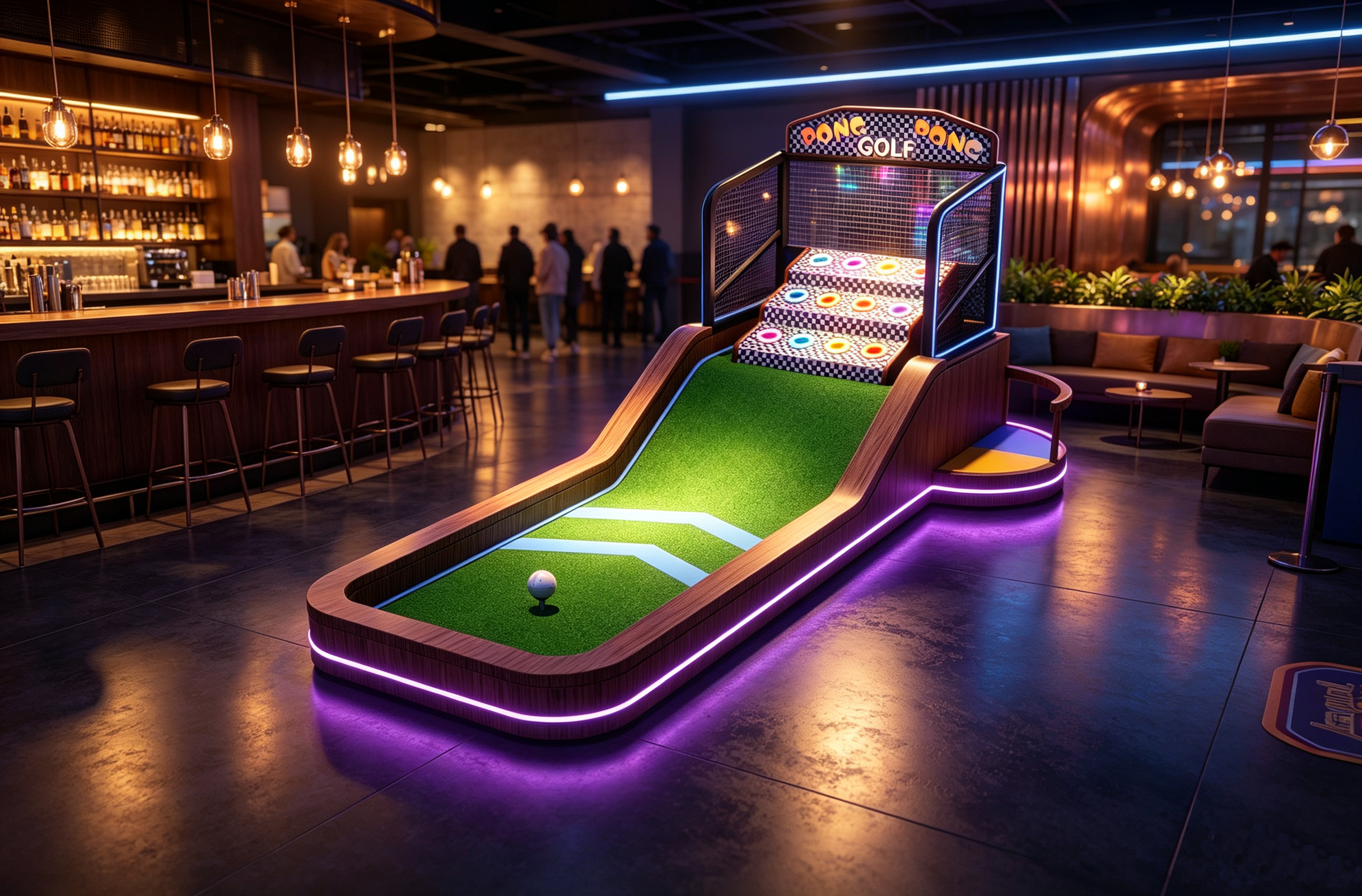
The standard-tier second act
Beer Pong Golf Hole - Indoor Mini Golf Hole
The group-format hole that gives the party package its second-attraction session - group logic at mini-golf prices, on floor the party already occupies.
View Details ›
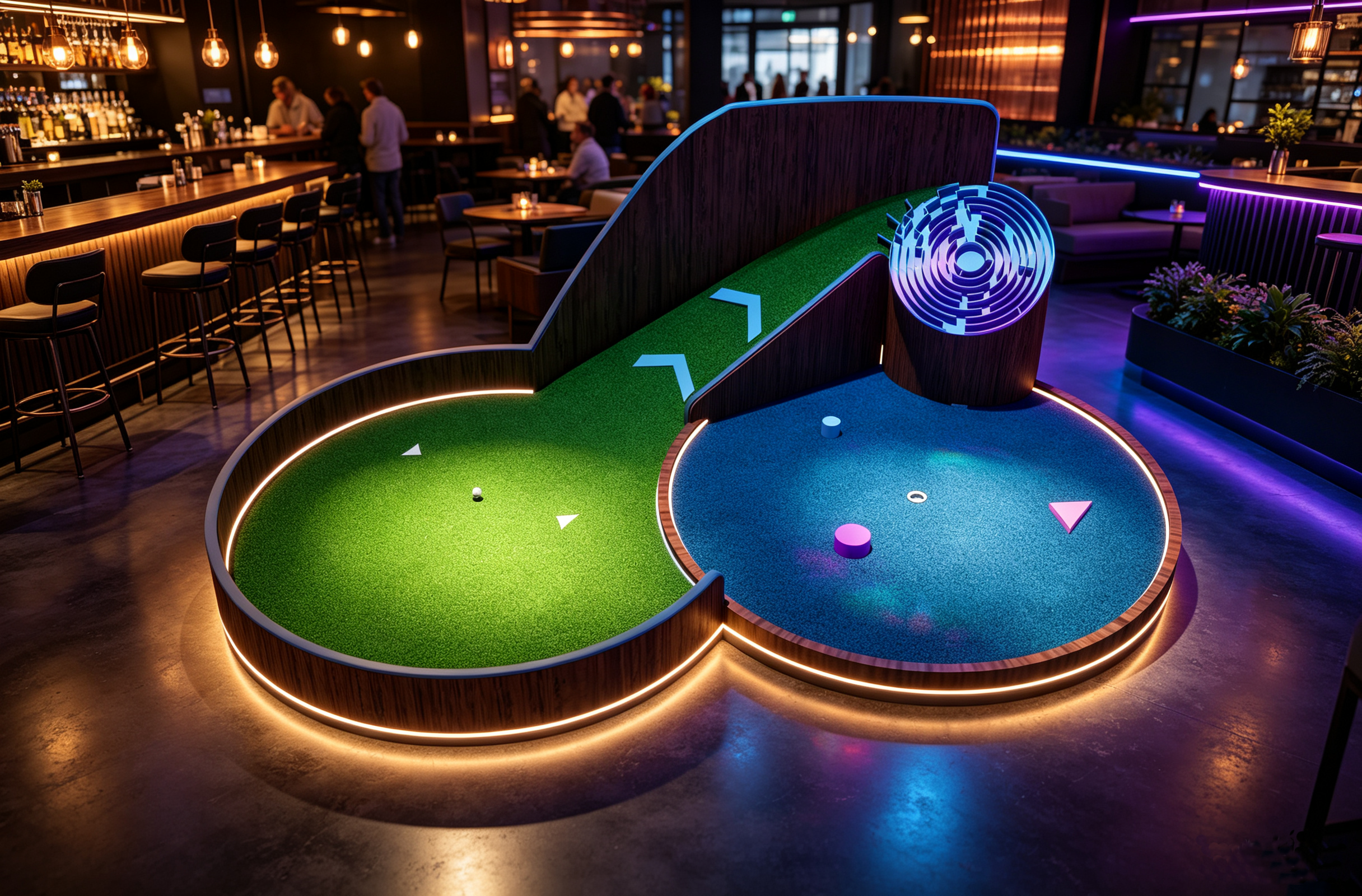
The corridor upgrade
Labyrinth Challenge - Indoor Mini Golf Game Interactive Putting Attraction
The putting attraction that takes a corridor instead of a bay - the add-on session that turns the base tier into the standard tier.
View Details ›
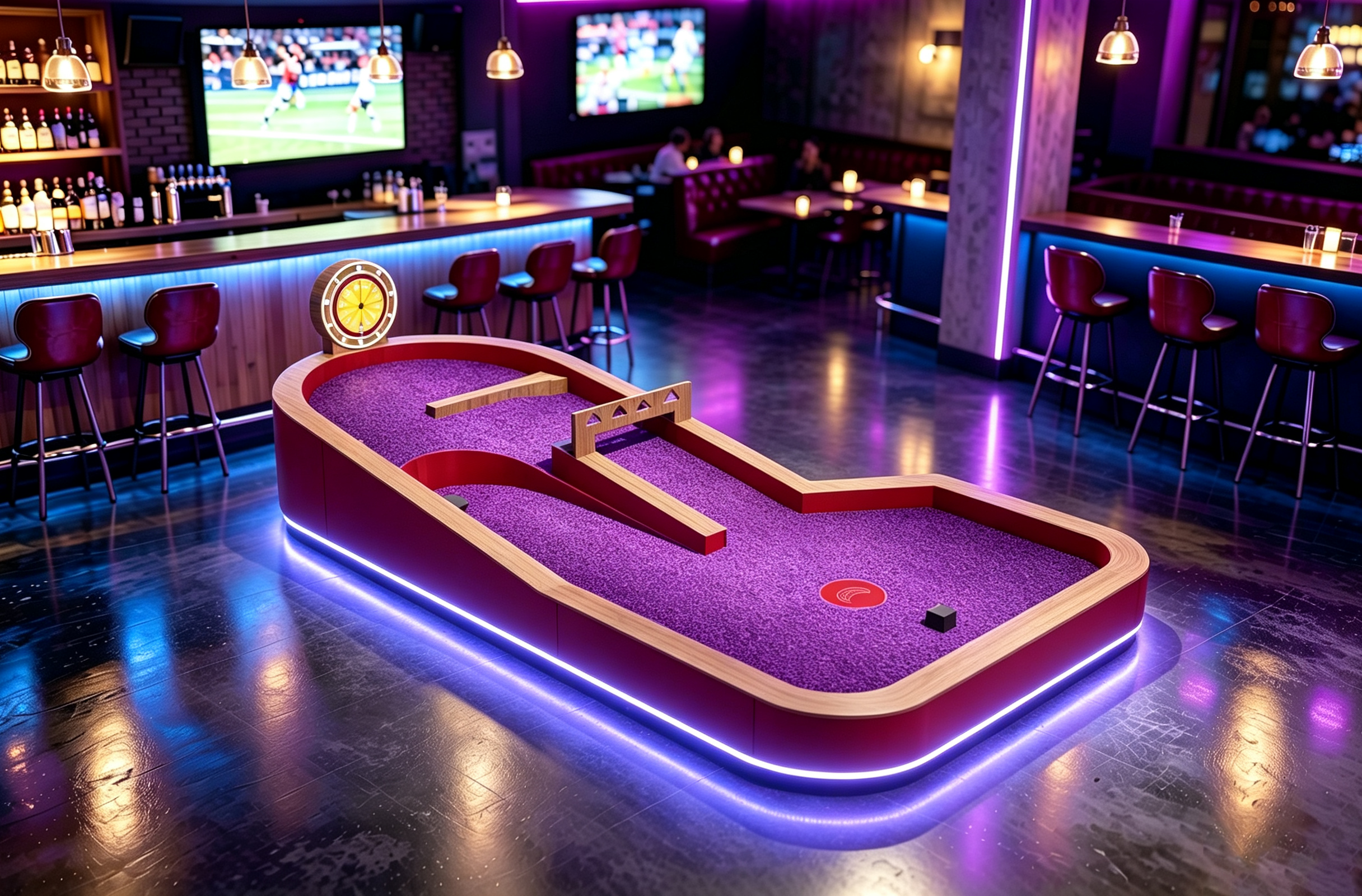
The compact competitor
Balance Challenge Golf Hole - Indoor Mini Golf Hole
The compact competition format that gives party groups a head-to-head game - the add-on the host runs between rounds.
View Details ›
Price Your Party Package With Real Numbers
Send your floor plan, party room and attraction mix and we will return the package structure, the capacity check and the layout behind the block via the free 3D layout design, anchored on the Indoor AR Golf Simulator family.

