MINI GOLF BIRTHDAY PARTIES - THE PARTY FLOW DESIGN GUIDE
How Do You Design a Mini Golf Course for Birthday Parties? The Party Flow From Invite to Goodie Bag
A birthday-ready mini golf course is designed around the party loop: check-in, a 6-9 hole rotation that plays in 18-45 minutes, a party table at the course midpoint, themed photo holes and one bundled package price. This guide maps the loop with published footprint bands, play times and group-event package economics.
Party loop Hole selection Slot timing Group math F&B and photos Package anchors
18-45 min
Party Play Time
+22-35%
Tiered Package Value Lift
1. How Do You Design a Mini Golf Course for Birthday Parties? The Party Flow From Invite to Goodie Bag
A mini golf course works for birthday parties when the course is designed around the party loop, not just the golf: a group of kids arrives on a schedule, plays a short session that fits a party slot, takes photos at themed holes, eats cake in a party area, and leaves with a scorecard worth keeping. The published explainer on what indoor mini golf is shows why the format suits parties in the first place - one modest ticket per player, about an hour for a full 18-hole round for a group of three or four, mixed ages, and smart-cup auto-scoring that removes the arguing kids hate most. This guide turns that fit into a design brief: which holes to pick, how to time the loop, how many players an hour a party course serves, and how the package math closes the sale.
The party loop in one line: invite sets a head count -> check-in and scorecards -> a 6-9 hole party course that plays in 25-40 minutes -> cake and food -> photos at the themed holes -> goodie bag with the scorecard. Design every element so the loop never stalls.
2. Pick Holes by Party Rhythm, Not by Difficulty Ladder
A party course is not a tournament course. Party groups are mixed ages, first-time players, and short attention spans, so the hole selection should front-load easy wins and save the spectacle for the finale. The published hole-design sheet (mini golf hole design, hole by hole) gives you the per-hole envelope to write down: lane length, lane width, clearance at the tallest obstacle, and a per-hole play time of three to five minutes. For parties, pick from the published footprint bands the capacity guide prints - beginner holes at 12 to 25 square meters, intermediate at 20 to 36, flagship at 30 to 48 - and weight the party rotation toward the beginner and intermediate bands.
The published capacity analysis also prints a per-hole play time of 3 to 5 minutes and a 0.10 to 0.12 meter ball-return band, which is the rhythm a party course should keep. Two or three themed holes carry the party photos: the Dream Castle Hole gives you the castle-superlative shot every parent wants, the Cyclone Spin Hole with its 360-degree loop ramp reads beautifully on video, and the Bowling Theme Mini Golf Challenge is the natural party finale because the whole group can cheer one roll together.
| Party slot |
Hole role |
Published footprint band |
Why it works for parties |
| Opening stretch |
Beginner holes (retro block) |
12-25 m2 per hole |
Early wins for first-timers, fast starts, no queue buildup |
| Middle rotation |
Intermediate themed holes |
20-36 m2 per hole |
Castle and maze photo moments inside the natural rotation |
| Finale |
Flagship spectacle hole |
30-48 m2 per hole |
One memorable finish worth the group photo |
3. The Party Loop, Step by Step
The loop is a schedule, and every step either feeds the next one or stalls it. Check-in: pre-printed scorecards grouped by party table, so ten kids do not queue at one counter. Play: a 6-9 hole party course rather than the full 18 - the published bar-lane format analysis times a 25-minute round over a six-hole loop at par 2, which is the right rhythm for a party slot with cake waiting. Eat: the party area sits at the course midpoint, not the end, so the group can break for cake between the middle rotation and the finale hole. Photos and goodie bags: the themed holes are the photo backdrop, and the scorecard doubles as the take-home keepsake.
Party Course Play Time by Hole Count (published per-hole band)
Source: published per-hole play time of 3-5 minutes (mini-golf-course-capacity and hole-design sheet). Arithmetic on published bounds: hole count x 3-5 minutes. Bars indexed to the 9-hole upper bound of 45 minutes.
The published capacity guide also names the throughput logic a party day lives on: whole-circuit throughput is decided by how fast a group cycles the loop without backtracking, and a short cycle keeps the queue moving. On a party-heavy weekend that means staggering party slots by 45 to 60 minutes, and it is exactly the slot-staggering logic the off-peak pricing rate card applies on weekdays - the same course serves both calendars.
4. The Group Math: What a Party Course Serves Per Hour
Party economics are throughput economics. The published capacity analysis is the source for the group math: a hole serves a group in 3 to 5 minutes, a 6-hole party loop runs 18 to 30 minutes at the published bounds, and the throughput question - how many players per hour the course serves - is owned by the mini golf course capacity guide and its utilization curve. For party planning, the number that matters is groups per slot: a 6-hole party course reset every 45 minutes serves roughly one party group per slot per rotation, and two parallel party courses double the calendar without doubling the floor.
| Planning line |
Value (published) |
Where it comes from |
| Per-hole play time |
3-5 min |
Published capacity guide per-hole band |
| 6-hole party loop |
18-30 min at published bounds |
Arithmetic on the published per-hole band |
| Bar-format 6-hole round |
~25 min at par 2 |
Published bar lane formats analysis |
| Full 18-hole round |
~1 hour for 3-4 players |
Published what-is-indoor-mini-golf explainer |
| Hole footprint |
12-48 m2 by tier |
Published per-hole footprint bands |
5. Food, Photos and F&B: The Half of Party Revenue Outside the Ticket
The party ticket buys the golf; the food, cake, drinks and photo moments buy the margin. The published corporate-night analysis (the mini golf corporate night buyout format) is the closest published proxy for group-event economics at a mini golf course: it shows a buyout format selling the same floor for four times a walk-up evening, and it works because the package bundles play, food and a private feel into one booking. Birthday parties run on the identical structure at a smaller scale - the venue sells a slot, a course rotation, a party table and food as one package price.
The published LED dance floor birthday analysis (packaging an LED dance floor for birthday parties) confirms the same pattern on a sibling attraction: party packages that bundle floor time, party room and food per booking, and a party-driven weekend that roughly doubles the base revenue of the attraction. Mini golf parties compound the same way because the themed holes - the Dream Castle finale, the LED light schemes in the published light-scheme rotation guide - are the photo content parents post, which is marketing the venue does not pay for.
For the package builder, the published revenue-menu blueprint inside the corporate-night analysis gives the bundle logic: sell the party as one decision (slot + play + food) instead of one decision per item, price the bundle against the sum of separate tickets so it reads as a saving, and let the tiered package - basic play-only, standard with food, premium with private area - lift perceived value. The published packages guide measures the perceived value lift of tiered pricing at 22 to 35 percent.
6. The Birthday Package, Anchored to Published Numbers
The buying decision closes with the package sheet. Anchor the party package on the published planning lines: a 6-hole party rotation sized from the 12-48 square meter per-hole footprint bands, a 45-to-60-minute slot calendar, a party table at the course midpoint, and a bundle price built from the packages blueprint - one decision, tiered, priced against separate tickets. The published corporate-night and LED-party analyses supply the group-event anchors, and the mini golf equipment buying guide covers the hardware checklist behind the holes themselves.
Group-Event Package vs Walk-Up Revenue (published multiples)
Corporate buyout vs walk-up evening
~4x
LED floor party weekend vs base revenue
~2x
Source: published corporate night buyout analysis (buyout vs walk-up comparison, ~4x) and LED dance floor birthday analysis (party-driven weekend roughly doubles base revenue, ~2x). Same-unit multiples only; the separate 22-35% tiered-pricing value lift is quoted in the text above. Bars indexed to the ~4x line.
If the floor plan is still open, the free layout service at free 3D layout design maps the party loop - check-in, course rotation, party table, photo holes - onto your actual square meters before a single hole is ordered. Design the party flow first and the hole count second; the course has to serve the birthday calendar, not the other way around.
All figures trace to published cluster articles and first-party product pages, verified live 2026-09-22. Planning bands are published references, not guarantees of results.
7. Mini Golf Birthday Party Course FAQ
The questions venue owners ask about designing a course for birthday parties, answered with the published references.
How many holes does a birthday-party mini golf course need?
Six to nine holes is the party-proven rotation. The published per-hole play time of 3 to 5 minutes puts a 6-hole party loop at 18 to 30 minutes, which fits a 45-to-60-minute party slot with cake and photos. A full 18-hole round takes about an hour for a group of three or four and suits destination venues more than party calendars.
How much space does a party course take?
Plan from the published per-hole footprint bands: beginner holes at 12 to 25 square meters, intermediate at 20 to 36, flagship at 30 to 48. A 6-hole party rotation weighted toward beginner and intermediate holes fits roughly 90 to 180 square meters of course, plus the party table area.
What makes a mini golf course good for mixed-age party groups?
Front-loaded easy wins, a spectacle finale, and auto-scoring. The published explainer notes the smart-cup auto-scoring removes score arguments - the thing kids hate most - and the published hole-design sheet keeps every hole in the 3-to-5-minute band so no child waits long at any hole.
How does a party package raise revenue compared with separate tickets?
The published packages blueprint shows bundling play, food and the party table into one priced decision, with tiered options lifting perceived value by 22 to 35 percent. The corporate-night and LED-party analyses show group packages out-earning walk-up traffic by multiples on the same floor.
Where should the party table go?
At the course midpoint, not the end. Placing the table between the middle rotation and the finale hole lets the group break for cake without abandoning the last holes, and it spreads photo moments across the whole party slot instead of clustering them at the end.
Can one course serve both parties and regular walk-up play?
Yes, and it should. The published off-peak pricing analysis shows the same course serving weekday rate cards and weekend party calendars, and the corporate-night format shows the same floor selling as a buyout for four times a walk-up evening. The party loop is a scheduling layer on top of the course, not a separate build.
8. Featured NextPlay Active Gaming Equipment
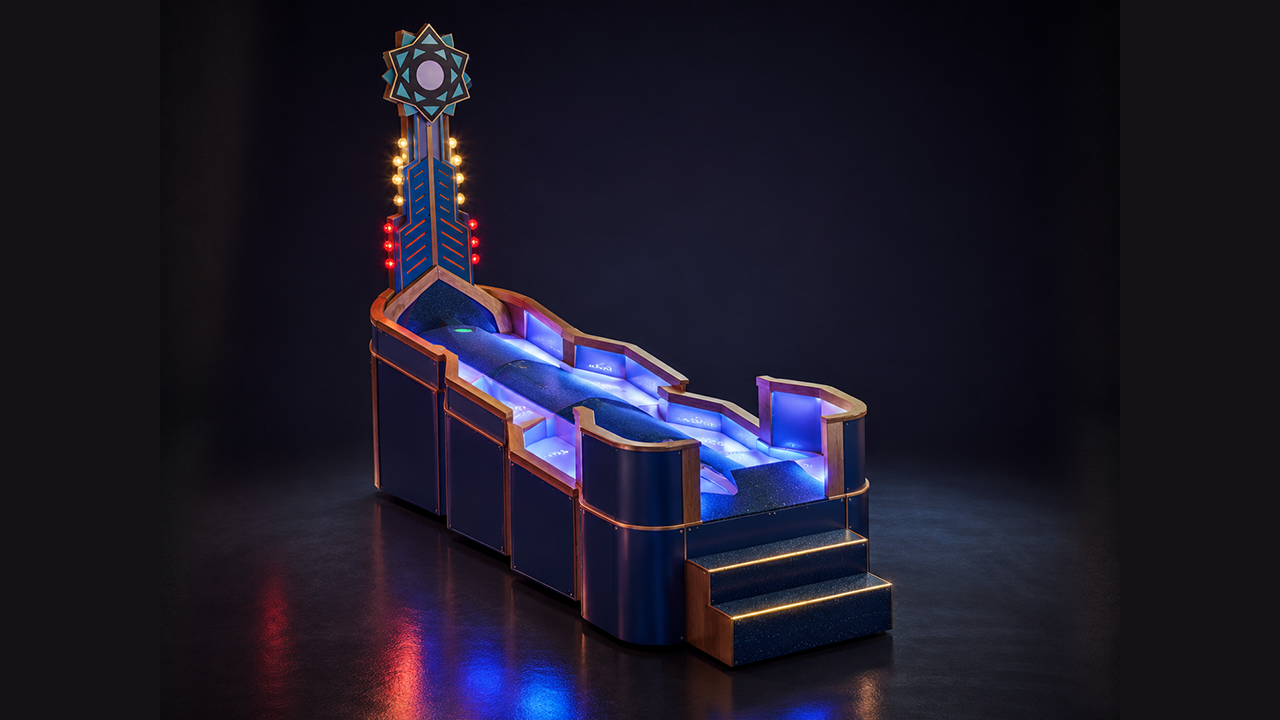
The party photo hole
Dream Castle Hole - Castle-Themed Mini Golf for Kids Venues
A castle-superlative themed hole built for kids venues - the photo backdrop every birthday parent wants, inside the beginner footprint band.
View Details ›
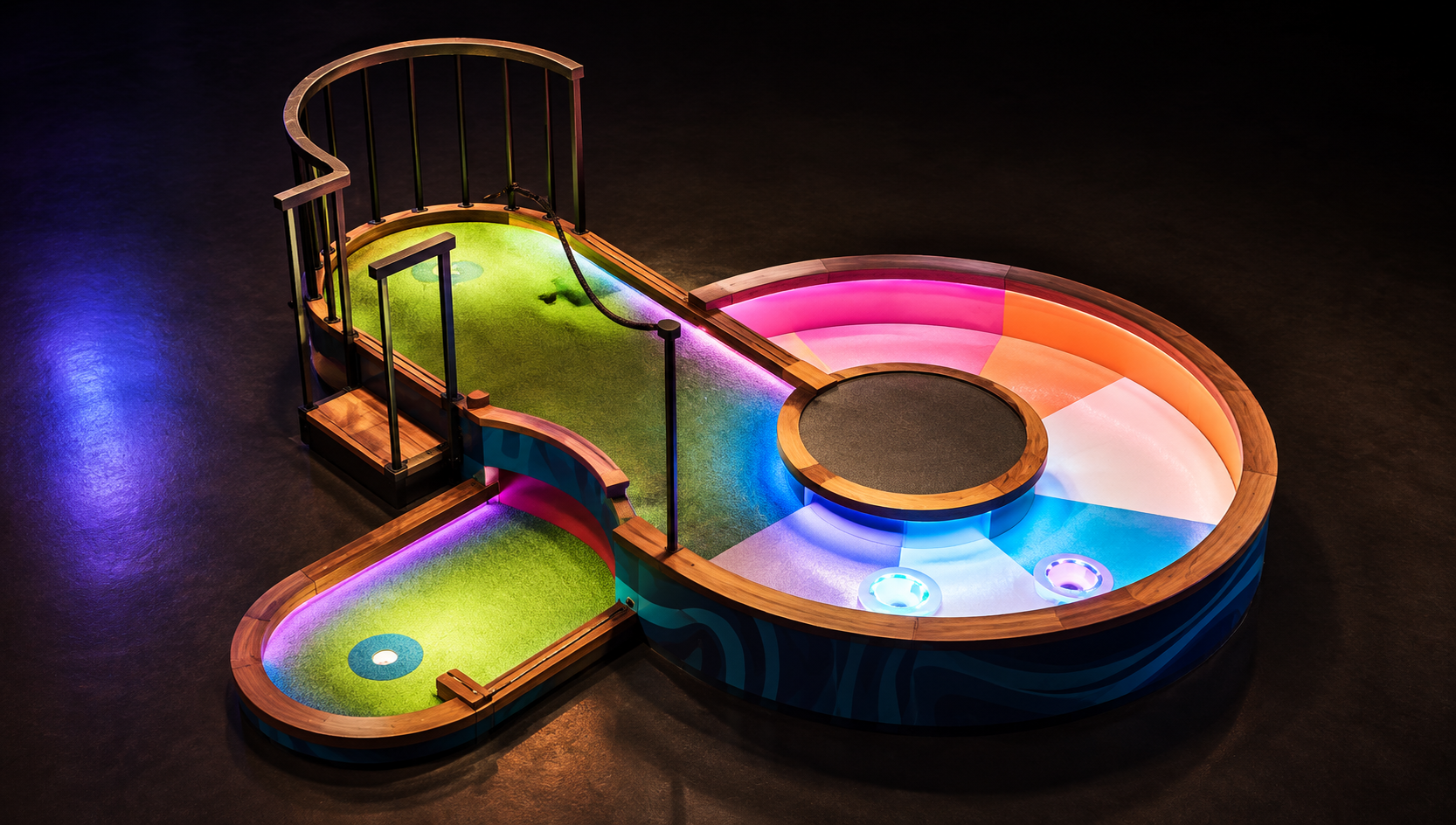
The video moment
Cyclone Spin Hole - 360 Loop Ramp Mini Golf for Venues
A 360-degree loop ramp flagship that reads beautifully on video - the spectacle shot that spreads the party content parents post.
View Details ›
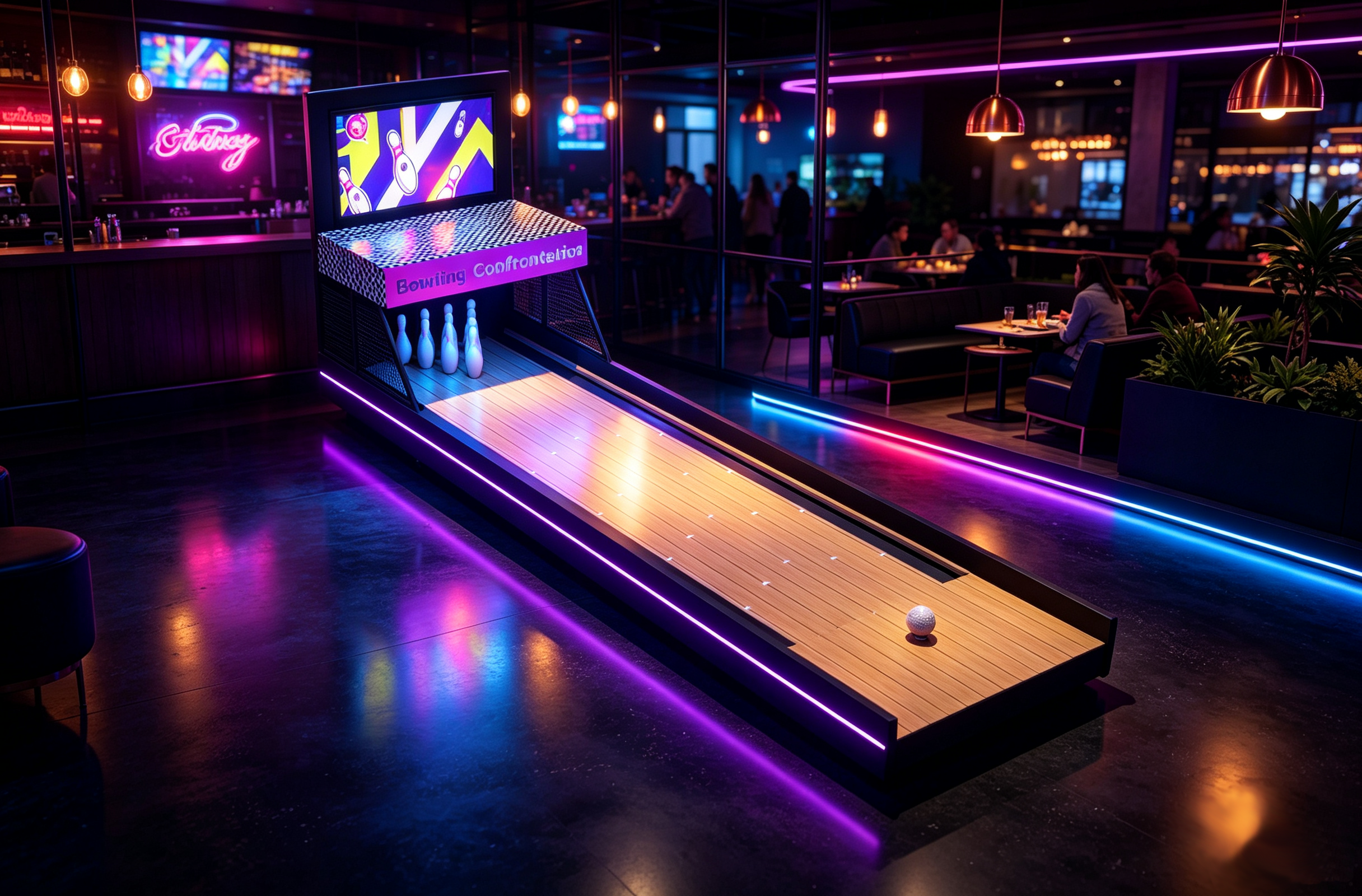
The group finale
Bowling Theme Mini Golf Challenge
A bowling-style challenge hole where the whole party group cheers one roll together - the natural finale inside the party rotation.
View Details ›

