FREE-ROAM VR VS SHOOTING CABINS - THE FEC DECISION
Free-Roam VR vs Shooting Cabins: Which Is Better for an FEC?
Six stated criteria - space, throughput, audience, staffing, revenue model and calendar fit - applied to both formats with the same published anchors: the arena's 24-40 players per hour and 60-70% rematch against the cabins' per-bay rhythm and lean staffing. A criteria-driven verdict, not a forced one.
6 stated criteria Same published anchors Arena: whole-party missions Cabins: per-bay rhythm Stack, not substitute Floor-plan test first
24-40/hr
Arena Players Per Hour
100-200m2
Published Arena Footprint
60-70%
Published Rematch Rate
57%
Prefer Multi-Activity Venues
1. What It Is: Two Shooting Formats, Two Structures
Both formats put a tracked weapon in a guest's hands and a scoreboard at the end of the session - the shooting machinery is shared, and the published shooting-accuracy deep dive covers it once for both. The structural difference is everything else. A free-roam VR arena is a shared physical space: 100-200 square meters (published) of walkable arena where a whole party plays one mission together on tracked headsets, guided through the published session-stages arc - briefing, calibration, rounds, scoreboard. A shooting cabin is a station: one or two tracked weapons at a screen or lane per bay, each bay running its own short session on its own clock.
The comparison criteria, stated up front so the verdict can be checked against them: floor area each format consumes; hourly throughput each format books; dwell and calendar fit; the audience each serves; the staffing and operations each demands; and the revenue model each builds. Six criteria, the same published anchors judging both formats - and the honest answer, developed below, is that the right pick is a function of square meters and calendar, not of which demo looks better in a showroom.
In one line: the arena sells a shared mission to a whole party at once; the cabin sells repeatable stations to a rotating queue - and the six criteria below turn that structural difference into a decision your floor plan can check.
2. Criterion One and Two: Space and Throughput
Space first, because it is the gate the other criteria pass through. The free-roam arena consumes 100-200 square meters in one contiguous block (published), with clear sightlines and the backpack-charging bench on top. Cabins and tracked lanes consume per-bay footprints that add up flexibly - two bays here, three lanes there - which is why the published 500m2 density plan treats stations as the flexible layer of a floor. If the spare floor is one irregular corner, the cabin family fits and the arena does not; if the floor is a clear rectangle above roughly 150 square meters, both formats are on the table.
Throughput second, on the same hourly frame. The published arena model books 24-40 players per hour across the 100-200 square meters - a whole party per mission, dwell 35-50 minutes. The station family books per bay: the tracked-lane rhythm (the 15-minute session model the grid room monetizes at a published $80) rotates a queue bay by bay, and the published laser-tag capacity study shows station-based throughput scaling with the count of stations. On pure players-per-square-meter-hour, stations compete; on players-per-mission and group experience, the arena is in a different category - which is the audience criterion, next.
| Criterion |
Free-roam VR arena |
Shooting cabins / lanes |
Published anchor |
| Floor area |
100-200m2 in one block |
Per-bay footprints, flexible |
Arena spec (published) |
| Throughput |
24-40 players/hr, whole party per mission |
Per-bay rotation, 15-min rhythm |
Both published |
| Dwell |
35-50 min per session |
Short per-bay sessions |
Arena dwell (published) |
| Audience |
Parties, corporate, groups of 4-10 |
Drop-ins, pairs, practice players |
Group-size patterns (published) |
| Staffing |
Marshals per session + vest/backpack bench |
One host across a bank of bays |
Zone patterns (published) |
| Revenue model |
Mission pricing, party packages, buyouts |
Per-session rate card, league nights |
Anchors below (published) |
3. Criterion Three: Audience and the Calendar They Book
The arena serves the group calendar. Its unit of sale is the party: the published group-size economics show multiplayer sessions priced and scheduled around waves of four to ten, and the published VR birthday playbook is written for arenas specifically - the mission structure is what makes a birthday a story with a scoreboard ending. The 60-70% rematch rate (published) lives on that leaderboard, and the 65% repeat pattern (published) is the calendar refilling itself.
Cabins serve the walk-in clock. The drop-in pair, the waiting sibling, the practice player who wants twenty minutes of targets without joining a mission - stations absorb the traffic that cannot wait for the next arena slot. The published queue playbook makes this the throughput argument: a floor with a busy arena sends its overflow to the stations instead of losing it, and the published playbook on reducing queues treats the station bank as the pressure valve.
The audience test for your floor: count the groups against the walk-ins. Group-heavy calendars (party rooms, corporate parks, mall atriums) pull arena-first; flow-heavy floors (arcades, bars, transport hubs) pull station-first - and the published attraction-mix work shows most real floors are both, which is why the mix study stacks them instead of choosing.
4. Criterion Four: Staffing and Operational Needs
The arena's operation is session-shaped: marshals brief and calibrate each mission, the vest-and-backpack bench turns over between waves, and the published session-stages structure is also the staffing rhythm - one marshal covers a mission cycle, with a second on peak waves. Hygiene consumables (face pads, lens inserts) and harness checks are the consumable line; calibration is the weekly routine the accuracy guide schedules.
The station's operation is floor-shaped: one host covers a bank of bays the way the published zone patterns describe, weapons stay bench-tracked and fixed, and the per-bay reset is seconds. The consumable line is smaller; the calibration line is the same weekly discipline. Net: the arena costs more staff hours per day and returns a bigger ticket per guest; the stations run leaner and return smaller tickets more often - the operational mirror of the audience split above.
5. Criterion Five: The Revenue Models, Priced Against Published Anchors
The arena's model stacks three layers: mission pricing per player, party packages that the published playbook prices into calendars, and buyouts for corporate evenings - with the F&B multiplier on top, because the published free-roam dwell study shows guests held 40 extra minutes spending them largely off-arena, and the spectator-screen pattern adds a published 30% to arena-side drink sales. Around it sits the station model: per-session rate cards (the tracked lanes at the 15-minute rhythm the grid room monetizes at a published $80), league nights, and the drop-in flow that keeps the counter busy between missions.
For scale context in the compact corner: where neither format fits, the published VR chair economics - $6-12K per chair returning $130-320 per chair per day at a roughly 4.5-month payback - show what the smallest VR units contribute, and the karting row ($18-28K open, 49-55% margin, 6-9 month payback) prices the per-seat alternative. All of it books against the $88-135 per-square-meter monthly ceiling (published) - the frame that keeps any format honest on your floor.
Example FEC Floor Split by Format Role (EXAMPLE allocation)
- Free-roam arena anchor 42
- Station / cabin lanes 20
- Per-seat rows (racing, chairs) 23
- Social units (grid, duckpin) 15
Source: worked scenario (EXAMPLE) - share of a sample FEC floor (by area) allocated across format roles, following the published attraction-mix stack pattern. Shares are planning references, not prescriptions.
Scenario Weekly Booked Sessions by Format (EXAMPLE mix)
Source: worked scenario (EXAMPLE) - weekly booked sessions per format on a sample mixed floor, arranged for readability; anchors are the published per-format throughput figures. Planning reference, not a forecast.
6. The Verdict: A Criteria-Driven Answer, Not a Forced One
Run the six criteria and the decision makes itself, in both directions. Floors above roughly 150-200 spare square meters with a group calendar: the free-roam arena is the anchor buy - its published throughput, dwell lift, rematch economics and party calendar are the strongest revenue structure in the VR family, which is the argument the published arena-vs-simulator comparison makes at venue scale. Floors with irregular corners, flow-heavy traffic or a station-friendly rhythm: cabins and tracked lanes win on fit and lean operations - and the compact-chair alternative covers the smallest footprints.
And on most real FEC floors the honest verdict is the stack: the arena anchoring the party calendar, the stations absorbing the overflow, both feeding the same counter - the pattern the 57% multi-activity preference (published, n=600) rewards and the published attraction-mix study prices. Decide with the criteria, size with the floor plan, and let the free 3D layout design test the stack before the purchase order - the cheapest possible moment to be wrong.
The one-line verdict: big rectangle plus group calendar buys the arena; awkward corner plus walk-in flow buys the stations; a floor that wants the whole calendar buys the stack - and the six criteria above are how you know which floor you have.
7. Frequently Asked Questions (FAQ)
What is the difference between free-roam VR and shooting cabins?
Free-roam VR is a shared physical space: players walk a 100-200 square meter arena with tracked headsets and weapons, one mission, one scoreboard, 24-40 players per hour (published). Shooting cabins are per-bay stations - tracked weapons at a screen or lane - where each bay runs its own session. The arena sells a group experience; the cabin sells a repeatable station. Everything else in this comparison follows from that structural difference.
Which is better for a small FEC?
Depends on the floor and the calendar, and the criteria in this article make the call honest. Under roughly 150 spare square meters, cabins and tracked lanes fit where an arena cannot; the published compact alternatives - VR chairs at $6-12K and $130-320 per chair per day - fill the same corner-footprint role. From about 150-200 square meters up, the arena's published throughput and party economics usually take the lead.
How many players per hour does each format book?
The published anchors: a free-roam arena books 24-40 players per hour across its 100-200 square meters with 35-50 minute dwell; a cabin lane books per bay - the tracked-lane family runs 15-minute style sessions that rotate a queue, and the published laser-tag capacity study shows how station-based throughput scales. The comparison table in this article puts both against the same hourly frame.
Is free-roam VR worth the CAPEX for an FEC?
The published models say the arena earns like an anchor: 60-70% rematch rates, the published +40 minute dwell lift spent largely on F&B, spectator screens adding a published 30% to arena-side drink sales, and the birthday and corporate calendar the published party playbook sells. It is a build-out at project scale - sized to the party calendar, not bought off a shelf - which is why the criteria table matters before the quote.
Can an FEC run both free-roam VR and cabins?
Yes, and the published multi-activity data rewards it: 57% of players prefer multi-activity venues against 17% for single-attraction ones. The pairing works because they stack rather than substitute - the arena anchors the party calendar while cabins absorb overflow and the drop-in traffic that does not want to wait for the next mission.
How do I decide for my specific floor?
Run the six criteria in this article against your numbers: floor area, hourly throughput, dwell and calendar fit, audience, staffing and operations, and the revenue model. Send the floor plan through the free 3D layout design and the mix gets tested on your actual square meters before any purchase order - the cheapest moment to discover the wrong format is on a plan.
8. Featured NextPlay Active Gaming Equipment
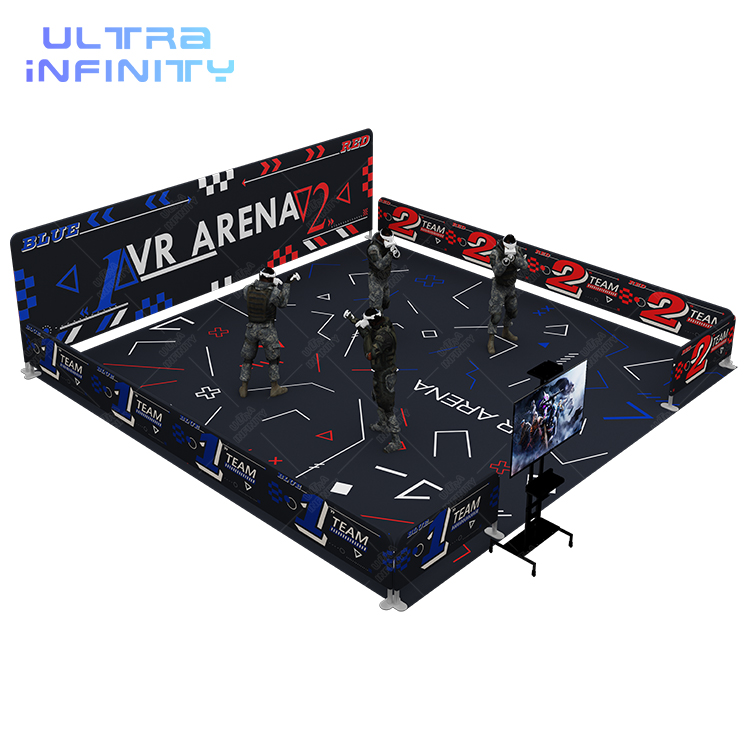
The anchor side
Free Roaming VR Arena 2.0 - Multiplayer VR Walking Shooting Simulator
The free-roam arena behind the published 24-40 players per hour and 60-70% rematch - the mission-based format this comparison anchors with.
View Details ›

The station system
Infinite Competition | Immersive Laser Tag Combat Game Solution
The immersive combat system for station-based play - vest-and-emitter sessions that scale bay by bay.
View Details ›
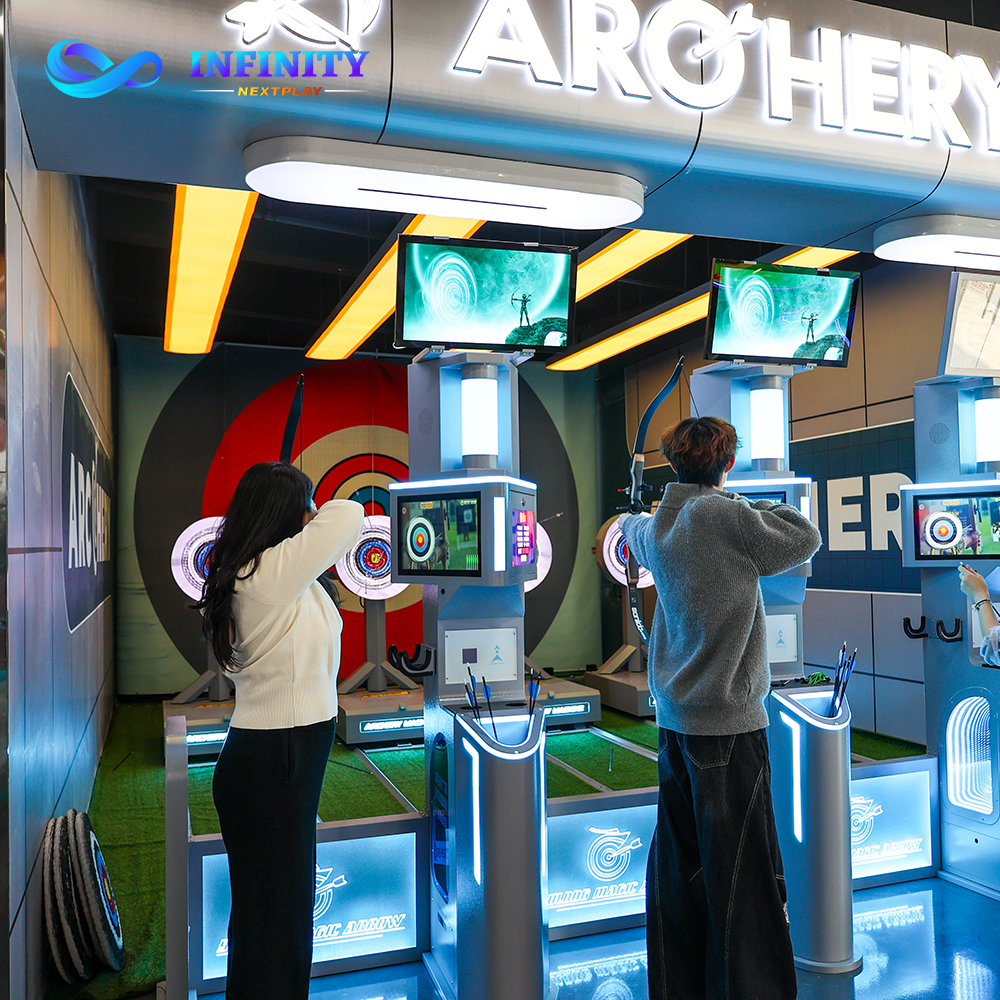
The tracked lane
Digital Archery Simulator for Full Venue Solution - Adjustable Track Distance & Dual Screen - Ideal for Sports Bars and Clubs - A4
The camera-tracked lane at the 15-minute rhythm - the station family's cleanest per-bay footprint.
View Details ›

