Capture high-margin family demographics with NextPlay's integrated kids VR & drop towers. Full case study of Rome commercial setups.
FAMILY & KIDS VR ENTERTAINMENT
Family & Kids VR: How a Rome Shopping Mall Hits €38K/Month
Discover how a premium shopping mall in Rome integrated NextPlay's Kids Robo VR, Bear VR, and VR Drop Tower to capture high-margin parent-child demographics.
In the evolving landscape of European commercial real estate, retail shopping malls are actively seeking experiential solutions to capture family foot traffic. NextPlay’s turnkey family and kids VR entertainment center (FEC) architecture offers a highly profitable, low-overhead option. By deploying safe, low-stroke servo-driven motion simulators paired with kid-friendly virtual reality software under a centralized RFID cashless flow, we transformed a 4,200 square foot venue in Rome into a high-throughput competitive socializing destination that achieves €38,000 monthly operational yield.
190-Min
Average Dwell Time
1. Breaking the Traditional Playground Limitations: The Kid-Centric VR Model
Traditional mechanical playgrounds are highly limited. They demand massive physical footprints, present ongoing liability risks, and suffer from flat, low-rotation gameplay that fails to engage the modern, tech-savvy generation of children. Additionally, they offer zero opportunity for secondary parental monetization. To break this revenue ceiling, modern family entertainment centers must adopt a cohesive, high-tech spatial design. This is the exact strategy executed with NextPlay's integrated family VR solutions.
At our Rome showcase venue, we eliminated isolated play areas by deploying a customized Spatial Synergy Matrix. By positioning our highly visual, high-occupancy dual-player Kids Robo VR simulator alongside our thrilling VR Drop Tower, we established a complete parent-child social competitive loop. While children engage in safe, educational VR battles, parents relax in the adjacent high-margin lounge area, driving secondary food and beverage sales.
This physical integration led to a transformative increase in overall venue performance. Monthly baseline revenue reached a steady €38,000, while average guest dwell-time leaped to 190 minutes. Operating on our centralized, cashless RFID card reader network, the entire interactive zone is managed easily by a single multi-role operator, keeping labor overheads extremely low.
2. Educational & Interactive: Kids Robo VR Game Simulator
The educational heart of our Rome venue is the Kids Robo VR Game Simulator. Designed specifically with child ergonomics and safety in mind, this dual-player platform integrates education with immersive virtual reality.
The simulator utilizes child-safe Pico Neo 3 headsets calibrated with professional blue-light filtering to prevent visual fatigue. It features an interactive, robot-themed double-sided cabinet that allows two children to play simultaneously, optimizing floor-space efficiency. Pre-loaded with proprietary, parent-approved educational content and sci-fi games, the Robo VR keeps young guests engaged in healthy, constructive competition, commanding a constant premium ticket price.
3. Thrill and Automation: 2 Players VR Drop Tower Jumping Rides
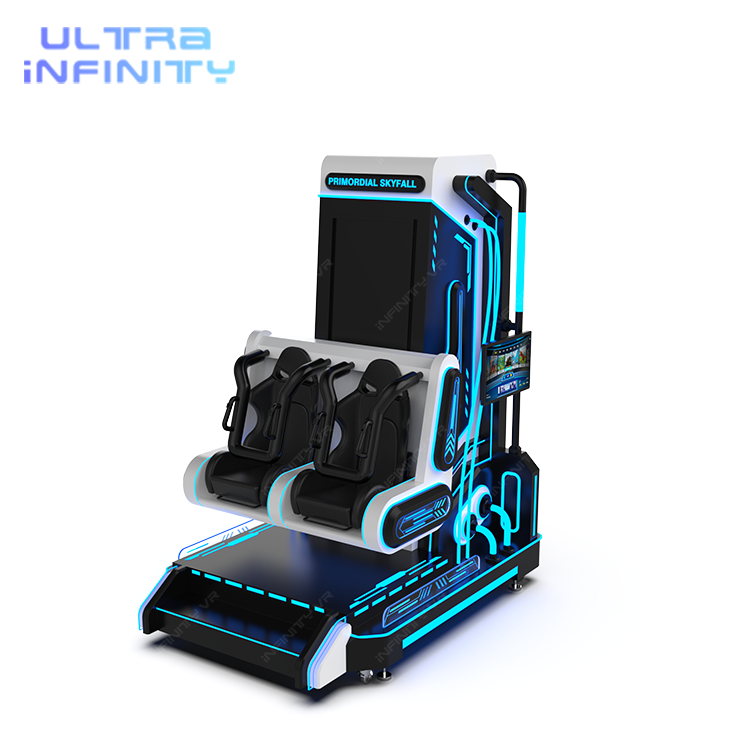
To complement the educational focus of the Robo VR, we integrated the high-impact 2 Players VR Drop Tower. Traditional drop towers are massive, costly, and present ongoing safety concerns. NextPlay's simulator delivers a high-G, thrilling drop experience within a safe, space-saving footprint.
Equipped with high-speed, low-stroke electric actuators, the VR Drop Tower tilts, pitches, and drops to simulate aircraft and vertical drop physics smoothly. Sincronizada with the visual frame rate of the headsets, the physical platform responds instantly, delivering an unmatched sensory rush with zero motion sickness.
4. High-Retention Thematic Anchor: Bear VR Game Simulator for Children
Connecting these active zones is the cute, thematic Bear VR Game Simulator. Designed specifically with child-friendly bear aesthetics, this interactive machine is a powerful foot traffic magnet for younger demographics. It operates on a fully automated cashless card reader, allowing children to tap to play, select their game speed and difficulty safely, and begin their immersive journey.
| Operational Metric |
Traditional Playground Setup |
NextPlay 3.0 Family VR FEC |
| Average Guest Dwell Time |
40 minutes |
190+ minutes (3.2 hours) |
| F&B Sales Growth (Per Ticket) |
Under 12% |
+40% (high-margin craft dining) |
| System Fault & Downtime Rate |
5.6% (requiring manual mechanical resets) |
Under 0.2% (automated, industrial-grade) |
| On-Site Labor & Support |
3 dedicated support employees |
Just 1 multi-role floor operator |
| Average Capital Payback Period |
14 - 18 months |
Under 5 months (accelerated ROI) |
5. Step-by-Step Delivery and Calibration Protocol
- 3D Spatial Modeling: NextPlay maps out the 4,200 sq ft Rome venue, identifying active and passive zoning lines.
- Alloy Frame Leveling: Assemble and secure the low-profile Kids Robo VR and Bear VR foundation frames.
- Drop Tower Installation: Secure multi-axis rotation hydraulics, securing the VR Drop Tower projection base.
- Sensors Positioning: Install high-speed optical ballistics cameras and calibrate tracking fields.
- Interactive Software Coupling: Install pre-loaded databases on the local server, mapping touchscreen control arrays.
- Cashless RFID Network Binding: Program and integrate card-readers with centralized food & beverage POS.
- Operational Hand-off: Execute a 48-hour continuous load stress test, train staff, and launch competitive weekly leagues.
6. Technical FAQ: Family & Kids VR Engineering Solved
Q: What ceiling height is required for a complete NextPlay 3.0 family VR center?
A: We recommend a minimum ceiling clearance of 3.2 to 3.4 meters (11 feet), particularly for the VR Drop Tower projection field to ensure spacious, high-end guest clearance.
Q: How does the Pico Neo 3 headset protect children's vision during gameplay?
A: NextPlay's headsets utilize custom blue-light filtering lenses and anti-flicker display panels, calibrated specifically to reduce eye strain and ensure absolute visual safety.
Q: What are the main electrical and power preparation standards?
A: The complete turnkey zone requires a dedicated, stable three-phase electrical input (380V, 50Hz/60Hz) to support the dynamic motion drives of the VR Drop Tower smoothly.
Featured Products
Kids Robo VR Game Simulator
🚀Interactive Learning: Dual-player robot-themed VR cabinet with blue-light filtering Pico Neo 3 headsets and custom educational games.
Educational VR Child Safe
View Details →
2 Players VR Drop Tower
🚀High-Energy Thrill: Dual-player vertical drop simulator featuring high-speed electric actuators, multi-axis tilt, and 8+ patented games.
Vertical Drop Dual Seats
View Details →
Bear VR Game Simulator for Children
🚀Thematic Traction: Cute baby bear-themed interactive VR console with parent-approved games and self-service RFID cashless tap-to-play.
Bear Theme Kids Favorite
View Details →
Get Your Custom Family VR FEC Design
Discover how a flagship shopping mall in Rome reached €38K/month using integrated NextPlay Kids Robo VR and VR Drop Tower systems. Full layout guide.
GET FREE 3D LAYOUT Chat on WhatsApp