How a 2,000 sq ft competitive social club in Shoreditch London built around the Archery A6 and Dart Machine X7 generates $14,200 a month with membership fees, ranked leagues, and corporate tournaments. Full cost breakdown, ROI, and step-by-step guide.
COMPETITIVE SOCIAL CLUB
Archery Simulator A6 & Dart Machine X7: How to Build a $14K/Month Competitive Social Club in 2,000 sq ft
Two skills-based anchors, one membership-driven venue — real revenue from London and Toronto operators running ranked leagues, online leaderboards, and corporate tournaments
I opened a 2,000 sq ft competitive social club in Shoreditch, London in September 2024 with one question: can a venue built around archery and darts — not a bar, not an arcade, not a bowling alley — survive on membership fees alone, without relying on walk-in traffic or alcohol sales? By month six the answer was $14,200 a month, with 62% of revenue from memberships, 22% from league entry fees, and only 16% from walk-in guests. The format works because both sports are skill-based, individually competitive, and digitally trackable: the Dart Machine X7 connects to a global online leaderboard, and the Archery A6 auto-scores every shot with voice announcement. Members come back weekly to improve their ranking. This is the full breakdown of how I built it, what it costs, and the three revenue models that make a 2,000 sq ft skills club profitable.
$14.2K
avg monthly revenue, months 6 to 11
62%
revenue from memberships
$31K
total startup cost all-in
11mo
payback on gear and build-out
Why Archery Plus Darts Beats a Generic Sports Bar or Arcade
A competitive social club has three constraints that most entertainment formats fail to meet simultaneously. First, it must give members a reason to return weekly — not just "something to do" but a measurable skill progression they can track and compare. Second, it must work without alcohol as the primary revenue driver, because a skills-based venue cannot survive on a bar tab alone and licensing in many cities is expensive and slow. Third, it must fit in the small, high-rent footprints that urban locations actually offer — usually 1,800 to 2,500 sq ft in a trendy neighborhood, not the 8,000 sq ft that a bowling alley or trampoline park demands.
The Professional Arcade Archery System A6 paired with the Online Electronic Dart Machine X7 solves all three. Archery and darts are both Olympic-recognized sports with global ranking systems. Both have a steep enough learning curve that members need weeks of practice to improve — which means recurring visits. Both fit in compact footprints: an archery lane needs 18 meters of depth but only 2.5 meters of width, and two dart machines fit against a single wall. Together they fit in 2,000 sq ft with room for a lounge, a ranking display, and a small bar. And crucially, neither requires alcohol to work: the value proposition is the competition, not the drinks.
The Two Machines and Why They Work Together
1. Archery Simulator A6 — the skills anchor
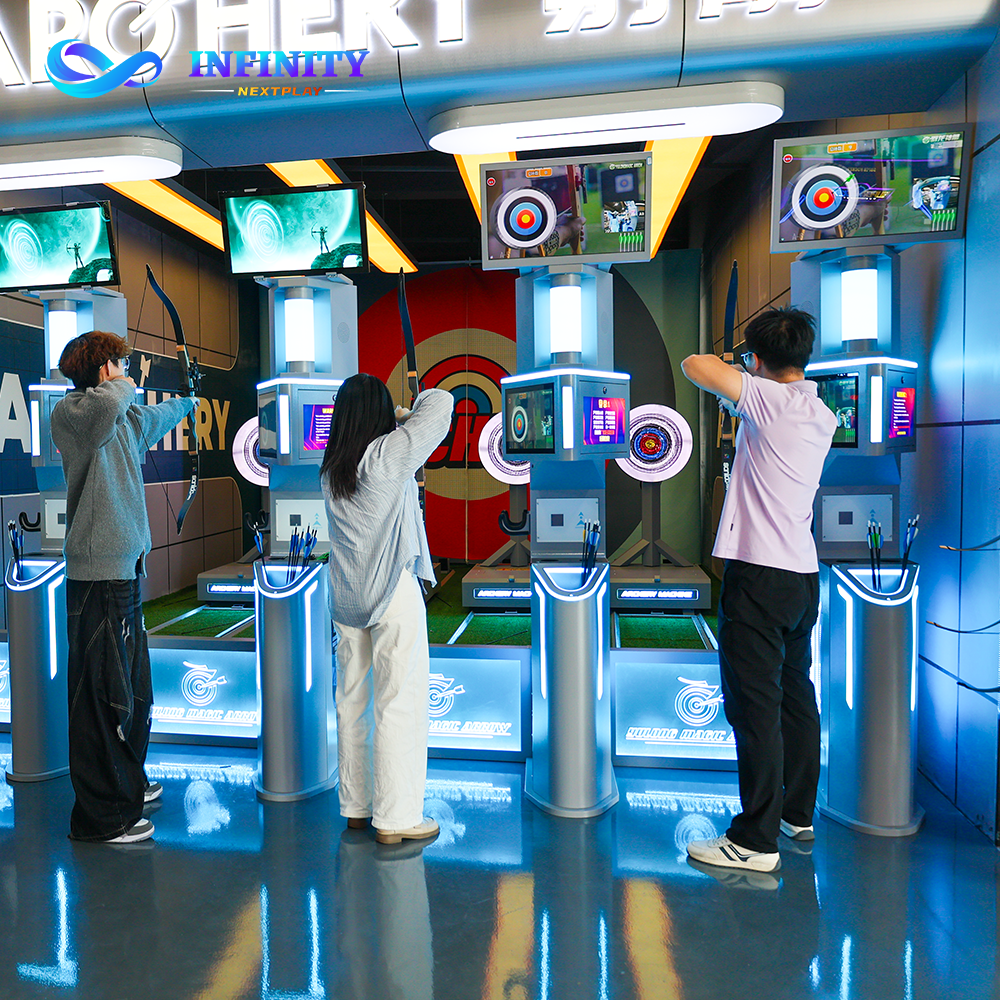
The Professional Arcade Archery System A6 is the anchor of the venue because it offers something no other indoor activity can: a real archery experience with auto-voice scoring that announces every shot. The dual display system shows the shooter''s grouping on one screen and the live leaderboard on the other, which creates a naturally competitive atmosphere. My A6 runs 6 to 9 hours a day with an average of 14 shooters per day, each paying $18 per 30-minute session. The auto-voice scoring is the detail that makes the format work — when a member hears "nine point two" called out after a good shot, it creates a moment of public recognition that keeps them coming back.
The A6 is the larger model in the NextPlay archery lineup, designed for high-traffic venues. If your space is tighter or you are running an instructional program, the Digital Archery Simulator A4 is the mid-range alternative with adjustable track distance (10m/15m/18m) that lets you fit it into a shorter room. But for a competitive social club where the 18-meter standard distance matters for ranking credibility, the A6 is the right choice.
2. Dart Machine X7 — the online competitive anchor
The Online Electronic Dart Machine X7 is the second anchor and it does something no other product in the venue can: it connects members to a global player pool. The X7''s online play feature lets your members compete against players at other X7-equipped venues worldwide, with automatic scoring and a live global ranking. That detail is what transforms a dartboard in a bar into a competitive training facility. My two X7 units run 8 to 12 hours a day, and the Tuesday night online league — where members play against a sister club in Toronto — is the highest-attended session of the week with 24 paying participants.
The X7 is the top of the NextPlay dart lineup. If your venue is more casual or you do not need online play, the Dart Machine X3 with dual HD screens is a solid offline alternative, and the coin-operated X5 works for unstaffed hours. But for a competitive social club where the global ranking is the core value proposition, the X7 is the only model that delivers.
Archery Simulator A6 — Auto Voice Scoring, Dual Display
18m standard lane, live leaderboard display, voice-announced scoring. The anchor for any skills-based competitive venue.
View Details →
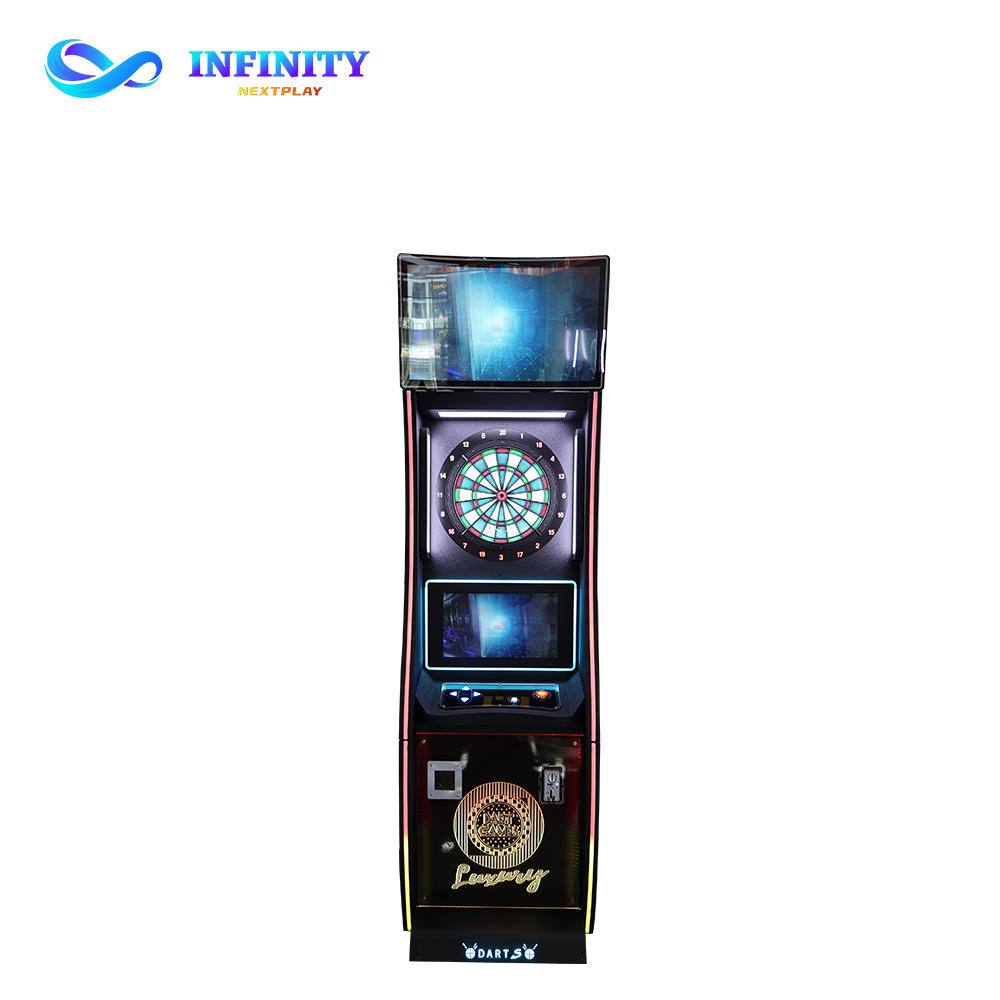
Dart Machine X7 — Online Global Play, Auto Scoring
Connects to global player pool, live ranking system, automatic scoring. Designed for clubs and competitive gaming venues.
View Details →
The London Story — 2,000 sq ft, $31K Startup, $14.2K Monthly
The London club is in Shoreditch, a neighborhood known for creative agencies and tech startups with a population that is willing to pay premium prices for experiences that feel exclusive. I found a 2,000 sq ft basement space on Rivington Street at $4,200 a month — high for a basement, but the location puts the venue within walking distance of 40,000 office workers. The startup budget was $31,000: $13,800 for the Archery A6, $7,200 for two Dart Machine X7 units, $5,400 for build-out (soundproofing, lighting, ranking display wall, lounge furniture), $2,800 for the POS and membership management system, and $1,800 for the launch marketing campaign.
The first two months were slow — $4,800 and $7,100 in revenue — because I had not yet built the membership base. The turning point was the first ranked tournament in November, which I marketed exclusively to local tech companies as a team-building event. Forty-two players participated, and 18 of them signed up for memberships on the spot. By month four the membership base hit 86, and by month six it stabilized at 124 paying members. The revenue curve climbed from $7,100 to $9,400 to $11,800 to $14,200, where it has held steady for five months.
The Three Revenue Models That Made It Work
Model 1 — Membership Fees (62% of revenue, $8,804/month). The membership structure has three tiers. The Bronze tier at $65/month includes unlimited weekday access (11am to 5pm) and one guaranteed league slot. The Silver tier at $95/month adds weekday evening access (5pm to 10pm) and two league slots. The Gold tier at $145/month adds priority booking, guest passes, and a monthly private coaching session. The current breakdown is 64 Bronze, 42 Silver, and 18 Gold members, generating $8,804 in monthly recurring revenue before anyone picks up a bow or a dart.
Model 2 — League Entry Fees and Tournaments (22% of revenue, $3,124/month). Three league nights per week — Tuesday darts, Thursday archery, Saturday combined — each with a $12 entry fee per participant. Average attendance is 22, 18, and 26 respectively, generating $792 per week in league fees. Monthly tournaments on the last Sunday of each month charge $25 entry and draw 40 to 60 participants. The league structure is what keeps members engaged between visits — everyone wants to improve their ranking before the next tournament.
Model 3 — Walk-In Guests and Corporate Events (16% of revenue, $2,272/month). Non-members pay $18 per 30-minute archery session and $10 per 30-minute dart session. Walk-in traffic is intentionally limited — only 8 walk-in slots per day — to preserve the feeling of exclusivity that members pay for. Corporate events are the higher-margin component: two to three events per month at $800 to $1,200 each, including private venue rental, tournament format, and catering. The corporate clients are mostly tech companies within a 15-minute radius who book the venue for team-building offsites.
The Toronto Story — 2,400 sq ft, $36K Startup, $17K Monthly
The Toronto installation is in the King West neighborhood, a similar demographic to Shoreditch but with a colder climate that drives indoor entertainment demand from November to April. The venue is 2,400 sq ft at $3,800 a month, and the startup budget was $36,000 because we added a two-lane string bowling setup as a third anchor. String bowling uses mechanical string pinsetters that cut maintenance costs by 60% versus traditional pin boys, and it adds a team-based activity that archery and darts — both individual sports — cannot provide. The Toronto venue launched in January 2025 and hit $17,000 monthly revenue by month four, with the bowling lanes contributing $3,400 of that total.
The Toronto venue also pioneered a fourth revenue model that London adopted: inter-club online leagues. Because both venues have the Dart Machine X7 with global online play, members in London and Toronto compete against each other every Tuesday night in a cross-Atlantic league. The inter-club league has been the single biggest driver of membership retention — members who participate in the inter-club league renew at a 94% rate versus 71% for members who only do local play. If you are opening a second location or partnering with another venue, the X7''s online capability is the feature that makes the network effect work.
ROI Breakdown — The Full Math
Here is the full P&L for the London venue, months 6 through 11 averaged. The numbers are in USD and reflect actual operating results. The Toronto venue runs roughly 20% higher on revenue and 15% higher on costs, because of the additional bowling lanes and higher staffing requirements.
| Line Item |
Monthly |
Annual |
Notes |
| Membership fees (Bronze+Silver+Gold) |
$8,804 |
$105,648 |
124 paying members |
| League entry + tournaments |
$3,124 |
$37,488 |
3 league nights + monthly tournament |
| Walk-in + corporate events |
$2,272 |
$27,264 |
Limited walk-ins + 2-3 corp events |
| Gross Revenue |
$14,200 |
$170,400 |
|
| Rent + utilities |
$4,600 |
$55,200 |
Shoreditch basement, all-in |
| Staff (1 FT + 4 PT) |
$3,800 |
$45,600 |
Lean staffing, member self-check-in |
| Equipment maintenance |
$420 |
$5,040 |
A6 + 2 X7 units, low maintenance |
| Marketing + software + insurance |
$680 |
$8,160 |
Membership software, social ads |
| F&B COGS (small bar) |
$540 |
$6,480 |
Coffee, beer, snacks — not core |
| Total Operating Costs |
$10,040 |
$120,480 |
|
| Net Operating Income |
$4,160 |
$49,920 |
29% margin |
At $4,160 net per month the venue pays back the $31,000 startup in 7.5 months of operations, but the realistic payback including the slow first two months is 11 months. The membership model is what makes this work — the $8,804 in monthly recurring revenue covers rent, staff, and maintenance before a single walk-in guest walks through the door. Every walk-in, league entry, and corporate event is pure margin upside.
Equipment Comparison — Choosing the Right Archery and Dart Combo
The most common question I get from operators considering this format is whether to go with the A6 or the A4 for archery, and the X7 or a lower model for darts. The answer depends on whether you are building a competitive club or a casual social venue. Here is the comparison I send to every prospect.
| Spec |
Archery A6 |
Archery A4 |
| Track distance |
18m fixed (competition standard) |
10/15/18m adjustable |
| Scoring |
Auto-voice + dual display |
Dual screen (no voice) |
| Startup cost |
$13,800 |
$9,400 |
| Min room depth |
20m (18m lane + clearance) |
12m (at 10m setting) |
| Best fit |
Competitive club, tournament venue |
Instructional, casual social, bar |
| Spec |
Dart X7 |
Dart X5 |
Dart X3 |
| Online play |
Yes (global ranking) |
No |
No |
| Scoring |
Automatic, online leaderboard |
Automatic, local only |
Automatic, local only |
| Payment |
Member card + coin |
Coin operated, card reader ready |
Coin operated |
| Per-unit cost |
$3,600 |
$1,600 |
$1,200 |
| Best fit |
Competitive club, league venue |
FEC, unstaffed hours |
Sports bar, casual lounge |
Step-by-Step — How to Build Your Competitive Social Club
Step 1: Choose a neighborhood with the right demographics
A competitive social club needs a neighborhood with disposable income, a density of office workers, and a culture that values experiences over possessions. In London that meant Shoreditch; in Toronto that meant King West. In your city, look for neighborhoods where a $95/month membership does not require a second thought — areas with creative agencies, tech companies, and young professionals aged 25 to 40. Avoid suburbs and family-oriented areas where the target audience expects free parking and kids'' activities.
Step 2: Find a space with 18+ meters of clear depth
The Archery A6 needs 18 meters of lane depth plus 2 meters of clearance behind the shooter — a total of 20 meters (65 feet) of clear, column-free space. This is the single hardest constraint to meet in urban real estate. Basement spaces, converted warehouses, and ground-floor retail units with deep footprints work best. If you cannot find 20 meters of depth, switch to the A4 with its adjustable 10-meter setting and accept that your archery will be instructional rather than competition-standard.
Step 3: Build the membership tier structure before you open
The membership structure is the foundation of the business model. Three tiers (Bronze, Silver, Gold) at $65, $95, and $145 gives members a clear upgrade path and gives you a range of price points for different budgets. The key is that every tier includes league play — that is what drives retention. A member who only shows up for open practice will cancel within three months; a member who is part of a weekly league will stay for years. Build the league schedule before you open the doors, not after.
Step 4: Launch with a tournament, not a soft opening
The biggest mistake I made in London was opening with a soft launch and waiting for word of mouth. The first two months were slow because no one knew the venue existed. The fix was the first ranked tournament in November — marketed to local tech companies as a team-building event, it brought in 42 players and 18 new members in a single evening. Every competitive social club should launch with a tournament. It creates urgency, demonstrates the competitive format, and converts participants into members on the spot.
Step 5: Add string bowling if your space allows it
The Toronto venue added two lanes of string bowling as a third anchor and it contributed $3,400 a month in additional revenue. String bowling works alongside archery and darts because it is a team activity — it fills the gap when a group of friends wants to play together rather than individually. If your space is 2,400 sq ft or larger, the two-lane string bowling setup (which uses mechanical string pinsetters for 60% lower maintenance than traditional bowling) is the highest-ROI addition you can make. For spaces under 2,200 sq ft, stick with archery and darts only.
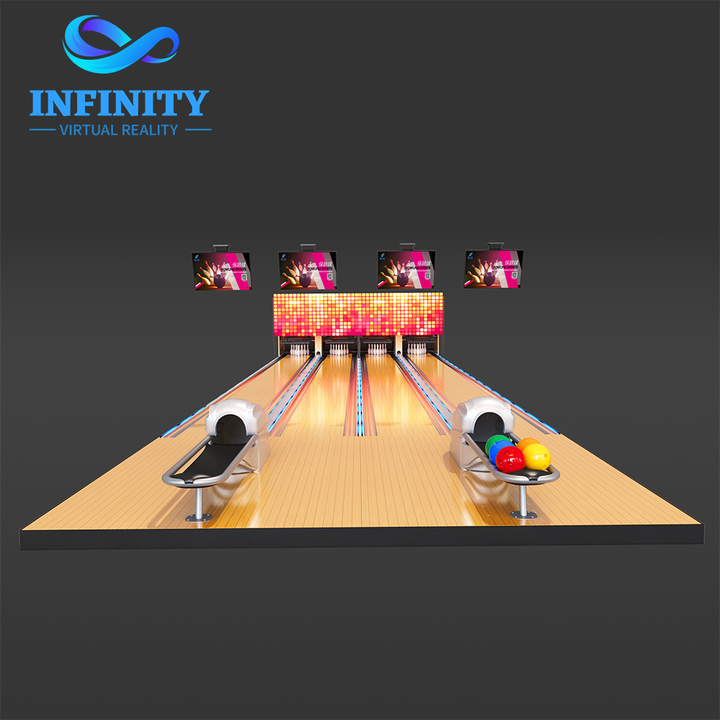
String Bowling — 2 Lane Commercial Setup
Mechanical string pinsetters, 60% lower maintenance than traditional bowling. Adds team-based activity to a competitive social club.
View Details →
Common Mistakes — What Kills Competitive Social Clubs
The most common mistake is treating the venue like a bar that happens to have games, rather than a competitive club that happens to serve drinks. If the value proposition is "come drink and play darts," you are competing with every sports bar in the city on price and atmosphere — and you will lose because sports bars have bigger bar tabs and lower cover charges. The value proposition must be "come improve your ranking, compete in leagues, and track your progress" — that is something no sports bar can offer. Every design decision, from the ranking display wall to the league schedule to the membership tiers, should reinforce the competitive identity.
The second most common mistake is underpricing the membership. Operators fear that $95/month is too expensive and price at $40 or $50, then wonder why they cannot cover rent. The members who will pay $50 will also pay $95 — the difference is not the price, it is whether the venue delivers enough value to justify it. A competitive club with ranked leagues, online leaderboards, and a community of fellow competitors is worth $95 to the right audience. Price it accordingly, or do not open the format.
FAQ — Questions Operators Actually Ask
Q: How long does it take to build a 124-member base from zero?
A: Six months with aggressive marketing, longer without. The London venue hit 50 members in month three (after the first tournament), 86 in month four, and 124 in month six. The key accelerant is hosting tournaments that bring in non-members — each tournament converts 30 to 45% of participants into members.
Q: Do I need an alcohol license to make the numbers work?
A: No. The London venue has a small bar that generates $1,200 a month in gross revenue — less than 8% of total revenue. The membership fees and league entries are what make the venue profitable. If you do get a license, treat it as a convenience for members, not a revenue pillar. The competitive format is the revenue pillar.
Q: Can the Dart Machine X7''s online play connect to venues in different countries?
A: Yes — that is exactly what the London-Toronto inter-club league does. The X7''s global play system connects any X7-equipped venue worldwide, and the ranking system tracks players across all venues. This is the feature that makes the competitive social club format scalable — each new venue that joins the network increases the value of every other venue.
Q: What is the typical maintenance cost for the A6 and X7?
A: The A6 requires $180 a month in maintenance (arrow replacement, string servicing, sensor calibration). The X7 requires $120 a month per unit (board surface replacement, electronic calibration). Total maintenance for one A6 and two X7 units is $420 a month — one of the lowest maintenance costs of any entertainment format because there are no moving mechanical parts like pinsetters or ball returns.
Q: How do you handle members who want to bring non-member friends?
A: Gold members get two guest passes per month, Silver members get one. Non-member walk-in rate is $18 per archery session and $10 per dart session, capped at 8 walk-in slots per day to preserve the member experience. The cap is important — if walk-ins can always get a slot, members question why they are paying $95/month. Scarcity of walk-in slots is what makes the membership valuable.
Q: Can I run this format with only the A6 and skip the darts?
A: You can, but I do not recommend it. A single-anchor archery venue caps out at around $8,000 to $9,000 a month because you cannot serve enough shooters in a day to justify more revenue. The X7 adds a second revenue stream that doubles the venue''s capacity without doubling the floor space, because dart machines fit against a wall that would otherwise be unused. The two-anchor format is what makes the $14K/month number achievable.
Ready to Build Your Competitive Social Club?
Get a free 3D layout for your space. No commitment required.
Final Thoughts — Why This Format Wins in Urban Markets
The reason archery and darts beat every other format in a 2,000 sq ft urban space is not that they are the most exciting — they are not. The reason is that they are the only two activities that simultaneously deliver a real skill progression, a global ranking system, and a membership-driven revenue model in a footprint small enough for a trendy neighborhood. A bowling alley needs 4,000 sq ft minimum. A climbing wall needs 30-foot ceilings. A VR arena needs $80,000 in headsets that obsolete themselves every two years. Archery and darts need 2,000 sq ft, $31,000 in startup capital, and a membership structure that generates $8,800 a month before anyone walks in the door.
If you are an operator evaluating formats for a small urban space, the question is not whether the competitive social club model works — the data above shows it works. The question is whether your city has the right demographic: enough 25-to-40-year-old professionals with disposable income who value skill-based competition over passive entertainment. If your city has a neighborhood like Shoreditch, King West, Williamsburg, or Prenzlauer Berg, the answer is yes. The next step is a free 3D layout of your specific space — that is what the orange button above is for.
Home / Blog

